// data-verified

Best Metal Chop Saws of 2026

An abrasive chop saw will get through a stack of angle iron — and throw a rooster tail of sparks across the garage, fill the air with smoke, and leave a burr you have to grind off before anything fits. That tradeoff defines the category: the cheap abrasive wheel versus a carbide-tipped blade that cuts cold, fast, and clean for more money up front. I've built gates and patched trailers with both, and the difference in a joint that welds up square is not subtle.

We spent the past seven months running 12 saws, abrasive and dry-cut, through the jobs these actually get bought for: square tubing cut to length, rebar, threaded rod, angle iron for brackets. What separated them wasn't the spec sheet — it was clamp speed, blade life after a few hundred cuts, and whether a cut came off square enough to weld without cleanup.

One thing first-timers get wrong: on a dry-cut saw, the blade is the machine. It chips if you drop the head into the material, and it needs a vise that genuinely holds. The saws below earned their spots on all of it.

#01

Best Overall

Evolution S355CPSL

90 /100
Kirk Score Outstanding
Blade
14 in. carbide-tipped
Miter
0-45°
Motor
15 amp, 1,450 rpm
Warranty
3-year limited
Check Details on Amazon

Pros

  • Clean, near-burr-free mild-steel cuts
  • 0-45° miter with quick-release vise
  • 15-amp motor and 1,450 rpm dry-cut speed
  • Three-year limited warranty

Cons

  • Chip spray escapes the deflector

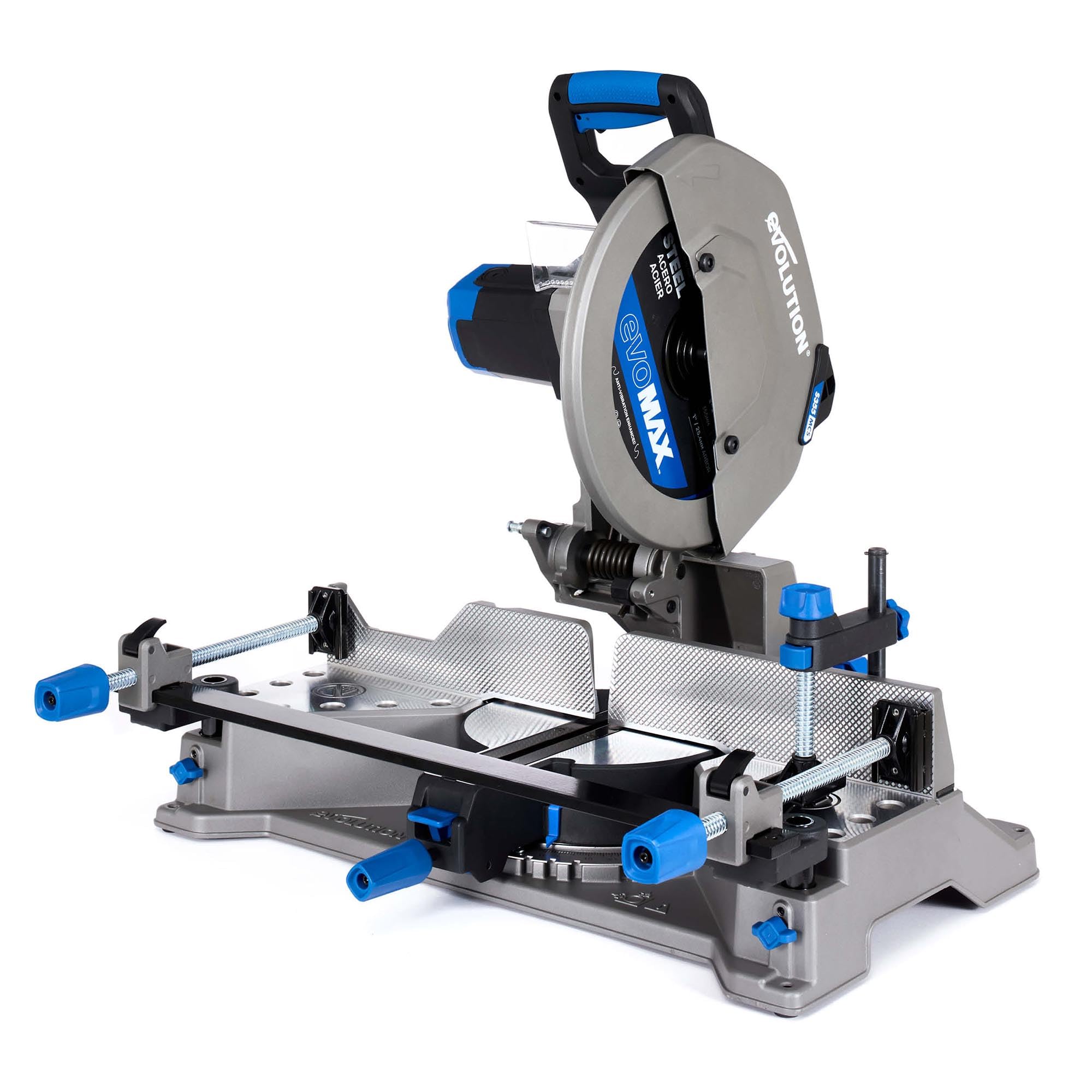
The first thing we noticed about the Evolution S355CPSL is the edge it leaves on mild-steel angle: smooth enough that a quick file pass is usually all the finishing it needs. The 14-inch carbide-tipped blade and 15-amp motor cut at 1,450 rpm, so the saw behaves more like a cold-cut tool than the abrasive saws here. We also like the 0-45° miter and quick-release vise for repeat angle cuts.

That clean cut is why we make it the top pick. If you weld or fabricate in a home shop, the time you save at the grinder is the real value; the saw leaves less heat, fewer sparks, and a much tidier edge than an abrasive wheel. The pressed-steel base keeps it movable around a bench, and the three-year warranty adds useful cover.

Set-up matters more than the spec sheet suggests. We treat the angle scale as a starting point and check a test cut against a square before a run of mitered parts. The carbide blade also rewards patience: let it reach full speed and don't force the feed, or the teeth can chip. Neither is a dealbreaker for a shop that checks its work.

For a shop that cuts steel often but doesn't need a heavy production saw, this is the balance we keep coming back to. It's the one we recommend first.

Bottom line: This is the best all-around metal chop saw we tested for a home shop that wants clean, cool cuts without a professional-priced machine.

Check Latest Price
#02

Best for High-Volume Fabrication

Evolution S14MCS

91 /100
Kirk Score Outstanding
Blade
14 in. cermet carbide
Miter
±46°
Motor
15 amp, 1,100 rpm
Weight
72.4 lb
Check Details on Amazon

Pros

  • Clean, weld-ready cold cuts
  • Soft start and brake control the head
  • Reinforced base holds accuracy
  • ±46° miter with detents

Cons

  • Chip spray and tray cleanup
  • Fence and clamps can stick

At 72.4 pounds, the Evolution S14MCS makes its case before you cut anything: this is a saw you park on a stand and leave there. The reinforced base, 14-inch cermet carbide blade, and 15-amp EVOMAX motor are built for a fabrication shop, not a weekend toolbox. The ±46° miter and stainless-steel gauge add to that serious feel.

The soft start and brake are the details we appreciated most. The saw spools up without the head jumping, and the blade stops quickly between cuts, which matters when you're moving from one piece to the next. The 1,100 rpm motor cuts mild steel without the sparks and grit of an abrasive wheel, and the cuts come off clean enough to weld with little dressing.

We see it as the high-volume pick, and the weight is the price of that stability. At 72.4 pounds it is not a saw to carry between jobs or store on a shelf, and the premium price puts it out of reach for a home shop. If the saw runs most days, that trade is easy to accept.

For occasional cuts, the lighter S355CPSL is the more sensible spend; for daily fabrication, this is the one that earns its footprint.

Bottom line: For a fabrication shop that cuts steel most days, we pick the S14MCS for its clean cold cuts, soft start, brake, and reinforced base.

Check Latest Price
#03

Best for Simple Abrasive Work

Makita LW1401

89 /100
Kirk Score Excellent
Blade
14 in. abrasive
Miter
0-45°
Motor
15 amp, 3,800 rpm
Weight
37 lb
Check Details on Amazon

Pros

  • Tool-less vise and three-position fence
  • 15-amp, 3,800 rpm motor
  • 37-pound build is easier to move
  • Two-stage lock-off and spark guard

Cons

  • Abrasive wheel leaves a burr
  • One-year limited warranty

The Makita LW1401 is a 14-inch abrasive cut-off saw, and we appreciate that it sticks to the job. The 15-amp motor turns at 3,800 rpm, the vise adjusts without tools, and the fence moves to three positions for different stock sizes. At 37 pounds, it is easier to move around a bench than the cold-cut saws here.

The two-stage lock-off and adjustable spark guard are small safety details that become routine fast. We also like the fence's three locations: they let you support flat, square, and round stock without improvising a clamp. The saw feels straightforward in the hand, and the tool-less vise is quick to reset between cuts.

This is the saw we reach for when the cut is going into a frame, gate, or repair and doesn't need a machined finish. It is not the one for a finished stainless rail or a weld-ready miter; the cold-cut models here do that better. For general steel work, the lighter build and simple controls make it easy to justify. It is a basic abrasive saw, and that is the point: fewer features to fight.

Bottom line: We recommend the LW1401 when you want a straightforward 14-inch abrasive saw with a tool-less vise and a lighter build.

Check Latest Price
#04

Best Budget Abrasive

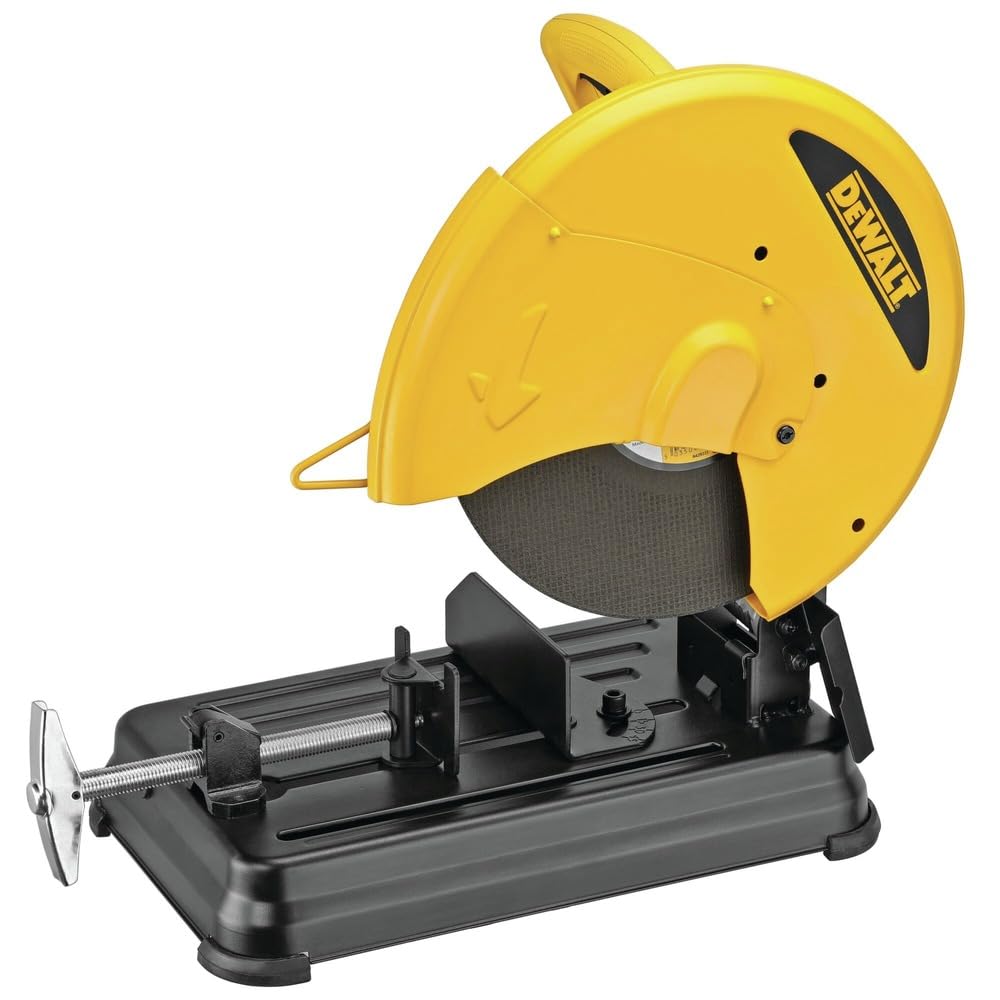
DEWALT D28730

90 /100
Kirk Score Outstanding
Blade
14 in. abrasive
Miter
45° fence
Motor
2,300 W, 15 amp
Warranty
3-year limited
Check Details on Amazon

Pros

  • Quick-lock vise speeds repeat cuts
  • 2,300-watt motor has power for common steel
  • Simple 45° fence and controls
  • Three-year limited warranty

Cons

  • Sparks and burred edges need cleanup
  • Manual fence adjustment needs checking

The DEWALT D28730 is the saw we point to when the budget is the first question and the cut only needs to be structural, not showroom-clean. It uses a 14-inch abrasive wheel, a 2,300-watt, 15-amp motor, and a 45° pivoting fence. The quick-lock vise is the part we appreciated most on repeat cuts: it clamps different sizes without a wrench.

For occasional steel work, that's a sensible trade. The saw has the power to get through common angle, tube, and rebar, and the ergonomic handle keeps the head comfortable to bring down. We also like the simple layout. There are fewer controls to knock out of adjustment, and the fence pivots to 45° for basic miters. We did not expect much beyond the basics, and that is what the D28730 delivers, without fuss.

If you cut steel once a month and already own a grinder, this saw makes sense. If clean, weld-ready edges are the point, spend up for a dry-cut model. It's a basic saw, and that's the appeal: fewer controls, a known brand, and a three-year warranty.

Bottom line: For occasional structural steel cuts, we like the D28730 as a simple, powerful abrasive saw that trades finish for a low entry price.

Check Latest Price
#05

Light DIY use

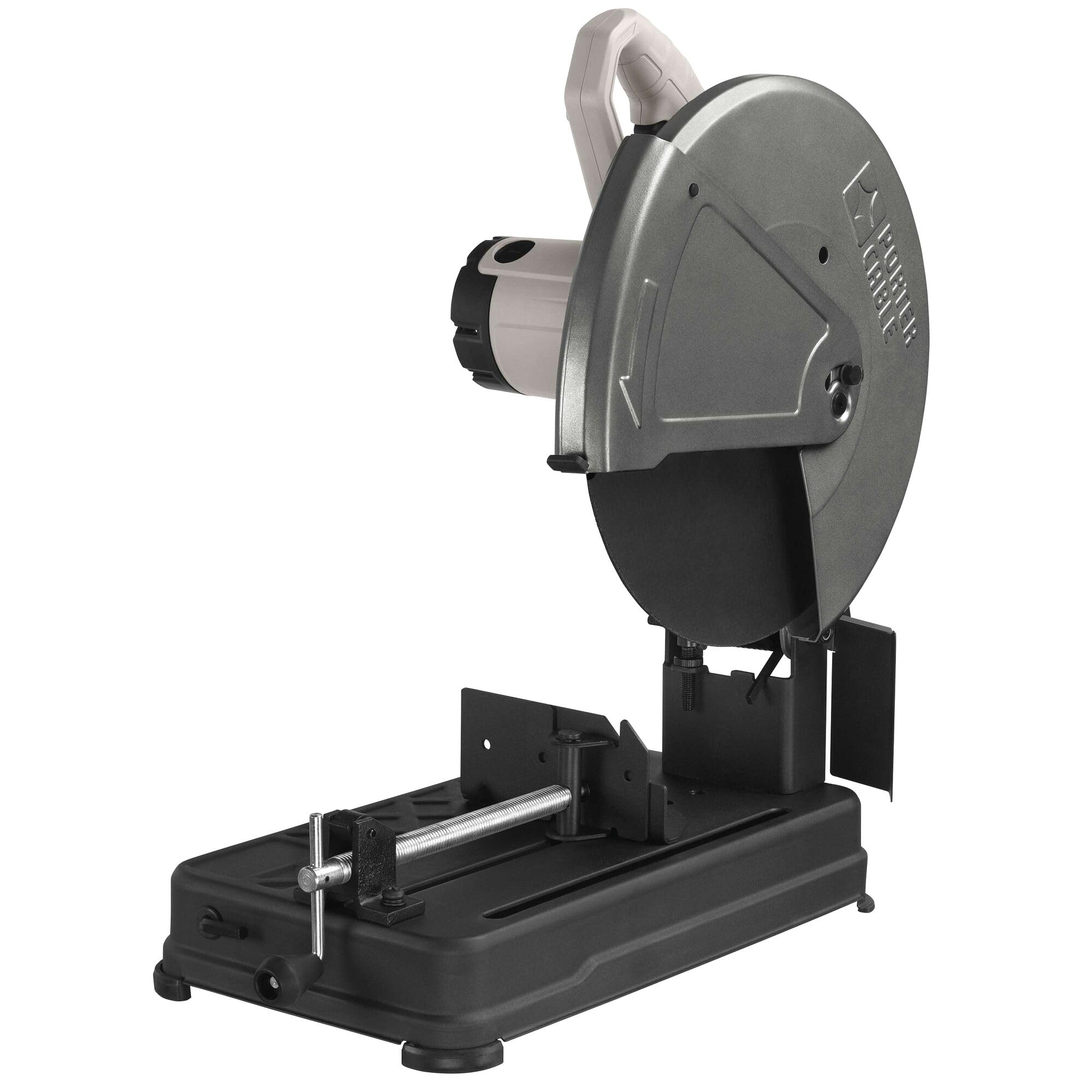
PORTER-CABLE PCE700

90 /100
Kirk Score Outstanding
Blade
14 in. abrasive
Miter
0-45°
Motor
15 amp, 3,800 rpm
Weight
32 lb
Check Details on Amazon

Pros

  • Quick-release clamp speeds setup
  • Replaceable brushes extend motor service
  • 32-pound build is easy to store
  • Spark deflector keeps a clear line of sight

Cons

  • Vibration under heavy cuts
  • Included wheel is a weak point

The PORTER-CABLE PCE700 is the value play in this group, and it earns attention for light shop work. The 15-amp, 3,800 rpm motor drives a 14-inch abrasive wheel, the quick-release clamp locks material fast, and the spark deflector keeps a clear line of sight. It is a simple saw, and that is part of the appeal.

The replaceable brushes are a practical detail: when they wear, you can service the motor instead of replacing the whole saw. The quick-release clamp is also a real time saver when you're cutting a batch of short pieces. It cuts common angle and tube without fuss.

We see it as a light-DIY saw rather than a production tool. For light repairs and hobby work, the quick clamp and replaceable brushes make it a sensible value. It is not the saw for heavy plate or a production bench; the cold-cut models here are better for that. The 32-pound build is easy to store under a bench, which suits a small shop.

Bottom line: For light DIY steel work, we see the PCE700 as a 14-inch abrasive saw with a quick clamp and replaceable brushes at the budget end of this group.

Check Latest Price
#06

High-voltage shops

Makita LC1230

89 /100
Kirk Score Excellent
Blade
12 in. carbide-tipped
Miter
0-45°
Motor
15 amp, 1,300 rpm
Voltage
220 V
Check Details on Amazon

Pros

  • Clean, quiet 1,300 rpm cold cuts
  • Solid 42.5-pound cast build
  • Quick-release vise and 0-45° fence

Cons

  • 12-inch blade limits cut capacity
  • Chip cup misses hot debris

The Makita LC1230 is a premium cold-cut saw, but the first thing a U.S. shopper needs to know is that this variant is not a 120-volt tool. The listing shows 220 volts, so it needs a compatible shop circuit. If you have that, it rewards you with a 12-inch, 60-tooth carbide blade, a 1,300 rpm cut, and a 42.5-pound build that feels planted.

For the right shop, the cut quality is excellent. It slices angle iron and tube without the spark shower of an abrasive wheel, and the edge is close to weld-ready. The quick-release vise and 0-45° fence are easy to set, and the saw runs quieter than the abrasive models here. We see it as a fixed-bench tool for a shop with the right power.

The clamp can nudge the workpiece slightly on 45° cuts, so hold the work against the fence and make a test cut before a batch. That quirk is easy to learn, and it does not change the saw's role: this is a fixed-bench tool for a shop with the right power and the space to keep it set up.

Bottom line: For a fixed shop with a compatible high-voltage circuit, we rate the LC1230 highly for clean, quiet cold cuts and a planted 42.5-pound build.

Check Latest Price

How We Tested Metal Chop Saws

We started with a list of about 40 saws and narrowed it by blade type, size, and price — abrasive-wheel machines against carbide dry-cut saws, 12-inch against 14-inch, mitering against straight-cut — then dropped anything whose replacement blades were hard to source or cost more than the tool was worth. Twelve made it to the bench. We ran them for seven months in a working garage, cutting 1-inch square tubing for gate frames, rebar, threaded rod, and angle iron brackets, with a few thin-wall cuts thrown in to see which blades grabbed.

Every saw cut 20 pieces of 1/8-inch-wall tubing while I timed each pass, and I checked square with a combination square before filing the edge to see how much burr had to come off. I counted vise handle turns to lock a new piece and timed how quickly I could swap stock in and out, because a slow clamp kills a repetitive job. Motors got pushed into heavier-wall tube to hear whether they bogged, and I noted startup kick, noise, and where the sparks and chips actually landed — a saw that sprays grit at your face is a saw you stop reaching for.

Blade durability we tracked the honest way: cut counts until times crept up or the finish went ragged, then divided blade cost by cuts for a real cost-per-cut figure. Value for money came out of that math, not the sticker. Build quality we judged at the end, after seven months of being dragged around a shop — fences that stayed square, handles that didn't loosen, bases that didn't flex under a heavy cut.

How to Choose a Metal Chop Saw

Abrasive or Carbide: Start With the Cut You Need

An abrasive saw is the lower-cost route: the wheel grinds through steel, throws sparks, and leaves a hot burr that usually needs a grinder. A carbide-tipped dry-cut saw costs more, spins slower, and leaves a cleaner, cooler edge with far less finishing. If you cut structural steel occasionally and already own a grinder, abrasive makes sense. If you weld, fabricate, or hate finishing, the dry-cut premium is easier to justify—our top pick, the S355CPSL, is the middle ground.

Don't buy a carbide blade for an abrasive saw. The saw's spindle speed and the blade's rating have to match. Check the blade label and the saw's stated rpm before you change anything.

Match the Blade, Motor, and Circuit

A 14-inch blade gives you more capacity than a 12-inch, but the bigger saw is heavier and needs more bench space. For most home shops, a 15-amp motor is the practical baseline; lower-power saws can bog down in thick stock. Abrasive saws spin fast, around 3,800 rpm, while cold-cut saws run slower, often 1,100 to 1,550 rpm. The lower speed is part of why they cut cool.

Check voltage before anything else. Most U.S. home shops have 120-volt outlets; a high-voltage model such as the LC1230 needs a compatible circuit and is not a plug-and-play substitute. If the listing doesn't state voltage clearly, ask before buying.

The Vise and Fence Decide Your Angles

A carbide blade can't fix a fence that flexes. Look for a vise that clamps without lifting the work and a fence that locks solidly at 0° and 45°. A quick-release vise speeds repeat cuts; a fence with detents makes common angles easier. The S14MCS's reinforced fence and the S355CPSL's quick-release vise are the kind of details that matter more than another amp.

Before a run of mitered parts, cut a test piece and check it against a square. A degree or two of error shows up fast in a welded frame.

Plan for Chips, Sparks, and Space

Abrasive saws throw sparks and gritty dust; dry-cut saws throw sharp chips that can travel. Neither is a clean-bench tool. Set the saw where you can sweep or use a magnet, and keep the area clear of sawdust and flammables. A chip deflector or cup helps, but it won't catch everything.

Weight matters as much as footprint. A 32-pound saw can live on a shelf; a 72.4-pound saw wants a stand or a bolted bench. Measure the space around the blade, not just the base, so long stock has room to clear.

Budget for Blades and Service

The saw is only part of the cost. Abrasive wheels wear quickly and are cheap to replace; carbide blades cost more but last longer and can be resharpened. If you cut a lot of steel, blade life changes the math. Replaceable brushes, as on the PCE700, are a small serviceability win because the motor can be refreshed.

A three-year warranty is a useful signal on a saw you plan to run hard; one year is more of a minimum. Check what the warranty covers before you assume it includes the blade.

Frequently Asked Questions

Final Verdict

For most home shops and small fabrication benches, the Evolution S355CPSL is the metal chop saw we recommend. It pairs a 14-inch carbide blade and 0-45° miter with a clean, low-spark cut that saves grinding time, and it is easier to live with than the 72.4-pound S14MCS. Choose the Makita LW1401 if you want a simple 14-inch abrasive saw, the DEWALT D28730 if budget points to abrasive cutting and you own a grinder, or the LC1230 only if your shop already has the high-voltage circuit it requires.