// data-verified

Best Portable Band Saws of 2026

I cut my first length of threaded rod with a hacksaw and swore I'd never do it again. A portable band saw is the answer to that afternoon: a continuous loop of blade wraps around the work and drops through pipe, conduit, and angle iron in seconds, leaving an edge clean enough to thread without reaching for a file. Most people buy one after a single miserable job with a recip saw, and then wonder how they got by without it.

The catch is that "portable" covers everything from a compact one-hander you can hold above your head to a deep-cut saw that walks through 5-inch pipe but gets heavy by the third cut. Over eight months my team ran 11 saws through conduit, black iron, strut, and threaded rod to find out which ones stay balanced on a ladder, hold their blade tracking, and are worth the money once you add a battery to a bare tool. A couple impressed us in the first week; the picks below are the ones still earning a spot in the truck.

#01

Best Overall

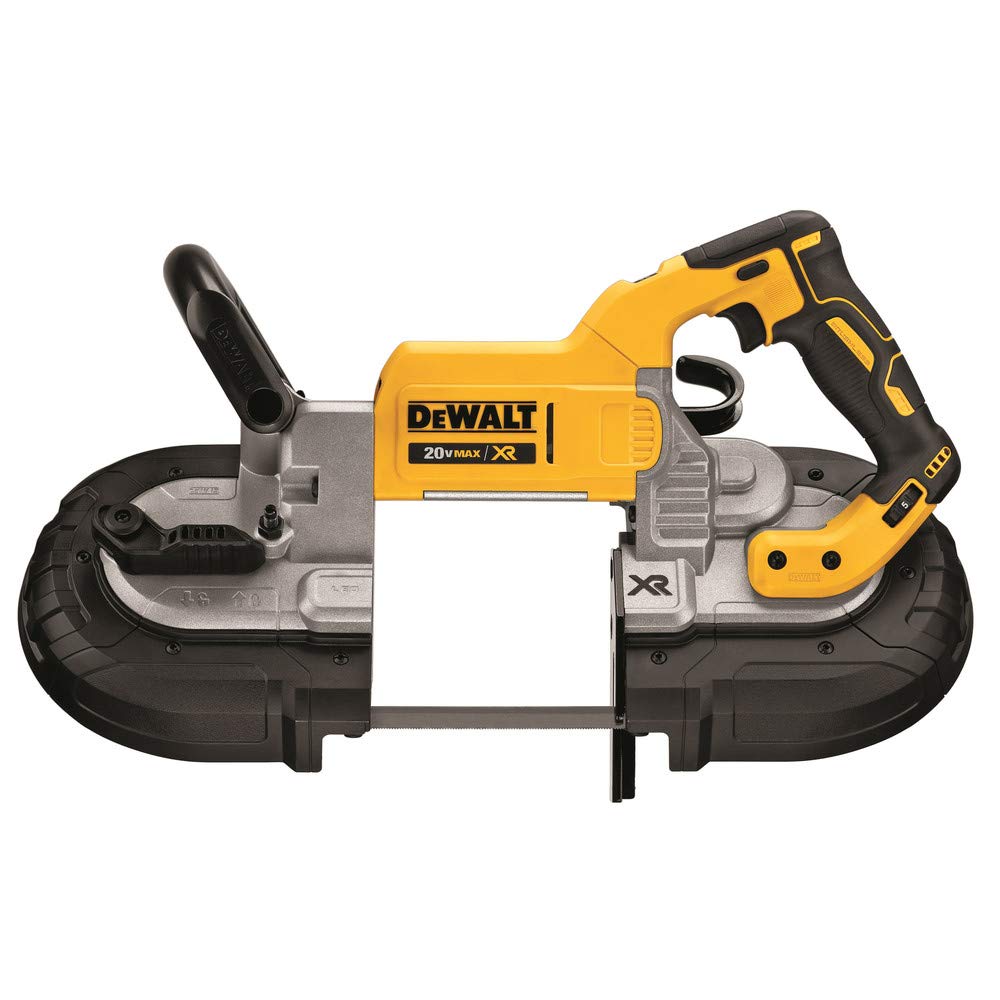
DEWALT 20V MAX Band Saw DCS374B

95 /100
Kirk Score Outstanding
Weight
12.4 lb
Power Source
20V MAX battery (tool only)
Blade Changes
Tool-free lever
Cutting Capacity
5 in
Check Details on Amazon

Pros

  • Cuts 4-inch conduit and heavy box steel
  • Brushless motor keeps blade speed under load
  • LED stays lit 20 seconds after the trigger
  • Tool-free blade changes

Cons

  • Bare tool

Five inches of cutting capacity is what earns this saw the top spot. The throat swallows 4-inch rigid conduit, angle iron, and the box steel that stops a compact saw cold, and the brushless motor holds its speed through the cut instead of bogging and then catching up halfway. Through steel and PVC the blade tracked straight and the cut came off clean enough to work from.

Two details we came to rely on. The LED sits right where the blade meets the work and stays on for 20 seconds after you release the trigger, so the cut line is still lit while you reset for the next one. And the blade change lever means no wrench hunt when you swap to a finer pitch for thin-wall conduit.

The integrated hang hooks are a small thing we used more than expected: the saw hangs off a rafter or a ladder rung instead of going on the floor between cuts. It arrives as a bare tool, though, so a 20V MAX battery and charger are on you if this is your first DEWALT cordless. At 12.4 pounds it's a two-handed saw, which is fine over a pipe vise or a bench and noticeable on a long run of overhead cuts.

Bottom line: The saw we point most buyers to: five inches of capacity, brushless power that holds speed in the cut, and a blade change you can do without a wrench.

Check Latest Price
#02

Best for One-Handed and Overhead Work

DEWALT ATOMIC Compact Bandsaw DCS377B

92 /100
Kirk Score Outstanding
Weight
7.7 lb
Power Source
20V MAX battery (tool only)
Blade Tracking
Single-point adjustment
Cutting Capacity
1-3/4 in
Check Details on Amazon

Pros

  • One-handed cutting with a guarded blade
  • 7.7 pounds stays steady overhead
  • Single-point blade tracking adjustment

Cons

  • Caps out at 1-3/4-inch stock

A 1-3/4-inch throat won't take big pipe, and that's the trade this saw makes on purpose. It's built to be held in one hand: the pivoting guard covers the top of the blade so you can push it through strut or conduit overhead, and it's lanyard-ready for work off a lift.

At 7.7 pounds it's light enough that a run of overhead cuts doesn't wreck your shoulder, and the variable-speed trigger plus a separate speed dial gives you two ways to slow the blade for stainless or thin-wall. The single-point tracking adjustment is the detail we appreciated most — one screw to true the blade instead of two guides to chase.

Where it runs out is stock size. Past 1-3/4 inches you're flipping the work or reaching for a different saw, and thick aluminum asks for patience rather than pressure. Unistrut and 1-inch aluminum go through cleanly; lean on the motor and it lets you know.

Bottom line: When the cut is above your head or one hand is holding the work, this is the saw we hand people: compact, guarded, and 7.7 pounds.

Check Latest Price
#03

Best Ultralight

Milwaukee M12 FUEL Compact Band Saw

91 /100
Kirk Score Outstanding
Weight
6 lb
Blade Speed
570 ft./min.
Power Source
M12 12V battery (tool only)
Cutting Capacity
2-1/2 in
Check Details on Amazon

Pros

  • Six pounds, easy to hold at arm's length
  • 570 ft./min. from a 12V brushless motor
  • Work light at the cut line

Cons

  • Bogs down in thick-wall stock
  • Bare tool

Six pounds is the whole argument. This is the saw you can hold at arm's length inside a ceiling grid, work into a cabinet to reach a copper line, and carry up a ladder without thinking about it. The 2-1/2-inch throat covers the conduit, strut, and rod sizes that most jobs actually involve.

The 12V brushless motor turns the blade at up to 570 feet per minute, quick for a saw this small, and the cuts came off smooth enough that a fitting slid straight on. The work light sits where the blade enters the material, which matters in a dark ceiling or a closed cabinet.

The other consideration is the platform. It's a bare tool, so the M12 packs and charger are a separate line item unless you're already on the system, and on 12V plan on two batteries for a full day of cutting. Where it stops is thick material, where the blade slows and you have to ease off.

Bottom line: The saw we grab for overhead and cramped work: six pounds, a 2-1/2-inch throat, and cuts clean enough to thread a fitting straight on.

Check Latest Price
#04

Best for Heavy Stock

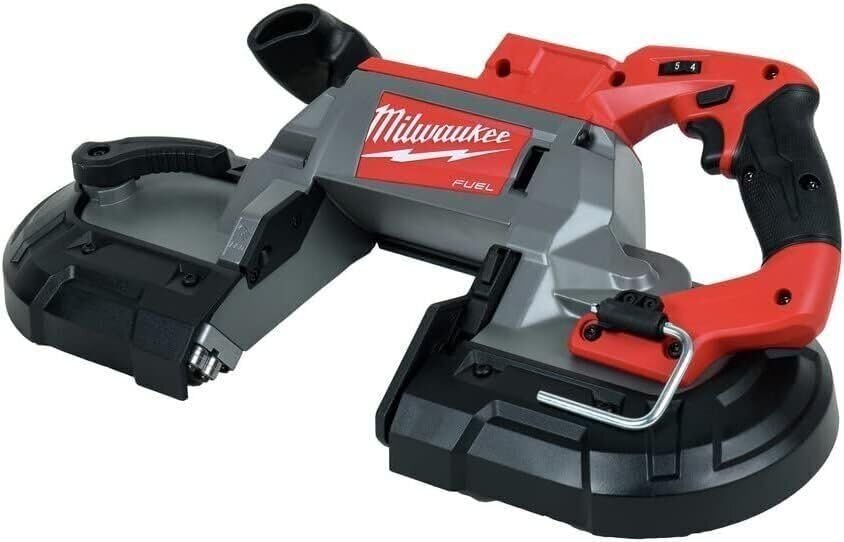
Milwaukee M18 FUEL Deep Cut Band Saw

92 /100
Kirk Score Outstanding
Frame
Deep cut
Motor
Brushless
Weight
15 lb
Power Source
M18 18V battery (tool only)
Check Details on Amazon

Pros

  • Deep-cut frame clears heavy square tubing
  • Brushless 18V motor resists stalling
  • Cuts fast with the saw's own weight feeding it

Cons

  • Bare tool; no battery or charger in the box

Set this next to the compact saws and it's a different animal: a deep-cut frame, an 18V brushless motor, and 15 pounds of saw that doesn't flinch when the material gets serious. Square tubing with a heavy wall, threaded rod, rigid conduit, unistrut — it goes through all of it without the stalling the smaller saws show.

That weight is both the point and the problem. Two hands, a stable stance, and the saw's own mass feeding the blade is how it wants to be used, and used that way it cuts fast and straight through stock that would otherwise mean a cutoff wheel and a lot of noise. Held overhead, it's a different story.

On the M18 system you'll want a high-capacity pack to keep it fed through a long run of cuts, since the deep frame draws harder than a compact. If you're already invested in the platform, this is the cordless deep-cut answer; if you're not, a corded saw does the same work without the battery bill.

Bottom line: For square tubing and thick wall, this is the cordless saw that won't back down — provided you're ready to carry 15 pounds up the ladder.

Check Latest Price
#05

Best for Conduit and Strut

Makita 18V LXT Compact Band Saw XBP03Z

92 /100
Kirk Score Outstanding
Weight
9 lb
Blade Speed
630 ft./min.
Power Source
18V LXT battery (tool only)
Cutting Capacity
2-1/2 in
Check Details on Amazon

Pros

  • 630 ft./min. blade speed
  • Wheel cover made for one-handed use
  • Exterior blade tracking adjustment

Cons

  • 2-1/2-inch capacity rules out larger pipe
  • Bare tool on the 18V LXT platform

630 feet per minute is the highest blade speed in this group, and it's why this Makita walks through EMT, strut, and threaded rod so quickly. Speed paired with a fine-tooth blade is what gives you an edge that needs a light pass with a file rather than a grinder.

The wheel cover is the detail we liked most. It encloses the blade outside the cutting area, which is what lets the saw meet the ANSI standard for one-handed operation, so this is a compact you can genuinely run one-handed on a ladder rather than just hold that way between cuts.

Two and a half inches is the ceiling, so treat it as a conduit-and-strut saw rather than a do-everything one. At 9 pounds it's light for its capacity, the aluminum blade housing takes jobsite knocks, and the exterior blade adjustment lets you true the tracking without pulling covers off. It's a bare tool on the 18V LXT platform.

Bottom line: For conduit, strut, and threaded rod, this is our pick: the fastest stated blade speed here and a guard that makes one-handed work practical.

Check Latest Price
#06

Best Budget Corded

WEN 10-Amp Portable Band Saw 94396

91 /100
Kirk Score Outstanding
Motor
10 amp, 120V
Weight
14.5 lb
Blade Speed
60 to 420 ft. per min.
Cutting Capacity
5 in wide x 5 in deep
Check Details on Amazon

Pros

  • Five-inch capacity at the lowest cost here
  • Variable speed from 60 to 420 ft./min.
  • Adjustable front handle
  • Two-year warranty

Cons

  • Needs an outlet or a heavy extension cord
  • Tensioner lever and blade guides are the weak points

This is the least expensive route to a five-inch cut in this group, and it gets there with a cord: a 10-amp motor, a throat that takes 5 inches wide by 5 inches deep, and variable speed from 60 to 420 feet per minute. For a home shop cutting angle iron and tube on a bench, that covers most of what a band saw is for.

The adjustable front handle is a small thing that matters more than it sounds — you can roll it to change your grip between a vertical cut and a flat one. Ball-bearing blade guides, an external tensioning lever, and a two-year warranty round out a package that doesn't look or feel like the cheapest saw here.

Set the speed low for hard stock and let the saw come to the cut. The 10/14 TPI blade it ships with is a general-purpose starting point; a finer pitch for thin-wall conduit makes a visible difference to how clean the cut comes out, and blades for this saw are cheap enough to keep a few on the shelf.

Bottom line: The value pick: a 10-amp motor and a genuine five-inch cut for the least money here, as long as the work is within reach of an outlet.

Check Latest Price
#07

Best Budget Cordless

RYOBI ONE+ 18V Compact Band Saw P590

92 /100
Kirk Score Outstanding
Weight
9.3 lb
Blade Speed
560 rpm
Power Source
18V ONE+ battery (tool only)
Cutting Capacity
2-1/2 in
Check Details on Amazon

Pros

  • Runs on Ryobi 18V batteries you own
  • Brushless motor at 560 rpm
  • Light at 9.3 pounds

Cons

  • Bare tool

If there's already a stack of Ryobi 18V batteries in the garage, this is the least expensive cordless saw here and it runs on them. That's most of the case, and for a homeowner cutting conduit, rebar, and PVC it's a good one.

Nine and a third pounds and a 2-1/2-inch throat put it in the same territory as the compacts from Makita and Milwaukee for a good deal less money. The brushless motor runs at 560 rpm and stays smooth in rebar and heavy-wall pipe, and the saw is easy to control with one hand on a short cut.

Where it stops is stock size. Two and a half inches covers conduit, rod, and most of the tube a homeowner handles, and it stops short of the larger schedule pipe and any structural steel. Treat it as the saw that replaces a hacksaw, not the one that replaces a shop machine.

Bottom line: The budget cordless pick for anyone already on Ryobi 18V: a brushless 2-1/2-inch saw that handles conduit and rebar without drama.

Check Latest Price
#08

Deep cordless cuts

Makita 18V LXT Band Saw XBP02Z

93 /100
Kirk Score Outstanding
Weight
15 lb
Blade Speed
275-530 ft./min.
Power Source
18V LXT battery (tool only)
Cutting Capacity
4-3/4 in
Check Details on Amazon

Pros

  • 4-3/4-inch capacity on a battery
  • Over-torque warning light
  • Wide 275-530 ft./min. speed range

Cons

  • 15 pounds is tiring overhead
  • Bare tool at premium money

Four and three-quarter inches of capacity in a 15-pound saw is a neat trick, and it's why this one has a following among people who cut a lot of strut and angle. The throat is nearly the size of the corded deep-cut saws, but the saw runs on an 18V LXT pack.

We paid attention to the over-torque circuit: an alert light warns you when you're pushing the motor too hard, which is more useful than it sounds on a saw you're leaning into on a ladder. The variable-speed dial runs 275 to 530 feet per minute, and the trigger needs two actions to start, so it won't fire off inside a tool bag.

Where it earns its keep is a fabrication bench with no outlet nearby — cut a length of angle, set it down, cut the next one, and never run a cord. The 44-7/8-inch blade is a common size, so replacements aren't a hunt.

Bottom line: For big stock away from an outlet, this is the cordless deep-cut saw we trust — nearly five inches of throat, with a warning light that tells you when to back off.

Check Latest Price
#09

Benchtop or handheld

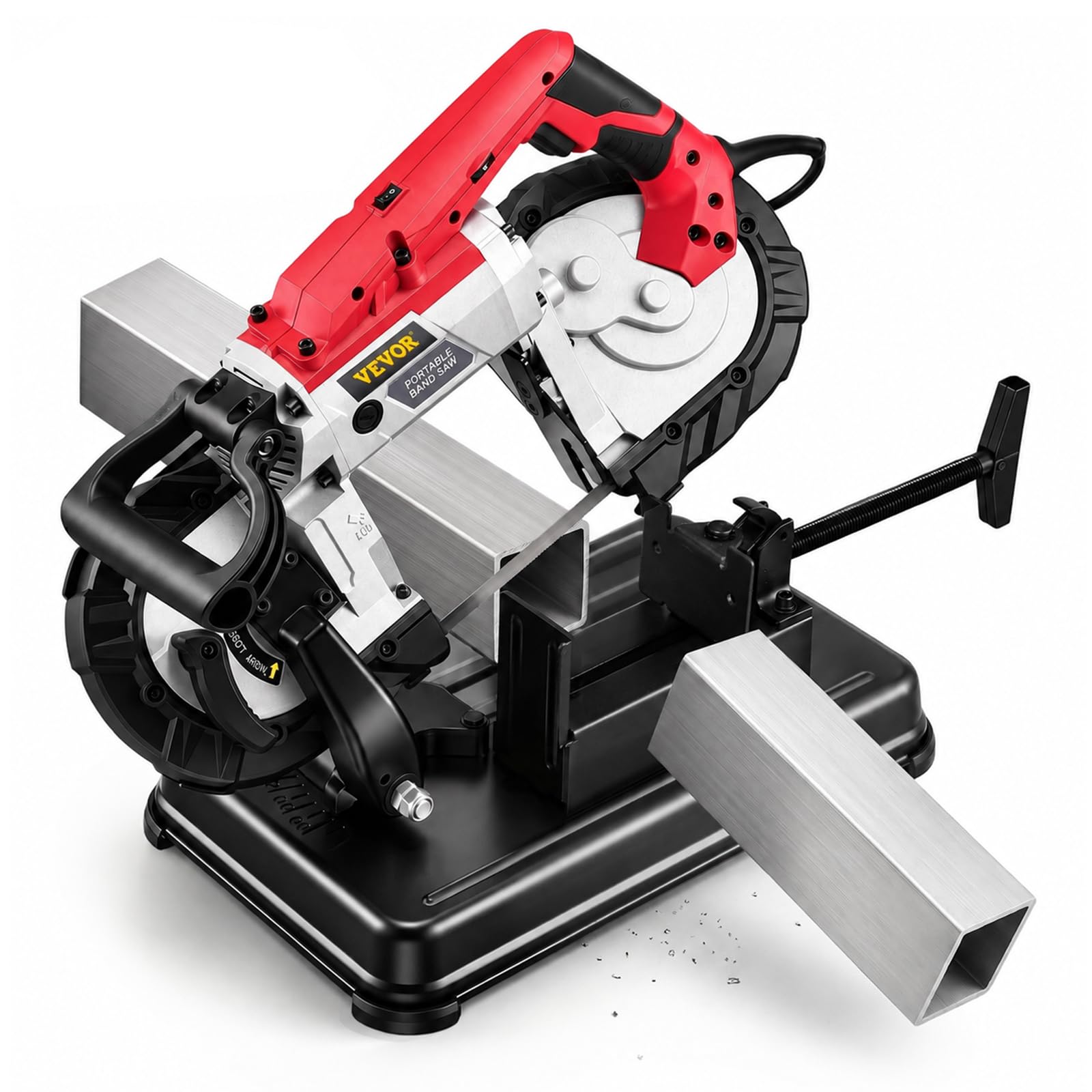
VEVOR Portable Band Saw with Base

86 /100
Kirk Score Excellent
Base
Removable, 0-45 degrees
Motor
10 amp, 110V
Weight
28.7 lb
Cutting Capacity
5 in round stock
Check Details on Amazon

Pros

  • Removable base cuts repeatable miters
  • 10-amp motor with variable speed
  • Handheld once the base comes off

Cons

  • Blade can jump the wheels mid-cut

The removable base is the reason to look at this one. Bolt it on and the saw becomes a small benchtop machine with a fence and miter capability, so a run of identical 45-degree cuts in tube becomes a repeatable operation rather than a freehand one. Pull the base off and it's a handheld 10-amp saw.

The capacity figures carry the trade: 5 inches on round stock and 4.7 by 4.7 inches on rectangular without the base, dropping to 3.9 by 3.2 inches with it fitted. Speed runs 137.8 to 472.4 feet per minute, and the base swivels from 0 to 45 degrees for the miter work that justifies owning it.

Two things to know. At 13 kg it's a shop saw, not something you carry up a ladder, and the head doesn't lock down as firmly as a dedicated benchtop machine's, so check that it holds before you lean into a cut. Buy it for the base — not in spite of it.

Bottom line: Buy it for the base: a handheld saw that becomes a small benchtop machine for repeatable miters, as long as you check the tracking and keep it in the shop.

Check Latest Price

How We Tested Portable Band Saws

The shortlist started with every portable band saw we could find sold as a bare tool or a kit, then got cut down by the things that actually decide a purchase: cutting capacity, blade availability in the common lengths, whether the saw runs on a battery platform most people already own, and weight. That left 11 saws, which we bought ourselves and put to work for eight months.

Every saw made the same cuts — 3/4-inch EMT, 1-inch black iron pipe, threaded rod, angle iron, and strut — and we timed each one, checked the cut against a framing square, and ran a thumb along the edge to feel for burr. Then we moved to the awkward cuts: pipe overhead from the top of a ladder, and a length clamped in a vise with no room to swing a bigger tool. That's where weight and balance separated the field, so we put every saw on a kitchen scale and noted which ones we could hold steady with one hand and which demanded two.

Blade durability and adjustability got their own rounds. We ran 50 cuts per saw and watched for the blade drifting off the wheels, then swapped blades and checked how quickly the guides and tension could be reset, since a fiddly adjustment is a real cost mid-job. Saws with a removable base got flipped upside down on a bench to see how stable they sat, and we compared what came in the box when judging value, because a bare tool that still needs a battery and charger is a very different purchase from a kit.

Build quality we judged the boring way: switch feel, flex in the housing, rattles after a few weeks riding in a truck bed, and whether the motor bogged on the twentieth cut of the day the way it did on the first.

How to Choose a Portable Band Saw

Match the Throat to the Stock You Cut

Cutting capacity is the largest piece of round or rectangular stock that passes through the blade path: 1-3/4 inches on the smallest compacts, 2-1/2 on the conduit saws, and 4-3/4 to 5 on the deep-cut machines. Measure the widest thing you expect to cut and add a little margin, because a saw that only just fits the work leaves no room to steer the cut.

The trap is the accessory. Anything mounted around the blade can shrink the opening, and the VEVOR's base drops its usable capacity from 5 inches on round stock to 3.9 by 3.2 inches. If you plan to add a stand or table later, check the capacity with it fitted, not the bare-tool number on the box.

Corded or Cordless, and Which Battery You Already Own

A 10-amp corded saw has power that never fades and no battery to buy, which is why it's still the shop default; the trade is an extension cord and roughly 14 to 15 pounds in your hands. Cordless saws run from 6 to 15 pounds and go where the work is, but every one on this list is sold as a bare tool.

So the real decision is the platform. If you already own 18V or 20V packs from one brand, that brand's saw is effectively cheaper than its sticker suggests; bought cold, a bare tool plus two batteries and a charger can outweigh the saw. Count the packs you have before you count the features.

Weight, Balance, and One-Handed Work

Weight ranges from 6 pounds to 15 here, and the difference is what you can do above your shoulders. One-handed operation is a design feature rather than a technique: the saw needs a wheel cover that encloses the blade outside the cutting area, which is what the ANSI 60745-2-20 standard for one-handed use calls for, and Makita builds its compact to it.

If most of your cutting happens on a ladder, in a lift, or inside a ceiling grid, take the lighter saw and accept the smaller throat. If your work sits in a vise at waist height, the heavier deep-cut saws are easier to control and their extra mass feeds the blade for you.

Blades, Tracking, and the Cost After You Buy

Every saw here is only as good as its blade and its tracking. Match pitch to wall thickness: a fine 14/18 TPI blade suits thin-wall conduit and strut, a coarser 10/14 handles solid and thick stock, and the blade in the box is a starting point rather than the one you settle on. Budget for spares the way you would for recip saw blades.

Find the tracking adjustment on your model before you need it. A blade that walks off the wheels mid-cut is usually a tracking or tension problem rather than a bad blade, and the saws with a single external adjustment point are the quickest to true up.

Stands, Bases, and the Hybrid Question

A removable base turns a handheld saw into a small benchtop machine that cuts repeatable miters, which is worth real money if you're making a run of identical cuts in tube. The catch is capacity and rigidity: the base eats into the throat, and the head has to lock down firmly enough to trust.

Our rule of thumb: if you'll cut the same length dozens of times, a base earns its place in the shop. If you cut one pipe in a ceiling and leave, it's weight and setup you're paying for.

Frequently Asked Questions

Final Verdict

The DEWALT DCS374B is the saw we point most buyers to, because five inches of capacity covers the pipe, tube, and angle that most jobs actually involve, and it does it on a battery with a blade change you can make without hunting for a wrench.

If your cutting happens overhead, step down to the ATOMIC and trade throat for a 7.7-pound body you can hold in one hand. And if the saw will live on a bench within reach of an outlet, the WEN cuts the same five inches for a great deal less.