// data-verified

Best Butane Torches of 2026

A butane torch is a small thing that fails in memorable ways. The flame dies halfway through caramelizing sugar, the ignition clicks and clicks without catching, or the nozzle is so short your knuckles sit in the fire. What you're actually paying for is control: a torch that lights on the first click, holds the flame you set, and refills without fighting you.

We spent four months with 14 torches, from pocket-size kitchen models to heavier workshop tools built for soldering and resin work. We brûléed custard, seared steak, lit charcoal, and soldered copper pipe, refilling each one over and over to see which valves ran clean and which dribbled fuel. Peak heat mattered less than the details: a fuel gauge you can read at a glance, a safety lock that doesn't slip, a flame that stays where you point it.

One thing worth knowing before you shop: most of these ship without butane, and the fuel matters. Decent refined butane keeps a nozzle clean; cheap cans are what clog the torches people end up frustrated with. The picks below are the ones we kept reaching for.

#01

Best Overall

Blazer GT8000 Big Shot

93 /100
Kirk Score Outstanding
Base
Attachable tabletop stand
Nozzle
Brass, anti-flare
Weight
12 oz
Max Temperature
2,500 °F
Check Details on Amazon

Pros

  • Lights on the first press, every time
  • Anti-flare brass nozzle holds a tight flame
  • Clip-on base gives hands-free use

Cons

  • Metal head stays hot after use

The click is what sold us. Several torches in this group need a second or third press when they have been sitting in a drawer; the Blazer fires on the first one, and it kept doing it through every session we put it through. Behind the trigger sits a brass-frame nozzle with an anti-flare design, which in practice means a tight blue point of flame rather than a soft orange bloom that curls up the sides of a ramekin.

The clip-on base is the detail we did not expect to use as much as we do. Fit it and the torch stands on the bench, lit, while both hands are busy with a wire splice or a tray of sugar; take it off and you have a plain handheld torch with the gas dial where your thumb expects it. That dial is the one place this torch asks for patience, because its sweep is shorter than the kitchen torches here and feathering the flame down to a whisper takes a careful hand.

It is, unmistakably, a tool. At 12 ounces it is heavier than any of the kitchen torches in this group, the body is black metal, and it makes no attempt to look like something you would leave beside the coffee maker. What the heft buys is a torch we have never had to coax: pick it up, press, work, set it back on its base. For a sear, a solder joint, or a stubborn bolt, that is the whole argument.

Bottom line: The most reliable torch in this group, with a tight anti-flare flame and a base that keeps both hands free. We pick it up knowing it will light.

Check Latest Price
#02

Best for Searing and Sous Vide

Iwatani PRO2

92 /100
Kirk Score Outstanding
Flame
Adjustable size and shape
Weight
2.88 oz
Included
Stabilizing stand
Max Temperature
2,700 °F
Check Details on Amazon

Pros

  • Flame can be shaped, not just sized
  • Highest maximum temperature of the picks
  • Included stand holds it steady between passes

Cons

  • Priciest of the culinary torches here

Two thousand seven hundred degrees is the highest figure on any torch in this guide, and the Iwatani is the one we pick when the job is a steak rather than a crème brûlée. The valve does more than raise and lower the heat: it changes the shape of the flame, so you can draw it into a concentrated point for a sous vide crust or open it out to glaze a ham.

The stabilizing plate is the other reason it stays near the stove. Set the torch on it and the head points where you left it, so you can put it down between passes instead of laying a hot torch on the counter. Ignition is a single touch rather than a button-and-dial combination, which sounds like a small thing until one hand is holding a pan.

Heat like this is unforgiving. At the top of the range it will blacken sugar before you have finished moving the torch, so dessert work happens at the bottom of the dial where the flame is a thin blue pencil. Fuel is not included, and the torch is happiest left on its stand between passes rather than rolling around a drawer.

Bottom line: A valve that changes the flame's shape, not just its size, plus the highest heat here. This is our searing torch.

Check Latest Price
#03

Best for Soldering and Shop Work

LEXIVON LX-771

89 /100
Kirk Score Excellent
Kit
12-piece soldering set
Run Time
Up to 2 hours
Flame Length
1/2 in. to 2 in.
Max Temperature
2,400 °F
Check Details on Amazon

Pros

  • Metal fuel tank instead of plastic
  • Up to two hours of run time per fill
  • Twelve-piece kit covers soldering and heat work
  • Child-resistant ignition stopper

Cons

  • Pricier than the kitchen torches here
  • Two-inch maximum flame is broad for fine work

This one is not for the kitchen, and it does not pretend to be. The LX-771 is a twelve-piece kit — the torch body plus soldering tips and the fittings that turn flame into an iron — and it is the only thing here built around bench work. Heat shrink, wire splices, melting the end of a length of twine, loosening a seized bolt: this is the torch that earns a place in a toolbox.

The spec that matters is the tank. It is metal rather than plastic, it refills in about fifteen seconds, and it runs up to two hours on a fill, which is long enough to finish a project instead of stopping to top up. The flame adjusts from half an inch to two inches and tops out at 2,400 °F, and the attachable base lets it stand and burn while you feed a wire with both hands.

Weight is the trade. At 1.3 pounds it is the heaviest thing in this guide, and on a bench that works in your favour: it sits where you put it and does not skitter when your sleeve catches it. Held over a ramekin, the same torch feels like using a hammer to crack an egg. Buy it for the workshop and it will outlast the drawer torches around it.

Bottom line: The only proper soldering kit in the group: metal tank, two-hour run time, and tips for wire work. No kitchen torch here can do this job.

Check Latest Price
#04

Best Budget Kitchen Torch

Kollea Culinary Torch

91 /100
Kirk Score Outstanding
Nozzle
Long-reach
Weight
7.52 oz
Fuel Gauge
Visible gauge
Max Temperature
2,500 °F
Check Details on Amazon

Pros

  • Visible fuel gauge on the body
  • Safety lock and finger guard
  • Takes any brand of small butane can
  • Light enough to hold over a dessert

Cons

  • Flame is small for anything bigger than dessert
  • Long-term durability is the open question

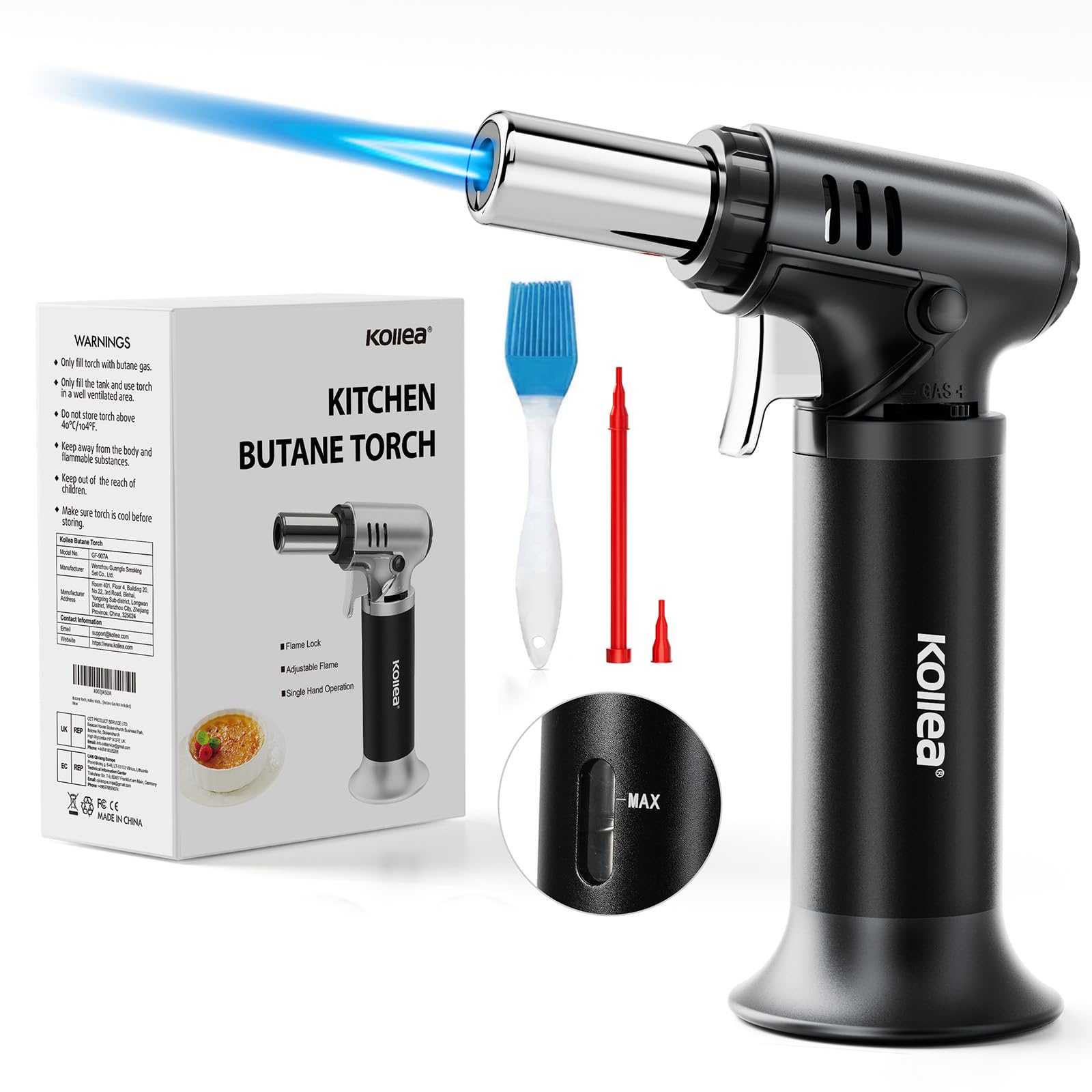
The Kollea costs less than anything else we tested, and it is the one we put in a first-timer's hands. There is nothing to work out: fill it, click the safety lock off, press the piezo button, and you have flame. The long-reach nozzle keeps your knuckles back from the heat, and the finger guard sits between your hand and the business end.

The fuel window is the feature we use most. A transparent gauge on the body shows how much butane is left, so you find out before you are halfway through a tray of brûlées rather than after. It also accepts any brand of small butane can, long nozzle or short, which takes one more decision off the list.

The tank is small and refilling is not always a one-shot job — expect to press the can down, listen, and top up again. None of that has stopped us reaching for it. It is the torch we keep filled for a quick pass over a dessert or a bubble-popping pass on resin, because it costs so little that leaving it in a drawer until the next crème brûlée is no worry at all.

Bottom line: The least expensive torch here, and still the easiest to hand to a beginner: fuel window, finger guard, first-press ignition.

Check Latest Price
#05

Best for Long Toasting Jobs

Tencoz Kitchen Torch

89 /100
Kirk Score Excellent
Safety
Lock and finger guard
Weight
6 oz
Fuel Capacity
12 ml
Max Temperature
2,370 °F
Check Details on Amazon

Pros

  • Lock holds the flame open one-handed
  • Six ounces, the lightest tank-bodied torch here
  • Finger guard built into the body
  • Refills easily from a standard can

Cons

  • Tank holds only 12 ml
  • No fuel window to check the level

The lock is why this one made the list. Roll the collar and the Tencoz keeps burning without a thumb on the trigger, which turns toasting a tray of meringue peaks or getting a fire going into a one-handed job. Of the torches here with a continuous-flame mode, this is the one whose lock we trusted most.

It is also the lightest of the tank-bodied torches at six ounces, so it does not drag on your wrist during a long pass over a roast. The finger guard is built into the body, the piezo press is a single button, and refilling from a standard butane can has been one of the easier jobs on this list.

The flame is the compromise. It will go from a soft yellow brush to a sharp blue tip as you turn the dial, but the change is not always where the markings suggest, and opening it wide from cold can give you more flame than you asked for. Turn it up slowly, give it a second to settle, and it behaves.

Bottom line: A lock that holds the flame without your thumb, on the lightest tank-bodied torch here. Worth it for long toasting and one-handed work.

Check Latest Price
#06

Everyday kitchen jobs

TBTeek GF-907

88 /100
Kirk Score Excellent
Weight
7.94 oz
Included
Three nozzle adapters
Fuel Gauge
Clear side window
Max Temperature
2,500 °F
Check Details on Amazon

Pros

  • Clear side window shows the fuel level
  • Angled extended nozzle keeps hands back
  • Three adapters fit most butane cans
  • One-hand ignition and continuous lock

Cons

  • Continuous lock can stop holding after a few months
  • Igniter is the weak point over time

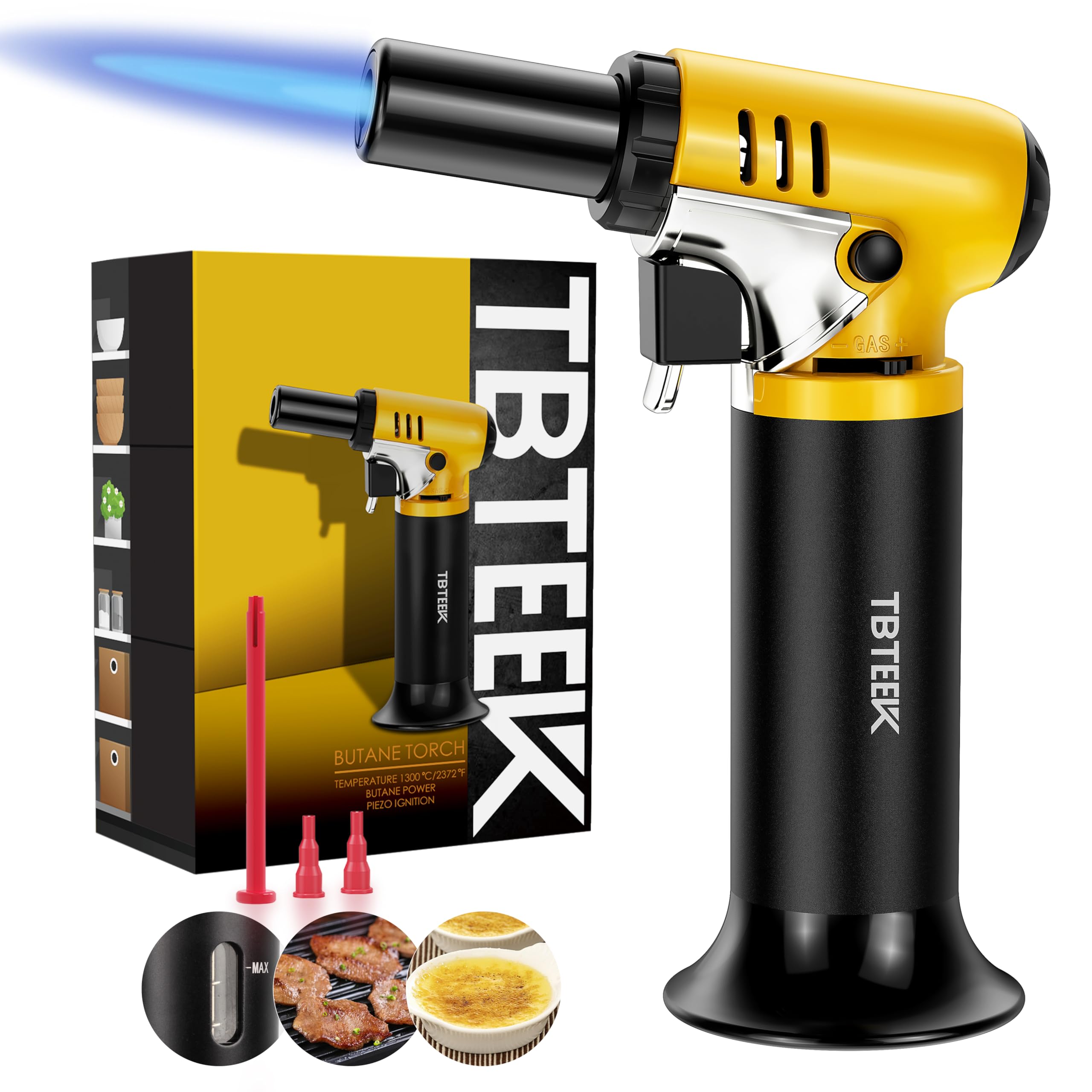
We filled it, slid the lock on, and kept the flame running while both hands were busy rearranging a pan — which is exactly the job this torch is built for. The nozzle is angled and extended, so the flame reaches past your fingers, and the lock holds it without any pressure from your thumb.

The clear fuel gauge on the side is the detail that keeps it useful. You can see the level before you start, which matters more on a torch this size because a small tank empties faster than you expect. Three nozzle adapters come in the box and cover both long- and short-nozzle butane cans, and the aluminum body is light enough to forget about in a drawer.

Where it is less consistent is the flame itself. Between fills it can come back weaker or broader than it was, and we have had to reset the dial each time rather than trusting the mark. That is the price of a torch this small and this inexpensive; the gauge and the grip still make it the one we leave within reach.

Bottom line: A clear fuel window, a one-hand grip, and a lock that lets you work two-handed. The torch we keep within reach in the kitchen.

Check Latest Price
#07

Small kitchen jobs

Semlos S-907

89 /100
Kirk Score Excellent
Base
Broad, stand-up base
Weight
7.05 oz
Fuel Gauge
Built-in
Max Temperature
2,372 °F
Check Details on Amazon

Pros

  • Stands upright on a broad base
  • Built-in fuel gauge
  • Multi-step flame dial
  • Takes any brand of butane can

Cons

  • Lock lever feels fragile

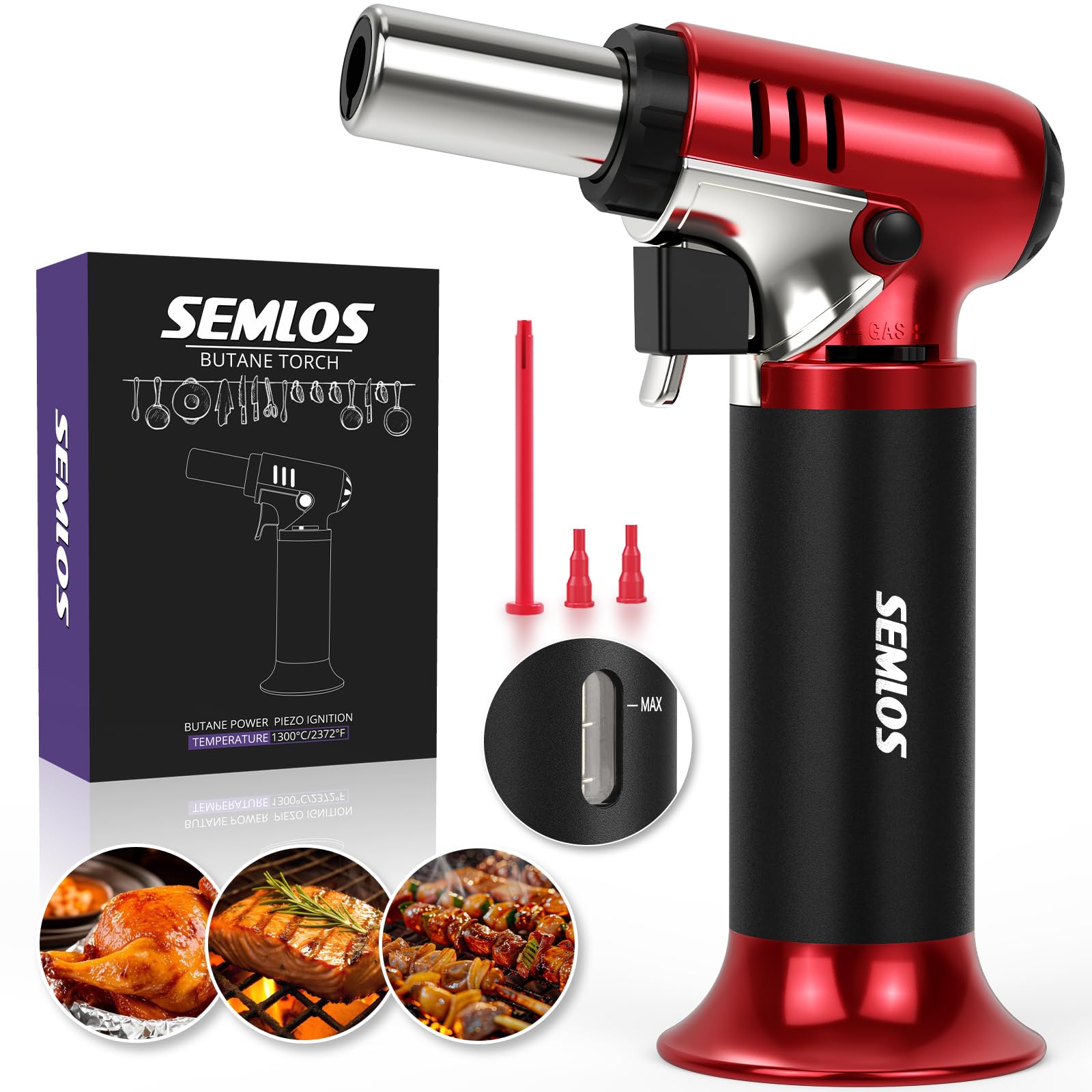
The red paint is what keeps this one out on the counter. Semlos finishes the S-907 in a candy red that stands out on a cluttered workbench or a dark countertop, which sounds like a small thing until you have spent ten minutes looking for a black torch under a pile of fabric.

It stands well, too. A broad base keeps it upright while you reach for something else, the fuel gauge on the body lets you check the level at a glance, and the dial gives several clear steps between low and high rather than one vague sweep. The continuous flame mode means you can set it going and use both hands for a moment.

Among the small kitchen torches here, this is the one that has given us the least trouble lighting — press and it goes, without the second or third click that dogs this category. The flame is closer to a strong lighter than to a tool torch, which is fine for sugar, wax, and craft work and nowhere near enough for a steak.

Bottom line: The small torch that lit most consistently for us, in a body that stands steady on the counter.

Check Latest Price
#08

Larger kitchen jobs

RAVS RB7033A

88 /100
Kirk Score Excellent
Body
Metal, wide base
Weight
9.3 oz
Fuel Capacity
24 ml
Max Temperature
2,372 °F
Check Details on Amazon

Pros

  • Metal body with a wide, stable base
  • Long angled nozzle keeps the hand back
  • 24 ml tank, twice the Tencoz's capacity
  • Broad flame covers large surfaces quickly

Cons

  • Flame is too broad for small dishes
  • Ignition is less consistent than the tool torches

Nine and a third ounces is a lot of torch to hold over a dessert, and that is the first thing you notice about the RAVS. The body is metal, the base is wide enough to stand it on the counter without a wobble, and the long angled nozzle puts real distance between your knuckles and the flame.

The flame is broad and bold, and it covers a wide area quickly — a roast, a tray of gratin, a batch of peppers going black for a salsa. That is the shape of flame this torch was designed around, and it is why the body is as big as it is. The 24 ml tank is twice what the Tencoz holds, so a long pass over a big cut does not run it dry.

In the hand it feels like equipment rather than a gadget: metal, upright on its wide base, no rattle. It is the one here we leave out when something large needs browning, and the one we put away when the job is a single ramekin of sugar.

Bottom line: Broad flame, metal body, wide base: built for searing big cuts and covering ground fast, not for precise sugar work.

Check Latest Price

How We Tested 14 Butane Torches — and Refilled Every One

We started by pulling together every torch with a real following, then cut the list by what the specs actually promised: an adjustable flame, a trigger lock that holds without your thumb, a visible fuel gauge, and a nozzle long enough to keep a hand clear of the heat. We also weighed what came in the box — a stabilizing stand, a case, a second nozzle — because that's usually where value hides. That left 14 torches, ranging from pocket-size culinary models to heavier tools sold as soldering stations.

Each one lived with us for four months. In the kitchen we caramelized sugar on custard, watching for an even melt instead of a scorched patch, and seared steaks and peppers. Outside we lit charcoal chimneys and fire-pit tinder on breezy evenings; in the garage we ran solder joints on copper pipe and cured resin crafts. We counted ignition attempts — one click or five? — and noted whether the flame fluttered when the torch was tilted mid-task.

Every torch was refilled at least a half-dozen times so we could watch the valve: did fuel spray back, did it accept a full can, did the flame change afterward? We left each one burning for several minutes at a stretch to see whether the body got too hot to hold and whether the lock stayed put. A torch that needed a second hand to keep running, or that coughed and sputtered after a top-up, was out.

How to Choose a Butane Torch

Match the torch to the job, not the temperature

Almost every torch here claims a maximum somewhere between 2,370 °F and 2,700 °F, and that number tells you very little about how the torch behaves in your hand. What separates them is flame shape and how low they will go. A workshop torch like the LEXIVON or the Blazer throws a broad, stable flame you can leave burning on a bench; a kitchen torch like the Kollea gives you a smaller flame with a finger guard and a body light enough to hold over a ramekin.

If your work is heat shrink, wire splices and seized bolts, buy the tool. If it is sugar and craft resin, buy the kitchen torch — a tool torch is simply too much flame for a small target.

Flame control and the continuous lock

The dial on a cheap torch often has two usable positions: on and off. Better ones let you walk the flame down to a pinpoint, which is what you need for caramelizing sugar without scorching it, and out to a broad brush for searing. The Iwatani goes further and changes the shape of the flame, not just its size, which is why it costs more than the other culinary torches here.

A continuous-flame lock is a separate mechanism that holds the trigger open so both hands are free. It is also the first thing to wear out. Test the lock the day the torch arrives, and if you rely on it for long jobs, keep the receipt.

Fuel, canisters, and refilling

Nearly every torch here ships empty, so budget for a can of butane when you buy the torch. Small cans come with short or long nozzles, and the adapters in the box usually cover both — check the can matches before you commit to a multipack.

Tank size is the other half of the decision. The Tencoz holds 12 ml and wants topping up before a long session; the RAVS holds 24 ml. A small tank is not a fault, just a rhythm of refilling you get used to, and a visible gauge makes that rhythm much easier to plan around.

Ignition is the part that fails

The piezo igniter is what ends a torch's life. It is a small spring-loaded spark maker, and once it stops clicking the torch is a paperweight — relighting it off another flame is not a habit worth starting.

Buy from a maker that states a warranty, which here runs from 90 days to a year, and keep the receipt. The Blazer's ignition has been the most consistent of this group in our testing; if ignition reliability is the whole reason you are buying, that is where to spend.

Size, balance, and where it stays

Torches here run from 2.88 ounces to 1.3 pounds, and the difference decides where the thing lives. A light kitchen torch goes in a drawer and comes out for dessert; a heavier tool torch stays on the bench because you would rather not move it.

If you want a torch you will actually use weekly, pick one that stands up on its own base — the Blazer, the Iwatani, the Semlos — so you can set it down hot without clearing space on the counter first.

Frequently Asked Questions

Final Verdict

If we were buying one torch for a house that cooks, fixes, and crafts, it would be the Blazer GT8000. It lights when you press it, the anti-flare nozzle keeps the flame where you point it, and the clip-on base means you can put it down lit and use both hands. The trade is a short flame dial and a metal head that holds heat, neither of which has cost us a job.

Buy the Iwatani PRO2 instead if dessert is the main event and you want to shape the flame rather than just shrink it. For a bench that sees wire and heat shrink, the LEXIVON kit is the only one here built for it.