// data-verified

Best Painting Respirators of 2026

The trouble with painting fumes is that they don't announce themselves. I once spent an afternoon spraying cabinet doors in a garage, pulled off my mask at the end feeling fine, and then noticed the rag I'd used to wipe the lens smelled like lacquer thinner — which meant I'd been breathing it too. A respirator only does its job if it seals against your face, and a leaky one is sneaky: it feels like protection while it quietly isn't.

Over the past six months, my team and I have worn 12 respirators through sanding sessions, spray projects, and roll-on painting, and the differences come down to things you can't see in a product photo. Fit and seal matter more than anything printed on the box, but so do breathability on a hot afternoon, straps that stay where you set them, and whether the thing is still usable six months in. One thing nobody tells a first-time buyer: plenty of masks arrive without filters, so check the box contents and price the replacements before you commit — a cheap mask with pricey cartridges isn't cheap.

The picks below are the ones we kept reaching for, whether for a quick sanding job or a full weekend of spraying. If you're mostly working in a garage with the door up, you have different needs than someone painting inside a finished room, and there's a match for both down there.

#01

Best Overall

3M 6300 Half Facepiece

95 /100
Kirk Score Outstanding
Size
Large
Approval
NIOSH
In The Box
Facepiece and storage bag; cartridges sold separately
Cartridge System
3M 6000 Series gas/vapor and 2000 Series particulate
Check Details on Amazon

Pros

  • NIOSH approval covers it with 3M cartridges
  • Cheapest way into 3M's cartridge system
  • Comes apart for cleaning; storage bag included
  • Exhale valve keeps safety glasses clear

Cons

  • Cartridges and filters are sold separately

The box holds the facepiece and a reclosable storage bag, and that is the lot — no cartridges. It is the one surprise worth knowing before you order, because the cartridge is what turns this into a painting respirator. Set that aside and this is the cheapest way into a system we trust: NIOSH approval covers this facepiece used with 3M's own cartridges and filters, which is a stronger guarantee than a mask sold on the shape of its shell.

It is the large, and that detail decides more than strap tension does. A shell a size too big gaps at the nose bridge and along the chin, and hauling the harness tighter will not close the gap — it just presses the seal harder where it already touches. If your face runs short between the bridge of the nose and the chin, buy the same facepiece in a smaller size rather than fighting this one.

What we noticed on the job: the exhale valve pushes breath down and away, so safety glasses stayed clear, and the adjustment points sit on the facepiece itself, which keeps the harness out of the way of glasses and a cap. It comes apart for cleaning, and the storage bag is a small thing we ended up using more than expected — a dusty seal is a leaking seal. Order a pair of 6000-series organic-vapor cartridges with the mask, plus a pair of particulate filters if you are sanding between coats.

Bottom line: Buy this one if you want proven fume protection without paying for extras — just order the cartridges in the same breath as the mask.

Check Latest Price
#02

Best Kit for Occasional Painting

AirGearPro G-500

93 /100
Kirk Score Outstanding
Weight
3.25 oz
Filtration
A1P2 vapor and particulate
In The Box
Mask, A1P2 filters, safety goggles
Certification
CE
Check Details on Amazon

Pros

  • Cartridges and goggles included in one order
  • A1P2 covers vapor and particles together
  • Light shell for longer sessions

Cons

  • Goggles will not fit over prescription glasses
  • One shell size, adjusted only by straps

One order gets you the mask, a pair of A1P2 cartridges, and safety goggles. That bundle is the whole argument for this one. The A half of the filter class handles solvent vapor, the P half handles overspray and sanding dust, and you are not making a second decision about which cartridge fits which mask.

For weekend painting and a house full of trim, that is enough, and it is what we would hand someone who does not want to research cartridge compatibility. The certification named on the box is CE rather than NIOSH, which is fine for home projects; if the painting is paid work that falls under an OSHA program, one of the 3M masks is the correct choice instead. Filters are replaceable, so the shell keeps working after the cartridges are spent.

Fit comes down to the elastic straps, and there is one shell size, so spend a minute on the two lower straps before you start spraying rather than after. The mask itself is light at 92 grams, which matters more the longer the job runs, and the strap range is wide enough to seat it on a big head or a small one. The goggles are the weak link if you wear glasses — they do not go over a prescription frame, so plan on your own safety glasses.

Bottom line: The one to grab if you would rather not research cartridges: the mask, the vapor filters, and the goggles all arrive together.

Check Latest Price
#03

Best Full-Face for Spraying

3M 6800 Full Facepiece

94 /100
Kirk Score Outstanding
Size
Medium
Approval
NIOSH
Eye Protection
ANSI Z87.1-2010 high impact lens
Cartridge System
3M 6000 Series gas/vapor and 2000 Series particulate
Check Details on Amazon

Pros

  • ANSI Z87.1 high-impact lens replaces goggles
  • Wide lens stays clear while you work
  • Silicone seal comfortable over long sessions
  • Takes 3M's full cartridge and supplied-air range

Cons

  • Straps and clips can fail before the shell does
  • Heavier and warmer than a half mask

A full facepiece does two jobs at once: it seals your airways and it covers your eyes, and the lens on this one meets ANSI Z87.1's high-impact level, so it stands in for safety glasses rather than fitting behind them. If you are spraying overhead — ceilings, cabinet interiors, anything that points the gun up at your face — that is the difference between finishing the job and rinsing paint out of your eye.

The view is what we would argue for. A single wide lens with the airflow directed across the inside of it stays clear, and there is no gap between mask and goggles for overspray to sneak through. It takes the same 6000-series cartridges and 2000-series filters as the half masks, and it is compatible with 3M's powered-air and supplied-air systems if a large job ever justifies one.

The cost is obvious and so is the weight. A full facepiece runs several times the price of the half mask, it is more mask to wear for an afternoon, and while it is on you are looking through its visor rather than your own glasses. What holds up is the silicone seal and the shell itself; the straps and clips are the parts that give out first. For a spraying-heavy project it is still the pick that stops you improvising eye protection.

Bottom line: Worth the leap if you spray overhead or work in a fog of overspray, since it protects your eyes and lungs in a single sealed unit.

Check Latest Price
#04

Occasional spraying

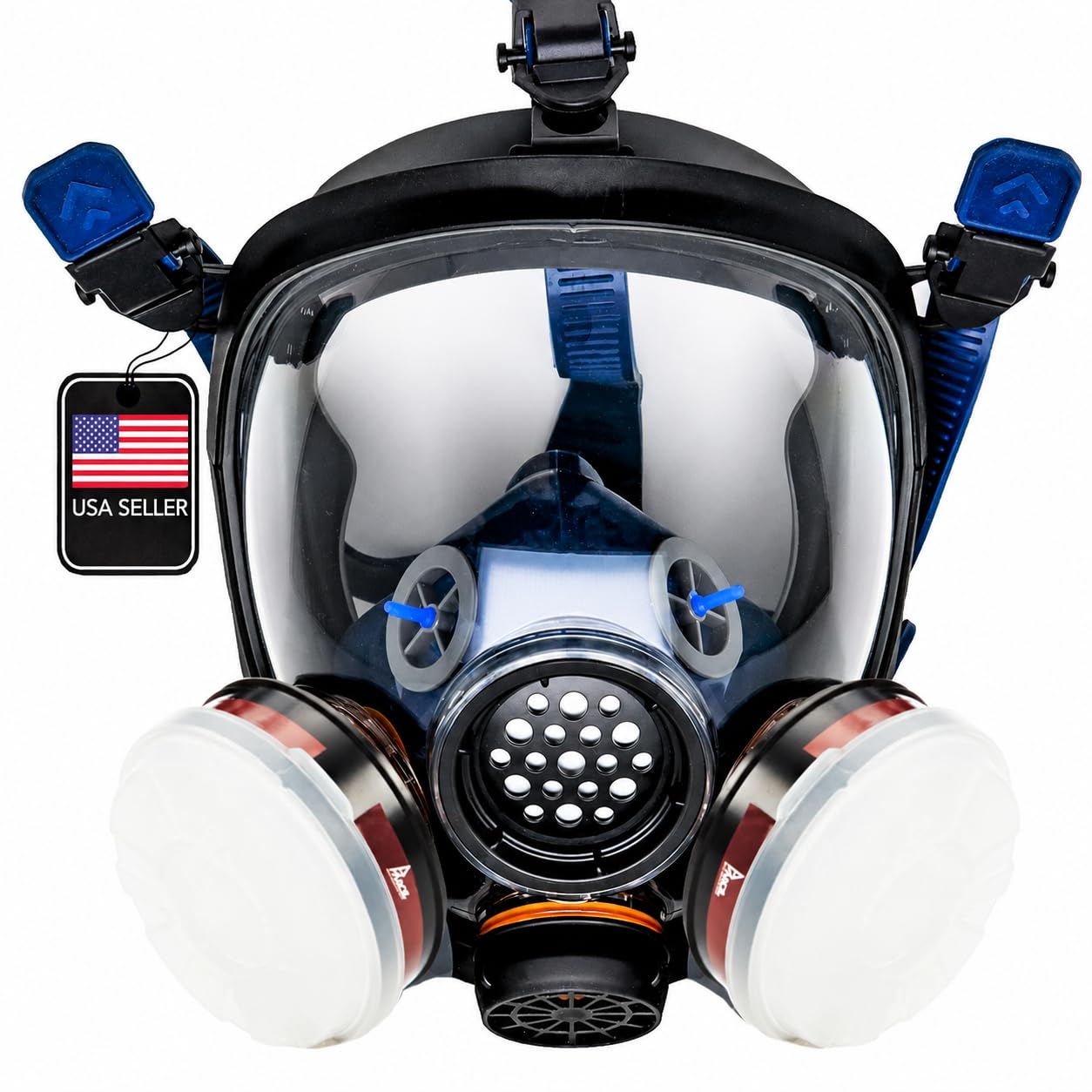
Parcil Full Face Respirator

92 /100
Kirk Score Outstanding
Coverage
Full facepiece
Filtration
Organic vapor and particulate
Certification
CE tested
Check Details on Amazon

Pros

  • Full-face coverage for less than the 3M
  • Stays clear in humid working conditions
  • Wide field of view through the lens
  • Comfortable enough for extended wear

Cons

  • Straps work loose and need re-tightening

The view out of this one is what we would mention first — a full facepiece wide enough that you are not turning your head to find the edge of the lens. The housing is CE tested for organic vapor and particulate, and it keeps the inside clear. Fog resistance is the strongest thing about it in this group, which is exactly what you want in a steamy garage.

It is a full-face mask for slightly less money than the 3M 6800, and that is the honest reason it is here: the same coverage and a clear lens without the premium. The seal runs around the whole face rather than just the nose and mouth, so there is more edge to seat before you start, and a full facepiece sitting crooked feels perfectly fine while it protects badly. Seat it, check it, then pick up the gun.

Comfort holds up over a long session — the shell sits wide of your mouth and nose, so nothing presses into your face, and the exhale path keeps the lens clear without a fan. That last part is no small thing two coats in, when the garage has gone steamy and every other mask you have owned has fogged at the worst possible moment.

Bottom line: A comfortable, genuinely fog-free full face for occasional spraying if the 3M price is more than your project justifies.

Check Latest Price

How We Tested Painting Respirators

We started with a list of roughly 40 masks sold for painting and sanding, then cut anything without replaceable filters, anything where the cartridges were pictured but not included, and anything whose replacement filters were hard to find or priced close to the mask itself. That left 12 respirators in half-face and full-face styles, which we wore over six months of real projects: spraying lacquer and polyurethane, sanding drywall patches, and painting two bedrooms with an oil-based trim enamel.

Seal and fit got the most scrutiny, because everything else is secondary if air gets in around the edges. We did a simple smell check with a rag soaked in mineral spirits held near the seal, ran each mask through two-hour sanding sessions, and noted who fogged their safety glasses and who didn't. We also counted how many strap points each harness had, how much adjusting it took to stop a leak, and how the mask behaved on both narrow and wide faces.

Breathability we judged by feel rather than spec sheets — how hot the mask got under a garage door in July, whether the exhalation valve kept the lens clear, and how quickly we wanted it off. For comfort and strap tightness, we looked for red marks after an hour and whether the straps crept loose while we were looking up at a ceiling. Durability came from living with them: rinsing lenses, swapping cartridges, and watching whether the straps stretched or the valves started flapping. Value, finally, meant the cost of the mask plus the filters it would burn through in a year.

How to Choose a Painting Respirator

Vapor and Dust Are Two Separate Jobs

Paint puts two things into the air. Solvents evaporate off the can and the wet film, and that is the vapor an organic-vapor cartridge handles. Sanding cured paint and spraying any paint throws fine particles, which need a particulate filter. A valved dust mask only does the second half, however comfortable it feels — solvent goes straight through it.

So look for a cartridge that names both, or an organic-vapor cartridge with a particulate prefilter clipped over it. Match the effort to the product: brushing a low-odor wall paint in a ventilated room is a different exposure from spraying lacquer in a closed garage, and a spray gun is what pushes most people into a combination cartridge or a full facepiece. If you can smell the solvent through the mask, the cartridge is spent or the wrong class.

Half Mask or Full Face

A half mask covers nose and mouth and leaves your eyes to safety glasses. It is lighter and cheaper, it lets you talk, and it is the right answer for brushing, rolling, and sanding. A full facepiece pulls your eyes into the same sealed system, which is what you want when you are spraying overhead or standing in a cloud of overspray — the 3M 6800's lens carries ANSI Z87.1 high-impact protection, so it replaces your goggles instead of fitting behind them.

The trade is weight and money. A full facepiece costs several times what a half mask does, and while it is on you are looking through its visor rather than your own glasses. If you spray occasionally with the gun below eye level, a half mask plus a decent pair of goggles covers the same ground for far less.

Fit Is the Part You Cannot Buy Your Way Out Of

A tight-fitting respirator protects you only where the seal meets skin. Hair under that edge — a beard, or a few days of stubble along the jaw — gives vapor a path around the cartridge, and so does a shell that is the wrong size. Sizing is not a comfort question: the 3M 6300 we recommend is the large, and a narrower face is better served by the same facepiece in a smaller size than by a tighter harness.

Check the seal every time you put it on. Cover the cartridge inlets with your palms and breathe in gently; the facepiece should pull in against your face and hold. If it leaks, reseat it and tighten in small steps, then try again — and if it still leaks, the mask is the wrong shape for your face rather than a bad mask.

Kit or Facepiece, and the Cost of Keeping It Running

You can buy the whole protection in one box or build it yourself. The AirGearPro G-500 arrives with cartridges and goggles; the 3M masks arrive as a bare facepiece and you choose the cartridge for the job. The kit is simpler and cheaper to start with. The bare facepiece is the better long-term buy if you will paint more than once, because the shell outlasts several sets of cartridges and you can switch between a vapor cartridge for painting and a particulate filter for sanding on the same mask.

Either way, price a spare pair of cartridges before you commit — that is the recurring number, and it decides whether a cheap mask is actually cheap. Store the facepiece so the seal is not crushed under a toolbox, and leave spare cartridges sealed until you need them.

Frequently Asked Questions

Final Verdict

For most people painting at home, the 3M 6300 with a pair of organic-vapor cartridges is the buy: NIOSH approval covering the facepiece and cartridge together, a seal that adjusts to a range of faces, and a shell that comes apart for cleaning and outlasts the paint job. Order the cartridges in the same breath as the mask, or you will be looking at a very good mask you cannot wear.

Two situations change the answer. If you want one box with everything in it, the AirGearPro G-500 arrives ready to spray, goggles included. If you are spraying overhead or working in a garage full of overspray, spend the difference on the 3M 6800 — that lens is doing eye protection your safety glasses cannot.