// data-verified

Best Drop Cloths for Painting of 2026

Nobody tells you before the first roller comes out of the tray that the drop cloth matters more than the brush. Canvas drinks up drips and grips the floor, but a skimpy one lets paint wick straight through to the hardwood. Plastic keeps everything out, then slides under your ladder and splits along the fold.

I've learned both lessons the hard way, once on a floor I'd just refinished. Over the past four months, my team and I spread 16 drop cloths across real jobs: a living room repaint, a garage cabinet refresh, a basement workshop, a hallway where the ladder moved six times in one weekend. Weight and weave turned out to matter more than brand — the ounce rating on a canvas tells you more than the words "heavy duty" on the package, and 8-ounce and 10-ounce fabrics behave like different products.

Below are the ones that earned a permanent spot in the paint bucket, from a heavyweight canvas you'll keep for years to a plastic sheet you'll happily throw away.

#01

Best Overall

Salt Earth Canvas Drop Cloth 9x12

93 /100
Kirk Score Outstanding
Size
9 x 12 ft
Weight
6.56 lb
Material
Recycled cotton canvas
Check Details on Amazon

Pros

  • Heaviest 9x12 canvas here; lies flat and stays put
  • Absorbs splatter without paint reaching the floor
  • Dense, tightly woven cotton that survives washing

Cons

  • Heavy and bulky to unfold and store

At 6.56 pounds, this is the heaviest 9-by-12 cloth in the group, and the CCS at the same footprint lists roughly two and a half pounds less. That difference is the review. Heavy cotton drops flat instead of ballooning, it stays under your feet as you work along a wall, and there's enough fiber between a drip and the floor to swallow it. Unrolling it takes a minute; the payoff is a floor cover that behaves like a floor cover.

Paint is where the canvases here divide, and this one came out on the good side: the tight recycled-cotton weave soaked up splatter and the occasional spill without anything reaching the boards underneath. It's still cotton and not a waterproof membrane, though, so a quart left pooling in one spot will wick through eventually. Blot a spill while it's wet, and roll out a plastic sheet under the cloth if you're spraying.

One cloth is what you get, so measure the run you're covering rather than the room's square footage. A single 9-by-12 handled the floor and the baseboard line in the room we used it in with cloth to spare; a long hallway plus a bedroom needs two. It's washable, and that's what makes the outlay make sense across a few repaints rather than one.

Bottom line: We reach for this one first: 6.5 pounds of recycled cotton that soaks up drips, lies flat underfoot, and held paint better than any other canvas in this group.

Check Latest Price
#02

Best for Draping Furniture

CCS Canvas Drop Cloth 9x12

93 /100
Kirk Score Outstanding
Size
9 x 12 ft
Weight
4 lb
Material
Cotton duck
Finished Size
8 ft 6 in x 11 ft 6 in
Check Details on Amazon

Pros

  • Light duck that drapes cleanly over furniture
  • Finished measurement printed on the listing
  • One-piece cloth with double-stitched hems

Cons

  • Slides on bare floors without tape

The number to read on this listing is 8 feet 6 inches by 11 feet 6 inches, the finished size once the hems are turned, not the 9-by-12 in the title. CCS prints both, which is more than most listings do, and it explains why the cloth reads short when you open it out on a 9-by-11 floor: you've been given exactly what was described. Measure your longest run against the finished figure and there's no surprise on the day.

Four pounds of cotton duck across 108 square feet is light, and light is the point. This is the cloth we reach for to cover furniture: it drapes over a sofa back, a dresser, or a bookcase without sliding off, and it's easy to flip from one side of a room to the other as you work around it. The hems are double-stitched and the cloth comes as one piece rather than panels sewn together, so nothing catches on a corner and tears.

It's an absorbent cloth, not a barrier, and that's the honest framing. Roller spatter, a knocked brush, sanding dust, and the general mess of a repaint land on it and stay there. What it won't do is hold a puddle. If you're pouring from a can or spraying, put a plastic sheet down first and lay this on top and you get absorption and waterproofing in one setup.

Bottom line: We like it most for draping furniture: a lighter cotton duck that one person can throw over a bookcase, with hems that survive being dragged around a job.

Check Latest Price
#03

Best Two-Pack

Dirt Defense Canvas Drop Cloth 2-Pack

94 /100
Kirk Score Outstanding
Size
9 x 12 ft
Fabric Weight
8 oz duck
Cloths Per Pack
2
Check Details on Amazon

Pros

  • Two finished-size 9x12 cloths for multi-room work
  • 8-ounce duck stays put on the floor
  • Lowest cost per square foot of the big canvases
  • Double-stitched edges and seams hold up

Cons

  • A center seam runs through each cloth

Two cloths change how a job runs, not just how much floor you cover. One goes down on the floor while the other covers the sofa, the bed, or the TV, and neither has to be dragged through a wet doorway to do both jobs. Both sheets are 9-by-12 and both are cut to the finished measurement, so the 108 square feet per cloth is cloth you can actually use.

Eight-ounce duck isn't the heaviest fabric here, but a 9-by-12 at that weight sits down on a floor and stays there. It took a morning of roller work and a knocked-over tray without a spill reaching the boards, and the double-stitched edges and seams came through being hauled over a threshold and up a step ladder. What we noticed most is how little attention it needed: lay it out, walk on it, fold it up.

Value is the other half of it. Two 108-square-foot cloths land at the low end of this group per square foot, and the edges are finished properly, so they're not a false economy. For a renovation where the floor is down for weeks, or a repaint that moves from room to room, this is the pair that keeps two work areas protected at once.

Beige earns its keep in a way that's easy to miss: a mid-tone cloth shows a fresh drip while it's still wet, so you wipe it up instead of finding it cured into the weave a week later. Between that and the second sheet, the pair is worth the shelf space it takes.

Bottom line: We hand this pair to anyone painting more than one room: two big cloths so the floor and the furniture can be covered at the same time.

Check Latest Price
#04

Best for Stairs

CoverGrip Safety Drop Cloth 3.5x12

95 /100
Kirk Score Outstanding
Size
3.5 x 12 ft
Backing
Rubberized grip dots
Fabric Weight
8 oz canvas
Check Details on Amazon

Pros

  • Rubberized dots grip stairs and polished floors
  • Holds its fold over the nose of a tread
  • Machine washable without losing grip

Cons

  • Priciest cloth here per square foot

Stairs are where drop cloths fail. A flat sheet on a tread slides off the nose or bunches under a foot, and the person who finds out is the one coming down with a full tray. This one has thousands of tiny rubberized dots bonded to the underside: put weight on the cloth and they grab, and the fabric holds its fold over the nose of a step instead of flattening out. We laid it on a painted staircase and it stayed where it was put without a strip of tape anywhere.

At 3.5 by 12 feet it's a runner rather than a room cover, which suits a flight of stairs, a hallway, or the path between the door and the work area. The 8-ounce canvas is on the thinner side, so treat it as a splatter catcher and a footing aid rather than a waterproof barrier. A full spill can reach the floor beneath it, and that's where a plastic sheet under the canvas earns its keep.

The dots are the part we expected to wear. They're bonded rather than printed, they don't scrape off on grit or concrete, and the cloth goes through the washing machine and comes out still grippy. It's the most expensive cloth here per square foot, and for a hallway you have to keep walking through while the paint dries, that's money well spent.

Bottom line: The one we put on a staircase: rubberized dots on the back grab the treads so nobody carrying a tray finds out the hard way.

Check Latest Price
#05

Best Waterproof Layer

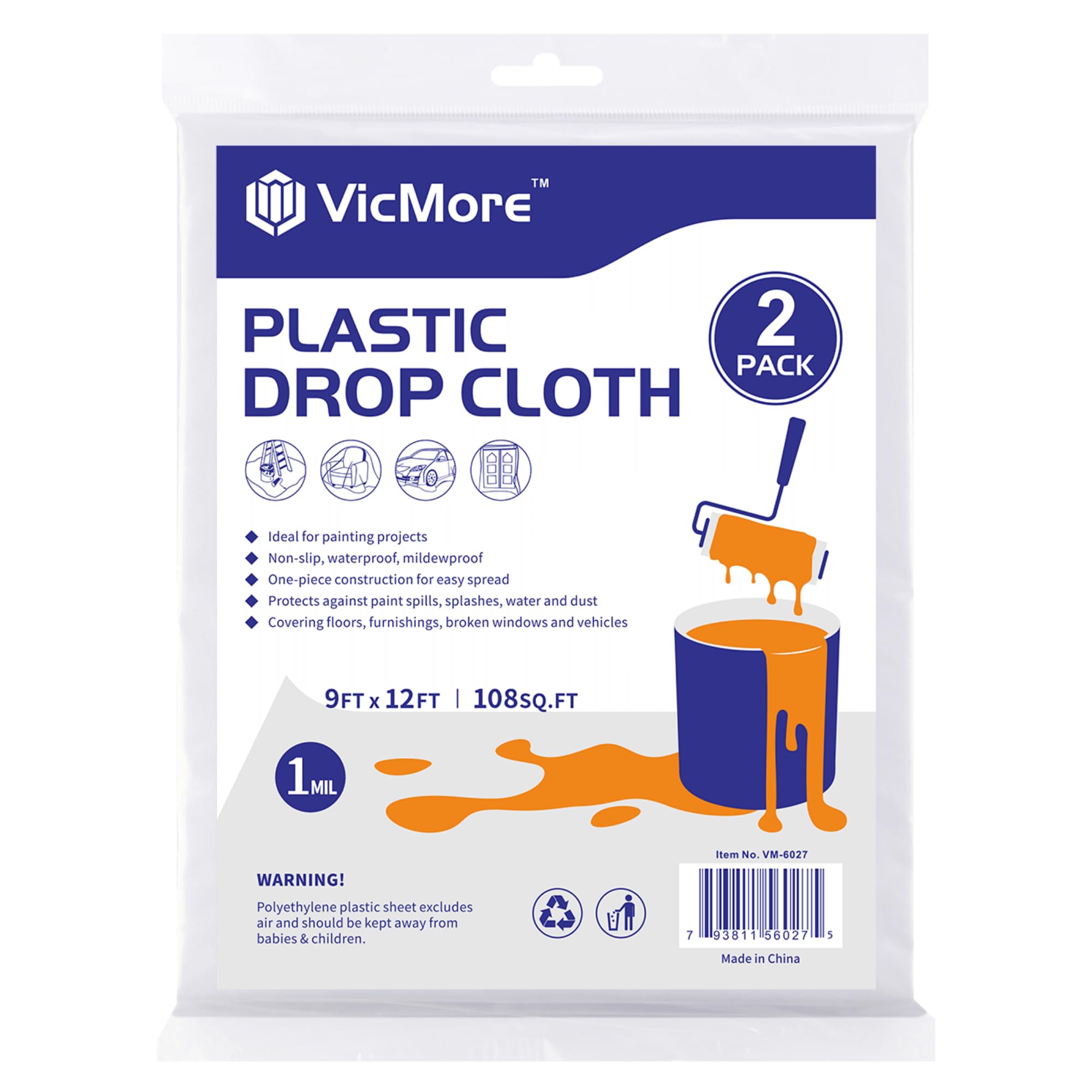
Vicmore Plastic Drop Cloth 2-Pack

93 /100
Kirk Score Outstanding
Size
9 x 12 ft
Thickness
1 mil
Waterproof
Yes
Sheets Per Pack
2
Check Details on Amazon

Pros

  • Waterproof barrier under canvas or over furniture
  • Two 9x12 sheets, 216 square feet total
  • Clear film keeps the floor visible

Cons

  • 1-mil film clings, wrinkles, and lifts in a draft

One-mil polyethylene isn't a drop cloth you keep for a decade, and it isn't trying to be. What it does is stop liquid. Lay it under a canvas cloth on a floor, drape it over a sofa while you cut in around the trim, or tape it across a doorway to keep sanding dust out of the next room. Two 9-by-12 sheets give you 216 square feet, enough to protect a floor and still have one in reserve.

Setup is the whole technique. Two hands to spread it, tape on the corners you can reach, and don't drag furniture across it, because the film is there to catch liquid rather than take weight. In exchange you get the one thing no canvas here offers, a waterproof barrier, at a fraction of the cost per square foot of any cloth in this guide.

The transparency is more useful than it sounds. You can see the floor through it, so a dropped screw or a chip of trim doesn't disappear, and you can check whether a spill has crept under an edge. Fold it rather than crumple it at the end of the day and it goes back in the bag for the next room.

Bottom line: The sheet that does what canvas can't: waterproof polyethylene for under a cloth or over a sofa, with two in the pack for one job's worth of mess.

Check Latest Price
#06

Best for Touch-Ups

Trimaco SuperTuff 10 oz Canvas 4x5

95 /100
Kirk Score Outstanding
Size
4 x 5 ft
Origin
Made in the USA
Fabric Weight
10 oz canvas
Check Details on Amazon

Pros

  • 10-ounce canvas, the heaviest fabric here
  • Lies flat without tape at this size
  • Small enough to wash, dry, and store easily

Cons

  • Too small to cover a room

Four by five feet is the size that solves the jobs a 9-by-12 is too much for: the cabinet you're repainting, the sill, the shelf that's come down to the garage. Ten-ounce canvas is the heaviest fabric in this guide, and at this size the weight is a benefit rather than a chore. The cloth lies flat without tape, and a spilled cup of water beads on it instead of running off the edge.

It's still canvas, so it absorbs splatter and small drips and will let a puddle through. Working from an open can, put a flattened box or a scrap of plastic underneath. The 4-by-5 cut is also small enough to wash and dry without a fight, which matters more than it sounds when you're cleaning up at the end of a long day.

Where this earns a permanent spot is repeatability. It's machine washable, it dries fast at this size, and it lives in the same crate as the rollers, so it actually gets used. For touch-ups, a small canvas you reach for beats a big one you leave folded in the garage.

Bottom line: We keep one of these with the brushes: 10-ounce contractor canvas in a size that fits a stair landing, a windowsill, or the top of a dresser.

Check Latest Price
#07

Furniture and tables

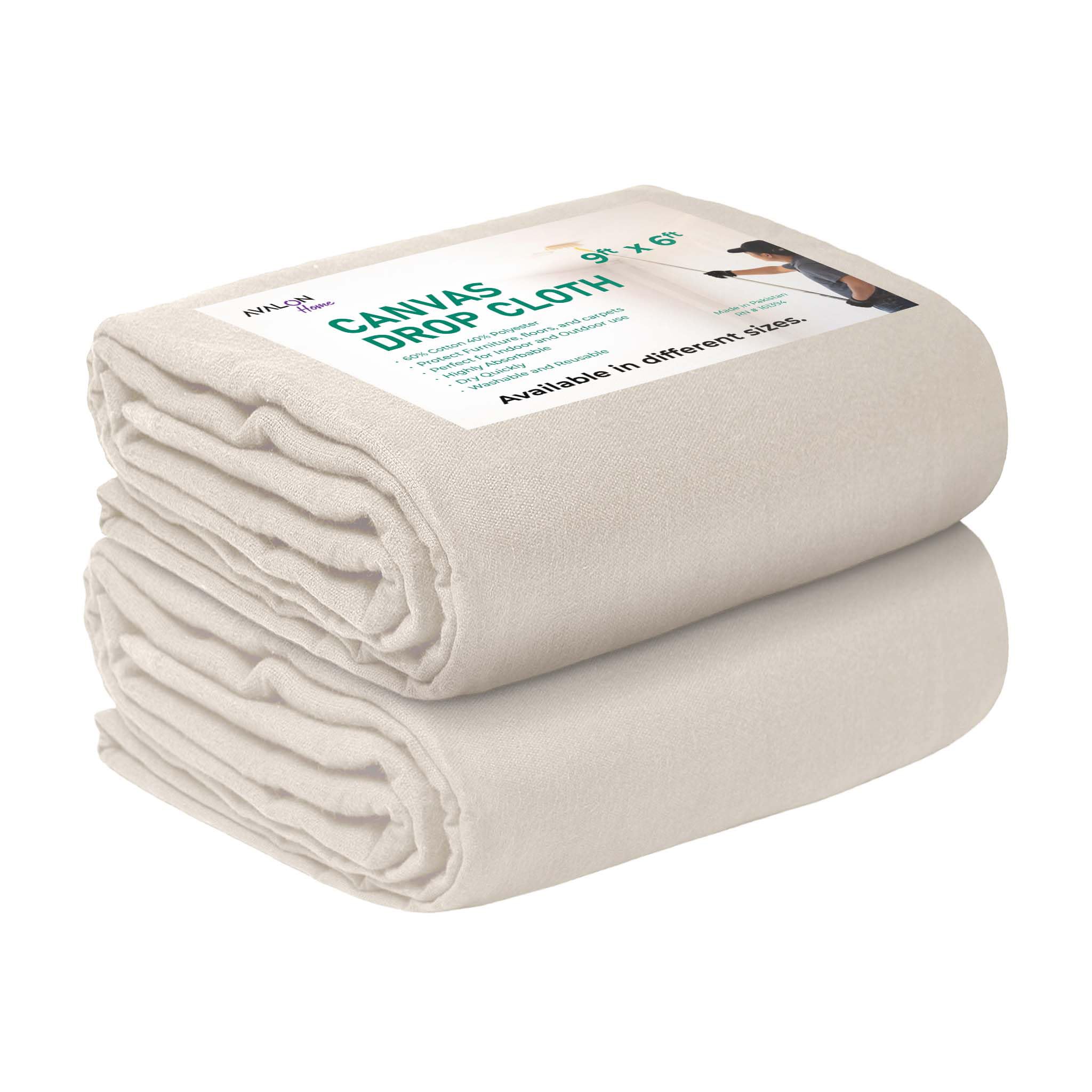
Avalon Home Canvas Drop Cloth 2-Pack

90 /100
Kirk Score Outstanding
Size
9 x 6 ft
Weight
5.9 lb
Fabric Weight
8 oz
Cloths Per Pack
2
Check Details on Amazon

Pros

  • 9x6 size fits furniture better than a room sheet
  • Two cloths cover furniture and floor at once
  • Light enough to drape one-handed

Cons

  • A heavy spill can soak through the light duck

A 9-by-12 is more cloth than a dresser needs. Nine by six is the size that matches furniture: it goes over a dining table and down the sides, covers the seat and back of a sofa, and hangs over the front of a bookcase without pooling on the floor around it. You get two, so one covers the furniture while the other takes the floor in front of it.

The duck is lighter per square foot than the big 9-by-12 cloths here, and that's exactly what makes it drapeable: you can flip one of these over a sofa back one-handed and pull it straight again without walking around. For roller work and brush touch-ups around furniture, it's absorbent enough for the job it's being asked to do.

Five-point-nine pounds for the pair makes these the easiest cloths here to move between rooms, and the lighter fabric means they go through the wash without a wrestling match. Tape the edge nearest your work area and the lightness stops mattering. For a living room where the furniture stays put and gets covered rather than carried out, this pair does the job without a 9-by-12 in the way.

Bottom line: We keep coming back to the 9-by-6 format for furniture: two drapes that go over a table or a sofa more easily than a full room sheet.

Check Latest Price

How We Tested 16 Drop Cloths on Real Paint Jobs

We built the shortlist from roughly 40 drop cloths pulled from listings and customer reviews, then filtered by material, weight class, actual footprint, and price. That meant cotton canvas in the 8- to 10-ounce range on one side and thin polyethylene sheeting on the other, in sizes from a small 4-by-5 furniture cover up to a 9-by-12 floor sheet. Sixteen made the cut and came home with us for four months.

Testing happened where painting actually happens: a living room repaint with the furniture pushed into the middle, a garage cabinet refresh, a basement workshop, and that hallway with the constantly moving ladder. To compare paint resistance, we poured a quarter-cup of latex onto each cloth and watched whether it beaded on the surface or wicked straight in; ten minutes later we pressed a paper towel underneath to see what had come through. Absorbency got the same spill-and-timer treatment at a smaller volume, and we noted which cloths let a puddle sit on top versus pulling it down into the weave.

We shuffled across each one in socks and in paint-flecked shoes, dragged a stepladder over the surface, and noted which bunched into tripping folds and which stayed flat underfoot. Seams and hems got pulled and flexed by hand, then re-checked after the washable ones went through a machine cycle — we looked for skipped stitches, fraying, and shrinkage that turned a 9-by-12 into something smaller. Thickness we judged by how each cloth felt under a ladder foot and whether the foot punched through.

Every cloth was reused across at least two jobs, folded, unfolded, and stored, since durability and value only reveal themselves on the second or third weekend. We also measured each one against its listed dimensions and tried folding it solo, because a cloth you can't handle alone isn't much use halfway through a project.

How to Choose a Drop Cloth for Painting

Canvas or Plastic, and Why the Answer Is Often Both

Canvas is absorbent, heavy enough to lie flat, and reusable, so a drip lands in the weave instead of skating across a slick surface. Plastic is waterproof and weightless per square foot, which also means it clings, wrinkles, and slides. Neither is the wrong choice, because they solve different halves of the same problem.

Our habit for anything wetter than roller spatter is a plastic sheet down first with a canvas cloth over the top. The plastic stops liquid, the canvas stops you sliding and holds splatter where it fell. If you're spraying, cutting in over a wood floor, or working from an open can, that two-layer setup is worth the extra two minutes.

Fabric Weight Is What You Feel Underfoot

Canvas is sold by weight per square yard, and 8 to 10 ounces is the contractor range. Heavier cloth lies flatter, absorbs more before anything reaches the floor, and doesn't creep when you walk across it. It's also a two-handed job to unfold and a bulkier thing to store between projects.

Match the weight to the job. A floor in a busy room wants the heavier cloth; furniture, cabinet tops, and anything you drape overhead is easier with a lighter duck that folds around corners. If you're buying a single cloth to do everything, take the heavier one and accept the folding.

The Size on the Label Is a Cut Size

A 9-by-12 drop cloth is cut at 9 by 12 feet and hemmed afterwards, so the cloth you actually spread out is smaller; CCS prints its finished measurement as 8 feet 6 inches by 11 feet 6 inches. Wash it hot and dry it hot and cotton gives up another inch or two. Measure the longest run you need to cover and buy against the finished figure, not the headline one.

One 9-by-12 covers roughly 108 square feet, enough for most single-room floors with a little to spare but not enough to run down a hallway and around a corner. Two cloths are more useful than one big one when you're working alone: one on the floor, one over the furniture.

Stairs and Hallways Are Where Cloths Slip

A cloth on a flat floor stays put by weight alone. On a staircase or a polished hallway it doesn't: the fabric slides off the nose of a tread, bunches underfoot, and the person carrying a tray is the one who finds out. Tape helps on bare wood, but tape doesn't hold on carpet or on a freshly painted step.

A grip-backed cloth solves it properly. CoverGrip bonds thousands of rubberized dots to the underside, so the cloth grabs once weight lands on it and holds its fold over a tread. If your work is mostly stairs and landings, a runner with a grip backing is worth more than another square yard of canvas.

Frequently Asked Questions

Final Verdict

Buy the Salt Earth 9-by-12 if you want one cloth that covers a room's floor, swallows a spill, and stays where you put it. Its 6.56 pounds is the reason it works, and that weight is the difference we noticed most against the lighter cloths here.

If your work is on a staircase or a hallway you have to keep walking through, the CoverGrip runner is the better tool and the extra cost per square foot buys footing. For spraying, open cans, or anything wetter than splatter, put a Vicmore plastic sheet underneath whichever canvas you choose.