// data-verified

Best Cordless Routers of 2026

The cord is the part of a router nobody thinks about until it drags across a finished edge or snags the corner of a benchtop halfway through a pass. Cordless routers get rid of that nuisance, then hand you a new set of worries: enough power to bury a half-inch roundover in oak, a base that stays exactly where you locked it, a battery that doesn't quit two hinge mortises from done. I've spent the past eight months running ten of them through actual trim and cabinet work to figure out which of those worries are real.

Here's what I wish someone had told me sooner: the spec sheet sells power, but the difference you feel every single day is in the depth adjustment. A sloppy rack, a lock that creeps a few thousandths under vibration — that ruins more work than a slightly weaker motor ever will. Most of these are bare tools, too, so the honest first question is which battery platform you're already invested in. The picks below are the ones that stayed set up and kept cutting clean.

#01

Best Overall

DEWALT DCW600B

96 /100
Kirk Score Outstanding
Weight
2.6 lb
Voltage
20V
Base Type
Fixed
Max Speed
25,500 rpm
Check Details on Amazon

Pros

  • Compact 2.6-lb body is easy to steer one-handed
  • Soft start and electronic brake smooth each cut
  • 25,500 rpm and variable speed cover 1/4-inch bits
  • Runs on DEWALT 20V Max batteries

Cons

  • Fixed base only; no plunge base in the box

At 2.6 pounds, the DCW600B is the router we reach for when the job is a few hinge mortises or a roundover, not a full afternoon in the shop. The fixed base sits low and the body is narrow enough to steer with one hand, and the soft-start motor spools up without the little jump that makes a trim router feel twitchy. The electronic brake is the detail we notice most between cuts: the bit slows quickly enough that we are not waiting on it before setting the tool down.

Power is more than adequate for 1/4-inch bits. The 25,500-rpm top speed and variable-speed dial let us slow down for a wider bit or speed up for a clean edge in softwood, and the dual LEDs cast light right at the bit. It is not a heavy stock-removal router, so deep, repeated cuts take more planning than they would with a plunge model. For trim work, that is the right trade: the lighter body is easier to control at the end of a long edge.

The bare-tool package is the other thing to plan for: no battery or charger, so factor those in if you are not already on the 20V Max platform. With a larger pack, the balance still feels good in the hand, and the tool is ready for a full trim session rather than a quick pass. If you want one router for both trim and deep plunge cuts, the DEWALT DCW620B is the better fit.

Bottom line: We recommend the DCW600B as the cordless router most woodworkers will reach for: compact, smooth-starting, and powerful enough for 1/4-inch work.

Check Latest Price
#02

Best for Hardwood

Milwaukee 2723-20

96 /100
Kirk Score Outstanding
Voltage
18V
Base Type
Fixed
Horsepower
1.25 hp
Speed Range
10,000–31,000 rpm
Check Details on Amazon

Pros

  • 1.25 hp and 31,000-rpm top speed for hardwoods
  • Widest speed range in this set
  • Comfortable compact body with 1.5-inch macro adjustment
  • Shares Milwaukee 18V batteries

Cons

  • Depth setting can creep during cuts

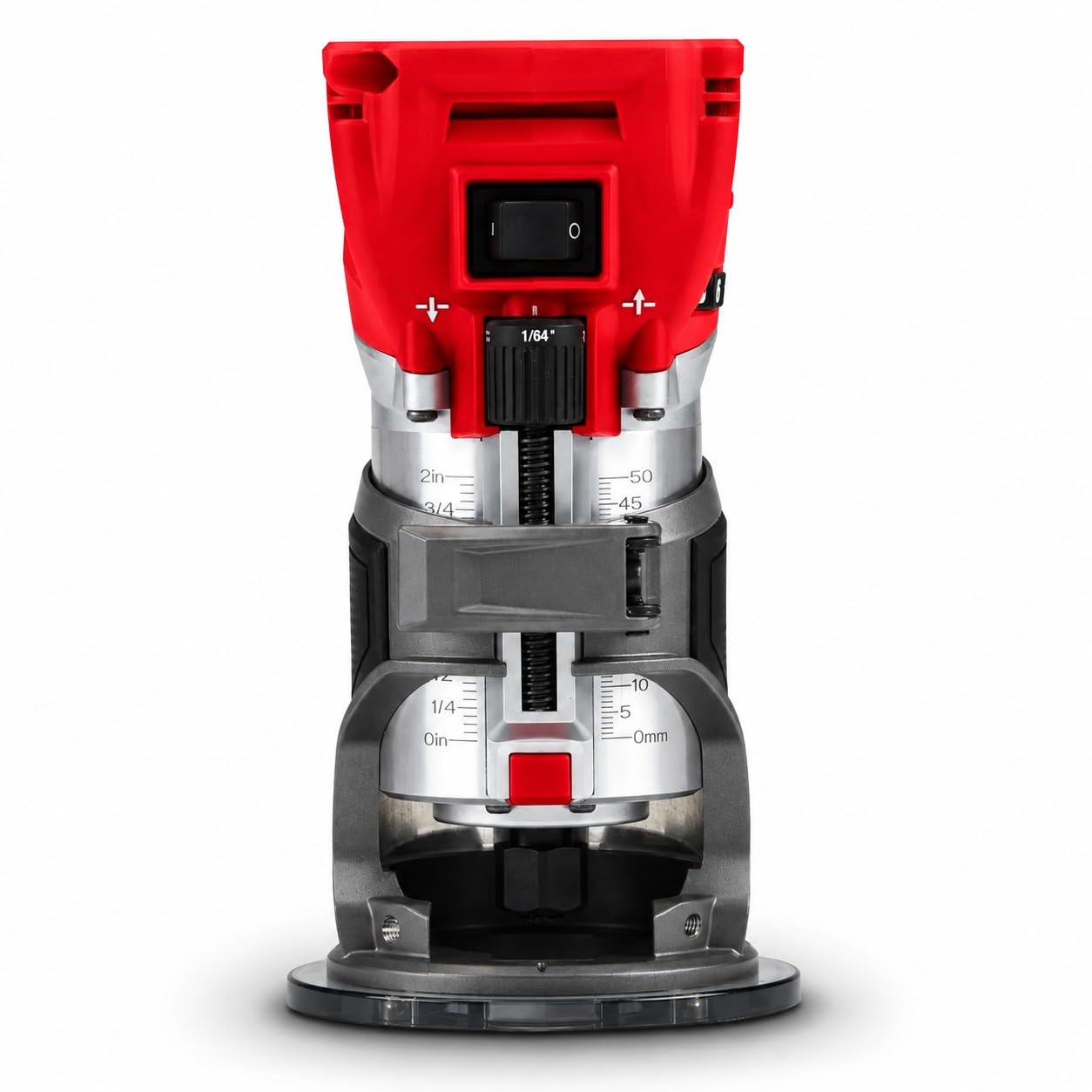
The Milwaukee is the muscle option in this group. Its 1.25 hp brushless motor and 10,000-to-31,000-rpm range give it the widest speed spread here, and the top end is useful when a small bit starts to smear in oak or maple. The body is compact and the grip is comfortable, but this is still a fixed-base router, so the base stays flat on the work while you adjust depth from above.

We found the power delivery smooth and the speed dial easy to read, and the 1.5-inch macro adjustment covers a lot of depth change quickly. The catch is the depth setting itself: it can creep during a cut, so we check the lock after every pass. That is a habit, not a dealbreaker, but it is the difference between this and a router that holds its number without fuss.

If you are already on Milwaukee's 18V platform, the bare tool makes a lot of sense for hardwood trim and hinge work. If you want a set-and-forget depth adjustment, the Makita or the DEWALT top pick is easier to live with. The Milwaukee earns its place when the cut is heavy enough that the extra horsepower and top speed are doing real work.

Bottom line: For harder woods and longer trim cuts, the Milwaukee's 1.25 hp motor and 31,000-rpm top speed make it our pick—just check the depth lock as you work.

Check Latest Price
#03

Best One-Handed Control

Makita XTR01Z

95 /100
Kirk Score Outstanding
Collet
1/4 in.
Voltage
18V
Base Type
Fixed
Speed Range
10,000–30,000 rpm
Check Details on Amazon

Pros

  • Balanced body is easy to control one-handed
  • 10,000-30,000 rpm with electronic speed control
  • Base slips off for quick bit changes
  • Uses 18V LXT batteries

Cons

  • Fine depth adjustment is fussy with the fixed base

Compared with the DEWALT top pick, the Makita feels more like a hand tool and less like a small motor bolted to a base. The body is compact, the grip falls naturally under the palm, and the balance stays close to the work, which makes one-handed edge routing less of a wrestle. The separate on and lock buttons are easy to find with a thumb, and the electronic speed control keeps the bit from bogging down in a long pass.

The 10,000-to-30,000-rpm range is wide enough for small bits and slower cuts, and the base slips off for bit changes, which saves time on a two-bit job. We were less taken with the fixed-base depth adjustment: fine tweaks take more back-and-forth than we want, and a plunge base is the better answer if you change depth often. For a router that lives mostly in a trim apron, that is an acceptable compromise.

For quick roundovers, hinge mortises, and shelf edges, it is a pleasure to use, and the 1/4-inch collet is the right size for the bits most trim routers run. It is a bare tool, so the value depends on already having 18V LXT batteries. If you do, this is the one to keep near the bench for small jobs that do not deserve the big router.

Bottom line: We hand the Makita to anyone who wants a light, balanced trim router for quick edge work; the fixed-base depth adjustment is the part that asks for patience.

Check Latest Price
#04

Best Plunge Router

DEWALT DCW620B

90 /100
Kirk Score Outstanding
Collets
1/4 in. and 1/2 in.
Voltage
20V
Base Type
Plunge
Peak Horsepower
2-1/4 hp
Check Details on Amazon

Pros

  • Plunge base and both 1/4- and 1/2-inch collets
  • 2-1/4 peak hp with constant speed under load
  • Integrated AIRLOCK dust collection
  • Anti-rotation shutdown for kickback

Cons

  • Premium price for a bare tool

The DCW620B comes with both 1/4-inch and 1/2-inch collets, a plunge base, two sub-bases, a guide bushing, and a dust port with AIRLOCK compatibility. That is a full routing kit in the box, minus the battery, and it puts the tool in a different class from the compact trim routers here.

The 2-1/4 peak horsepower motor and variable-speed dial with constant speed under load give it the reserve for raised panels, deep grooves, and hardwood. The plunge mechanism is smooth, and the trigger can be locked at any point in its travel, which is more useful than a simple on/off switch when you are easing into a cut. We also appreciate the anti-rotation system that shuts the tool down if it senses excessive kickback; it is the kind of feature you hope never to need.

Dust collection is the other reason to pick it. The integrated port and chip collector pull most of the mess away when you connect an extractor, and the two sub-bases help with template work. This is not a one-handed palm router, and it is a full-size tool for bench work, but for deep plunge cuts it is the most capable cordless option in this set.

Bottom line: If your work needs a plunge base and 1/2-inch bits, this is the cordless router we choose; it is a serious tool for deep cuts and dust control.

Check Latest Price
#05

Best Value

CRAFTSMAN CMCW400B

91 /100
Kirk Score Outstanding
Weight
4.1 lb
Voltage
20V
Base Type
Fixed
Speed Range
16,000–30,000 rpm
Check Details on Amazon

Pros

  • Edge guide and dust port included
  • Brushless motor with 16,000-30,000 rpm
  • Tool-free depth knob and LED
  • Precise height adjustment

Cons

  • Heavier than compact trim routers here

The CMCW400B ships with an edge guide and a dust port adapter, two accessories we usually end up buying separately. The body is compact, the depth knob is tool-free, and the LED sits close enough to the bit to be useful rather than decorative. At 4.1 pounds it is not the lightest router here, but the extra mass feels stable on a wide edge.

The brushless motor and 16,000-to-30,000-rpm variable-speed dial give it a wider working range than we expected at this end of the set. It has enough torque to edge a board without bogging down, and the depth adjustment is precise enough for shallow roundovers. The 4.1-pound body is the trade-off: it is comfortable two-handed, but it is not the one to grab for a quick one-handed trim.

For a shop that wants one fixed-base router for shelving, trim, and light template work, this is the value pick in the group. It is a bare tool, so the total depends on already having V20 batteries, and the compact DEWALT and Makita are easier to wave around overhead. The Craftsman makes more sense when the router will spend most of its time on a bench or a guided edge.

Bottom line: We think the Craftsman is the value pick: brushless power, a wide speed range, and an edge guide and dust port without a premium layout.

Check Latest Price
#06

Best for Ryobi One+ Users

Ryobi P601

93 /100
Kirk Score Outstanding
Weight
2.8 lb
Voltage
18V
Base Type
Fixed
Max Speed
29,000 rpm
Check Details on Amazon

Pros

  • Works with Ryobi One+ 18V batteries
  • Light 2.8-lb body
  • Tool-free depth knob and LED
  • Aluminum base

Cons

  • Small base is less stable on wide cuts
  • Short runtime with small battery packs

If your garage already has a stack of One+ batteries, the P601 is an easy way into cordless routing. The 18V pack slides in like it does on the rest of the line, the body weighs 2.8 pounds, and the rubber overmold gives you something to hold onto when the base is skating along an edge.

The LED light and tool-free depth knob are the two features we use most. The light is bright enough to follow a pencil line in a dim corner, and the knob lets you tweak depth without hunting for a wrench. The aluminum base is flat and stable on a straight edge, and the body stays comfortable during a short trim job.

For light roundovers, mortising, and edge work, it does the job without making you think about the tool. If you already have larger One+ batteries, it is a sensible second router; if you are starting from scratch, the DEWALT top pick is the better long-term buy. The Ryobi earns its spot on the platform, not on outright muscle.

Bottom line: The P601 is an easy addition if you already own Ryobi One+ batteries: light, simple, and comfortable for light trim work.

Check Latest Price
#07

Edge routing

Bosch GKF12V-25N

90 /100
Kirk Score Outstanding
Collet
1/4 in.
Voltage
12V
Base Type
Fixed
Max Speed
13,000 rpm
Check Details on Amazon

Pros

  • Offset body keeps the grip over the work
  • Fine depth dial with lock
  • Self-releasing collet speeds bit changes
  • Handy for laminate and edge profiles

Cons

  • Low top speed; no plunge base

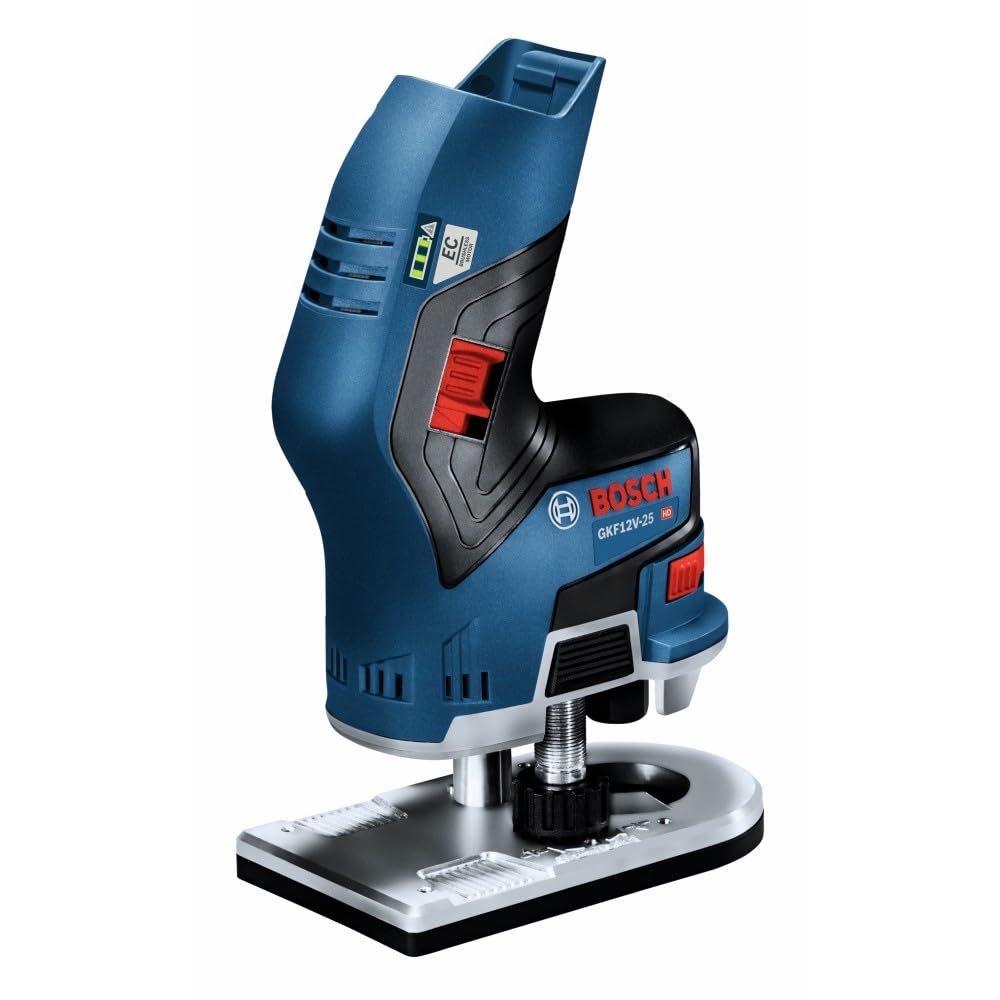
The GKF12V-25N is built around a different idea from the other routers here. Its offset body puts the grip over the work instead of beside it, so the tool feels balanced when you run it along a countertop edge or a cabinet face. That shape is the reason to consider it: it is a palm router for light edge work, not a smaller version of a full-size plunge router.

The 12V brushless motor tops out at 13,000 rpm, the lowest ceiling here, so it is happiest with small edge bits and shallow cuts. The depth dial moves in fine increments, and the depth lock keeps a setting from wandering. The self-releasing collet is a nice touch: bit changes are quick, and you do not need a second wrench to get the bit out.

Bosch rates the tool for up to 23 feet of roundover per battery amp hour, which is a useful way to think about runtime rather than a promise. The 1/4-inch collet keeps it in trim-router territory, and there is no plunge base. For laminate trimming, roundovers, and hinge work, the compact shape is a real advantage.

Where it falls down is anything that asks for more speed or a plunge cut. We reach for the Bosch when the job is a quick profile rather than a deep mortise. If you want one router for everything, the DEWALT top pick covers more ground; if you already own Bosch 12V batteries and do light edge work, this is a handy second tool.

Bottom line: We reach for the Bosch when the job is a quick edge profile or laminate trim, not a deep plunge cut.

Check Latest Price

How We Chose and Tested Cordless Routers

We built the shortlist by sorting compact fixed-base and plunge routers by base diameter, depth-adjustment style, battery platform, and price, then reading through owner reviews for the complaints that keep repeating — depth settings that drift, bases that don't sit flat, switches placed where a thumb can't reach. Ten routers came in for testing, and we ran them for eight months.

They lived in a shop, not a lab. Each one cut hinge mortises and strike plates on a run of interior doors, put quarter-inch roundovers on white-oak stair treads, trimmed plastic laminate, and cut dados in plywood shelving — held one-handed on small trim, two-handed on deeper passes.

For battery life, we ran an identical sequence of cuts with a fresh pack on each tool and counted linear feet of roundover until the motor started to bog. For adjustability, we set a depth, locked it, made repeated passes, then checked with a caliper whether the base had moved. We noted where the switch landed under the palm, how much of the cut line the LED actually lit, whether the speed dial held at low RPM without stalling in laminate, and how each tool handled dust and the occasional tumble off the bench. Compact size got judged overhead and in corners, where we marked how the base felt palmed in one hand and how much of it we could see past the motor housing. Cut quality, vibration, and what you get for the bare-tool price rounded out the notes.

How to Choose a Cordless Router

Start With Your Battery Platform

A bare tool is only a good deal if you already own the batteries and charger it needs. Before you compare routers, check the voltage and mount: DeWalt 20V Max, Milwaukee 18V, Makita 18V LXT, Ryobi One+, Craftsman V20, and Bosch 12V are separate systems. Switching platforms for one trim router usually costs more than it saves. If you are starting fresh, pick the platform you want for a drill and saw too, because the router will not be the last tool on it.

Choose the Base Type for the Work

A fixed-base router keeps the motor at a set depth and is the better choice for roundovers, hinge mortises, and edge profiles. A plunge base lets you lower the bit into the work and is the one to choose for deep grooves, raised panels, and stopped cuts. A palm edge router is lighter and offset for one-handed edge work, but it is not a substitute for a plunge router. Check what base comes in the box; the DEWALT DCW620B is the clear plunge option here, while the Bosch is built for light edge work.

Match Power and Speed to the Bit

Voltage and horsepower are only useful if they translate into clean cuts in the wood you use. A compact 18V or 20V router with a 25,000-to-30,000-rpm top speed handles 1/4-inch bits well; a 12V palm router with a lower ceiling is fine for small edge bits but not for hogging out material. If you want 1/2-inch bits, confirm the collet and the speed range before you buy. Variable speed matters more than the peak number: you need to slow down for larger bits and speed up for small ones.

Weigh Handling and Depth Adjustment

A trim router spends a lot of time in one hand, so weight and balance matter as much as power. Models around 2.5 to 3 pounds are easy to steer overhead; a 4-pound fixed-base router feels steadier on a wide edge but tires your wrist sooner. We pay close attention to depth adjustment because it is the control you touch most. A tool-free knob or ring is faster, but check that the setting locks and does not creep. If you change depth often, a plunge base is worth the extra bulk.

Plan for Dust and Accessories

We treat dust collection as part of the purchase, not an add-on. Chips obscure the cut line and pile up fast, and a dust port that accepts a shop vacuum makes edge work cleaner. An edge guide helps keep a roundover consistent without a separate jig, and LEDs are useful in a cabinet or corner. These accessories are often the difference between a bare-bones trim router and one that is ready to work, so compare what is in the box as well as the tool itself.

Frequently Asked Questions

Final Verdict

For most woodworkers, the DEWALT DCW600B is the cordless router to buy first. It is light enough to steer one-handed, smooth enough for hinge mortises and roundovers, and it shares the 20V Max batteries you may already own. The trade-off is a fixed base and 1/4-inch bits, so choose the DEWALT DCW620B if you need a plunge base and 1/2-inch capacity. If you are already on Milwaukee's 18V platform, the 2723-20 is the harder-cutting alternative.