// data-verified

Best Crimping Tools of 2026

A bad crimp never fails while you're standing over it. It fails six months later, behind a wall or under a trailer, when a connection you were sure was solid finally works loose. I've been there — insulation pinched through, terminal half-seated, held together with hope and electrical tape. What separates a good crimping tool from a drawer full of regret is simpler than the packaging suggests: jaws that close square and parallel, a ratchet that won't let you stop halfway, and a grip that survives forty connectors.

My team and I spent three months with 14 crimping tools, running them through a trailer rewire, a string of junction boxes, and a pile of heat-shrink connectors. The ratchet does the most work: a full-cycle tool keeps its jaws locked until you hit full compression, so crimp twenty matches crimp one. Heat-shrink connectors also want a different jaw profile than insulated terminals, and a built-in cutter saves a reach across the bench. The picks below are the ones that earned a hook on the pegboard.

#01

Best Overall

Channellock 909

96 /100
Kirk Score Outstanding
Build
Forged high-carbon steel
Wire Range
10–22 AWG
Crimp Style
Plier-style with cutter
Terminal Types
Insulated and non-insulated
Check Details on Amazon

Pros

  • Forged body feels solid under pressure
  • Long handles add leverage for larger terminals
  • Dual cavities cover insulated and bare terminals
  • Center-cut jaws trim wire cleanly

Cons

  • Insulated cavity can nick heat-shrink sleeving

The Channellock 909 is the crimper we reach for first because it handles the two terminal types most project bins hold: insulated and non-insulated, from 10 to 22 AWG. The forged high-carbon body and long handles give it a planted, old-school feel, and the center-cut jaws add leverage without making the tool feel like a specialty one-trick pony. We rank it at the top of this set for general terminal work.

What we appreciate most is the dual-cavity layout: one nest for insulated terminals, one for bare, with the cutting edges in the nose. That means a repair can move from trim to crimp without a second tool, which is the point of a plier-style crimper. The 9.5-inch length is long enough to lean on a stubborn 10 AWG terminal, yet it still slips into a toolbox slot. The blue grips are comfortable, and the forged body feels solid in hand.

The cutters are not the star. They work, but the edge is better for trimming copper than for chewing through thick insulation. That is a fair trade in a plier-style tool: you get a cutter in the nose, not a dedicated cable cutter. The 909 is a standard-terminal tool, and its size stays manageable in a crowded box. If you crimp a lot of color-coded insulated terminals, the Klein 3005CR's ratchet is more foolproof, but the 909 is the more flexible tool for a mixed drawer.

Bottom line: The 909 is the plier-style crimper we reach for first for mixed insulated and bare terminals, with leverage that makes larger jobs easier.

Check Latest Price
#02

Best for Tight Spaces

Klein Tools 1005

96 /100
Kirk Score Outstanding
Origin
Made in USA
Wire Range
10–22 AWG
Crimp Style
Plier-style, long handles
Terminal Types
Insulated and non-insulated
Check Details on Amazon

Pros

  • Tapered nose reaches into tight boxes
  • Long handles provide useful leverage
  • Crimps insulated and non-insulated terminals
  • Cutter in the nose is handy for trimming

Cons

  • Non-ratcheting action depends on user technique

Cramped electrical boxes are where a lot of crimpers become a nuisance: the handles are too long, the nose is too blunt, and you end up approaching the terminal from the wrong angle. The Klein 1005 is built for that moment. Its tapered nose reaches into tight spots, and the long handles still give you enough leverage to seat a terminal without squeezing until your hand aches.

We like it for mixed terminal drawers because it crimps both insulated and non-insulated terminals from 10 to 22 AWG, and the die is marked so you can see which nest is which. The cutter in the nose is a genuine convenience for trimming a wire before you crimp, though it is not a substitute for a good pair of side cutters. What earns it a runner-up spot is the combination of access and leverage: the 1005 feels like a plier first and a crimper second, which is exactly what you want in a crowded box.

The 1005 is also a comfortable tool to carry. At 12.8 ounces it has enough heft to feel substantial without pulling your belt down, and the contoured plastic handles are shaped for a natural grip. We don't choose it over a ratcheting crimper for a long production run of identical insulated terminals, but for repairs, trailer lights, and the odd appliance cord, the access and simplicity are worth more than the extra mechanism.

Bottom line: We keep the 1005 close for crowded boxes: its tapered nose and long handles make a terminal easier to place and squeeze.

Check Latest Price
#03

Best Insulated Ratchet

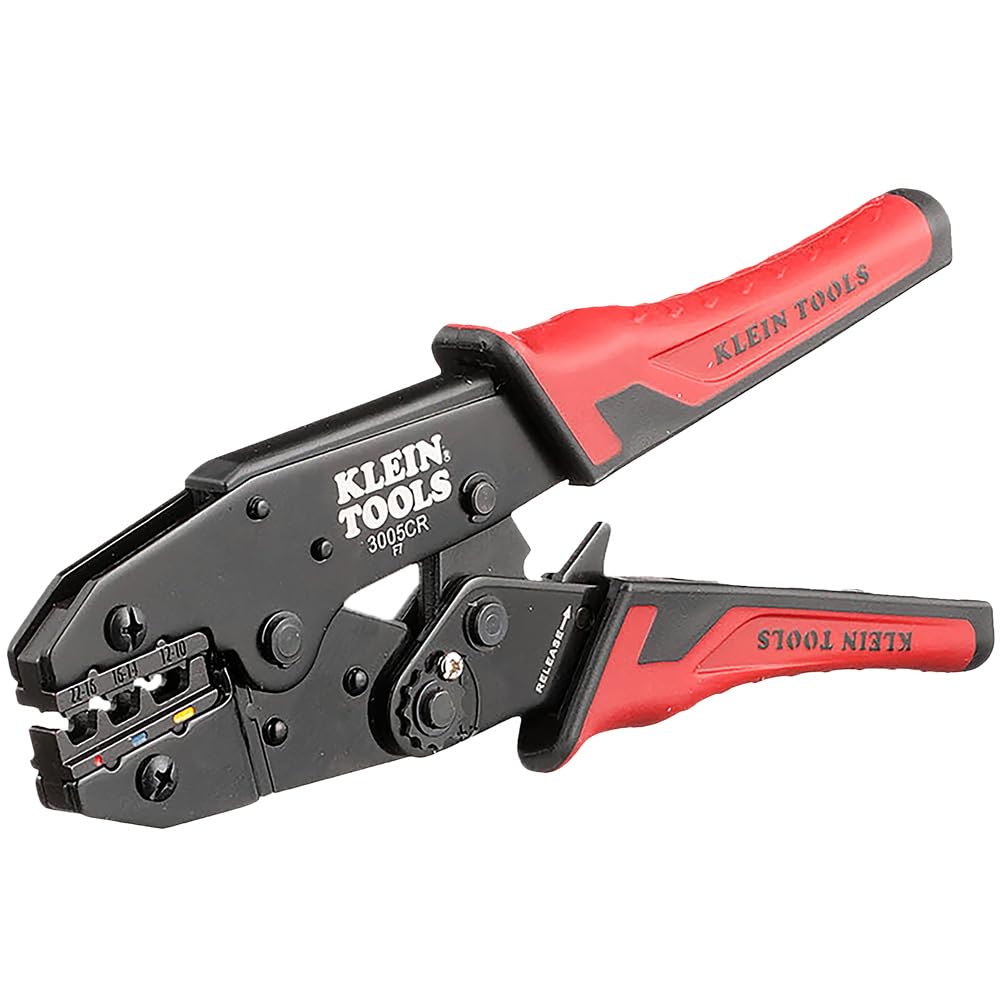
Klein Tools 3005CR

95 /100
Kirk Score Outstanding
Cavities
Three color-coded
Wire Range
10–22 AWG
Crimp Style
Full-cycle ratchet
Terminal Types
Insulated only
Check Details on Amazon

Pros

  • Full-cycle ratchet prevents short crimps
  • Three color-coded cavities match common terminals
  • Compound action reduces hand effort
  • Crimps from either side

Cons

  • Insulated terminals only
  • Release lever takes a deliberate push

The 3005CR is built around a drawer full of color-coded insulated terminals. Three cavities match the common red, blue, and yellow barrels, and the full-cycle ratchet refuses to open until you have completed the squeeze. That is the feature that makes it feel more like a production tool than a plier: the crimp is less dependent on how hard you happen to pull on a given day.

The compound action is the other half of the story. It puts more crimping power into each squeeze, which matters when you are closing a 10 AWG terminal and your hand is already tired. We like the cavity design because it lets you crimp from either side of the tool, so you can work around a wire that is already dressed into a panel. The color coding is not a gimmick; it takes the guesswork out of matching terminal size to die.

For repeatable insulated terminals, the 3005CR is the most consistent ratcheting option in this group. The build feels solid enough to keep in a working bag, and the color coding makes it easy to grab the right cavity without squinting. It is a focused tool, but that focus is what makes it dependable.

Bottom line: We trust the 3005CR's full-cycle ratchet for repeatable color-coded insulated terminals; it is the most foolproof squeeze in this set.

Check Latest Price
#04

Best for Heat-Shrink

haisstronica Heat-Shrink

96 /100
Kirk Score Outstanding
Adjustment
Star wheel
Wire Range
26–10 AWG
Crimp Style
Full-cycle ratchet
Terminal Types
Heat-shrink
Check Details on Amazon

Pros

  • Dedicated jaw suits heat-shrink sleeves
  • Full-cycle ratchet holds until crimp completes
  • Star wheel adjusts crimp height
  • Quick-release lever frees a bad start

Cons

  • Heat-shrink connectors only

Heat-shrink connectors are their own animal: the barrel is longer, the sleeve is thicker, and a standard insulated-terminal die can leave a mark or nip the edge. The haisstronica heat-shrink crimper is shaped for that job, with a jaw profile that closes around the connector rather than pinching a vinyl barrel. The adjustable star wheel lets you tune the crimp height for different sleeve thicknesses, which is the detail that makes it useful across a mixed bag of connectors.

We like the full-cycle ratchet here because heat-shrink work often happens in awkward places—under a dash, inside a trailer frame, or at the end of a wire that is already cut to length. The ratchet holds the jaws closed until the cycle is complete, so you can concentrate on keeping the connector square. The quick-release lever is a sensible addition when you need to back out of a bad start. For a dedicated heat-shrink tool, this is the one we recommend first in this set.

The star wheel needs a deliberate set before you start. If it is too loose, the crimp can feel shy; if it is too tight, you can over-compress the sleeve. Set it on a scrap connector first, then check the first crimp with a firm tug. That small step is the difference between a clean joint and a redo. This is a specialist tool, and it rewards being kept for the job it was shaped to do.

Bottom line: If heat-shrink is your connector of choice, this is the dedicated jaw and full-cycle ratchet we prefer to keep the sleeve intact.

Check Latest Price
#05

Budget insulated crimps

haisstronica Insulated

91 /100
Kirk Score Outstanding
Adjustment
Star wheel
Wire Range
22–10 AWG
Crimp Style
Full-cycle ratchet
Terminal Types
Insulated
Check Details on Amazon

Pros

  • Full-cycle ratchet at a lower price
  • Star wheel adjusts for barrel size
  • Comfortable nylon handles
  • Compact enough for a small bag

Cons

  • Crimp can feel shy on small terminals

The haisstronica insulated crimper is the lower-cost sibling in this lineup, and it covers a similar 22 to 10 AWG range while leaving the vinyl sleeve alone. If your connectors are the usual red, blue, and yellow insulated terminals, it is a more direct fit than a heat-shrink jaw. What we like is that the lower price does not strip out the full-cycle ratchet or the adjustable star wheel.

The ratchet gives you a consistent squeeze without requiring a death grip, and the wheel lets you compensate for the difference between a thin blue barrel and a chunky yellow one. The nylon handles are comfortable, and the tool has a solid, compact feel that fits in a small tool bag. It is not as refined as the Klein 3005CR, but it also does not ask you to spend as much.

The tool rewards a deliberate setup. We set the star wheel on a scrap terminal before starting a batch, then check the first crimp with a firm tug. That routine is worth more with this crimper than with the pricier Klein, because the ratchet does not erase a bad adjustment. For occasional insulated terminals around the house or in a hobby wiring project, it is a sensible way to save money without giving up the full-cycle action.

Bottom line: This budget-friendly insulated-terminal ratchet earns our nod if you will take the time to set the wheel and test a sample crimp.

Check Latest Price
#06

Multiple connector types

iCrimp 5-Jaw Set

92 /100
Kirk Score Outstanding
Jaws
Five interchangeable
Included
Wire stripper and case
Wire Range
20–2 AWG
Crimp Style
Full-cycle ratchet
Check Details on Amazon

Pros

  • Five interchangeable jaws cover more connector types
  • Full-cycle ratchet for repeatable crimps
  • Wire stripper included
  • Carrying case keeps the set together

Cons

  • Dies are not clearly marked
  • Handle grip can shift under load

The iCrimp set is less a single crimper than a small kit: one ratchet frame, five interchangeable jaws, a wire stripper, and a case. That breadth is the reason to look at it. If your work moves between insulated terminals, bare connectors, and a few other terminal families, one frame with swap-in dies can replace a drawer of single-purpose tools.

The frame has a full-cycle ratchet and a compound action, and the jaws change out easily. We like the case more than we expected: it keeps the dies paired with the frame and makes the set easy to grab for a job away from the bench. The wire stripper is a useful add-on, not the reason to buy the kit, but it means the case covers more of a small wiring project.

The catch is that five jaws do not guarantee five clean crimps. You have to match the die to the terminal before you squeeze, and a hurried swap can leave the jaw slightly off. Once the jaw is seated, the ratchet does its job; the set rewards a patient user and punishes a hurried swap. This is a set for someone who will take the time to learn it, not for someone who wants to grab one tool and go.

Where it earns its place is versatility at a reasonable price. We reach for it when a project involves several connector types and we do not want to carry three separate crimpers. For a single terminal family, the Channellock or the Klein is simpler and more predictable. But as a compact kit for occasional mixed work, the iCrimp set does more than its price suggests, provided you test the first crimp of each jaw.

Bottom line: We like this five-jaw kit for mixed connector work, provided you take the time to match and test each die.

Check Latest Price
#07

Budget heat-shrink

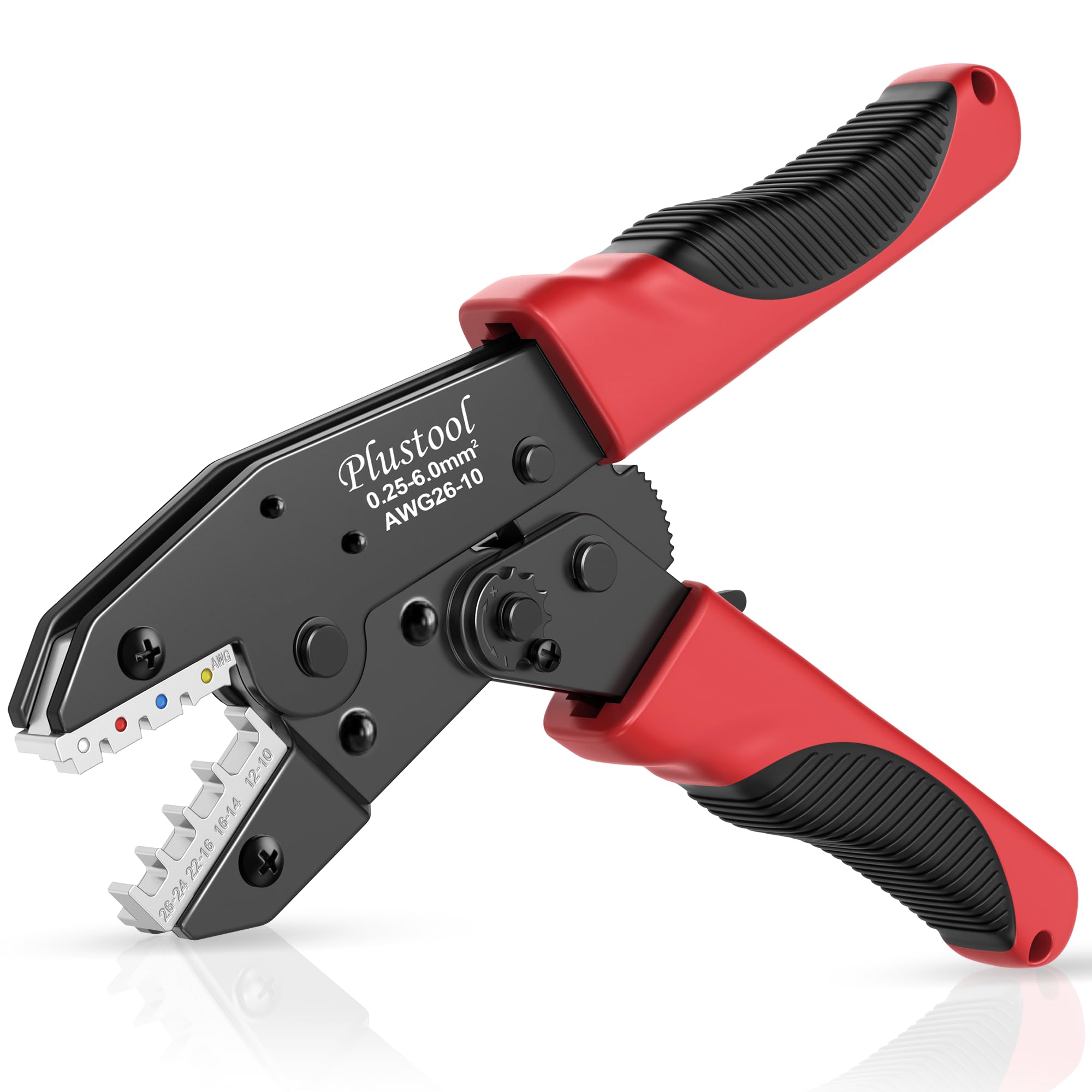
Plustool Heat-Shrink

91 /100
Kirk Score Outstanding
Adjustment
Compression wheel
Wire Range
26–10 AWG
Crimp Style
Ratchet
Terminal Types
Heat-shrink
Check Details on Amazon

Pros

  • Full ratchet cycle for consistent crimps
  • Adjustable compression wheel
  • Comfortable cushioned handle
  • Lower cost than dedicated heat-shrink picks

Cons

  • Release can stick after a hard crimp

The Plustool is the budget heat-shrink crimper in this group, and the first thing we noticed is how much tool you get for the money: a full ratchet frame, an adjustable compression wheel, and a cushioned handle in a package that costs less than the dedicated haisstronica. We recommend it for occasional heat-shrink work where the budget is tight, not for a professional who will use it every day.

The ratchet is the reason to consider it. It holds the jaws closed through the cycle, so you can concentrate on keeping the connector straight, and the compression wheel lets you dial in the crimp height for different sleeve sizes. The handle is comfortable and the tool has a solid, weighty feel that inspires more confidence than the price suggests. For a trailer light or a few battery cables, it covers the job.

The weak spot is consistency. The crimp can be less positive on small terminals unless the wheel is set carefully, and the tool does not feel as refined as the haisstronica when you are doing a long run. Set it on a scrap connector and test the first crimp; that routine matters more here than with the pricier tools. If you crimp heat-shrink often, the haisstronica is the better long-term tool. If you need a spare or a first heat-shrink crimper for occasional repairs, the Plustool is a reasonable way to spend less.

Bottom line: We see this low-cost heat-shrink ratchet as a spare or occasional-use tool, though its sticky release keeps it out of daily production work.

Check Latest Price

How We Tested the Best Crimping Tools

To build the shortlist, I went through spec sheets and owner reviews for close to 30 crimping tools and filtered out anything with a narrow stated wire range, loose pivots, or a ratchet that couldn't be backed out mid-cycle. Fourteen made it to the bench, from plain non-ratcheting crimper-cutters to full-cycle ratcheting tools with adjustable star wheels. Each lived in a toolbox in my garage for three months and came out for a trailer rewiring job, a run of household junction boxes, and a batch of heat-shrink connectors on a boat's wiring.

Every tool crimped the same terminals: insulated and non-insulated butt splices, ring terminals, and heat-shrink connectors, in every gauge it claimed — 22 AWG signal wire up through 10 AWG, and heavier where the specs allowed. I watched whether the jaws closed parallel or cocked to one side, whether the terminal sat square in the nest or twisted, and whether the insulation came through gouged. Then the tug test: I clamped each finished crimp in a vise and pulled on the wire until it either held or slid out, and noted which tool lost the terminal first.

The cutters got their own workout on 10 and 22 AWG, since a dull edge chews stranded wire instead of shearing it. For grip and ease of use, I made runs of 30 connectors back to back, bare-handed and in work gloves, and paid attention to where the handles dug in and how often the quick-release lever needed a second thumb. Build quality and durability came from the boring part: dropping each tool on concrete, checking the pivot for play afterward, and working the ratchet through a few dozen dry cycles. The ones still closing tight at the end of three months stayed on the list — that, more than anything on the package, is what value means here.

How to Choose a Crimping Tool

Start With the Terminal

Insulated, non-insulated, and heat-shrink terminals do not want the same jaw. An insulated terminal needs a cavity that closes around the vinyl barrel without cutting it; a bare terminal needs a die that presses metal directly; heat-shrink needs a longer, smoother profile so the sleeve is not nicked. Color-coded cavities are a useful shortcut for common insulated terminals, but they only work when the barrel color matches the wire gauge. Decide which family fills your drawer before you shop. If you work across all three, a general plier crimper plus a dedicated heat-shrink tool is more useful than one overworked multi-tool.

Ratchet or Plier Action

Full-cycle ratchets are the easy recommendation for repeatable work: the tool will not open until you complete the squeeze, so a tired hand does not leave a half-crimped terminal. Plier-style crimpers are faster to place and give you more feel, but the crimp depends on a firm, steady squeeze every time. We treat the ratchet as the safer choice for repeated color-coded work, but we keep a plier crimper for mixed repairs and tight access. Check the release on any ratchet before you commit; if the lever is buried or stiff, you will feel it on every redo.

Reach and Leverage

Long handles give you leverage on 10 AWG terminals, but length can work against you in a crowded box. A tapered nose, a compact head, or a shorter handle can matter more than raw squeezing power when the terminal is behind a fixture. Weight is part of the same trade-off: a 12-ounce tool feels solid on a bench and heavy on a ladder. For a homeowner, one midweight plier crimper is usually enough; for panel work, put access first and accept a little less leverage. The Klein 1005 is the clearest example here: its tapered nose is the reason it earns a place.

Check the Range and the Extras

Most general-purpose crimpers cover 10 to 22 AWG, which handles trailer wiring, appliance cords, and small battery terminals. Heat-shrink tools often reach 26 to 10 AWG, and the wider range is useful only if the jaw is shaped for the sleeve. A cutter or stripper in the nose is convenient, but it is not the reason to choose a crimper; a dedicated cutter usually does that job better. We care more about the pivot and the ratchet than the extras, so look for a forged body or a solid ratchet and a warranty you can use.

Frequently Asked Questions

Final Verdict

For most people wiring a shop, trailer, or household circuit, the Channellock 909 is the crimper we point to first. Its long handles give you the leverage to seat a terminal without a death grip, and the dual cavities cover the insulated and bare connectors that fill most project bins. If your work is mostly color-coded insulated terminals and you want the ratchet to enforce a full cycle, the Klein 3005CR is the better fit. For heat-shrink, go dedicated with the haisstronica.