// data-verified

Best Tools for Furniture Assembly of 2026

Every flat-pack box arrives with the same joke inside: a stamped hex key the length of my pinky and a bag of screws that assume I have all afternoon. Forty minutes into a dresser, my palm is dented and two cam locks are cross-threaded. The right tool doesn't make assembly fun, but it turns a four-hour grind into a finishable evening — bits that fit the screw heads, torque you can dial back, and a case you can actually find when the next box lands.

We've spent the past three months putting 14 tools through real builds — bookcases, a bed frame, a desk, more than one wobbly chair — and the differences came down to things you only notice on your knees at 9 p.m. A magnetic tip saves you a crawl under the sofa for a dropped screw, and adjustable torque matters more than raw voltage; too much twist and you'll chew straight through particleboard. Portability counts too, since most of us assemble in a hallway rather than a workshop, and the picks below run from a bit set that lives in a drawer to a driver you'll want to keep charged.

#01

Best Overall

SKIL 4V Screwdriver Set

94 /100
Kirk Score Outstanding
Bits
42-piece set
Speed
220 rpm
Torque
36 in-lb
Battery
4V lithium-ion, micro-USB
Check Details on Amazon

Pros

  • Cam screw sleeve holds fittings square
  • Magnetic collar lets you start screws one-handed
  • 42-piece bit set covers hex, Torx and Phillips
  • 36 in-lb torque will not strip particle board

Cons

  • Micro-USB charging rather than USB-C

Cam locks are where flat-pack builds stall, and the sleeve on the nose of this SKIL is built for exactly them. It holds the cam screw square and stops the fitting skating while the bit turns, which is the difference between a ten-second job and ten minutes of fishing a screw out of a cabinet corner. The slim magnetic collar does the same work for ordinary screws, multiplying the hold on the bit so a screw stays put while you bring the panel to it. Those two details, more than motor size, are why this is the tool we reach for first.

The numbers back the restraint up. At 36 in-lb and 220 rpm it drives assembly screws without the force that splits particle board or strips a cam, and the pistol grip lets you push straight down the axis of the screw instead of levering at it from the side. The 42-piece set covers 1-inch bits, five slim bits, a bit holder and a small screwdriver handle, so the odd Torx or square fitting is accounted for, and the five-year warranty is worth noting.

What it doesn't do is drill. There's no chuck for a twist bit, so pilot holes for a wall fixing or a hardwood plug still need a drill — pair it with the AVID POWER set and you've covered an apartment's worth of furniture, with the SKIL doing the assembly and the drill doing the walls. On its own, for the build itself, nothing else here saves as much time.

Bottom line: We point anyone with a flat-pack in the hallway at this one first: the cam sleeve and magnetic collar take the fight out of the fittings, and the torque is gentle enough to leave the board intact.

Check Latest Price
#02

Best Drill for Assembly

AVID POWER 20V Drill Set

93 /100
Kirk Score Outstanding
Chuck
3/8 in keyless
Speed
0–550 rpm
Torque
280 in-lb
Weight
2.5 lb
Check Details on Amazon

Pros

  • 15+1 clutch protects particle board
  • 280 in-lb handles pilot holes and studs
  • 2.5 lb body is light for a 20V drill
  • Flexible shaft reaches awkward screws

Cons

  • One battery, with no spare in the kit

Two figures separate this drill from everything else here: 280 in-lb of torque and a 2.5-pound body. The torque is several times what the SKIL screwdriver produces, and it's what you want the moment a build needs pilot holes, a screw driven into a stud, or a hole through a shelf for cables. The weight is low for a 20V tool, and after an afternoon of holding it overhead to fix a bracket, that counts for more than the spec sheet suggests.

The 15+1 clutch is the part furniture assemblers should care about. Set it low and the drill stops turning when the screw seats instead of crushing the board around a cam bolt, and the variable trigger lets you start slow and stay slow. The 3/8-inch keyless chuck takes standard bits, and the kit adds 10 drill bits, 10 driver bits, a flexible shaft and an extension bar. The flexible shaft is the accessory we've used most, because it reaches a screw on a cabinet back panel that no straight driver can approach.

Two things to know going in. The bits in the box are the weakest part of the package, and we treat them as starters — a decent set of driver bits is worth buying before a big build. It's also a basic single-speed drill with no hammer mode, so wood, plastic and light metal are its territory and masonry isn't. Neither stops it being the right second purchase for anyone furnishing a place from boxes.

Bottom line: If your build needs pilot holes, or you want one tool that drills and drives, this is the drill we hand people: light enough to hold overhead, strong enough for shelves.

Check Latest Price
#03

Best Manual Ratchet

CRAFTSMAN Ratcheting Screwdriver

93 /100
Kirk Score Outstanding
Drive
1/4 in hex
Pieces
26
Warranty
Full lifetime
Bit Types
Phillips, hex, Torx, square, slotted
Check Details on Amazon

Pros

  • Ratchet spins long runs of hex bolts
  • Hex, Torx, square, Phillips and slotted bits
  • Magnetic pick-up tool for dropped screws
  • Full lifetime warranty

Cons

  • Driver does not seat reliably in its case

A ratchet is the difference between a run of hex bolts and a sore wrist. Most flat-pack beds and bookcases are held together with hex socket bolts, and this set's hex bits — 1/8, 3/16, 1/4 and 5/16 inch — let you spin them down with the handle ratcheting instead of resetting your grip every quarter turn. Flip the collar to lock it and you get the feel of a fixed driver for the final snug, which is where over-tightened fittings usually happen.

The coverage runs wider than furniture. There are square, Torx from T6 to T27, Phillips and slotted bits, all on a 1/4-inch hex shank, plus a telescoping magnetic pick-up tool that earns its place the first time a screw drops behind a drawer back. The handle has a textured torque zone where your palm sits and a smoother collar you can spin between finger and thumb, and the CR-V bits have kept their edges on everything we've pointed them at.

For the money, this is the manual tool we reach for first. The ratchet action is smooth enough that we leave the bit driver in the box for anything short of a whole room of furniture, and the bit range means one tool handles the hex bolts, the cam locks and the odd square-drive fitting without a hunt through a drawer. It's the last ten percent of a build — 16 bolts in a row — where it earns its keep.

Bottom line: For a build with a long run of hex bolts, this is the manual tool we pick up first: the ratchet saves your wrist and the bit range covers almost everything else.

Check Latest Price
#04

Best Hex Key Set

Amazon Basics 36-Piece Hex Key Set

95 /100
Kirk Score Outstanding
Arms
Long and short
Keys
36
Sizes
SAE and metric
Material
Chrome vanadium steel
Check Details on Amazon

Pros

  • SAE and metric sizes in one set
  • Long and short arms for access
  • Two labeled cases keep sizes findable
  • Least expensive way to cover every hex size here

Cons

  • Smallest keys flex under hard torque

The first job with this set is a rag. Every key arrives with a film of protective oil on it, and you'll want to wipe all 36 before the first build unless you fancy black hands by the second panel. Once that's done, what's left is the most useful inexpensive thing in this guide: 36 keys in both SAE and metric, long arm and short, each in a labeled slot in one of two hinged cases.

Both arm lengths are why the set stays in the furniture drawer. The long arm gives leverage on a bolt that was over-tightened at the factory; the short arm gets into the gap between a cabinet side and a drawer runner, where a long key simply won't go. Keeping metric and SAE in separate cases means you're not sorting a pile to find the 4 mm you need, and the size markings are stamped where you can read them without hunting for glasses.

What the set doesn't do is speed. There's no ratchet and no handle, so a bed frame with 20 hex bolts is slow work by hand — that's the point where we put the keys down and pick up the CRAFTSMAN ratchet. As a backup for the key that always goes missing from the flat-pack bag, and as the thing that shifts a stubborn bolt, it earns its place.

Bottom line: Buy this before your next flat-pack: 36 labeled keys in two cases mean you'll always have the right size, and a properly seated key is what keeps a bolt from rounding.

Check Latest Price
#05

Best Starter Kit

CARTMAN 39-Piece Tool Set

95 /100
Kirk Score Outstanding
Pieces
39
Weight
3.31 lb
Case Size
12.4 x 7.4 x 3 in
Compartments
13
Check Details on Amazon

Pros

  • Hammer, pliers and drivers in one case
  • 13 compartments keep everything seated
  • Light enough to carry one-handed
  • Covers a first flat-pack and basic repairs

Cons

  • SAE hex keys only, no metric
  • Hammer too light for real striking

If you own no tools at all and a flat-pack is sitting in the hallway, this is the box that takes you from nothing to done. Thirty-nine pieces live in a case 12.4 inches long: a claw hammer, slip-joint pliers, a tape measure, a utility knife, scissors, a bit driver with bits, precision screwdrivers and a set of hex keys, each with its own compartment.

For assembly, the bit driver and hex keys do most of the work, and the hammer is there for tapping dowels and cam pins home without using the heel of your hand. The case is the quiet win: 13 compartments and a molded tray mean nothing shifts when you carry it by the handle, and at 1.5 kg it's light enough to keep on a closet shelf or under a sink without noticing it's there.

What you're buying is convenience rather than quality. The tools are heat-treated and chrome plated, and they've handled everything we've asked of them around a house, but this is a starter kit and it feels like one in the hand. What it buys is not having to stop halfway through a build and drive to the hardware store for a hammer.

Bottom line: For a first apartment with no tools in it, this is the box we point people to: a flat-pack, a shelf and a loose hinge all covered in one case you can carry one-handed.

Check Latest Price
#06

Best Compact Power Screwdriver

HOTO 12-in-1 Electric Screwdriver

94 /100
Kirk Score Outstanding
Bits
12 S2 steel
Torque
4 N·m electric, 8 N·m manual
Weight
8.82 oz
Charging
USB-C, 1500 mAh
Check Details on Amazon

Pros

  • Aluminum case keeps bits together
  • 250 g and drawer-sized
  • Three torque settings plus manual mode
  • USB-C charging with level-friendly 1500 mAh cell

Cons

  • Light-duty torque only, not for structural screws

The case is the first thing anyone picks up: a machined aluminum tube about the size of a glasses case, with twelve bits stored in the base and the driver sitting on top. We like it for what that means in a small apartment — a screwdriver that lives in a kitchen drawer rather than a toolbox — and for the fact that at 250 grams it doesn't drag on your wrist when you're working upside down under a table.

Three torque settings cover more than the size suggests: 4 N·m in electric mode for driving, and a manual mode that takes it to 8 N·m for the final tighten. The rotary knob clicks between settings where you can feel it without looking, the ring light around the bit holder lights the inside of a cabinet, and the 1,500 mAh battery charges over USB-C. The bits are S2 steel at 60HRC with a magnetic tip that holds a screw while you line it up with the hole.

It's the tool we hand someone who wants one small thing that makes flat-pack and cabinet hinges easier. The aluminum case protects the bits in a drawer, the driver comes out and goes back in one motion, and there's no charger brick to lose because the cable is USB-C like everything else in the house.

Bottom line: For small repairs and flat-pack in a home without a toolbox, this is the driver we reach for: it lives in a drawer, charges like a phone, and never overpowers a screw.

Check Latest Price
#07

Cam locks, hinges

CRAFTSMAN 8-Piece Screwdriver Set

95 /100
Kirk Score Outstanding
Finish
Chrome, black oxide tips
Pieces
8
Lengths
1.5 to 6 in
Tip Types
Phillips and slotted
Check Details on Amazon

Pros

  • Four Phillips and four slotted sizes
  • Stubby 1.5-inch drivers reach tight cabinets
  • Textured torque zone for hard turns
  • Black oxide tips resist slipping

Cons

  • No hex or Torx bits

A fixed screwdriver does something a bit driver can't: it puts your hand directly behind the tip, with no chuck or adapter between you and the screw, which is what you want on a cam lock that's half a turn from snug. This Craftsman set is four Phillips and four slotted drivers, from a stubby 1.5-inch to a 6-inch, and it covers the fasteners on cabinet hinges, drawer runners and cam fittings.

The handles are what we noticed first. There's a textured torque zone where your palm sits and a smoother collar near the tip that spins between thumb and finger to run a screw down fast, and the shape sits in the hand without needing a death grip. The chrome finish wipes clean, and the black oxide tips have held their shape without chewing a screw head.

The size selection is sensible rather than exhaustive: two stubby drivers for the inside of a cabinet, a PH3 and a 5/16-inch slotted for bigger hardware, and the mid-length PH2 that does most of the work on flat-pack. Having a fixed driver in each of those lengths means fewer bit changes in the middle of a build, which is most of the reason to own them.

As the Phillips half of a furniture toolkit, this is the set we keep within reach: comfortable enough for a long run of cam locks, and precise enough that you feel the screw seat before you overdo it. It's the last five minutes of a build, when everything is loose and needs a final pass, where a good fixed driver beats every powered option.

Bottom line: For cam locks, hinges and drawer runners, this is the screwdriver set we keep close: comfortable handles, tips that grip, and stubby sizes for tight cabinet interiors.

Check Latest Price
#08

Mixed fastener types

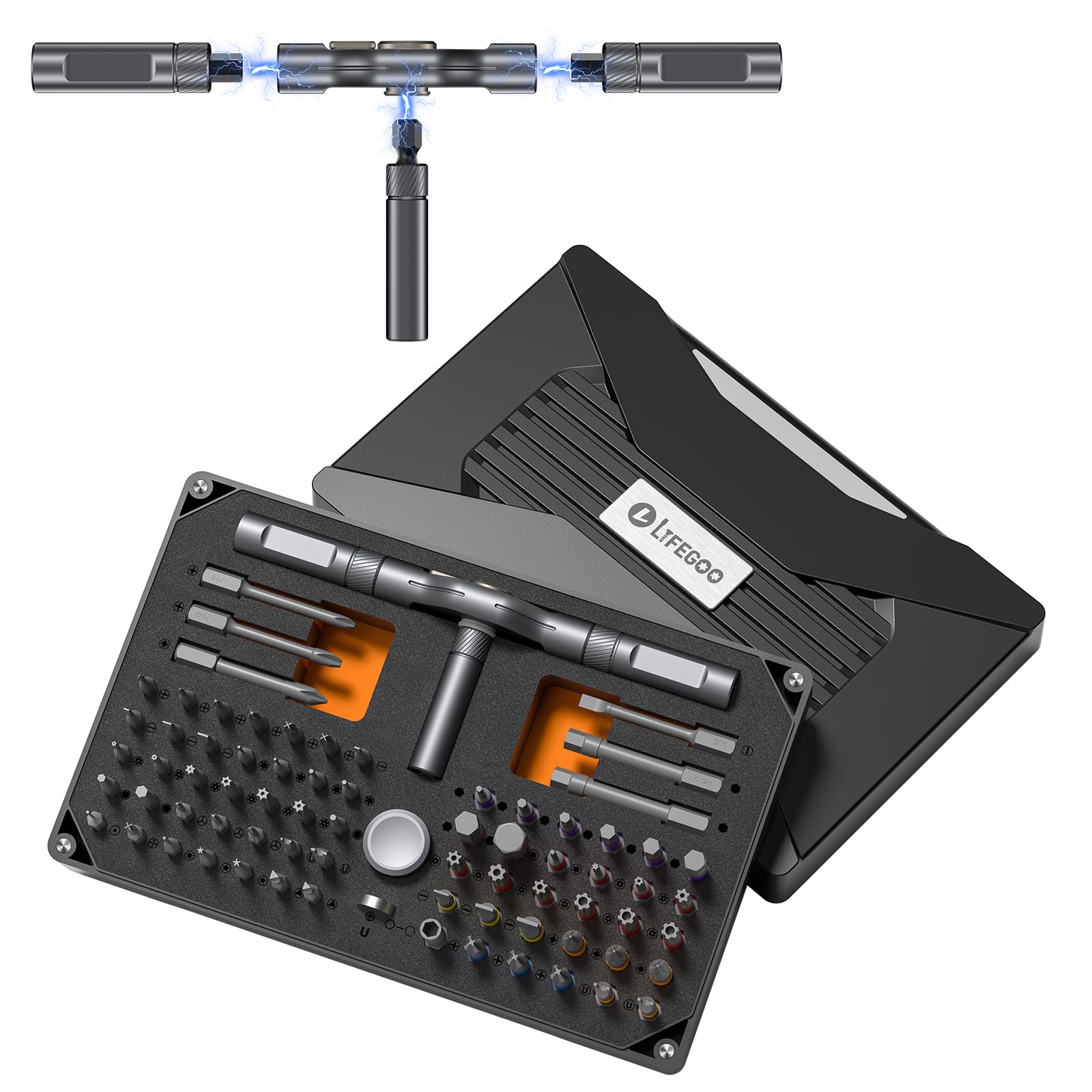
LIFEGOO 74-in-1 Ratchet Screwdriver

92 /100
Kirk Score Outstanding
Drive
1/4 in hex
Handle
Detachable T-handle
Pieces
74
Bit Material
S2 steel
Check Details on Amazon

Pros

  • 74 bits including Pozidriv, Torx and hex
  • Detachable T-handle for tight spaces
  • S2 steel bits in an aluminum case
  • Ratchets in both directions

Cons

  • Magnets hold bits loosely
  • Bits shift in their slots when carried

When a bolt sits somewhere too shallow for a screwdriver handle, the T-handle on this LIFEGOO comes apart and you can choke up on the shaft until the tool fits. That removable handle is the reason the set is here: it's the same trick as bending a hex key into an L, except the bit actually matches the fastener and there's a grip wide enough to put your palm behind.

Seventy-four pieces is more bits than most people will ever identify, but the range is the point: Phillips, slotted, Pozidriv, hex, Torx, tri-wing, Y-type and U-type, all on a 1/4-inch hex shank and all S2 steel. For furniture you'll live in the Phillips and hex bits; the rest is there for the dishwasher bracket, the bike and the laptop.

The aluminum handle ratchets in both directions with a flick of the collar, and between the ratchet and the T-handle it takes real torque for something this small. The case is the part that makes it livable: double-sided storage holds all 74 pieces in something the size of a paperback, with a slot for each bit that you can read at a glance.

It's not a replacement for a hex key set or a good fixed driver — a dedicated tool is faster when you know what you're facing. It's the set you buy when the fasteners in your life stopped being predictable, and you want one case that covers flat-pack today and a laptop or a bike next week.

Bottom line: For the drawer that has to cover everything — flat-pack today, a bike or a laptop next week — this is the bit set we grab, with a T-handle that reaches where a screwdriver won't.

Check Latest Price

How We Tested Furniture Assembly Tools

We started by gathering every tool that claimed to handle flat-pack furniture, then filtered on three things: whether the bit selection actually covered the hex, Phillips, and Torx sizes furniture ships with; whether the whole set came in a case we could carry one-handed; and price relative to what's inside. That left 14 tools, and we bought every one at full price.

Testing ran for three months, mostly in a spare bedroom that turned into an assembly shop. We built a dresser, a queen bed frame, a bookshelf, and two desk chairs, then took the dresser apart and rebuilt it to see how the bits held up on a second pass. Partway through, we handed the tools to a friend mid-move, which is about as close to a stress test as this category gets.

Fit and torque separated the field. We noted whether each bit seated fully or wobbled in the screw head, and drove 3-inch screws into pine to see which tools stalled and which spun the head clean. We counted how many screws a magnetic tip held before dropping one, timed the first full charge on the cordless models, tallied fasteners per charge, and checked the tips for rounding after each build. A few hex keys came out of the wrapper slick with oil; we wiped them and watched whether the film came off on our hands or on a light-oak shelf. We also weighed each case and tried stashing it in a drawer — several portable-looking kits were toolbox-sized.

Value came down to use rather than piece count: we logged which items we actually reached for, and most of the big kits had a dozen bits that never left the case.

How to Choose Tools for Furniture Assembly

Start With the Hardware, Not the Tool

Tip the fittings out of the bag and you'll usually find two or three fastener types: hex socket bolts in metric sizes, Phillips or Pozidriv cam locks, and occasionally Torx or square drive. That list decides what you need. If the bolts are hex and your toolbox is all Phillips, a hex key set is the purchase, and one with both SAE and metric in long and short arms covers more furniture than a bigger count of one family alone.

The trap is a kit that looks complete and isn't. Plenty of household sets include hex keys in SAE sizes only, which leaves you hunting for the metric key the furniture came with.

Torque: Less Is Usually More

Particle board and MDF are sawdust and glue, and they strip, split and crush long before a screw feels tight. That's why the useful number on a driver isn't its maximum torque but whether you can turn it down. A clutch drill clicked to the lowest setting that still drives the screw stops before it crushes a cam housing, and a low-torque driver does the same by design at 36 in-lb.

Save the high torque for pilot holes and screws going into studs. On the furniture itself it only causes damage.

Reach and Hold Decide the Awkward Ten Minutes

Most of the time lost on a build isn't turning screws, it's getting to them and keeping them on the bit. Look for a magnetic collar or slim bit holder that lets you start a screw one-handed, short-arm hex keys for the gap behind a drawer runner, a flexible shaft for cabinet backs, and a detachable handle for corners where nothing else fits.

The trap here is bulk. A fat bit driver or a drill chuck often won't fit against a back panel, which is exactly when a stubby fixed screwdriver earns its place in the kit.

Manual, Powered, or Both

For one bookcase, a hex key set and a ratcheting screwdriver will do the job and cost the least. For a room of furniture, a powered driver saves your wrists: a low-torque screwdriver for assembly, or a compact electric driver if you want something that lives in a drawer between builds.

A drill is a separate decision. Buy one for pilot holes and wall fixings, and don't expect it to be the tool you assemble with — its job in a furniture build is the holes, not the fittings.

What a Piece Count Really Tells You

A 126-piece kit and an 8-piece screwdriver set are not competing on the same axis. Big numbers are cheap to print on a box; what matters is whether the bits are the ones your furniture uses and whether the case closes with the tool inside it.

Budget shows up first in the bits, then in the case. The smallest hex keys and the cheapest driver bits are where a set fails, and a case the driver won't seat in is a daily annoyance on a tool you otherwise like.

Frequently Asked Questions

Final Verdict

The SKIL SD5618-03 is our answer to the flat-pack problem: the cam sleeve and magnetic collar do the fiddly work that makes assembly slow, and 36 in-lb is the right amount of force for particle board. If the same weekend includes shelves on plasterboard or pilot holes in hardwood, the AVID POWER drill covers both jobs, and the SKIL still earns its place beside it.

And if the hardware is hex and you own nothing else, the Amazon Basics key set is the least expensive way to be ready for whatever comes out of the box next.