// data-verified

Best Drill Bit Sharpeners of 2026

A dull drill bit is a small failure that turns into a big one: the point skates across steel, the hole comes out oversized, and you end up leaning on the drill until something smokes. I've made that mid-project dash to the hardware store more times than I'd like to admit. Over the past eight months, my team and I ran 11 sharpeners through a steady diet of tired twist bits and masonry bits—bench machines, portable units, and jig attachments—to see which ones actually bring an edge back.

The detail that separates a well-built sharpener from a frustrating one isn't motor size; it's whether the unit can hold a bit at the right angle, over and over. A narrow size range or a single fixed point angle will leave half your bit drawer untouched, and fussy instructions can turn a five-minute job into an evening. I also watched for stability and footprint—a sharpener that walks across the bench is worse than a dull bit. The picks below are the ones that earned a permanent spot near the drill press and justified their price.

#01

Best Overall

Drill Doctor 500X

92 /100
Kirk Score Outstanding
Wheel
180 grit diamond
Split Point
Yes, create or restore
Point Angles
118 or 135 degrees
Bit Size Range
3/32 to 1/2 in
Check Details on Amazon

Pros

  • Push to Stop port keeps split points repeatable
  • Two common angles: 118 and 135 degrees
  • Handles HSS, cobalt, carbide, coated and masonry bits
  • Least demanding setup of the electric machines here

Cons

  • Point angle limited to two settings, not a range

Split point is the reason this one earns the top spot. A plain point skates across steel until it finds a bite; grind a small facet across the tip and the bit starts cutting where you put it. The 500X both restores an existing split point and cuts a new one, and the Push to Stop port ends the grind before the facet runs long, which is the mistake that turns a useful bit into a scraper.

Two point angles cover most of what sits in a home index: 118 degrees is the grind your bits came with, and 135 holds up better in hard material and stays on line in a handheld drill. The chuck takes 3/32 to 1/2 inch, where nearly every bit people actually wear out lives, and a 3/4-inch chuck is sold separately for the ones that don't. Carbide, cobalt, black oxide, TiN and masonry bits all go through it on the same diamond wheel.

Setup is where we paid closest attention, because alignment is where a sharpener either works or quietly ruins an afternoon's worth of bits. Of the electric models here this is the one that asks least: the chuck indexes the bit, and by the third or fourth one you stop thinking about the sequence. One thing to know before the first bit: the white dots on the chuck aren't the alignment marks, whatever they look like, so follow the manual's line instead.

In the box you get the 1/2-inch chuck, a 180-grit diamond wheel already fitted, a hub wrench and a six-foot cord, backed by a three-year warranty. No bench grinder to mount, no second jig to buy. It lives within arm's reach of the drill press here, which is the highest compliment a shop tool gets.

Bottom line: The one we recommend first: split-point sharpening, a choice of 118 or 135 degrees, and the least demanding setup of the electric sharpeners here.

Check Latest Price
#02

Best for Large Bits

Drill Doctor 750X

91 /100
Kirk Score Outstanding
Split Point
Yes, create or restore
Point Angles
115 to 140 degrees
Bit Size Range
3/32 to 3/4 in
Included Chuck
3/4 in
Check Details on Amazon

Pros

  • Takes bits up to 3/4 inch out of the box
  • Point angle adjusts continuously from 115 to 140
  • Creates or restores split points

Cons

  • Costs more than the 500X for the same common sizes

A quarter inch doesn't sound like much until the bit you need is 5/8. The 750X takes 3/32 to 3/4 inch out of the box, the widest capacity of the electric machines here, so the big twist bits, the ones that actually hurt to replace, stay in service instead of the bin.

The other half of the case is the dial. Point angle runs continuously from 115 to 140 degrees rather than clicking between two detents, which matters most for a bit somebody already reground by hand at an odd angle. You can meet it where it is or bring it back to a consistent 135, instead of forcing it into the only setting the machine offers. Split points are created or restored here too, using the same Push to Stop port as the 500X.

The manual is the weak link. Plan on a video and two or three tired bits to practice on before anything good goes in the chuck, because the alignment step is the one that decides whether you get an edge or a stub. Give it that hour and the sequence sticks; we stopped checking the instructions after the first handful.

It is the pick for the drawer with 5/8 and 3/4 bits in it, or an index that has been hand-ground to odd angles over the years. Everything under half an inch, the 500X handles just as well.

Bottom line: Buy this one if your index runs past half an inch: a 3/4-inch mouth and a point angle you can set anywhere from 115 to 140 degrees.

Check Latest Price
#03

Best for a Busy Workshop

VEVOR MR-13A

86 /100
Kirk Score Excellent
Wheel
CBN
Collets
11, 3 to 13 mm
Bit Range
3 to 13 mm
Point Angle
95 to 135 degrees
Check Details on Amazon

Pros

  • Eleven collets hold bits from 3 to 13 mm
  • Point angle adjustable from 95 to 135 degrees
  • Collet chuck seats bits for repeatable geometry
  • CBN wheel and 4,500 rpm motor for steady output

Cons

  • CBN wheel is intended for high-speed steel, not carbide
  • Collet range starts at 3 mm, so smaller bits are out

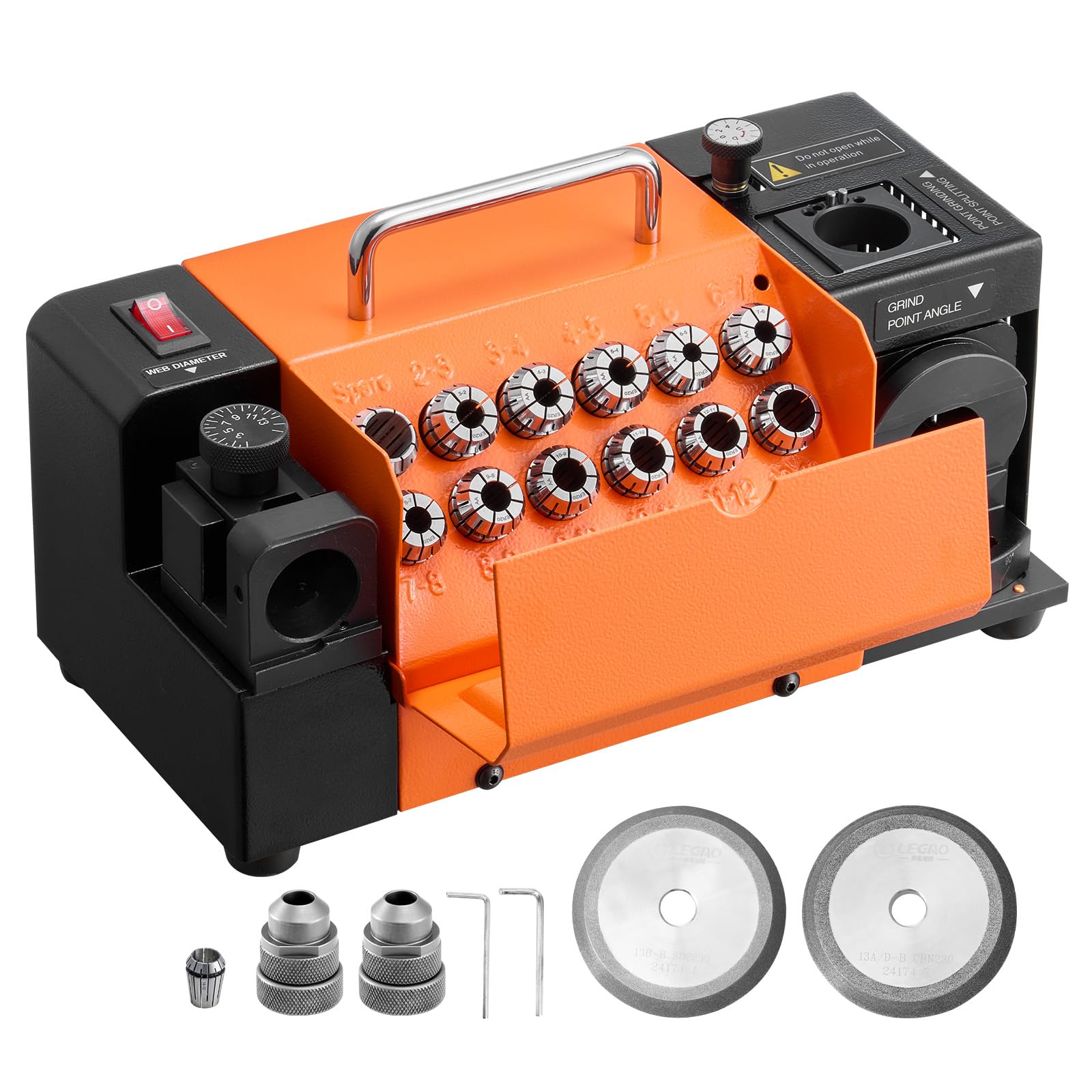
Eighteen pounds is the first thing you notice, and it is the trade the VEVOR asks you to make. This is a machine that lives on a bench, not something you tuck in a drawer beside the drill. In exchange it holds a bit the way a machine tool holds work: clamped, indexed, and repeatable.

Bits go into one of 11 collets covering 3 to 13 mm, and the collet seats in a chuck that indexes to the wheel, so the same geometry comes back every time. Point angle runs 95 to 135 degrees, which means a 135-degree split-point set stays a 135-degree split-point set instead of being talked into whatever the machine is set to. A CBN wheel and a 120-watt motor turning at 4,500 rpm are the other half of that: hard wheel, high speed, light passes.

Repeatability is the whole case for it. Sharpening one bit is easy; sharpening forty to the same point is where machines fall apart, and this is the one here that holds the line best. If you keep an index sharp for a shop or a serious garage, that consistency is worth both the bench space and the outlay.

Day to day it is a pleasure in the way machine tools often are: marked collets, a chuck that seats with a twist, and nothing plastic in the parts that hold the bit. It is also the least fiddly of the larger machines to feed, which is why it stayed set up rather than going back in its box.

Bottom line: The shop-grade pick: collet-held bits, a 95-to-135-degree point range, and the most repeatable grind of the machines here.

Check Latest Price
#04

Best Budget Electric

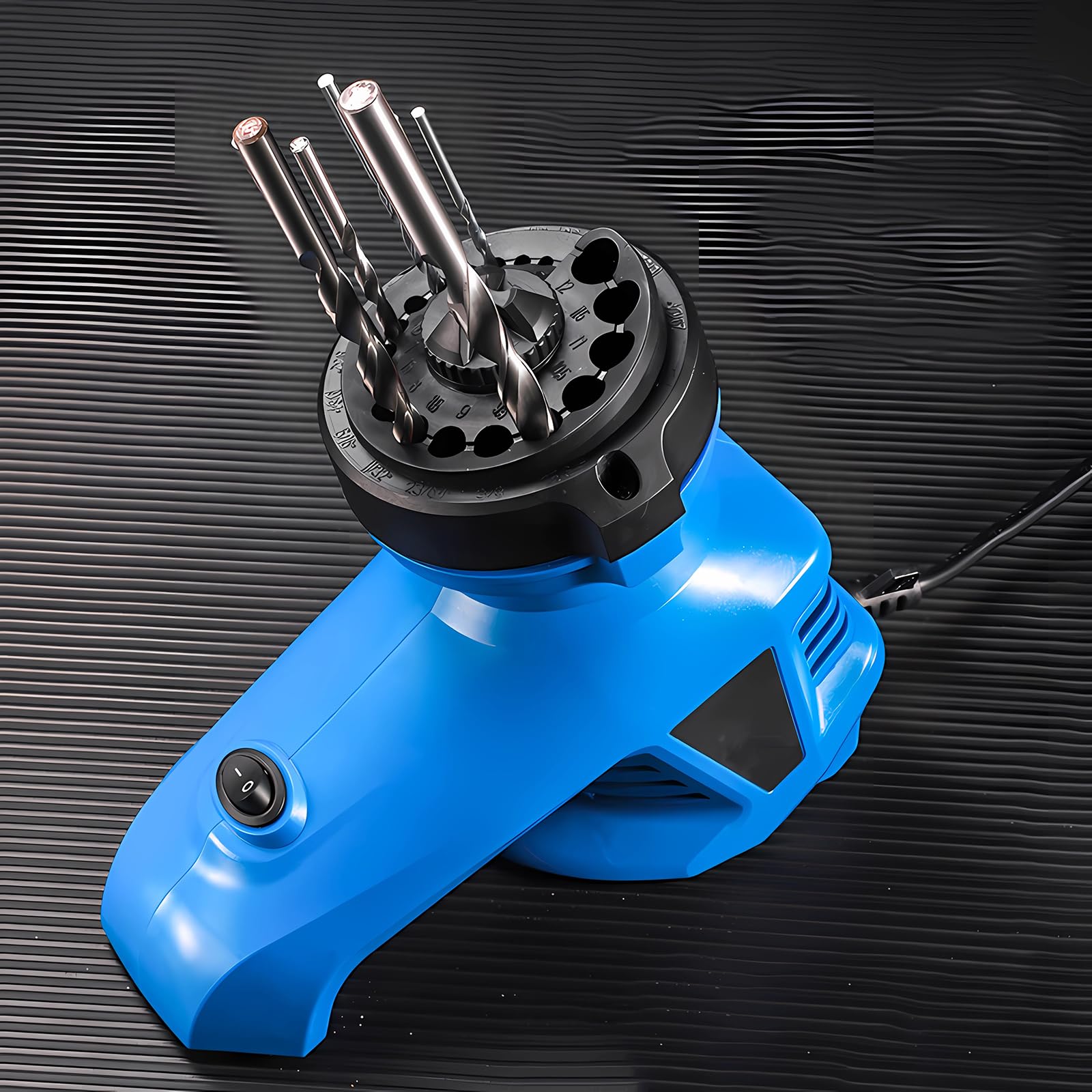
MDPSDS RS-1

83 /100
Kirk Score Excellent
Power
95 watts
Wheel
Built-in
Bit Range
1/8 to 15/32 in
Point Angle
130 degrees
Check Details on Amazon

Pros

  • Positioning plate sets the angle for you
  • Built-in wheel, nothing else to buy
  • Covers 19 sizes from 1/8 to 15/32 inch

Cons

  • Fixed 130-degree angle regrinds 118-degree bits

This sits at the low end of the powered machines here, and for a household with a drawer of tired bits that is most of the argument. It takes 1/8 to 15/32 inch across 19 sizes, through a positioning plate that sets the angle for you, and the grinding wheel is built in, so there is nothing else to buy before the first bit.

The catch is that the angle is fixed at 130 degrees. Most hardware-store sets are ground to 118, and this will regrind them to 130, which is a perfectly serviceable general-purpose point but no longer a match for the rest of the set. Rescuing neglected bits, that trade is worth making. Maintaining a matched index, it isn't.

Two things to know before you start. Small bits need a light hand: hold anything under 1/8 inch against that wheel and it can be gone before you have looked properly. And it is slower per bit than the collet machines, so this is a sharpener for a Saturday afternoon rather than a production bench. The plate does take the guesswork out of the angle, which is more than we expected at this end of the range.

Bottom line: A good cheap way to stop throwing bits away: the positioning plate sets the angle and the wheel is built in, though the fixed 130-degree point suits mixed drawers better than matched sets.

Check Latest Price
#05

Best for Tormek Systems

Tormek DBS-22

89 /100
Kirk Score Excellent
Bit Range
1/8 to 7/8 in
Point Angle
90 to 150 degrees
Point Geometry
4-facet
Clearance Angle
7, 9, 11 or 14 degrees
Check Details on Amazon

Pros

  • Four-facet point ground with both edges equal
  • Point angle 90 to 150 degrees, clearance 7 to 14
  • Takes bits from 1/8 to 7/8 inch
  • Wet grinding keeps heat off the tip

Cons

  • Does nothing without a Tormek base machine
  • Costs more than most complete sharpeners here

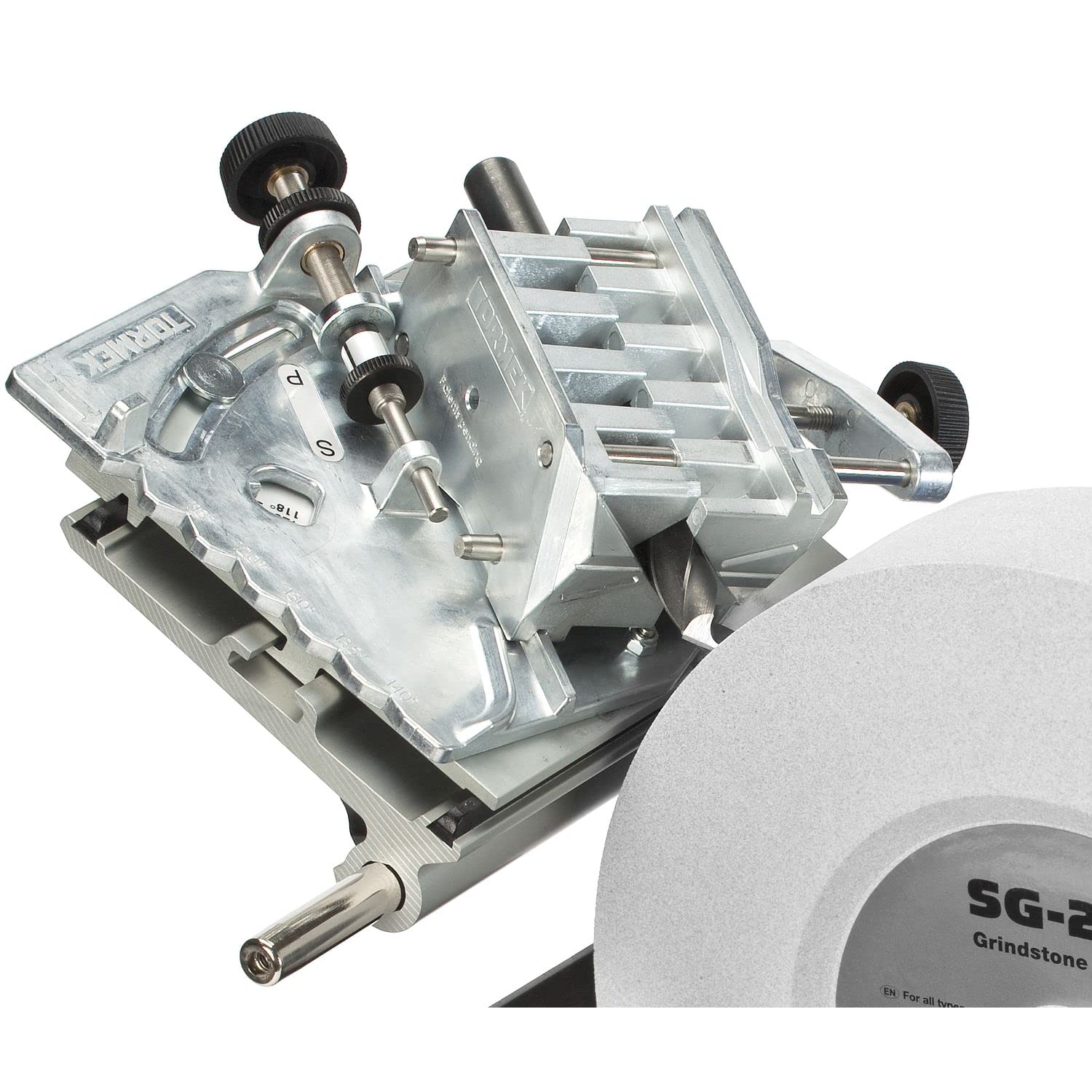
This is the jig we point Tormek owners to, and there's no point pretending it's anything else. The DBS-22 is built to run on a water-cooled Tormek base, and everything about it assumes that machine is already bolted to your bench.

What it does is geometry the rest of this group can't touch: four flat facets meeting at a chisel edge, both cutting edges ground equally, point angle anywhere from 90 to 150 degrees, and clearance set to 7, 9, 11 or 14. Because the wheel runs wet, the tip never gets hot enough to lose its temper, and a bit that comes off this jig doesn't walk when it touches metal.

The holder's cast alignment marks are rounded enough that getting a bit dead square takes practice, and the first few bits are a lesson in patience. Anyone with a Tormek knows the pattern: that system rewards setup and punishes hurry, and this jig is no exception. Give it an evening and the payoff is a point you can't buy off a shelf.

Bottom line: The best edge in this group, for the one buyer who can use it: four-facet geometry and full angle control on the Tormek you already own.

Check Latest Price
#06

Budget setup

General Tools 825

84 /100
Kirk Score Excellent
Type
Grinding jig attachment
Footprint
4.91 x 4.91 x 7.38 in
Point Angle
Adjustable
Countersinks
Yes
Check Details on Amazon

Pros

  • Cheapest sharpener of the group
  • Adjusts to nearly any point angle
  • Also grinds countersinks

Cons

  • Set screws can drift out of adjustment while grinding

The first hour with this one isn't sharpening, it's mounting. You have to fix it to a bench at the right angle and the right distance from the grinding wheel, and nothing in the box does that positioning for you. Get it wrong and every bit comes off lopsided, which is why the setup deserves more care than the sharpening does.

Once it's set, it earns the space. The adjustment will meet nearly any point angle you own, it handles countersinks as well as bits, and the non-marking depth stop keeps the tip where you put it. Bits from 1/8 inch up come out cutting; below that, it's more trouble than it's worth.

Nothing in the box teaches you to use it. The printed sheet is close to useless, so plan on a video and a handful of scrap bits to learn the sequence, because that is the difference between a tool that works and a tool that ruins a set.

What the money buys is a sharpener that costs less than a decent set of bits and can keep that set cutting for years. What it asks in return is an evening of setup and a tolerance for fiddling. If that's a fair trade, it's the cheapest route to sharp bits on this page; if you want them tonight, one of the electric machines gets you there.

Bottom line: The cheapest way into sharpening here, if you'll mount it square and learn it from a video; bits from 1/8 inch up come out cutting.

Check Latest Price
#07

Backup machine

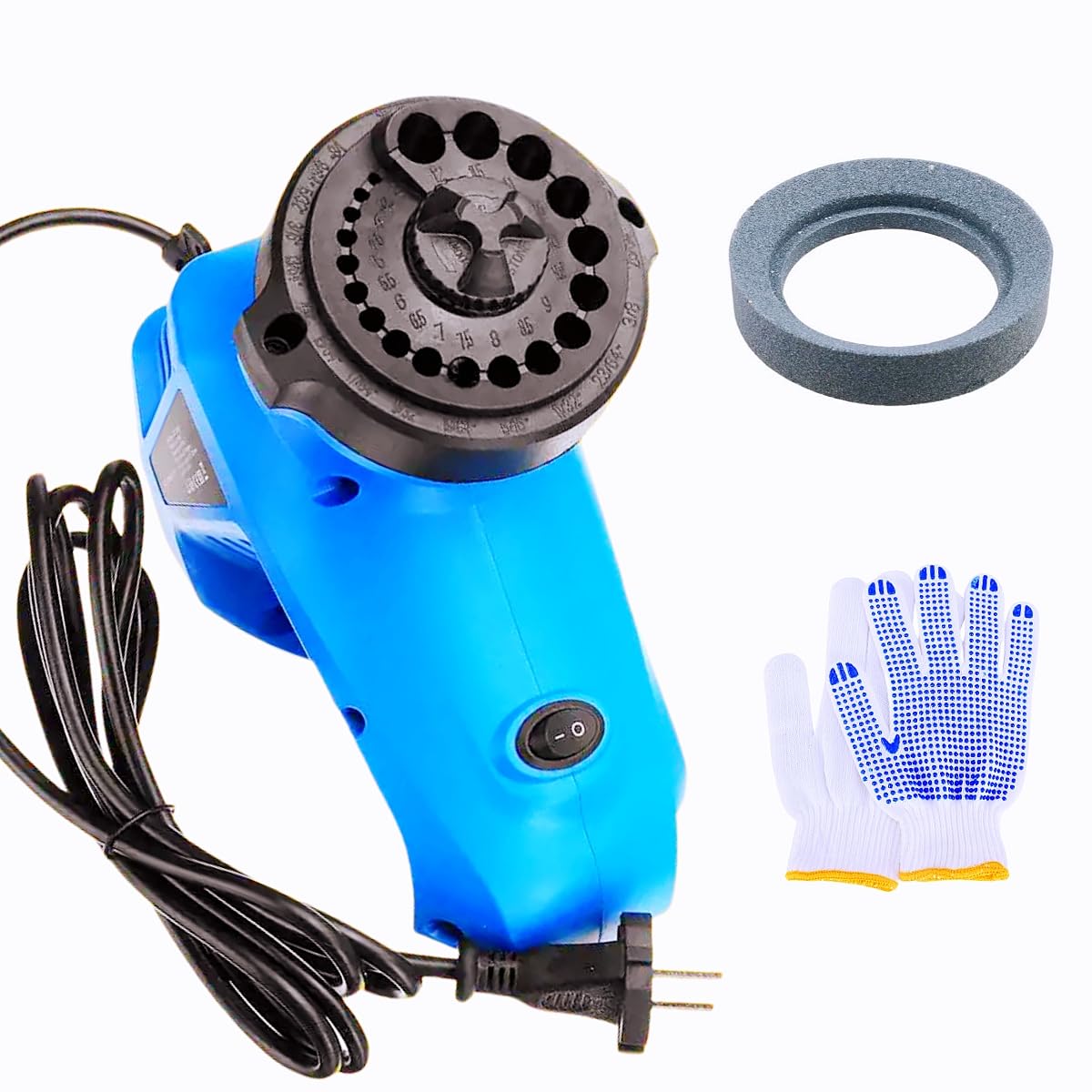
GMKD Sharpener

78 /100
Kirk Score Very Good
Bit Range
1/8 to 15/32 in
Point Angle
130 degrees
Sizes Handled
19
Grinding Wheels
Two included
Check Details on Amazon

Pros

  • Ships with a spare grinding wheel
  • Positioning plate fixes the angle for you
  • 19 sizes from 1/8 to 15/32 inch

Cons

  • Fixed 130-degree point regrinds 118-degree bits
  • Wheel is a wear item on cobalt and hard bits

Two grinding wheels come in the box, and the reason is more interesting than the fact. Cobalt bits wear a brown corundum wheel faster than plain steel does, so the second wheel is a consumable, not a bonus. It's an honest thing to include on a machine this cheap, and it tells you what the maker expects you to be sharpening.

The rest is the same recipe as the other budget unit here: 1/8 to 15/32 inch across 19 sizes, a positioning plate that holds the angle so you only control the pressure, and a fixed 130-degree point. Two seconds in the slot and out again is how it's meant to be used, and for touching up a tired general-purpose bit that's plenty.

Longevity is the open question. The plate is stamped, the body is light, and the two parts that wear, the wheel and the slot that guides the bit, aren't overbuilt. Buy it as a second machine for the garage or as a cheap way to find out whether you'll actually sharpen bits, and it makes sense. Buy it as the last sharpener you'll own and you're likely to be disappointed.

Bottom line: A cheap second machine for a garage drawer, with a spare wheel for cobalt bits; the fixed 130-degree point won't suit a matched 118-degree set.

Check Latest Price

How We Tested 11 Drill Bit Sharpeners

We started by gathering every sharpener that covered common twist-bit sizes, then narrowed to 11 that represented the main formats: bench-top machines, portable units, and jig attachments for a grinder. We favored models with adjustable point angles, multiple bit holders or collets, and a base that looked stable enough to stay put—the features that make a repeatable edge possible. Build quality got a quick hands-on check before testing: play in the guides, flex in the base, and how securely the bit holders seated.

Testing ran for eight months in a home garage and basement shop, mostly on weekend repair projects and a run of built-in shelving. Each session started with the instructions: we timed how long it took to get from unboxing to a first sharpened bit, and noted whether the manual answered basic questions about bit size and point angle. Then we sharpened a dull 3/8-inch twist bit, plus a masonry bit on the units that claimed to handle one, checking whether the point came out centered, the cutting edges were even, and the bit grabbed in scrap steel instead of wandering.

Adjustability got a hands-on pass: we changed point angles where the unit offered a choice, swapped holders, and noted whether the settings held or drifted and whether the controls moved smoothly. For stability, we set each unit on a smooth bench and sharpened a half-dozen bits in a row, watching for walking, vibration, or tipping; a small footprint only counted against a unit when it made the machine feel tippy. Durability came from repeat runs—20 bits in a session—watching for heat, wheel wear, and wobble. Finally, we weighed price against the cost of replacing bits, because a sharpener has to earn its bench space.

How to Choose a Drill Bit Sharpener

Start With the Sizes You Actually Dull

Most home indexes run to 1/2 inch, and the bits that wear out first sit in the middle of that range, not at the top. A machine covering 3/32 to 1/2 inch, like the Drill Doctor 500X, handles nearly everything a household sharpens. Step up to a 3/4-inch mouth only if you drill concrete or run hole saws.

The trap is paying for range you never use: a wider capacity costs more and claims more bench. The very small bits are the other end of the same problem. Anything under 1/8 inch grinds away quickly, so a light hand matters more than a specification on the box.

Self-Contained Machine or Attachment

Electric sharpeners take a bit, hold it, and grind it, with nothing else required. Attachments are cheaper because they leave the spinning and the rigidity to a machine you already own, and that is a good trade only when the machine is already on your bench.

The Tormek DBS-22 is the clearest example: it is an outstanding jig that does nothing until it sits on a Tormek base. The General Tools 825 wants a grinder behind it and a bench to bolt to. Starting from zero, price the complete machines before you fall for a jig's price tag.

Point Angle and Split Point

118 degrees is the general-purpose grind most bits ship with, 135 is common on cobalt and on bits for hard material, and several budget machines grind everything to 130. A fixed angle quietly regrinds your whole set to its setting, which is fine for a drawer of mismatched bits and irritating for a matched index. Adjustable ranges, 115 to 140 on the 750X and 95 to 135 on the VEVOR, let you match what you already have.

Split point is the other feature worth paying for. A small facet ground across the tip stops the bit skating on steel, and you feel it in the first second of a hole.

Setup, Alignment, and the Learning Curve

Every sharpener here lives or dies on how squarely the bit sits. Chucks and collets index the bit for you; a positioning plate holds the angle and leaves the pressure to your hand; a bench-mounted jig makes you set the geometry before the first bit goes in. Whichever you choose, put three or four worn bits aside to learn on.

Instructions are the weakest part of this category, so a ten-minute video closes most of the gap. Expect the first two bits you sharpen to be the worst two, and don't feed a good bit into a machine you haven't practiced on.

Frequently Asked Questions

Final Verdict

The Drill Doctor 500X is the one we point most people to. It covers the sizes a home index actually holds, cuts a split point that stops the bit walking, and asks less of you at setup than any other electric machine here.

Step up to the 750X only if your bits run past half an inch, or to the VEVOR if you're keeping an index sharp for a shop rather than a shelf. If a Tormek already sits on your bench, the DBS-22 is the best edge in this group, and without that machine it is the wrong purchase entirely.