// data-verified

Best Masonry Drill Bits of 2026

A masonry bit rarely fails dramatically. It just stops cutting — the tip rounds over, the drill starts smoking, and you end up leaning into the wall with both hands while the concrete wins. Usually it isn't the bit so much as the match: the wrong shank in the wrong chuck, or a bit asked to cut something harder than it was built for.

I've kept a jar of dead bits in my basement for years, most of them bought in a hurry the night before a project. So we ran 16 bits through four months of real work — shelves and a TV mount in poured concrete, a shed anchored into block, brick and mortar on a repointing job — and the good ones shared the same few traits.

The first is fit. An SDS-Plus shank only goes in a rotary hammer, a smooth round shank belongs in a hammer drill, and a hex shank is for an impact driver, so the bit has to match the tool you actually own before anything else matters. The picks below cover all three, from slim pilot bits up to the sizes you'd use for an anchor bolt.

#01

Best Overall

DEWALT DW5207 7-Piece Set

95 /100
Kirk Score Outstanding
Tip
2-cutter carbide
Flutes
4
Pieces
7
Shank Type
3-Flat
Check Details on Amazon

Pros

  • Three-flat shanks grip a standard chuck
  • Four flutes clear dust and protect the tip
  • Seven pieces cover everyday fixing sizes

Cons

  • Won't fit an SDS-Plus rotary hammer

What settles this set as our top pick is fit, in both senses. The three flats machined into each shank give a three-jaw chuck something to bite on, so the bit keeps turning once the hammer starts instead of spinning in the jaws, and seven pieces mean the diameter you need is usually already in the box. For a homeowner with a corded or cordless hammer drill, that is the whole job described in one sentence.

The cutting end is a two-cutter carbide tip on a four-flute body, and the flute count is worth more than it looks. Dust is what finishes masonry bits: once grit packs around the tip, the carbide overheats and chips. Four flutes lift that dust out of the hole instead of letting it grind, which is why this set keeps cutting through a run of holes in block.

The one thing worth knowing before you start is that these bits want a light hand. Carbide is hard and brittle, and leaning into old, hard concrete is how tips snap. Let the hammer do the work, back the bit out every inch or so to clear the dust, and you will finish the job with the same bit you started with.

Bottom line: Our default for anyone with a hammer drill: seven bits that hold fast in a three-jaw chuck, cut brick and block cleanly, and do not demand a rotary hammer to use them.

Check Latest Price
#02

Best for Rotary Hammers

Bosch HCK001 7-Piece SDS-Plus Set

95 /100
Kirk Score Outstanding
Case
Hard case included
Pieces
7
Shank Type
SDS-Plus
Size Range
3/16 to 1/2 in
Check Details on Amazon

Pros

  • Hard case with a slot per bit
  • Three 1/4-inch bits across two lengths
  • Centric carbide tips start without walking

Cons

  • Working lengths top out at 4 inches

The case is the first thing out of the box, and it is the detail that makes this set feel thought through: a hard, molded box with a slot for every bit, so a missing 3/8-inch is obvious at a glance rather than discovered up a ladder. Bits that rattle loose in a bag arrive at the wall with chipped tips.

Inside, seven bits run from 3/16 inch to 1/2 inch, with the 1/4-inch size appearing three times across two lengths. That repetition is not padding. Quarter-inch holes cover a lot of plugs and small anchors, and the short 2-inch working length is the one that gets used when you are drilling next to a baseboard or inside a cabinet.

The tips are centric-ground carbide with a wear mark ground into the flute, so you can see when a bit is past its best, and the SDS-Plus shank drops into any rotary hammer that takes the format. In concrete they start without skating, which is the difference between a clean hole and a wandering scratch you have to fill.

Where this set earns its place over a mixed assortment is consistency: seven bits that all cut the same way, a case that keeps them that way, and a wear mark that tells you when to stop rather than letting you find out on the last hole. Anyone who already owns a rotary hammer should start here rather than buying round-shank bits for a tool that cannot use them.

Bottom line: For an SDS-Plus rotary hammer, this is the set we reach for: seven carbide-tipped sizes in a hard case, with the 1/4-inch size repeated so the workhorse never strands you mid-job.

Check Latest Price
#03

Best Set With Chisels

WORKPRO 17-Piece SDS-Plus Set

91 /100
Kirk Score Outstanding
Pieces
17
Contents
12 drill bits, 5 chisels
Shank Type
SDS-Plus
Tip Material
YG8C carbide
Check Details on Amazon

Pros

  • Five chisels plus twelve SDS-Plus bits
  • Chisels break out block and mortar
  • Hard case holds all 17 pieces
  • Fits Bosch, Makita and Milwaukee hammers

Cons

  • Drill bits can arrive bent or wear fast

Five chisels is what makes this set worth a second look. Two points and three flats, plus twelve SDS-Plus drill bits, all in one case: if the job means taking tile off a wall or opening a hole in block as well as drilling it, this is one purchase instead of two, and it is the only set here that covers both.

The drill bits are cemented carbide with a U-shaped flute, arranged in four groups of lengths and diameters, and they run in any SDS-Plus hammer. In brick and softer stone they cut quickly. The chisels are the more convincing half: they break out block and mortar rather than drilling it, which is a job a drill bit simply cannot do.

Seventeen pieces need somewhere to live, and the case handles that, with a slot for each bit and chisel so the whole set travels as one box. For a bathroom strip-out or a wall you need to open up, that is a fair trade; for four clean holes in a garage wall, it is more tool than the job needs.

Bottom line: Buy this one for the chisels: five of them plus twelve SDS-Plus bits make it the set we keep for a bathroom strip-out or a block wall that needs opening up, not just drilling.

Check Latest Price
#04

Best Long-Reach Bit

Sabre Tools 1/2-Inch SDS-Plus Bit

91 /100
Kirk Score Outstanding
Diameter
1/2 in
Shank Type
SDS-Plus
Overall Length
12 in
Working Length
10 in
Check Details on Amazon

Pros

  • 10-inch working length reaches through walls
  • Self-centering carbide tip starts cleanly
  • Fits any SDS-Plus rotary hammer

Cons

  • Dulls sooner than expected in repeated drilling

Ten inches of working length is the number that matters here. This is a half-inch SDS-Plus bit with a 10-inch flute on a 12-inch body, which is what you need when the hole has to pass through a wall cavity, a thick concrete slab, or a layer of plaster before it reaches anything structural.

The tip is two-flute, self-centering carbide, and the flutes are shaped to push dust back out of the hole rather than let it pack around the cutting edge. The longer the bit, the more that matters, because a deep hole has a long way to clear. It seats in any SDS-Plus hammer and starts without skating on a smooth surface.

We keep coming back to it for the jobs where a short bit simply is not an option: running cable or pipe through a wall, setting a long anchor, or finding a fixing point buried behind plaster. It is one bit in one diameter, so plan the run before you start, because a half-inch hole is not the one to practice on.

Bottom line: Ten inches of working length turns a thick wall into an ordinary hole, and this is the single SDS-Plus bit we keep for pipe runs, long anchors, and anything a short bit cannot reach.

Check Latest Price
#05

Best Small-Bit Pack

Diablo 5/32-Inch 5-Pack

90 /100
Kirk Score Outstanding
Diameter
5/32 in
Pack Size
5
Shank Type
Hex
Working Length
3 in
Check Details on Amazon

Pros

  • Five identical bits, so spares are on hand
  • Grip-point tip resists walking
  • Hex shank fits chucks and impact drivers
  • 3-inch working length for deeper pilots

Cons

  • Hex shank won't fit SDS-Plus hammers
  • Dulls fast in hard concrete

Five bits, all the same size, which looks like a mistake until you have spent an afternoon on a ladder with a dull 5/32-inch and no spare. This is the diameter that does the small work, from pilot holes to light fixings and cable clips, and it is the one that dies first, so a pack of five is a supply rather than a set.

We appreciate the grip-point tip: it bites into concrete without walking across the surface, which on a small bit is the difference between a hole where you marked it and a scratch an inch away. The hex shank fits a three-jaw chuck and a quick-change impact driver, and three inches of working length is generous for a bit this size, so pilot holes can go deeper than the fixing.

Bottom line: Five identical 5/32-inch bits with a grip-point tip and a hex shank: the small-diameter pack we want in the box when the job is thirty pilot holes and one dull bit.

Check Latest Price
#06

Standard drills, brick

Bosch BM5000 14-Piece Set

89 /100
Kirk Score Excellent
Pieces
14
Shank Type
Round, straight
Size Range
1/8 to 1/2 in
Flute Design
Single-flute
Check Details on Amazon

Pros

  • Three each of the small sizes that break
  • Cuts brick and block without hammer action
  • Round shanks fit any three-jaw chuck

Cons

  • Not for poured concrete or hammer drilling

Not every masonry bit is meant to be hammered. The BM5000 is a fast-spiral rotary bit, ground to cut brick, block and mortar with a plain spinning drill rather than a percussion action. If your drill has no hammer setting, or you are working in soft brick that crumbles under impact, that distinction is the whole reason to own it.

Fourteen pieces, and the shape of the set is smarter than the count suggests: three each of 1/8, 3/16 and 1/4 inch, then one each of 5/16, 3/8 and 1/2 inch. We noticed those duplicates land exactly on the diameters that see the most use and break first, which makes this more practical than a set with fourteen different sizes, most of which go unused.

The single-flute design moves dust, the taper point resists walking, and the round shanks spin in any keyed or keyless chuck, including the old corded drill in the back of the garage. It is happiest at high speed with light pressure, and it is the set that turns a brick wall or a block partition into an ordinary afternoon's work.

Bottom line: For brick, block and mortar with a plain spinning drill, this is the set we point to; for poured concrete it is not, and no amount of patience will change that.

Check Latest Price
#07

Large anchor holes

Bosch HC2122 3/4-Inch SDS Bit

94 /100
Kirk Score Outstanding
Diameter
3/4 in
Shank Type
SDS-Plus
Overall Length
8 in
Working Length
6 in
Check Details on Amazon

Pros

  • Four flutes clear dust from deep holes
  • 6-inch working length on a 3/4-inch bit
  • Cuts large holes quickly in concrete
  • Fits any SDS-Plus rotary hammer

Cons

  • Tip can arrive less than sharp

Three-quarters of an inch is a different kind of hole. At that diameter you are not hanging a picture, you are running a pipe through a wall, setting a heavy anchor, or bolting a railing down, and the bit has to move a lot of material without wandering. This one carries 6 inches of working length on an 8-inch body, with four flutes to take the dust out.

Those flutes are why it clears itself: coarse fluting lifts drillings up and away instead of letting them pack around the tip, which keeps the carbide cooler in a deep hole. The tip is brazed carbide built for heavy loads, and in concrete the bit cuts faster than the size suggests, so a three-quarter-inch hole stops feeling like a project.

What earns it shelf space is that combination of speed and reach. It is the bit you keep for the one job a year that needs a big hole, and it will outlast that job. Buy it for the specific anchor or pipe you have in mind rather than as part of a collection, because a single large bit only earns its place when the size is one you actually need.

Bottom line: A single 3/4-inch SDS bit for pipe runs and heavy anchors: the flutes and working length we want when a big hole has to go through concrete without a fight.

Check Latest Price
#08

One-off jobs

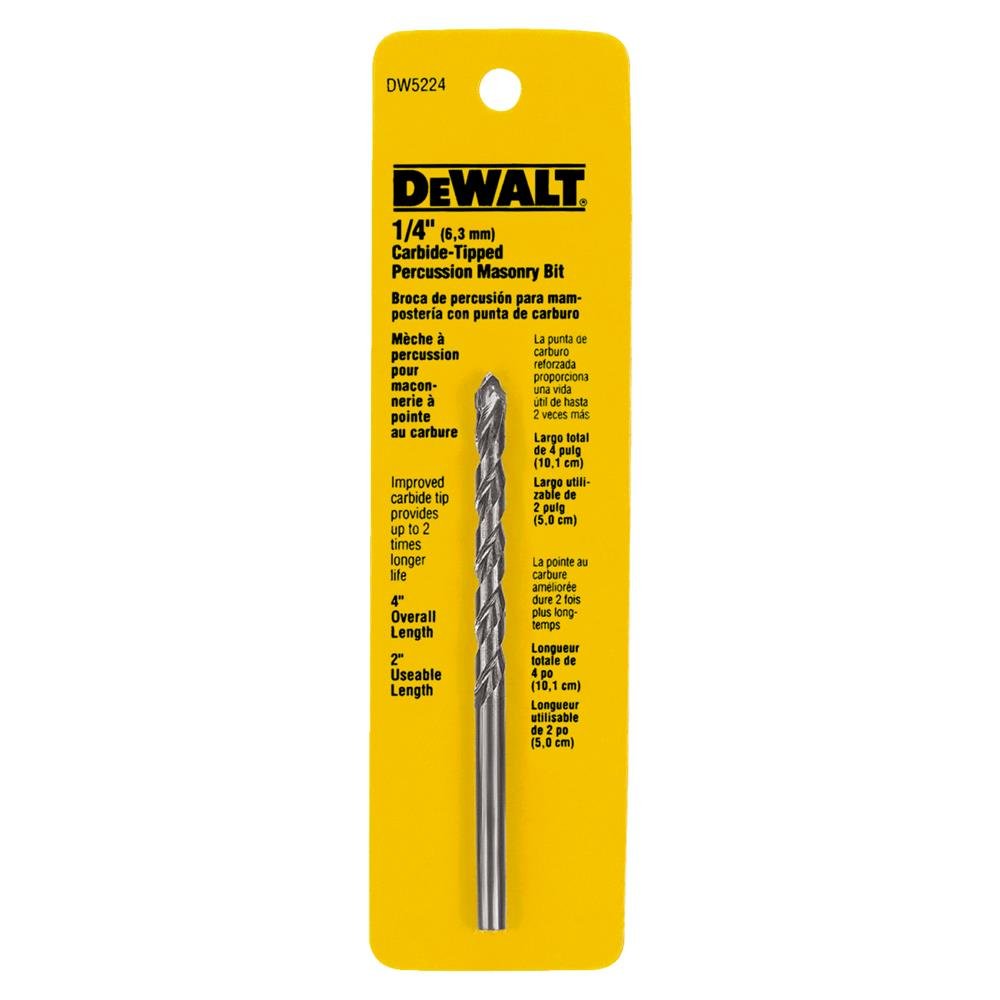
DEWALT DW5224 1/4-Inch Bit

91 /100
Kirk Score Outstanding
Flutes
4
Length
4 in
Diameter
1/4 in
Shank Type
Straight
Check Details on Amazon

Pros

  • Fits a standard three-jaw chuck
  • Carbide percussion tip for concrete
  • Four flutes clear dust as it cuts

Cons

One size, one bit, no case. The DW5224 is what you buy when the job is a few 1/4-inch holes for plugs or anchors and a set would be beside the point. At four inches overall it fits a standard three-jaw chuck, and it is a percussion bit, so it wants a hammer drill and a light hand rather than muscle.

In concrete and block it bites quickly for the first holes, and the four-flute body clears dust the way a masonry bit should. Nothing about it is fancy, from the straight shank to the plated finish, and that is fine for a bit that lives in a drawer until a shelf needs hanging.

The edge is the part that gives out. A bit this size working old concrete can go off after a handful of holes, and once the carbide rounds over, a file will not bring it back. Buy it knowing it is a job-sized bit rather than the start of a collection.

Where it makes sense is small, finished work: two brackets, a doorbell, a grab bar into a solid wall. A single quarter-inch bit gets those done without dragging out a set, and a bit you do not have to protect is one you will actually use.

Bottom line: For a handful of 1/4-inch holes in concrete or block, this single percussion bit does the job in a hammer drill, and that one job is all we ask of it.

Check Latest Price

How We Chose and Tested Masonry Drill Bits

We started with a list of about 40 bits and sets, sorted them by shank type, tip material, and the sizes people actually reach for, then dropped anything that duplicated a size we already had. Price mattered, but only as a tiebreaker — a cheap bit that dies after six holes costs more than a good one. That left 16 bits, ranging from single rotary hammer bits to a couple of multi-piece sets, and we used them for four months.

The testing happened wherever a hole was needed: a poured concrete basement wall, a block foundation, a brick chimney, and a stack of pavers. We drilled with a corded hammer drill and an SDS-Plus rotary hammer, noted whether each bit walked across the surface before biting, and timed the first hole in each material so we had a baseline for sharpness.

After that, durability was mostly repetition. We kept drilling until a bit noticeably slowed or stopped cutting, counted the holes it managed, and checked the hole diameter with a caliper after every tenth hole to see whether it was cutting oversize. Bits that bound up got pulled and inspected for bent shanks and rounded tips, and we watched how cleanly dust cleared the flutes, since a bit that packs with powder quits long before the carbide wears out.

Ease of use came down to small things: whether a bit seated in the chuck without wobble, whether we could back it out of a deep hole without a fight, and whether the case kept sizes findable. At the end we weighed what each one cost against the holes it produced, because value in this category is holes per dollar, not dollars per bit.

How to Choose Masonry Drill Bits

Match the shank to your drill first

A masonry bit that does not fit your drill is scrap, so start at the chuck. If yours has three jaws that tighten around the bit, which covers nearly every corded and cordless hammer drill, you want a round or three-flat shank; the flats are worth seeking out because they stop the bit spinning once percussion starts. If the bit slots in with a collar and sliding sleeve, you have an SDS-Plus rotary hammer and you need SDS-Plus bits.

The two families are not interchangeable. An SDS bit will not seat in a three-jaw chuck, and a round shank spins and chews its own shank in an SDS tool. Hex-shank masonry bits are the third option, made for quick-change chucks and impact drivers rather than rotary hammers.

Hammer bits, rotary bits, and what is in the wall

Most carbide masonry bits are percussion bits: the hammer action does much of the cutting, and they are the right choice for concrete, dense block and hard brick. Fast-spiral rotary bits are ground for a plain spinning drill and suit soft brick, block and mortar, where hammering crumbles the surface instead of cutting it. SDS bits belong with the percussion camp and are the fastest route through poured concrete.

The word masonry on a package covers a lot of ground. A rotary bit that is happy in old brick can polish for a minute and go nowhere in a poured foundation, and small-diameter bits dull first in hard concrete. Match the bit type to the material, and move up to SDS if the wall is poured concrete.

Buy for the sizes you use, not the piece count

Sets are sold on piece count, but what matters is how many of the small diameters you get. The 3/16 and 1/4-inch bits do most of the work in a house and they are the ones that break, so a 14-piece set with three 1/4-inch bits is more useful than a 20-piece set with one of each.

If one size is all you need, a single bit or a five-pack of that diameter is the better purchase. If you are mixing plugs, anchors and cable clips, look for a set that carries both short and long versions of the common sizes so a fixing in a tight corner does not send you back to the shelf.

Working length is reach, and reach decides the job

Bit listings give up to three numbers, and the one that matters is the working length: the fluted part that actually drills. A 1/4-inch bit with a 2-inch working length is fine for a shelf bracket. A fixing that has to pass through stucco, block and a cavity wants 4 inches or more, and a pipe run through a thick wall wants a 10-inch bit.

Longer bits flex more and clear dust more slowly, so buy the shortest bit that reaches. Before you start, work out how deep the hole has to go: the difference between a 6-inch and a 12-inch bit is often the difference between finishing the job and buying again.

Treat bits as consumables and drill like it

Carbide is hard and brittle, and every masonry bit eventually gives up its edge; small ones in hard concrete go first. That is normal rather than a defect, and it is why good sets repeat the popular sizes. Drill with light, steady pressure and let the hammer work, because leaning on the drill is how tips overheat and snap.

Clear the hole as you go. Back the bit out every inch or so to let dust escape, and do not force a bit that has stopped cutting: a spinning, smoking bit work-hardens the concrete and dulls itself at the same time. If a bit stops biting halfway through, change to a fresh one rather than pressing harder.

Frequently Asked Questions

Final Verdict

The DEWALT DW5207 is what we point most people to: it works in the hammer drill they already own, holds properly in a three-jaw chuck, and covers the sizes household fixings ask for. If your drill takes SDS-Plus bits, the Bosch HCK001 is the better set and the one to buy.

And if the job means taking something out as well as putting a hole in, the WORKPRO set's five chisels do what no drill bit can.