// data-verified

Best Drill Bits for Metal of 2026

Halfway through a steel bracket last spring, my bit stopped cutting and started smoking — which is how I learned the bit matters more than the drill. A set built for metal bites where you point it instead of skating across the surface, holds an edge long enough to finish the job, and doesn't send you back to the hardware store mid-project.

My team and I spent six months putting 14 sets through that bracket and through worse. Two things separate a good set from a frustrating one. Shank style comes first: hex-shank bits snap into an impact driver and shine on light-gauge work, while round shanks with three flats grip a standard chuck without spinning — the better bet for stainless and cast iron. Coatings come second: titanium nitride runs cooler, cobalt survives harder steel, but no coating saves a bit that's spinning in one spot. Count the sizes before you buy, too; four bits you'll never chuck up are worse value than eight you'll actually wear out.

The sets below earned their drawer space, and they didn't all earn it the same way.

#01

Best Overall

DEWALT DWA1184 14-Piece HSS Set

96 /100
Kirk Score Outstanding
Tip
135-degree split point
Shank
3-flat above 3/16 in
Pieces
14
Size Range
1/16 in to 1/2 in
Check Details on Amazon

Pros

  • Three-flat shanks resist spinning above 3/16 in
  • 135-degree split point starts without walking
  • Full range to 1/2 in in a marked, locking case
  • Budget price for a metal-ready set

Cons

  • High-speed steel stalls in stainless and hardened plate

Bits rarely fail by going dull first. They spin in the chuck the moment the flutes bite, the hole goes oval, the edge overheats, and the bit is finished. DEWALT's fix on this 14-piece set is a three-flat shank on every bit above 3/16 inch, so the jaws have a flat to lock against instead of a smooth cylinder to slip on. It's the least glamorous thing about the set and the main reason it holds up through a run of holes.

The geometry is metal-first in the ways that count. A 135-degree split point cuts on contact instead of skating across the surface, which is the usual failure of the 118-degree general-purpose bits in bargain kits, and the black and gold oxide coating handles friction and rust while the high-speed steel underneath takes on mild steel, aluminum, and sheet. We watched it start where we put it — no center punch, no wander — hole after hole in plate and light-gauge stock. That consistency is what separates a set you trust from one you fight.

Where the set stops is stainless and hardened material. High-speed steel loses its hardness at the temperatures those metals generate, and no coating changes that; for that work, move to the cobalt set below. For everything else, 14 marked sizes in a case that snaps shut is a lot of kit for the money, and it's the set we put in a first metalworking toolbox.

Bottom line: For mild steel, aluminum, and sheet metal, this is the set we hand people: split-point tips that don't walk and three-flat shanks that don't spin, in a full run of sizes.

Check Latest Price
#02

Best for Stainless Steel

Bosch CO21B Cobalt 21-Piece Set

93 /100
Kirk Score Outstanding
Shank
3-flat
Pieces
21
Material
M42 cobalt, 8% cobalt
Size Range
1/16 in to 1/2 in
Check Details on Amazon

Pros

  • Cobalt alloy holds hardness in stainless steel
  • Duplicates the small sizes that break first
  • 21 pieces with 3-flat shanks and split points

Cons

  • Premium price that only pays off on hard metal

Stainless steel is where ordinary bits give up. The metal work-hardens under a dull edge, so a bit that sailed through mild steel will polish a bright spot on a stainless plate all afternoon without making a chip. The Bosch CO21B is the set we reach for when the job is stainless, cast iron, or a hardened bolt, because the M42 alloy carries 8 percent cobalt in the steel itself rather than as a coating on top.

That distinction is the whole purchase. Titanium nitride and gold oxide are surface treatments that cut friction and rust; cobalt changes what the cutting edge is made of, so it keeps its hardness at temperatures that soften plain high-speed steel. Bosch also duplicates the sizes that die first here — two each of 1/16, 5/64, 1/8, 3/16, and 1/4 inch — which tells you the set was built for people who burn through small bits.

So you get 21 bits to 1/2 inch, three-flat shanks, and 135-degree split points for a premium price. We think that's the right buy only if hard metal is a regular part of your work; on mild steel and aluminum you're paying for headroom you'll never use. Cobalt is not a force field either — the edge can chip if it's run fast and dry, so plan on low speed, steady pressure, and cutting fluid on every hole.

Bottom line: Buy this one when the metal is stainless, cast iron, or a hardened bolt — the cobalt in the alloy is what keeps the edge alive, and the price only makes sense for that work.

Check Latest Price
#03

Best for Deep Holes

DEWALT DWA1181 21-Piece HSS Set

0 /100
Kirk Score Fair
Flute
Parabolic, 31-degree helix
Pieces
21
Material
High-speed steel, black oxide
Size Range
1/16 in to 1/2 in
Check Details on Amazon

Pros

  • Parabolic flute lifts chips out of deep holes
  • 21 pieces reaching 1/2 inch
  • 135-degree split points and black oxide coating

Cons

  • Edge life is uneven across the sizes

A deep hole is a chip-removal problem before it's a cutting problem. As the flutes go deeper they have less room to lift swarf, and a bit that packs chips starts rubbing instead of cutting. The parabolic flute and 31-degree helix on this 21-piece DEWALT set are shaped for exactly that, which is why it's our pick when the hole has to go all the way through thick stock, tube, or stacked plate.

The rest is familiar ground done well: high-speed steel with a black oxide coating, 135-degree split points that start without a center punch, and a full spread of sizes up to 1/2 inch. The shallower helix keeps the aggressive flute from screwing the bit into the workpiece when it grabs, which is what makes a parabolic bit trustworthy in a handheld drill and not just a drill press.

If your drilling is mostly plate under a quarter inch thick, the extra flute buys you nothing and the 14-piece set we recommend first is the better buy: fewer bits, less to lose, and the same split points. This one earns its place on depth and chip flow, and it's the set we keep loaded for anything where the swarf has to travel.

Bottom line: The set we pick when a hole has to go deep: the parabolic flute lifts chips out of the bore instead of grinding them back into the cut.

Check Latest Price
#04

Best for Impact Drivers

Makita B-65399 Impact Gold 14-Piece

91 /100
Kirk Score Outstanding
Shank
1/4 in hex, impact rated
Pieces
14
Coating
Titanium nitride
Size Range
1/16 in to 1/2 in
Check Details on Amazon

Pros

  • Impact-rated 1/4-inch hex shanks
  • Full range from 1/16 to 1/2 inch
  • TiN coating reduces friction and heat

Cons

  • Sold without a stated manufacturer warranty

If the tool in your hand is an impact driver rather than a drill, a round-shank set is the wrong purchase: there's nothing for a quick-change collar to grab, and the bit wobbles from the first hole. Makita puts a 1/4-inch hex shank on all 14 bits in the B-65399 and rates them for impact use, and that single decision is why it earns a place here.

Sizes run 1/16 to 1/2 inch, the tips are 135-degree split points, and the titanium nitride coating is doing friction and heat duty rather than hardness duty — on hand-drill work that mostly means the bit runs cooler and gives you a few more holes before the edge goes. The shank is the real feature, though: swap a driver bit for a drill bit without touching a chuck, which is the entire reason impact-rated sets exist.

One thing to know before you buy: a hex shank wants a quick-change collar, and in a three-jaw chuck it can slip if the jaws aren't snug. That's a fair trade if your impact driver is also your drill, and money spent on the wrong format if it isn't.

Bottom line: If your drill is really an impact driver, start here — the impact-rated hex shanks lock into a quick-change collar and cover everything from 1/16 to 1/2 inch.

Check Latest Price
#05

Best for Sheet Metal

Milwaukee Shockwave 23-Piece Kit

93 /100
Kirk Score Outstanding
Tip
135-degree split point
Pieces
23
Coating
Titanium
Largest Size
3/8 in
Check Details on Amazon

Pros

  • Aggressive grind and helix for sheet metal
  • 135-degree split point starts without a punch
  • 23 pieces in a compact case

Cons

  • Stops at 3/8 inch with no 1/2-inch bit

Sheet metal punishes a lazy bit. Too little rake and the edge skates across the panel; too much and it grabs, tears, and leaves a keyhole instead of a hole. Milwaukee's Shockwave grind sits on the aggressive side — four flutes and a red helix that throws chips clear — and it's the set we reach for when the material is thin.

Twenty-three bits cover the small and mid sizes that brackets, panels, and aluminum extrusion actually call for, with a 135-degree split point that starts on flat stock without a center punch. What struck us in use is how little time we spent backing the bit out to clear a hole: the helix moves the chip along instead of recutting it, and the titanium coating keeps friction down when you're making a run of holes in the same panel.

The straight shank makes it a chuck-only set, so it isn't the one for an impact driver, and the case is bulkier than 23 short bits really need. Neither matters much beside how comfortably it handles light-gauge work. This is the kit that lives in the bag for small hardware and quick brackets, not the one you buy for structural steel.

Bottom line: Our pick for sheet metal and small hardware: an aggressive grind and a chip-clearing helix that make short work of thin stock.

Check Latest Price
#06

Small holes

Bosch TI5IM 5-Piece Impact Set

93 /100
Kirk Score Outstanding
Shank
1/4 in hex, impact rated
Pieces
5
Coating
Titanium nitride
Size Range
3/32 in to 1/4 in
Check Details on Amazon

Pros

  • Impact-rated hex shanks in the small sizes
  • No-skate split points for steel
  • Compact case that fits a tool bag

Cons

  • Short bits run out of reach in deep work

Five bits in a small case is not the set you buy to cover a workshop. It is, though, the cheapest set here for keeping impact-rated bits on hand for the holes that turn up constantly — a 1/8-inch pilot, a 3/16-inch clearance hole, a 1/4-inch pass through a bracket.

The sizes are 3/32, 1/8, 5/32, 3/16, and 1/4 inch, which is the small end of the range and exactly where bits break and where a hex shank earns its keep in a quick-change collar. Bosch aims the tip geometry at heavy-gauge and high-carbon steel, and the titanium nitride coating adds a little lubricity when the bit is buried in a hole.

What five bits means over a project is that the two sizes you use most wear out first, and this set doesn't duplicate them, so it's a top-up kit rather than a primary one. Buy it to keep impact-rated small bits in the bag alongside a full range like the Makita or the DEWALT, and it does its job without fuss.

Bottom line: An inexpensive way to keep impact-rated bits in the small sizes on hand, provided you don't expect jobber length or a wide range.

Check Latest Price
#07

Single-size replacement

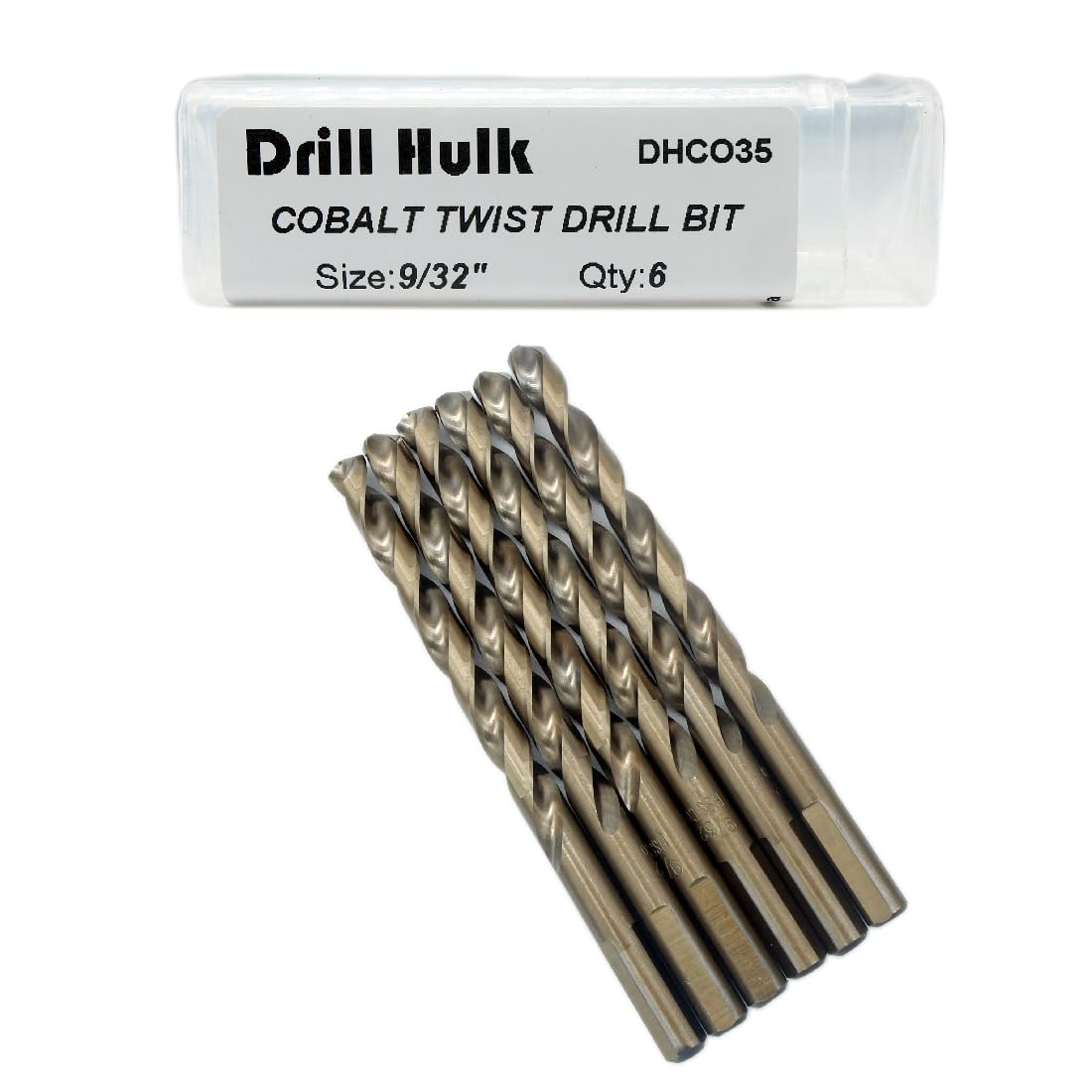
Drill Hulk 9/32-Inch Cobalt 6-Pack

92 /100
Kirk Score Outstanding
Size
9/32 in
Length
Jobber, 4-1/4 in overall
Pieces
6
Material
M35 cobalt, 5% cobalt
Check Details on Amazon

Pros

  • M35 cobalt keeps its hardness when hot
  • Jobber length with 3-flat shanks
  • Six of one size, resharpened not replaced

Cons

  • One size only, so it is not a starter set

Every shop has one size that dies. For a lot of people drilling steel it's the 9/32 or the 1/4 inch — the size that goes into every bracket and clearance hole until it dulls, then snaps, and suddenly you're buying a whole new set to get one bit back.

This six-pack is the answer to that specific problem. The bits are M35 cobalt with 5 percent cobalt in the alloy, jobber length at 4-1/4 inches overall with a 2-15/16-inch flute, 135-degree split points, and three-flat shanks that hold in the chuck. Cobalt's advantage is red hardness — the edge keeps cutting while it's hot — and because the hardness runs through the whole bit rather than sitting in a coating, it can be resharpened and put back to work.

What it won't do is drill everything. The bits can still stall and skate on work-hardened stainless if they're run fast or dry, and a single 9/32-inch size is not a general-purpose kit. It's a replacement part, and it should be judged as one.

Judged that way, we like it. Keeping the size you actually wear out in stock, in a steel that survives stainless, makes more sense than a third full set bought for one bit — and six of them means you're not rationing the last one.

Bottom line: The sensible buy when one size keeps dying on you: six cobalt 9/32-inch bits that can be resharpened, without another full set.

Check Latest Price

How We Tested Metal Drill Bits

We started by gathering every set that covered the sizes a home shop actually reaches for, then filtered by bit material, shank style — round with three flats versus impact-rated hex — whether the case holds bits without spilling them into a toolbox, and price per bit against buying singles. That left 14 sets, which we ran for six months on the same bench.

Most of the work happened on Saturdays: steel brackets, angle iron, a trailer frame, thin stainless during a kitchen repair, aluminum plate for a bike rack mount. We drilled with a cordless on high and low speed and with a drill press, noting how each bit started — biting on contact or wandering until we center-punched.

Durability and sharpness got the slow test. We drilled counted runs in 1/8-inch mild steel, tallying holes until a bit quit throwing chips and started squealing, then checked the tip for rounding and the flutes for bluing. We caliper-checked bits from each set against their stamped size, spun them in a keyless chuck to watch for wobble, and measured overall length to see which ones reached into a recessed hole.

For material compatibility, every set got the same stainless, cast iron, aluminum, and light-gauge sheet. We tracked which sizes went missing or doubled up, whether the case survived being carried around, and what each set cost per usable bit.

How to Choose Drill Bits for Metal

Material First: High-Speed Steel or Cobalt

Nearly every bit in this guide is high-speed steel, and for mild steel, aluminum, sheet, and brass that's all you need. Cobalt is the step up: M42 with 8 percent cobalt or M35 with 5 percent keeps its hardness at higher temperatures, which is what stainless, cast iron, and hardened fasteners demand.

Coatings are a separate question. Titanium nitride and black oxide reduce friction and rust but don't make a soft bit hard, so don't pay a premium for a coating and expect cobalt performance. Our advice is to buy high-speed steel for general work and add a cobalt set only when stainless is a regular material rather than an occasional one.

Point Geometry and the Walking Problem

On metal the point does two jobs: start the hole where you marked it and spread the load as it cuts. A 135-degree split point cuts on contact and resists walking, which is why it turns up on every metal-first set here. The older 118-degree chisel point skates until it bites and wants a center punch on anything smooth.

Pilot-point tips start fast in sheet and plastic but are less at home in thick steel. On polished stainless or a curved surface, punch a mark anyway — geometry helps, it doesn't guarantee.

Shanks: Round, Three-Flat, or Hex

The shank decides whether the bit stays put. Round shanks are the default and work fine in a keyed chuck. Three-flat shanks, which DEWALT fits to the larger sizes in both of its sets here, give the jaws something to bite, and that matters once a bit above 3/16 inch starts pulling hard.

Hex shanks are for quick-change collars and impact drivers: they lock positively and swap in a second, but they tie you to that tool. Match the shank to the drill you'll actually hold, not to the one in the catalog photo.

Sizes, Duplicates, and the Case

Look at the largest size before anything else. A set that stops at 3/8 inch won't drill a 1/2-inch clearance hole, and buying that bit separately often costs more than the difference between two sets. Then check whether the sizes that actually break — 1/8, 3/16, 1/4 inch — appear once or twice; the Bosch cobalt set duplicates them deliberately.

A case with marked slots is worth a little extra. Bits rattling loose in a bag are the fastest way to lose the one you need and dull the rest.

Technique Outlasts Any Bit

Most bits that fail on the first hole were run too fast. Steel wants low speed, firm steady pressure, and a chip that keeps moving; if the bit squeals or the flutes turn blue, you're burning the edge off. Use cutting fluid on steel and stainless, clear chips with a pecking rhythm on deep holes, and drill a pilot hole before opening anything past 1/4 inch.

None of that rescues a dull bit, but it's what separates a set that lasts from one that doesn't.

Frequently Asked Questions

Final Verdict

Most people drilling metal need one set, and it's the DEWALT DWA1184. The split points start where you put them, the three-flat shanks stop the spinning that ruins cheaper bits, and the range runs to 1/2 inch without a premium price. Spend what you saved on cutting fluid and a center punch.

If stainless, cast iron, or hardened bolts are a regular part of your week, go straight to the Bosch CO21B instead — cobalt is the only thing in this group that keeps an edge in that work.