// data-verified

Best Drill Bits of 2026

A drill bit that walks off your mark or snaps halfway through a hole can turn a ten-minute repair into an afternoon at the hardware store. The right bit cuts a clean hole and keeps its edge through wood, plastic, and light metal; the wrong one dulls by the second weekend. Too many cheap bits have spun in soft pine on my watch.

Over four months, my team and I put 16 sets and single-bit packs through their paces—drilling pilot holes in pine and oak, boring through plastic, and pressing into steel and aluminum. We noted how they tracked, cleared chips, and held up after repeated holes. One thing first-time buyers miss: shank style matters as much as the tip—three-flat and hex shanks grip without slipping, while round shanks can spin.

Value isn't just a low sticker price; it's how many clean holes you get before a bit starts to wander. The picks below reflect that trade-off, from compact sets that cover the basics to cobalt bits meant for harder metals. We didn't crown anything that couldn't keep a consistent hole size.

#01

Best Overall

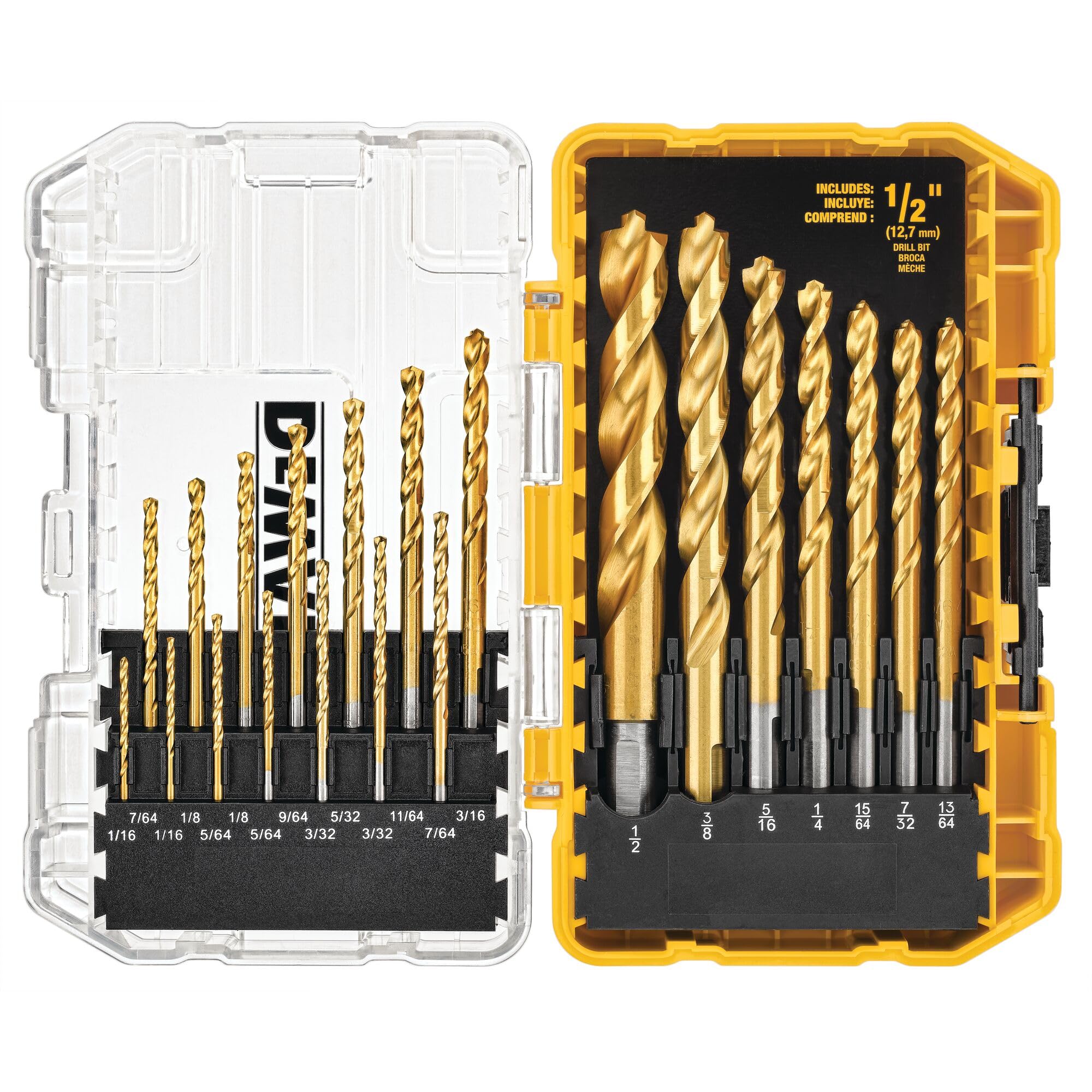
DEWALT DW1361 Drill Bit Set

96 /100
Kirk Score Outstanding
Case
Plastic tough case
Set Size
21 pieces
Size Range
1/16 in to 1/2 in
Point And Coating
Titanium nitride pilot point
Check Details on Amazon

Pros

  • 21 sizes from 1/16 to 1/2 inch
  • Pilot point starts on contact
  • Titanium nitride coating with tapered web

Cons

  • Bits sit tight in the case and come out stiffly

Twenty-one bits, running from 1/16 inch up to 1/2 inch, is the first reason this is the set we point most people toward. The second is the pilot point: the tip starts cutting on contact instead of skating, so on pine, plywood, and most plastic you can skip the center punch and go straight to the hole. Anchors, cable, pilot holes, and bolt clearance all sit inside that range.

Of everything here, this covers the widest spread of household work without asking you to think about it. We chucked these into pine, plywood, plastic, and mild steel, and what stood out is how little technique they demand — keep the drill straight and the hole arrives. The titanium nitride coating is a wear treatment rather than a speed trick, and the tapered web behind the point is what DEWALT credits for the bits holding together instead of snapping.

Where a set like this has bad days is in the smallest sizes. The 1/16 and 5/64 bits are thin steel, and thin steel can snap in sheet metal when you lean on the drill. Buy the individual sizes as they go, which DEWALT sells, and keep the drill slow and square in metal; the point and the coating are doing the real work, not your body weight.

Bottom line: If you want one set that handles wood, plastic, and the occasional metal bracket, this is the one we hand people: 21 sizes to 1/2 inch, with pilot points that start where you put them.

Check Latest Price
#02

Best Value

DEWALT DWA1184 Drill Bit Set

96 /100
Kirk Score Outstanding
Point
135-degree split point
Shank
3-flat above 3/16 in
Coating
Black and gold oxide
Set Size
14 pieces
Check Details on Amazon

Pros

  • Three-flat shanks resist spin-out
  • Split point starts cleanly in metal
  • Best value in this group

Cons

  • Lid closure is awkward to work

Spin-out is the failure nobody warns you about: the bit grabs, the chuck slips, and the shank comes out chewed. This set's three-flat shanks, on every size above 3/16 inch, are why we rate it the best value here. The flats give the jaws something to bite, so the bit turns with the chuck instead of inside it.

The rest of the package is unfussy in the way that matters: high-speed steel with a black-and-gold coating, a 135-degree split point that keeps the bit from wandering when you start a hole in metal, and 14 pieces running up to 1/2 inch. That is fewer sizes than the 21-piece top pick, so you may find yourself buying a single when a job calls for something in between, and a punch mark still helps on smooth steel, where the split point only does so much.

What we did not expect at this end of the range is how well the bits hold their edge in metal — this is the set we reach for when we do not want to think about the good bits. It is also the set that belongs in a second toolbox or a first apartment: enough range for furniture, anchors, and cable, without paying for capability nobody there is going to use.

Bottom line: The best value in this group: three-flat shanks stop the bit spinning in the chuck, and 14 sizes cover everyday wood, plastic, and light metal work for the least money here.

Check Latest Price
#03

Best for Stainless Steel

Bosch CO21B Cobalt Drill Bit Set

93 /100
Kirk Score Outstanding
Point
135-degree split point
Shank
3-flat
Material
Cobalt M42, 8% cobalt
Set Size
21 pieces
Check Details on Amazon

Pros

  • M42 cobalt holds hardness in hot metal
  • Two of each small size most likely to snap
  • Three-flat shanks on every bit

Cons

  • Costs more than every other set here

Stainless is where drill bits go to die. It work-hardens under a dull edge and the heat pulls the temper out of ordinary high-speed steel, which is why the cobalt question comes up the moment somebody needs a hole in a sink, a bracket, or a rusted exhaust bolt. Bosch builds this set for that job: M42 steel with 8% cobalt, which holds its hardness at temperatures that would soften a standard bit.

The pack-out tells you Bosch knows where sets fail. The small sizes — 1/16, 5/64, 1/8, 3/16, and 1/4 inch — all appear twice, so the bits most likely to snap or blunt in metal have a spare sitting in the same case. Every bit carries a three-flat shank, and the sizes are easy to put your hand on without reading glasses.

It is the most capable metal set here, and it is priced like one. Cobalt buys margin rather than immunity: we run these slow and wet in stainless, and the bits that dulled soonest are the ones pushed fast and dry. Treat it as a hard-metal bit that will also drill wood, not the other way round.

Where it does not earn its keep is a woodworking shop or a general household set. Nothing here drills pine or plywood more cleanly than the top pick, and you would be paying for heat resistance that never gets used. The case is good and the sizes are clear; the argument for buying it is the material on the other side of the chuck.

Bottom line: The cobalt set we reach for when stainless or cast iron is on the bench: two of each small size, three-flat shanks, and an edge that survives heat.

Check Latest Price
#04

Best for Quick-Change Chucks

Makita B-65399 Impact Gold Drill Bit Set

91 /100
Kirk Score Outstanding
Point
135-degree split point
Shank
1/4 in hex, impact rated
Coating
Titanium nitride
Set Size
14 pieces
Check Details on Amazon

Pros

  • Hex shanks click into quick-change chucks
  • Rated for 1/4-inch impact drivers
  • 135-degree split point resists walking

Cons

  • Fewer sizes than the 21-piece sets here

We kept this set beside a quick-change chuck and stopped swapping bits by hand. The 1/4-inch hex shank clicks in and out of a quick-release holder in a second, and on a job that walks from pilot hole to clearance hole to one size up, that is the difference between working and fiddling.

Fourteen bits, 1/16 inch to 1/2 inch, titanium nitride coated, all with a 135-degree split point for a start that does not wander. Makita's claim that the coating lasts 2.5 times longer than uncoated bits is the manufacturer's figure and not something we measured; what we can say is that the coating is doing the same job here as on the DEWALT sets, and the hex seats without wobble in a quick-release holder.

The catch is the chuck. In a keyed three-jaw chuck the hex shank buys you nothing — you are still tightening jaws, and the flats give them less to grip than a round shank would. If your drill has a standard chuck, the DEWALT DWA1184 does the same work for less and holds better; if you live on a quick-change holder or an impact driver, this is the set that makes sense.

Bottom line: If your drill or driver takes 1/4-inch hex shanks, this is the set to keep loaded: bit changes take a second and the 135-degree split points still start cleanly.

Check Latest Price
#05

Wood and plastic

CRAFTSMAN CMAM2214 Drill Bit Set

94 /100
Kirk Score Outstanding
Point
Split point
Coating
Gold oxide
Set Size
14 pieces
Size Range
1/16 in to 1/2 in
Check Details on Amazon

Pros

  • Lowest price in this group
  • 14 sizes running up to 1/2 inch
  • Case keeps the bits indexed

Cons

  • Not the set for steel or aluminum

Cheapest here, and shaped like a proper set: 14 gold-oxide bits from 1/16 inch to 1/2 inch with a split point, in a case that keeps them indexed instead of rattling around a drawer. For a spare toolbox, a first apartment, or a garage where the drilling is mostly pine and PVC, that is a sensible place to start.

We like it for what it honestly is — a wood-and-plastic set at the bottom of the price range — and we do not expect it to be more than that. The size markings are clear, the lid keeps everything where you left it, and for hanging shelves, running cable, and building a plywood box it does what a set costing several times as much would do.

What you get for the money is the full span, including the 1/2-inch bit that most cheap kits leave out and that people usually end up buying on its own. That single bit is the reason this set is worth a place in the garage rather than a bigger box with more duplicates of sizes you already have.

Bottom line: A sensible first set for wood and plastic at the lowest price here, as long as steel and aluminum are not what you plan to drill.

Check Latest Price
#06

Repeated steel drilling

Drill Hulk 1/4-Inch Cobalt Drill Bits

92 /100
Kirk Score Outstanding
Shank
3-flat
Diameter
1/4 in
Material
M35 cobalt, 5% cobalt
Quantity
12 bits, one size
Check Details on Amazon

Pros

  • Twelve bits in the size that wears out first
  • M35 cobalt handles heat in steel
  • Can be resharpened repeatedly

Cons

  • Dulls in hardened stainless steel

Twelve identical 1/4-inch bits looks like an odd purchase until you have snapped your third one mid-job. This is a refill pack rather than a first set: cobalt jobber bits, 4 inches overall with a 2-3/4-inch flute, each with a 135-degree split point and a three-flat shank.

The steel is M35 with 5% cobalt, and the property that matters is hardness running uniformly through the bit rather than only at the tip, which is what lets you take a dull one back to a grinder and bring the point back instead of throwing it away. We ran one through a length of mild steel and it held its line, and the three-flat shank did its job in a keyed chuck without the spin a round shank gives you.

What it is not is a replacement for a set, and it is priced like the specialist item it is. What it is: the answer for somebody drilling brackets, hinges, and pilot holes in steel all afternoon, where 1/4 inch does most of the work and is the size that keeps disappearing into the swarf. Buy it alongside a set, not instead of one.

Bottom line: For anyone who drills 1/4-inch holes in steel all day, a dozen cobalt bits of the same size beats a set with one of each — you never stop to resharpen.

Check Latest Price

How We Tested Drill Bits on Wood, Metal, and Plastic

We started by pulling together the drill bit sets and singles that keep showing up in reviews and on job sites, then sorted them by coating, point geometry, shank type, and the materials they claim to handle. We ruled out anything that couldn't cover at least two of the three basics—wood, plastic, and metal—unless it was a dedicated cobalt bit for hard metal.

In total, we tested 16 sets and packs over four months. At my workbench and on weekend projects, I used each bit in a cordless drill and, where the shank allowed, an impact driver. I drilled pilot holes in pine, oak, and plywood; ran bits through plastic; and pressed into mild steel, stainless, cast iron, aluminum, and light-gauge metal.

I watched whether a bit walked across the surface before biting, how quickly chips cleared, and whether the hole stayed round after repeated use. To check sharpness and durability, I drilled the same size hole 20 times in scrap and noted when a bit started to heat up, squeal, or need more pressure. For metal compatibility, I paid attention to which bits cut cleanly in stainless versus which only smeared the surface.

Ease of use showed up in small things: whether a bit seated straight in the chuck, whether the case kept sizes organized, and whether I could swap bits without hunting. Consistency mattered more than peak performance—one fast hole didn't count for much if the next one wandered. We also weighed what you actually get for the money, not just the bit count, because a set full of sizes you'll never use isn't a bargain.

How to Choose Drill Bits

Match the steel to the material

High-speed steel is the baseline, and it handles wood, plastic, and mild steel without complaint. A titanium nitride coating adds wear resistance at the surface, but it does not turn an HSS bit into a hard-metal bit; a coated bit still struggles in stainless. Cobalt is the real step up. M35 or M42 with 5% to 8% cobalt holds its hardness at higher temperatures, which is exactly what stainless, cast iron, and hard bolts demand.

The practical rule: if your drilling is wood, plastic, and the odd bracket, plain HSS or a TiN set is plenty and the extra money is better spent on more sizes. If stainless shows up on your bench more than once a year, pay for cobalt once and stop fighting it.

What a set should actually cover

Most household drilling lives between 1/16 inch and 1/2 inch: pilot holes for screws, clearance for cable and anchors, and the occasional 1/2-inch hole for a bolt or a pipe stub. A 14-piece set usually covers that span with fewer steps in between, while a 20- or 21-piece set fills the gaps, which matters more when you are matching an existing fastener than when you are drilling a vent.

Whatever you buy, plan on replacing single bits rather than whole sets as they dull. DEWALT sells its sizes individually, and a worn 1/8-inch bit is a purchase, not a crisis.

Points and shanks: two details that change how a bit behaves

A 118-degree point is the traditional general-purpose grind. A 135-degree split point starts more easily and wanders less on metal and hard plastic, which is why most of the sets here use it. DEWALT's pilot point goes further with a small starting tip that bites on contact, so you can skip the center punch on wood. Neither one replaces a punch mark on polished steel.

On the shank, three flats above 3/16 inch stop the bit spinning in the jaws, and a 1/4-inch hex is built for quick-change holders and impact drivers. In a standard keyed chuck, round or three-flat shanks are what you want; hex is a convenience only when the chuck is made for it.

Why small bits break, and how to keep a set alive

The bits that fail first are almost always the small ones, and they fail from side load and heat rather than from being too soft. Keep the drill square to the work, ease off as the point breaks through, and peck at deep holes to clear chips instead of running one long push.

Speed matters more than pressure on the big sizes: a 1/2-inch bit in steel wants to turn slowly, while a 1/16-inch bit wants speed and a light hand. Getting that backwards is how a good set gets ruined in an afternoon.

Frequently Asked Questions

Final Verdict

For most people the DEWALT DW1361 is the set to buy: 21 sizes up to 1/2 inch, pilot points that start where you put them, and enough range that you stop making hardware-store runs for one missing bit. It is the set we hand a new homeowner without a second thought.

Move up to the Bosch CO21B only when stainless, cast iron, or hardened steel is routine, because that is a material upgrade you are paying for. If the budget is the deciding factor, the DEWALT DWA1184 covers wood, plastic, and light metal with better shank grip for a good deal less.