// data-verified

Best Fencing Pliers of 2026

A fence that's pulled loose from a post is a small problem that acts like a big one. Pull the staple, straighten the wire, hold tension with one hand, drive a new staple with the other — a claw hammer and a pair of lineman's pliers each do half of that badly. A fencing plier packs the whole job into one tool: hammer head on one side, hooked staple claw on the other, and a wire-cutting notch down by the hinge.

I spent four months working 14 pairs against woven wire, barbed wire, weathered cedar posts, and T-posts, and the pattern never changed. The pairs worth carrying bit a staple on the first pull, drove it flat in two swings, and cut wire clean. The rest had me hunting for a second tool within the hour.

Two things shoppers tend to misjudge. Sharpness matters less than claw geometry — a hooked jaw that catches a staple beats a keen edge every time. And weight cuts both ways: a heavier head seats staples in fewer swings but tires your forearm by the end of a run. The picks below all earned a spot in the bucket.

#01

Best Overall

Channellock 85 Fence Tool

95 /100
Kirk Score Outstanding
Weight
1.5 lb
Built-in Tools
Staple starter and puller, hammer, stretcher, splicers, two cutters
Overall Length
10.5 in
Handle Material
High-carbon U.S. steel
Check Details on Amazon

Pros

  • Two deep cutter slots sever both barbed strands at once
  • Staple starter, puller, hammer and stretcher in one tool
  • High-carbon U.S. steel with comfortable blue grips
  • Opens and closes easily with one hand

Cons

  • No published wire-gauge cutting rating

Two cutting slots, both deep enough to take a full strand, is the detail that settled the Channellock 85 for us. Line the top and bottom strand of a barbed run into them and one squeeze severs both, with no second bite and no re-seating halfway along a hundred-foot pull. Of everything here, this is the pair we reach for first when a fence job turns into a whole afternoon.

The rest of the tool is laid out the way fence work actually goes. A notch at the jaw tip holds a staple upright against the post while you start it, the curved claw tips it back out, the flat face taps it home, and the jaws behind the pivot stretch and splice wire. Channellock forges it from high-carbon U.S. steel and finishes it in the blue grips the brand is known for. At 10.5 inches and 1.5 pounds it hangs in a belt loop without ever feeling like a toy in the hand.

Where it asks something of you is endurance. There's no compound leverage here — the jaws close as far as your grip takes them, and a few hundred staples in, your forearm will know it. The hammer face is a seating face rather than a real hammer, fine for tapping a staple flush and useless for driving a post. Neither is a design fault so much as the boundary of a hand tool, and for a landowner working a seasonal repair it rarely comes up.

What stays with us is how little switching it requires. Pliers, hammer, staple puller and stretcher in one 10.5-inch body means fewer walks back to the truck and no hunting for the right implement with gloves on.

Bottom line: Buy this one if you want a single forged tool that cuts both barbed strands at once and pulls staples all day — it's the best all-round fence plier here.

Check Latest Price
#02

Best Grip

IRWIN VISE-GRIP Fencing Pliers

93 /100
Kirk Score Outstanding
Handle
Anti-slip ProTouch grips
Weight
1.55 lb
Material
Nickel chromium steel
Overall Length
10-1/4 in
Check Details on Amazon

Pros

  • Machined jaws hold wire and staple legs without slipping
  • Cushioned anti-pinch grips reduce hand fatigue
  • Short 10-1/4-inch body puts the jaws close to your fist

Cons

  • Wide claw can stall on staples driven flush

The IRWIN lands in the hand like a tool that means it: 703 grams of nickel chromium steel, sitting low, doing a good share of the pulling on its own. Its machined jaws have the hardest bite in this group — once they close on a wire end or a staple leg, slipping stops being something you think about. For a fence that has to come apart before it goes back up, that grip is worth more than any extra function.

The ProTouch handles do the other half of the work. They're cushioned, shaped so the pinch point stays clear of the web of your hand, and they hold their grip when your palms are damp — on a July fence line, that is most of the time. We noticed the difference late in the day, when a lesser pair has you stopping to shake your hand out.

Up front, the claw is the widest of the tools here, and that width is what gives it the leverage to walk a staple out of seasoned hardwood. Ten and a quarter inches puts the jaws a little closer to your fist than the Channellock or the TEKTON, which makes short controlled twists easier. It is the pair to hand someone who has never pulled a staple before.

Bottom line: Choose the IRWIN if your work is more pulling than finesse: its machined jaws grip hardest of anything here, and the cushioned handles keep your hands fresher.

Check Latest Price
#03

Best Wire Cutting

TEKTON PSP10010 Fencing Pliers

91 /100
Kirk Score Outstanding
Weight
1.7 lb
Staple Jaws
Parallel crown-gripping jaws
Overall Length
10.5 in
Cutting Capacity
8 to 18 AWG steel, 6 to 18 AWG aluminum, 12.5 to 18 AWG two-strand wire
Check Details on Amazon

Pros

  • Published 8 to 18 AWG cutting range for steel wire
  • 80-degree shears slice strands rather than crushing them
  • Flat striking face resists chipping under a hammer
  • Parallel jaws grip staple crowns and nail heads squarely

Cons

  • Heavier than the Channellock and IRWIN at 1.7 lb

TEKTON is the only maker here that prints cutting numbers on the package: solid galvanized or coated steel from 8 to 18 AWG, solid aluminum from 6 to 18, and two-strand barbed or barbless wire from 12.5 to 18. If you buy wire by the gauge and want to know before the box arrives whether the tool will take it, that is the most useful line in this whole roundup.

The shears back the claim up. They sit close to the pivot where the leverage is, and the teeth are cut at an 80-degree angle so they slice a strand instead of crushing it — the cut end stays clean enough to feed straight into a tie or a splice. On a long run of barbed wire that difference shows up as fewer re-cuts and less burred wire snagging on gloves.

Two more details earn their keep. The striking face is flat rather than serrated, so you can tap the claw under a stubborn staple with a hammer without mushrooming the tool — the detail we came back to most often. The parallel jaws then grip the crown of a staple or the head of a nail square-on for a straight pull, and the induction hardening on the shears is what decides whether the edge survives a season.

The grips are the one place TEKTON leaves money on the table: smooth standard handles, no cushioning, no anti-pinch shaping. With work gloves on and the wire at waist height that barely registers; on a long overhead stretch it does.

Bottom line: The one to buy when you know your wire gauge: TEKTON publishes a cutting range the others don't, and the shears slice cleanly enough to make splices easy.

Check Latest Price
#04

Best Value

Bates Fencing Pliers 2-Pack

91 /100
Kirk Score Outstanding
Material
Alloy steel
Pack Count
2
Built-in Tools
Hammer face, wire cutter, gripping jaws, staple puller
Overall Length
10.8 in
Check Details on Amazon

Pros

  • Two full tools for the lowest cost per tool here
  • Longest handles in the group at 10.8 inches
  • Hammer face, cutter, grippers and staple puller on each
  • Cuts 12-gauge fence wire without straining

Cons

  • Finish can rust if stored damp
  • Corrugated handles are thinner than the IRWIN's cushioned grips

Two fence tools in one order is the whole proposition, and if your fencing is spread across a home place and a lease, or you work with someone who never brings their own tools, it is a good one. The Bates pair puts a full-size fence tool in two hands for the lowest cost per tool in this group.

Neither tool feels like the spare, which is not what we expected at this end of the price range. The 10.8-inch body is the longest here, and the extra handle length gives you more to pull against when a staple is stubborn. Each head carries a hammer face, a wire cutter, gripping jaws and a staple puller — everything a repair asks for, on both tools.

Weight is what you pay for that length. An alloy head on a long handle is not a light thing to hold out at shoulder height, and over a long afternoon the Bates tires your arm sooner than the Channellock does. Keep the work at chest height, which most of it is, and that never becomes a problem.

Buy it if two genuinely needs to be two: one behind the seat, one on the barn wall. If you only ever need the one tool, the extra pair will sit in a drawer un-oiled, and that is exactly how a cheap tool becomes a rusty one.

Bottom line: Two capable fence tools for the price of one, which makes this the sensible buy when you need a set for the truck and a set for the barn.

Check Latest Price
#05

Cutting past posts

Crescent Solid Joint Fence Tool

90 /100
Kirk Score Outstanding
Head
Angled for offset cutting
Weight
1.7 lb
Material
Corrosion-resistant alloy steel
Overall Length
10 in
Check Details on Amazon

Pros

  • Angled head keeps the cut clear of your knuckles
  • Polished corrosion-resistant head holds up to weather
  • Dipped handles wipe clean of mud and dust

Cons

  • Heavy 9-gauge wire takes a firm squeeze and a second bite

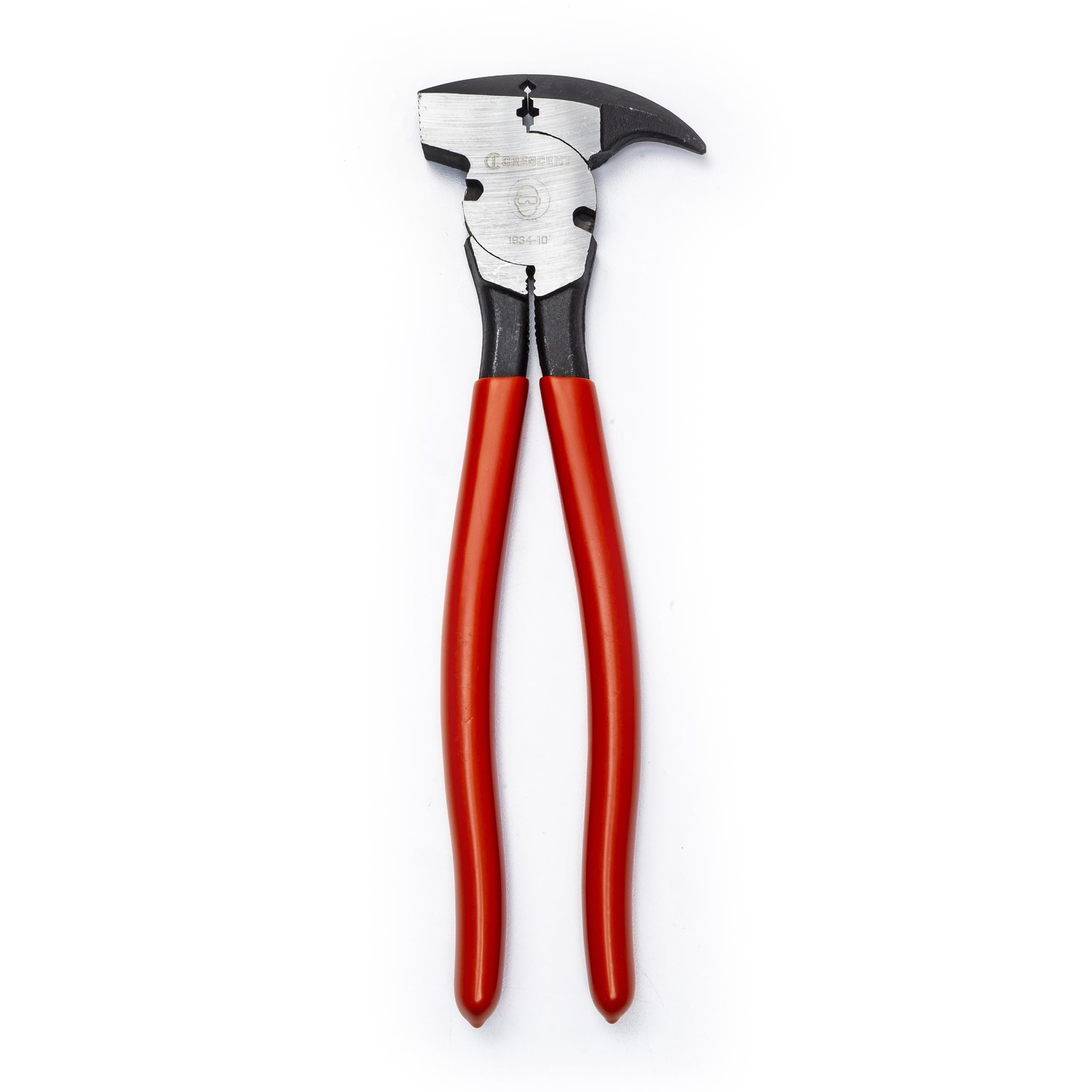
The Crescent's head is set at an angle, so the cut lands out to the side of your knuckles rather than straight ahead of them. On a post where the wire is pinned tight against the wood, that offset is the difference between a clean snip and a scraped hand.

The rest is conventional in the best sense: a solid joint, a staple puller worked into the jaws, dipped handles, and a polished alloy head that Crescent treats for corrosion. It is built to ASME B107.2M, which is the sort of thing you want to see on a tool that gets left out in the weather.

We ended up liking it most for repair work rather than new builds. The offset head and dipped handles make it a tidy thing to carry for patching a gate or re-tensioning a strand, and the grip wipes clean of mud in a way cushioned handles do not. It just does not out-cut the TEKTON or out-feature the Channellock, and with a short body and 1.7 pounds behind it, it sits behind both.

Bottom line: A tidy, well-finished plier whose angled head earns its place on tight posts, though it gives ground to our top picks on heavy wire.

Check Latest Price
#06

Small tool bags

WORKPRO 10-Inch Fencing Pliers

88 /100
Kirk Score Excellent
Handle
Ergonomic plastic
Material
Chrome vanadium steel
Built-in Tools
Six functions including hammer head and staple puller
Overall Length
10 in
Check Details on Amazon

Pros

  • Six functions in one compact 10-inch tool
  • Lowest single-tool price in this group
  • Ergonomic handle is comfortable for short jobs

Cons

Six jobs in a 10-inch tool, for the lowest single-tool price here. The WORKPRO is the one you hand to a helper, drop in a saddlebag, or buy for a fence you will only think about twice a year.

The function set is as complete as the listing promises: wire cutter, nail puller, staple puller, hammer head, gripping jaws, and a shape that slips into a tool bag without announcing itself. We were struck by how compact it feels next to the 10.8-inch Bates, and the ergonomic handle is comfortable for the twenty minutes a gate repair actually takes.

Where it gives ground is the steel, and that is the part that matters. Hardening is what keeps a shear edge biting, and a budget head will not hold it the way a forged one does: the first sign is a cutter that starts crushing strands instead of slicing them, which makes every splice after it harder work. For a season of gate repairs that is a fair trade. For a quarter mile of new fence, it is not.

Bottom line: The cheapest way into a full six-function fence tool, and a fair choice for occasional repairs — just know the steel is softer than the forged picks here.

Check Latest Price

How We Tested Fencing Pliers

I started by pulling together every fencing plier I could find from the big hand-tool brands and the budget import labels, then narrowed by head design, joint type, listed length, and handle style until 14 pairs were left, all in that ten-inch working size.

Testing ran four months, from early spring into summer, on a working fence line and a handful of backyard repairs: lacing woven wire to cedar posts, restringing barbed wire on T-posts, pulling staples out of posts that had been in the ground for decades, splicing, and cutting a few hundred feet of wire.

At every post I noted whether the claw caught the staple on the first bite or skated off, whether the hammer head landed flat enough to seat a staple without a second swing, and whether the cutter notch sheared the wire or mashed it. I weighed each pair and checked where it balanced in the hand, then used them in thick work gloves on cold mornings to see whether the dipped handles filled my palm or let the tool twist.

Durability got the roughest treatment: pairs rode loose in a truck bed, sat out overnight in dew, and were used to pry staples that had rusted into place. I watched for joint play, finish loss, and whether the cutting edges dulled or rolled. By the end, value was easy to call — several pairs did everything the expensive-looking ones did, and a couple did nothing well twice.

How to Choose Fencing Pliers

Start With the Claw

The claw works harder than any other part of the tool. It has to slide under a staple crown that may be sitting flush in a post that has been weathering for a decade. A narrow, sharply tapered claw gets under more staples; a broad one levers harder once it is in, which is why the IRWIN's wide jaw is both its strength and its occasional limit. Fencing an old property? Favor the slimmer point. Pulling staples you drove last season? Width is an advantage.

Cut the Wire You Actually Buy

Fence wire is sold by gauge, and gauge is what the shears have to survive. Shears set close to the pivot multiply your squeeze, and a hardened tooth cut on an angle slices a strand cleanly instead of crushing it — a crushed end will not feed through a splice without another cut. The trap is the phrase wire cutter on the package: it says nothing about gauge or tensile strength. Only the TEKTON publishes a range here, so on the others start with scrap wire and work up.

Weight, Length and Where Your Hands Are

These tools run 10 to 10.8 inches and 1.5 to 1.7 pounds, and the difference shows up at shoulder height. A longer handle gives you more to pull against and more reach; a heavier head carries momentum into a cut and into a staple. Neither helps once your arm is above your head. If most of your work is top wire on standing posts, take the lighter body. If you are building a line from the ground up, take the length.

Steel, Finish and a Wet Season

Forged high-carbon steel holds an edge and shrugs off levering; plated or budget alloy heads are softer and quicker to rust. That does not disqualify them — it decides how often you oil the joint and whether the tool lives in a truck bed or on a hook in the barn. Whatever you buy, wipe the head dry after a wet day and put a drop of oil at the pivot. Rust starts in the joint long before it reaches the jaws.

Frequently Asked Questions

Final Verdict

The Channellock 85 is the pair we point to first, and the reason is simple: two deep cutter slots that take both barbed strands in one squeeze, plus a staple starter, hammer, stretcher and splicers in a single 10.5-inch forging. It is the least compromised tool here for someone who maintains wire fence rather than patching it once a summer.

If you buy wire by the gauge and want a printed range before you order, the TEKTON is the better call, and its flat striking face is made for driving the claw under stubborn staples. Need two tools rather than one good one? The Bates pack is the answer.