// data-verified

Best Needle Nose Pliers of 2026

Needle nose pliers are what you reach for when your fingers won't fit — a screw that rolled behind the radiator, a hook buried past the barb, a wire that needs a bend in a gap too narrow to see into. The pair rattling around in the bottom of the toolbox usually picks that moment to fail: the tips don't quite meet, so the wire spins out, or the jaws skate off a nut and round the corners. A good pair grabs clean and cuts clean, one-handed, the first time.

We spent the past four months working through 14 pairs — 6-inch and 8-inch, standard and high-leverage, sprung and unsprung — and the differences showed up within an afternoon. Two things matter more than the packaging lets on: whether the jaws actually meet at the very tip, which you can check by closing them and holding them up to a light, and how the pivot feels after a few hundred squeezes. Long handles buy you cutting power and cost you reach; a spring saves your hand on repeat work and gets in the way in a tight box.

Some of the picks below are built to snake into narrow spaces, others to bite through heavy wire, and a couple manage both. Each one got there by doing the small, annoying job without a fight.

#01

Best Overall

Knipex 26 12 200 Long Nose Pliers

96 /100
Kirk Score Outstanding
Handle
Multi-component comfort
Jaw Shape
Half-round, long point
Cutting Edge
Side cutter
Overall Length
8 in.
Check Details on Amazon

Pros

  • Tips stay stable when twisted
  • Side cutter handles small wire
  • Comfortable multi-component handles

Cons

  • Large 8-inch body for fine electronics

A needle-nose tip that folds under a twist is useless for the job you bought it for. The Knipex 26 12 200 is the pair in this group we trust when a clip or wire needs a firm grip and a sideways nudge: its half-round, long-pointed jaws are designed to stay stable when twisted, and the flexible precision tips tolerate some distortion without turning into a bent paper clip. The 8-inch body gives you reach into a junction box, behind a panel, or down a narrow gap without making the tool feel like a specialist's novelty.

The side cutter is useful, not decorative. It sits close to the joint, so you can snip small wire without repositioning the tool, and the jaws meet cleanly at the tip. The multi-component handles are comfortable over a long session; the black zones give your fingers something to brace against when you bear down. We also like that the joint moves smoothly with no side-to-side slop—that is the detail that keeps a fine tip usable.

For occasional household bending, the IRWIN is the smarter spend. For daily electrical, automotive, or assembly work, the Knipex is the pair we reach for first. Its machining and finish are the reason: the jaws still meet cleanly after a session of twisting and snipping, which is what separates a tool you keep from one you replace.

Bottom line: For precise gripping, bending, and cutting in tight spaces, the Knipex 26 12 200 is the best all-around pair here and the one we recommend first for daily shop work.

Check Latest Price
#02

Best Value

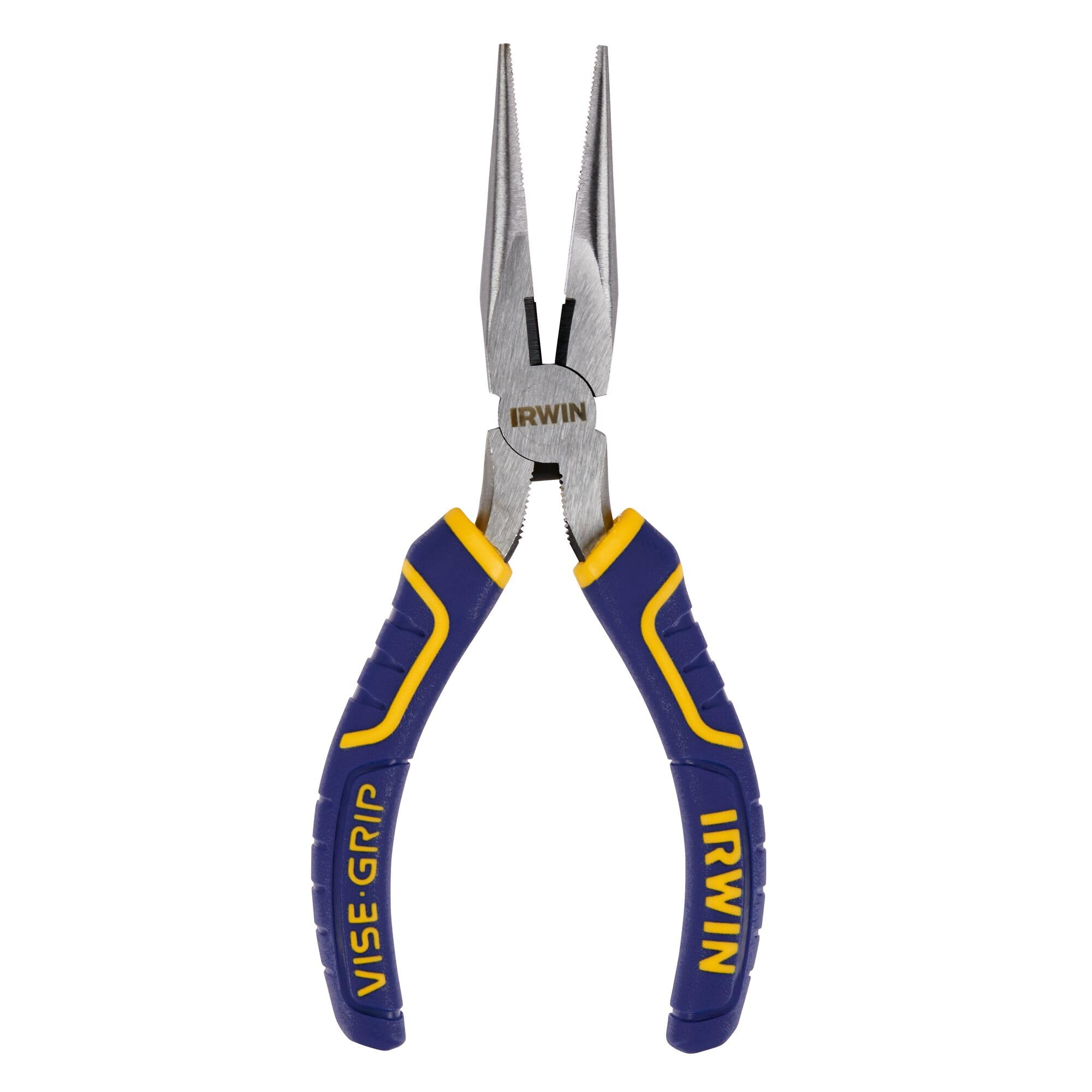
IRWIN Vise-Grip 6-Inch Long Nose

96 /100
Kirk Score Outstanding
Jaw
Machined
Material
Nickel chromium steel
Cutting Edge
Induction hardened
Overall Length
6 in.
Check Details on Amazon

Pros

  • Compact 6-inch body fits a tool roll
  • Machined jaws grip small parts
  • Induction-hardened cutting edge
  • Comfortable ProTouch grips

Cons

  • Tips can break under heavy prying

Six inches is the length that actually lives in a tool roll. The IRWIN Vise-Grip 2078216 is the pair we leave in a motorcycle kit, a kitchen drawer, or a glovebox because it takes up little space and still gives you a real long-nose shape. The ProTouch grips are shaped rather than dipped, so you get more to hold onto than the bare handles on the cheapest pairs.

The machined jaws bite small nuts and wire without needing a death grip, and the induction-hardened cutting edge handles light wire and zip ties. We like the reach for a tool this small—you can get behind a panel without walking back for the 8-inch pair. The trade-off is handle length: if you have large hands or plan to squeeze hard for an afternoon, the compact body will feel short.

What makes it a value pick is not that it is the cheapest pair here. It is that the size, the grip, and the cutter are all useful enough that you can buy it as a second pair and actually keep it where you need it. The pair that lives in the drawer is the one that gets used.

Bottom line: The IRWIN Vise-Grip is the compact, budget-friendly pair we recommend for a tool roll, a kitchen drawer, or anyone who wants useful reach without a full-size tool.

Check Latest Price
#03

Best Heavy-Duty

Klein Tools J203-8 Long Nose

94 /100
Kirk Score Outstanding
Head
Slim
Handle
Extended power grip
Cutting Edge
Induction-hardened knives
Overall Length
8 in.
Check Details on Amazon

Pros

  • Extended handles add cutting leverage
  • Slim head reaches confined areas
  • Induction-hardened cutting knives
  • Forged in the USA

Cons

  • Heavier than compact picks
  • Premium price for a single pair

The Klein J203-8 is not trying to be a jeweler's tool. It is an 8-inch heavy-duty long-nose plier with extended handles, built to put more force into a cut than the compact pairs here. We noticed the extra handle length when clipping stiff wire: you get leverage without the jaw feeling flexible, and the slim head still slips into a junction box or behind a fixture.

The induction-hardened knives meet cleanly, and the power grips are comfortable when you are bearing down. This is a substantial tool in hand, which is exactly what you want for pulling and cutting, but it is not the pair for tiny electronics or jewelry links. The forged-in-USA steel and one-year warranty are reassuring for a tool that will see hard use.

We reach for the Klein when a wire cutter needs to do real work, not when we need to place a tiny screw. It is the heavy-duty choice in this group, and it earns that role with leverage and a slim head rather than a long list of features. If you want one pair to cut and grip in a shop setting, this is the one.

Bottom line: The Klein J203-8 is the heavy-duty pick for cutting and pulling in a shop setting, and we recommend it when leverage matters more than delicate control.

Check Latest Price
#04

Best for Fine Wire and Jewelry

Xuron 450 Tweezer Nose

97 /100
Kirk Score Outstanding
Jaw
Non-marring radiused edges
Tip
Precision tweezer nose
Material
Steel
Overall Length
6.3 in.
Check Details on Amazon

Pros

  • Tweezer nose reaches tiny spaces
  • Non-marring edges protect wire
  • Close tip alignment for fine work

Cons

  • Smooth jaws can slip on rounded fasteners
  • Fine tip is not for heavy pulling

The Xuron 450 looks less like a hardware-store plier and more like a precision instrument, and that is the point. Its tweezer-like nose and radiused, non-marring edges are made for wire work where a serrated jaw would leave marks. We used it on small bends and found the tips align closely enough to pick up fine wire without the usual fumbling; the narrow profile reaches into spaces where a standard chain-nose pair feels clumsy.

The soft cushioned grips are comfortable for a tool this small, and the compact 6.3-inch body is easy to control between thumb and fingers. This is a specialist, not a garage generalist. For jewelry, models, and fine electrical work, the smooth-jaw design is worth the trade.

What we appreciate most is the edge treatment. The radiused edges protect the wire you are forming, not just the tool, and that is a detail you notice when you are working with soft metal. It earns its drawer space beside the bench, not in the bottom of a toolbox.

Bottom line: The Xuron 450 is the fine-wire specialist we recommend for jewelry, models, and delicate bending, where a smooth, precise tip matters more than brute strength.

Check Latest Price
#05

Best USA-Made Pair

Channellock 317 Long Nose

94 /100
Kirk Score Outstanding
Jaw
Crosshatch
Material
High-carbon C1080 steel
Cutting Edge
Knife-and-anvil side cutter
Overall Length
8 in.
Check Details on Amazon

Pros

  • Crosshatch jaws bite stubborn fasteners
  • Knife-and-anvil side cutter
  • High-carbon C1080 steel
  • Made in USA with limited lifetime warranty

Cons

  • Tips can be less symmetrical than premium picks
  • Crosshatch jaws can mark soft wire

The Channellock 317 has the sort of crosshatch jaw that makes you trust it with a stubborn fastener. The teeth bite without requiring a death grip, and the 8-inch body gives you enough leverage to lean into a pull. We like the knife-and-anvil side cutter: the blades meet cleanly, and the cutter is useful on small wire and fishing line rather than just being a notch in the jaw.

The high-carbon C1080 steel and electronic coating are built for a shop or boat, and the blue comfort grips are shaped for a working hand. This is a general-purpose pair, not a delicate instrument. The crosshatch pattern is the reason to choose it over a smooth-jaw pair.

Made in the USA and backed by a limited lifetime warranty, it is the pair we leave in a boat or a shop drawer without worrying about it. It is the pair we hand to someone who wants one 8-inch tool for pulling, twisting, and light cutting.

Bottom line: The Channellock 317 is the USA-made general-shop pair we recommend when crosshatch grip and a clean side cutter matter more than a jewelry-grade tip.

Check Latest Price
#06

Best for Deep Reach

Amazon Basics 3-Piece Long Reach Set

95 /100
Kirk Score Outstanding
Handle
Plastic-dipped
Material
Alloy steel
Set Includes
Straight, 45°, 90°
Overall Length
12.69 in.
Check Details on Amazon

Pros

  • Three nose angles reach around obstacles
  • Extra-long 12.69-inch reach
  • Alloy steel construction

Cons

  • Long handles need two hands for firm squeezing

The Amazon Basics 3-piece set is the problem-solver in this group. The straight, 45-degree, and 90-degree noses let you reach around an obstacle instead of dismantling it, and the extra-long 12.69-inch body keeps your knuckles away from a hot manifold or a tight firewall. We used the 90-degree pair where a straight tool was blocked; the angle is the whole reason to own the set.

The alloy steel bodies feel sturdy enough for home and automotive work, and the plastic-dipped handles are comfortable for a basic tool. They are not molded ergonomic grips, though, and they can feel slick when your hands are oily; a quick wipe before a hard pull makes a difference.

This is not the set for precise electronics or jewelry. The tips are long and the jaws are bulkier than a fine needle nose, and the reach is the point rather than delicacy.

For automotive, plumbing, and around-the-house jobs where the fastener is deep and awkward, the three angles earn their space. The 90-degree pair is the one that solves the problem a straight tool cannot.

Bottom line: The Amazon Basics long-reach set is the practical buy when the fastener is deep behind an engine or under a sink, and access matters more than finesse.

Check Latest Price
#07

Best Budget 8-Inch

Craftsman CMHT81645 8-Inch Long Nose

96 /100
Kirk Score Outstanding
Handle
Bi-material
Material
Drop-forged steel
Cutting Edge
Induction hardened
Overall Length
8 in.
Check Details on Amazon

Pros

  • 8-inch drop-forged body for leverage
  • Induction-hardened cutting edges
  • Bi-material grips add control

Cons

  • Broad jaws are a poor fit for fine electronics

The Craftsman CMHT81645 is the pair we hand to someone who wants a full-size needle nose without paying premium prices. The 8-inch drop-forged body feels more substantial than the budget label suggests, and the bi-material grips give you a secure hold when you lean on a nut. The induction-hardened cutting edges handle light wire and zip ties; the chrome finish wipes clean.

Where it earns its place is leverage. The 8-inch handles let you put force into a pull without the jaw flex you feel in a compact pair, and the serrated jaws bite a fastener with authority. The broad jaw is the one for garage work, not jewelry links.

The finish is corrosion-resistant, but this is still a steel tool that will show surface rust if it lives in a damp garage. A wipe with an oily rag before storage keeps it serviceable. For a first pair or a spare, it does the everyday work without asking you to baby it.

Bottom line: The Craftsman CMHT81645 is the budget 8-inch pair we recommend for a garage toolbox, where full-size leverage and a hardened cutter matter more than jewelry-level precision.

Check Latest Price
#08

Two-size kit

ZUZUAN 6- and 8-Inch Needle Nose Set

91 /100
Kirk Score Outstanding
Handle
TPR
Material
Carbon steel
Cutting Edge
HRC60-62
Set Includes
6 in. and 8 in.
Check Details on Amazon

Pros

  • Two sizes cover tight and larger jobs
  • Spring-loaded smaller pair
  • Hardened cutting edges

Cons

  • Spring action can feel fussy in a crowded drawer

The ZUZUAN set puts a 6-inch and an 8-inch needle nose in the same package, and the smaller pair is spring-loaded to open after each squeeze. That is a small convenience that matters when you are bending the same wire over and over. The two sizes cover more jobs than a single pair: the 6-inch for tight spaces and light wire, the 8-inch for more leverage.

The cutting edges are hardened to HRC60-62, which is a serious claim for a budget set, and the TPR handles are comfortable enough for household work. We like the lever-friendly handle-to-head ratio; it makes the 8-inch pair feel stronger than its price. The steel will show rust if it stays damp, so dry it after use and keep it out of a wet toolbox.

It is not a precision instrument for jewelry or tiny electronics. The tips are not as fine as the Xuron's, and the two-size value is aimed at general household work rather than bench work.

For a starter kit or a second set for the house, the two sizes are the argument. The 6-inch pair is the one we reach for first; the 8-inch stays for the extra leverage. It is a practical pair of pairs for the money, not a replacement for a specialist.

Bottom line: The ZUZUAN two-size set is a sensible budget pick for a home drawer, where having both a 6-inch and an 8-inch pair matters more than bench-grade precision.

Check Latest Price

How We Tested Needle Nose Pliers

We started by pulling specs and current prices on every long-nose plier we could find from brands we've used for years, then filtered for the things that separate a working tool from a drawer filler: a cutting edge, a jaw that tapers to something genuinely fine, and a handle we could inspect rather than a molded sleeve. We bought 14 pairs out of pocket, ranging from a tweezer-nose model to an extra-long-reach set, and put them into rotation.

They lived where pliers actually live. One pair stayed on the bench for a lamp rewire and a run of small electrical work; another went into a network closet for zip ties and cable bends; a third came along on a fishing trip for hook removal and split rings; the tweezer-nose pair handled jewelry loops and craft wire at the kitchen table. We retrieved dropped screws from between deck boards and from behind a sink trap, twisted safety wire, and pulled 6d finishing nails out of pine to see which jaws slipped and which held.

Then we measured the boring stuff. Every pair got the closed-tip light test for jaw alignment, a cut through 12-gauge copper, a coat hanger, and a zip tie — noting whether the cut came out clean or crushed. We opened and closed each sprung pair 100 times in one hand to judge fatigue, and worked the pivot looking for grit or play. To check rust resistance, pairs sat on a damp shop rag for a week and we counted the specks; to check grip, we repeated the wire-bending and nail-pulling with oily gloves on.

After four months we went back through every pair for pivot slop, handle flex, and whether the price had bought better steel or just a nicer-looking grip. The ones that survived that last pass are the ones below.

How to Choose Needle Nose Pliers

Start with the jaw shape and tip

A smooth, finely tapered jaw is the better choice for jewelry, electronics, and any wire you do not want marked; a serrated or crosshatch jaw bites harder on nuts and stubborn fasteners. Bent noses and angled sets reach around obstacles, but they trade direct control for access. We prefer a straight pair as the default and add a 45- or 90-degree tool only when the job is genuinely tucked away. Check the tips for alignment before you buy: a pair that meets cleanly at the point is the difference between picking up a small screw and chasing it across the floor.

Match the length to the reach

Six-inch pliers are the easiest to carry and control, which is why they end up in tool rolls and kitchen drawers. Eight-inch pairs give more leverage for cutting and pulling, but they can feel bulky in a small hand or a tight electronics bay. Extra-long 12-inch pliers are a specialist reach tool: great for a hose clamp behind an engine, poor for fine control. Match the length to the space you actually work in, not to the biggest job you can imagine. If you have larger hands and plan to squeeze hard, an 8-inch pair usually feels better; for precision, a compact pair wins.

Look closely at the cutter and steel

A side cutter turns needle-nose pliers into a one-tool job for wire and zip ties, but the cutter is only as good as its alignment and hardness. Induction-hardened edges hold up longer; a knife-and-anvil design, like the Channellock's, is built for clean mating. Steel grade matters less than fit and finish at this price, though high-carbon and chrome vanadium tools need a wipe-down if they live in a damp garage. Do not assume a plastic handle makes a pair insulated for live electrical work; check for an explicit voltage rating. If you cut a lot of small wire, pay for the cutter; if you mostly grip and bend, put the money into the jaws.

Do not overlook the handles and joint

Comfort is not just padding. A handle that is too fat weakens your grip; one that is too slick makes you squeeze harder. We look for a shaped grip that lets us close the jaws with the pads of our fingers, not the whole hand. A spring return is a real convenience for repetitive bending, but it can be fussy in a crowded drawer and it does not suit everyone. The joint should move smoothly without side play; that is what keeps the tips aligned. If you work one-handed, test the spring and the handle shape before you commit.

Frequently Asked Questions

Final Verdict

The Knipex 26 12 200 is the pair we recommend first because it handles the whole job—precise gripping, bending, and cutting—without making you switch tools. Its tips stay stable under a twist and the side cutter is useful, which is why it earns the premium over the budget picks. If you want a low-cost general pair, the IRWIN is the better fit; if you need maximum leverage for heavy wire, choose the Klein.