// data-verified

Best Framing Nailers of 2026

A framing nailer only has to hiccup once to cost you a morning. A nail that feeds sideways halfway along a wall, a misfire that leaves a head standing proud of the sheathing, a gun heavy enough that your arm quits before the roof decking does — that's the stuff I remember from builds, not the nails that went in clean. So when we rounded up 12 framers for six months of actual work, jam-free feeding and honest weight sat at the top of the list.

The part that trips up most first-time buyers is the magazine. A 21-degree plastic-collated stick, a 15-degree coil, clipped heads versus round heads — they don't all shoot the same nails, and being able to buy those nails locally on a Saturday matters more than any spec sheet. Capacity is the other quiet one: fewer reloads is a genuine gift when you're working overhead on a truss run.

We framed, laid subfloor, patched roof decking, and built crates with all of them. What follows are the ones that kept firing without drama and didn't leave my shoulder sore the next day.

#01

Best Overall

Metabo HPT NR90AES1

94 /100
Kirk Score Outstanding
Weight
7.5 lb
Nail Type
21-degree plastic collated
Nail Length
2 to 3.5 in
Power Source
Pneumatic
Check Details on Amazon

Pros

  • Light 7.5-pound body for overhead work
  • Runs common 21-degree plastic-collated nails
  • Selective trigger and tool-less depth
  • Five-year warranty

Cons

  • Needs a compressor and air line

At 7.5 pounds, the Metabo HPT NR90AES1 is the framing nailer we reach for when the work is overhead or the day is long. That number matters because a framing gun is held out in front of you far more than it sits on a bench, and the NR90AES1 stays controllable one-handed without feeling toy-light. It fires 21-degree plastic-collated nails from 2 to 3-1/2 inches, the format most lumberyards and home centers stock, so you're less likely to end up hunting for a specialty strip mid-project.

Selective actuation is the feature we used most: flip the switch and the trigger moves between sequential fire for precise placement and contact fire for sheathing and decking. The depth dial adjusts without a tool, and the nose stays put when you're toe-nailing. We also appreciate that the safety glasses come in the box—not a reason to buy, but one less stop.

What makes it the best default here is the balance of weight, common nails, and control. It isn't the cheapest 21-degree gun in this group—the NuMax and Freeman undercut it—but it gives up little and is easier to live with overhead. The five-year warranty is also longer than the budget picks. We did see the occasional end-of-strip hiccup; keeping a fresh strip handy is the simple fix.

Bottom line: For most framing jobs, we point people to the NR90AES1: it is light, feeds common 21-degree nails, and gives you selectable trigger modes plus a five-year warranty.

Check Latest Price
#02

Best Cordless

Milwaukee M18 FUEL 30°

88 /100
Kirk Score Excellent
Motor
FUEL brushless
Nail Angle
30°
Power Source
Cordless M18
Check Details on Amazon

Pros

  • Framing power without a compressor
  • Runs on Milwaukee M18 batteries
  • Fast driving and all-day battery life

Cons

  • Heavy with a battery mounted
  • Single-rack magazine needs frequent reloads

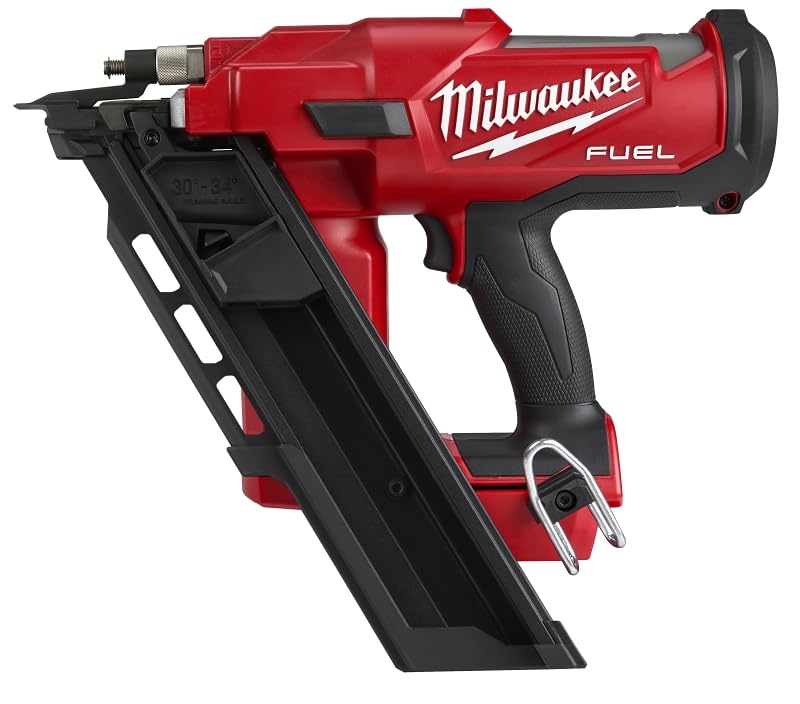
If your framing happens in a basement, a finished addition, or anywhere a hose turns into a trip hazard, the Milwaukee M18 FUEL 30-degree is the cordless answer. It runs on the M18 battery platform, so if you already carry Milwaukee batteries, the tool body is the only new system to buy. We like that it doesn't force you to drag a compressor through a finished house just to nail off a wall.

The tool drives fast and feels like a real framer rather than a compromise, and the battery holds up through a day of intermittent framing. The trigger response is quick enough for production-style work, and the balance keeps it controllable when you're working at an angle. We trust it for more than a quick repair, which is not something we can say for every cordless nailer.

For a remodeler working inside occupied homes, the trade is easy to make. For a crew framing walls all day with a compressor on site, the pneumatic guns are lighter and cheaper to run. Milwaukee's M18 FUEL is the one cordless framing nailer here we trust for a full day of trim-out and framing work.

Bottom line: For remodelers who need framing power without a compressor, the M18 FUEL is the cordless pick; it drives like a serious framer and runs on Milwaukee batteries.

Check Latest Price
#03

Best for Metal Connectors

Bostitch F21PL

91 /100
Kirk Score Outstanding
Weight
8.15 lb
Nail Type
Plastic collated round head
Nail Length
1-1/2 to 3-1/2 in
Power Source
Pneumatic
Check Details on Amazon

Pros

  • Two nosepieces cover framing and metal connectors
  • Adjustable depth guide and rafter hook
  • Magnesium body at 8.15 pounds

Cons

  • Metal-connector nails can be hard to source

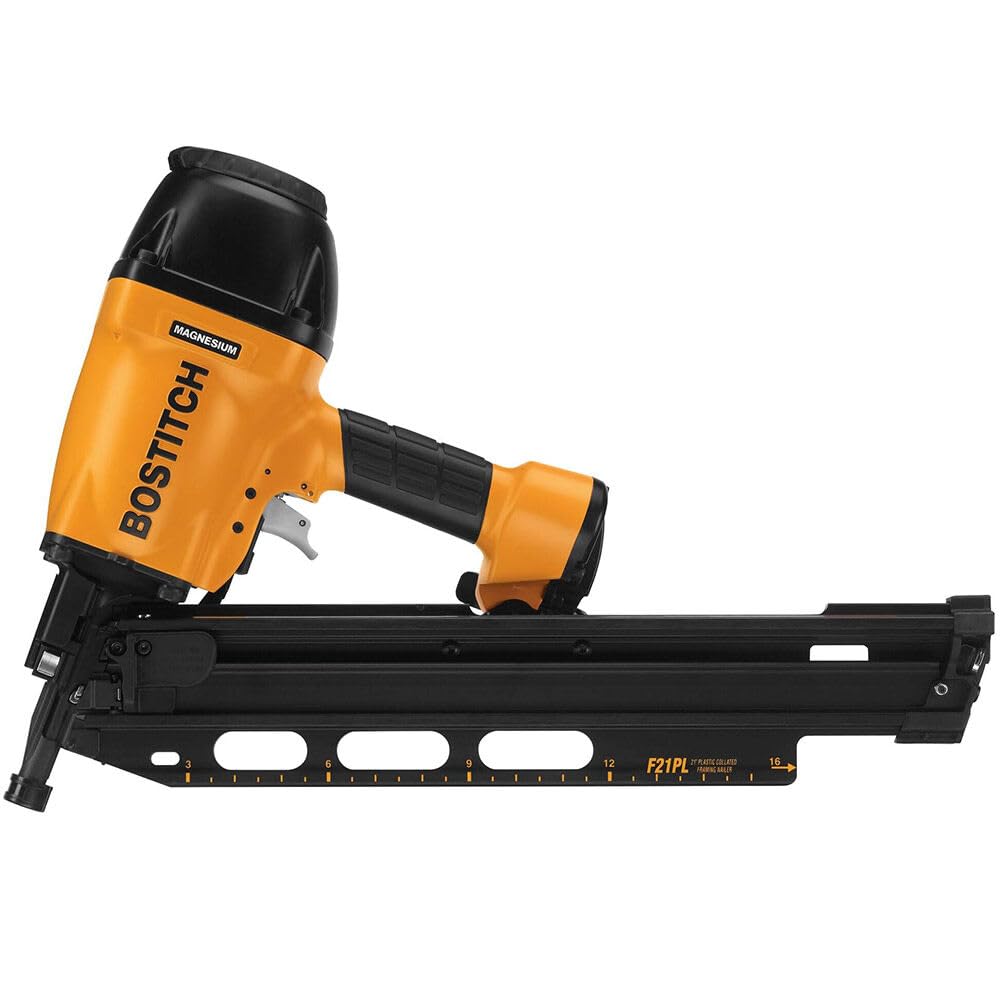
The Bostitch F21PL's second nosepiece is the reason we keep it in the conversation: swap the framing nose for the metal-connector nose and the same gun drives joist-hanger nails. That two-in-one role is genuinely useful on a deck or addition, where you're switching between framing and hardware all day. It drives 1-1/2- to 3-1/2-inch round-head framing nails, plus the smaller metal-connector nails the second nose is built for.

As a framer, it has the details we want: a push-button depth guide, a magnesium body, and an adjustable rafter hook that lets you hang it within reach. The 8.15-pound weight is mid-pack here, and the balance is good enough that the extra heft doesn't feel like a penalty when you're driving 3-1/2-inch nails. We did hit occasional jams near the end of a strip; clearing them was straightforward, and a fresh strip avoided most of it.

The catch is that it is a specialist. If you hang hangers only once in a while, a simpler framer and a separate hanger gun may make more sense. If you do both kinds of work, the quick change saves a tool change and a second purchase. For us, that flexibility is the whole point.

Bottom line: We choose the F21PL when joist hangers are part of the job: its second nosepiece turns one framing gun into a metal-connector tool.

Check Latest Price
#04

Best Coil Nailer

Metabo HPT NV90AGS

88 /100
Kirk Score Excellent
Weight
7.7 lb
Nail Type
15-degree wire coil
Nail Length
1-3/4 to 3-1/2 in
Power Source
Pneumatic
Check Details on Amazon

Pros

  • Coil magazine reduces reloads
  • Light 7.7-pound body for a coil nailer
  • Tool-less depth and selective trigger
  • Five-year professional warranty

Cons

  • Costs more than the 21-degree strip picks

A coil magazine changes the rhythm of a framing job: instead of stopping every strip, you keep driving. The Metabo HPT NV90AGS takes 15-degree wire-coil nails from 1-3/4 to 3-1/2 inches, and that long feed is why it suits production framing, fencing, and deck runs where reloads eat time. At 7.7 pounds, it is also light enough to steer with one hand while the other holds a board.

This is the coil gun we point high-volume framers to because it combines that capacity with a tool-less depth dial and selectable trigger modes. The five-year warranty is another point in its favor; it matches the top pick and beats the budget guns. Power is not the issue—the coil gun drives 3-1/2-inch nails without drama—and the balance stays comfortable through a long run.

The limitation is the nail system. Coil nails are less universal than 21-degree plastic strips, and a small yard may not stock the exact wire-collated length you need. If you already buy coil nails for a siding or fencing gun, this is an easy choice. If not, price a box before you commit, because the tool is only convenient when the fasteners are.

Bottom line: We send high-volume framers to the NV90AGS: the coil magazine keeps the gun fed, and the 7.7-pound body stays manageable.

Check Latest Price
#05

Best Budget Workhorse

NuMax SFR2190

93 /100
Kirk Score Outstanding
Weight
8.6 lb
Nail Type
21-degree plastic collated
Nail Length
2 to 3-1/2 in
Power Source
Pneumatic
Check Details on Amazon

Pros

  • Common 21-degree plastic-collated nails
  • Anti-dry-fire and dual-mode trigger
  • Low-cost 21-degree framing

Cons

  • One-year warranty is short
  • Jams can occur near the end of a strip

The NuMax SFR2190 is the tool you buy when the framing budget is tight and the job is bigger than a hammer can handle. It takes the same 21-degree plastic-collated nails as our top pick, from 2 to 3-1/2 inches, and it has the features that matter on a budget gun: anti-dry-fire, a dual-mode trigger, and a one-piece steel drive blade. At 8.6 pounds, it is not a featherweight, but it is manageable for wall framing and sheathing.

We noticed the trigger and depth adjustment are the places where the low price shows least. Switching between sequential and bump fire is simple, and the depth setting is easy to reach. The gun drives 3-inch nails cleanly in ordinary framing lumber; long 3-1/2-inch nails want full pressure and a steady hand. The anti-dry-fire lockout is a genuine convenience when you're moving fast and lose track of the strip.

For a homeowner framing a shed or a small crew watching costs, we think the NuMax is the value pick in this group. It gives you the core framing function for less than the premium guns, and the feature set is sensible. What it doesn't give you is the refinement of the Metabo, so try one before you plan a production schedule around it.

Bottom line: For a budget-conscious shed or deck build, the SFR2190 gives you the core 21-degree framing function and sensible features for less than the premium guns.

Check Latest Price
#06

Best for Wire-Collated Nails

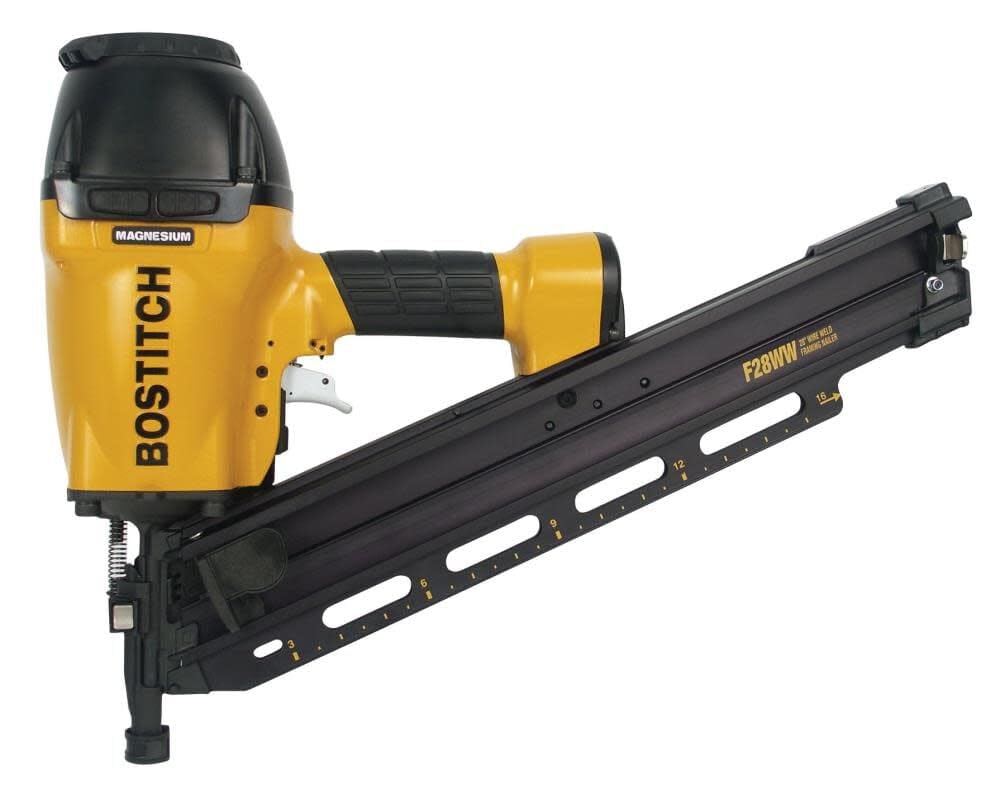
Bostitch F28WW

93 /100
Kirk Score Outstanding
Weight
9.8 lb
Nail Type
28-degree wire collated clipped head
Nail Length
2 to 3-1/2 in
Power Source
Pneumatic
Check Details on Amazon

Pros

  • Strong driving up to 3-1/2 inches
  • 16-inch layout indicator on magazine
  • Quick depth adjustment and rafter hook

Cons

  • Heavier than the 7.5-pound top pick

Before you fall for the Bostitch F28WW, check what nails it takes. This is a 28-degree wire-collated clipped-head framing nailer, and 28-degree nails are not the strip you'll find in every home center. If your yard stocks them, the F28WW is a sweet-driving tool with a magnesium body and a notched 16-inch layout indicator on the magazine. If it doesn't, the savings in time won't matter.

On the job, the depth adjustment is quick and the rafter hook is useful when you're working alone. The gun drives 2- to 3-1/2-inch nails with plenty of power, and the clipped-head design lets you get into tighter spots than some full-round-head tools. At 9.8 pounds it is not the lightest framer here, but the balance is good; we noticed the weight less than the number suggests.

This is a specialist pick, not the default. It makes sense for the buyer who already has a 28-degree nail supply or does work where the clipped head and wire collation pay off. For everyone else, the 21-degree Metabo is easier to feed and easier to live with. The F28WW's high rating is earned, but it comes with a supply-chain condition that belongs in the buying decision, not in the fine print.

Bottom line: Buy the F28WW only if 28-degree wire-collated nails are easy for you to source; then it rewards you with strong driving and a handy layout indicator.

Check Latest Price
#07

Best Kit

Freeman PFR2190

90 /100
Kirk Score Outstanding
Includes
Blow-molded case
Nail Type
21-degree plastic collated
Nail Length
2 to 3-1/2 in
Power Source
Pneumatic
Check Details on Amazon

Pros

  • Hard case keeps the tool and accessories together
  • Seven-year limited warranty
  • Common 21-degree nail format
  • Anti-dry-fire and dual-mode trigger

Cons

  • Heavier than the 7.5-pound top pick

The blow-molded case is the first thing you notice with the Freeman PFR2190, and it is more than a box: it keeps the gun, oil, and spare fittings together between projects. For a DIYer who stores a framing nailer in a garage, that is a practical advantage the bare-tool picks don't offer. The case also makes it easier to lend the tool without losing the accessories.

The gun itself is a 21-degree plastic-collated framer for 2- to 3-1/2-inch nails, with a one-piece steel drive blade, anti-dry-fire, and the same dual-mode trigger layout as the NuMax. At 8.8 pounds, it is a two-handed tool for overhead work, but the balance is reasonable for decking and wall framing. We like the seven-year limited warranty; it is the longest coverage in this group and a real confidence boost for occasional users.

On a typical framing job, it does the basics without fuss. The depth adjustment is easy to set, and the gun drives 3-inch nails flush with a normal compressor. The trigger switch is positive, and the anti-dry-fire saved us from a dry cycle when we lost track of the strip. It is not as smooth as the Metabo, and the finish is more workmanlike than premium, but nothing about it feels disposable.

The Freeman makes the most sense for the DIYer who wants one complete kit and long warranty coverage rather than the lightest possible gun. If you frame every day, the Metabo's lower weight and smoother cycle are worth the step up. If you frame a shed, deck, or addition a few times a year, the Freeman's case and coverage make it easier to own.

Bottom line: For a DIYer who wants a complete kit, the Freeman's hard case and seven-year warranty make it the easier ownership story.

Check Latest Price
#08

Low-cost framing

3PLUS H2190SP

88 /100
Kirk Score Excellent
Weight
10.7 lb
Nail Type
21-degree plastic collated
Nail Length
2 to 3-1/2 in
Power Source
Pneumatic
Check Details on Amazon

Pros

  • Lowest-cost 21-degree entry here
  • Tool-free depth and dry-fire lockout
  • 360-degree exhaust and no-mar tip

Cons

  • One of the heavier tools here at 10.69 pounds

The 3PLUS H2190SP is the lowest-cost way into a 21-degree framing nailer in this group, and it doesn't strip out the basics to get there. It drives 2- to 3-1/2-inch plastic-collated full-round-head nails, has tool-free depth adjustment, and includes a dry-fire lockout. For a homeowner who needs a framer for one deck or a shed, that is a lot of function for the money.

The details are more thoughtful than the price suggests. The exhaust cover rotates 360 degrees so you can keep the air off your face, the no-mar tip protects finished surfaces, and the hardened claw tip bites when you're toe-nailing. The selective trigger is a welcome feature at this end of the market; switching between sequential and bump fire is a simple flip.

What you give up is refinement. At 10.69 pounds, it is one of the heavier tools here, and you feel it when you're working overhead or nailing off a wall. The drive is adequate rather than effortless with long 3-1/2-inch nails, and the overall feel is more utilitarian than the Metabo or Bostitch guns. It is a tool you buy for the job, not for the pleasure of handling it.

Think of it as a budget starter or a second gun for occasional framing, not as the primary tool for a production crew. If the price difference is what gets you into a framing nailer, the 3PLUS does the core job. If you frame often, spend more for lower weight and a smoother cycle; your shoulders will notice the difference.

Bottom line: The H2190SP is the budget entry we point to for occasional framing, provided you can live with its heavier body.

Check Latest Price

How We Chose and Tested These Framing Nailers

We started with the models that keep showing up on job sites and in owner reviews, then filtered by the things that actually change a buying decision: magazine angle and collation type, the nail length range each gun handles (most of these cover roughly 2 to 3-1/2 inches), whether it needs a compressor, and what it costs relative to what comes in the box. That narrowed to 12 nailers, which we ran for six months.

Testing happened on real work rather than a bench. We framed a shed, reframed a back deck, laid subfloor panels, patched roof decking, and assembled shipping crates, logging every jam and misfire across roughly 500 nails per gun per session. We timed reloads with a stopwatch and counted how many sticks or coils it took to finish a wall, weighed each tool on a kitchen scale, then held it overhead through a run of truss nailing to see how the balance felt once fatigue set in. We also dialed depth adjustment up and down across compressor pressures and drove into both engineered lumber and wet treated 2x4s to see whether the gun still set nails flush when the pressure dropped.

For durability, each nailer rode loose in a truck bed and got knocked off a sawhorse more than once, and we noted which ones came back firing clean. We cleared induced jams by hand to see how easy the latch and pusher were to work with gloves on, and we factored in nail cost and local availability when weighing value. The guns are still in the shop, and we'll update if anything changes.

How to Choose a Framing Nailer

Pick the Nail System First

The angle and collation decide where you can buy fasteners and what the tool will drive. 21-degree plastic-collated full-round-head nails are the most widely stocked and suit general framing, sheathing, and decking; our top pick and the NuMax and Freeman use them. A 15-degree wire coil is the high-volume choice, while 28-degree wire-collated clipped-head nails are a specialist format. Buy one strip before you commit to a box, and check local stock rather than assuming a big-box shelf will carry your angle.

Pneumatic or Cordless

Pneumatic framing nailers are lighter and run as long as the compressor does, but you need a hose and enough air. Cordless models remove the hose and are easier in occupied remodels, at the cost of battery weight and more frequent reloads. If you already own M18 batteries, the Milwaukee is the obvious cordless route; if you frame on a site with air, a pneumatic gun gives you more tool for the money.

Weight and Balance Are the Real Comfort Spec

A framing nailer is held away from your body, often overhead, so a pound matters more than it does on a bench tool. The 7.5-pound Metabo and 7.7-pound coil Metabo are the easiest to steer one-handed; 9- to 10-pound tools can still balance well, but they tire you faster. Look for a rafter hook if you work alone, and don't mistake overall weight for balance. For overhead work, we put more value on a sub-8-pound body than on an extra feature.

Trigger, Depth, and Jam Behavior

Selective actuation lets you choose sequential fire for precision and contact fire for speed; we value it on any gun that will do both sheathing and trim-out framing. Tool-less depth adjustment saves fiddling when you move between species or treated lumber. Jams and misfires can still happen, especially near the end of a strip, so keep spare strips close and don't force a dry cycle. Anti-dry-fire is worth having.

Capacity, Warranty, and Value

A coil magazine reduces reloads on production work; a strip magazine is easier to feed from a box you already own. Warranty length separates the budget guns from the long-haul picks—one year versus five or seven years. Spend for capacity or a second nosepiece only if you'll use it; otherwise put the difference into nails and a decent hose. Our budget picks make sense for occasional framing, while the top pick is the better long-term default.

Frequently Asked Questions

Final Verdict

For most framing jobs, the Metabo HPT NR90AES1 is the one we recommend: it is light enough to control overhead, feeds the 21-degree plastic-collated nails most yards stock, and gives you selectable trigger modes and a five-year warranty without a premium price.

If you work where a compressor can't go, choose the Milwaukee M18 FUEL and accept the battery weight. If joist hangers are a regular part of your framing, the Bostitch F21PL's second nosepiece is the feature that changes the answer.