// data-verified

Best Heat Guns of 2026

A heat gun makes a stubborn job look easy: forty-year-old paint lifts off a doorframe in sheets, shrink tubing tightens around a splice in seconds, a frozen pipe stops being an emergency. It also warps vinyl and scorches the wood under the paint if you hold it too close, which is why the cheap ones and the good ones aren't interchangeable.

I've used heat guns for years on trim paint and wiring projects, and over the past six months my team and I put eight through the same jobs, from palm-sized 350-watt craft models to 1,800-watt guns with variable dials. What first-time buyers miss: a two-setting gun, usually around 750°F and 1,000°F, handles paint, caulk, and shrink wrap fine, but for vinyl or thin wire, the variable knob earns its keep.

The rest comes down to what's in the box and whether the gun stays put when you set it down mid-job. The picks below run from a mini you can hold like a pencil to a heavy-duty kit, and each earned its spot on the same handful of jobs.

#01

Best Overall

SEEKONE 1800W Heat Gun

93 /100
Kirk Score Outstanding
Weight
1.98 lb
Airflow Modes
190–210 / 250–500 L/min
Nozzles Included
4
Temperature Range
122°F–1,202°F
Check Details on Amazon

Pros

  • Stepless 122°F to 1,202°F temperature dial
  • Two airflow ranges for delicate and heavy work
  • Four nozzles cover common jobs
  • Overheat protection adds reassurance

Cons

  • No storage case included
  • Full-size body is bulky in tight spaces

The stepless dial is what earns this SEEKONE the top spot. It moves from 122°F to 1,202°F without stopping at two presets, and the separate airflow switch gives you a low 190–210 L/min range or a high 250–500 L/min range. We liked having both controls independent: you can turn down the blast for a vinyl decal without losing the heat you need to soften the adhesive.

The four nozzles are not filler. The deflector keeps heat off glass and trim, while the concentrators put heat where a connector or a paint edge needs it. We used the narrow nozzle most for shrink tubing; the wider pattern is better for softening a broad strip of paint.

At 1.98 pounds it is manageable for short overhead stretches, but it is still a full-size body. The overheat protection is a sensible addition for a gun that can run hot for several minutes at a time.

Longevity is the open question. The function is strong, but this is not the gun we count on for all-day production work; the Porter-Cable is the sturdier choice for a heavy workshop schedule. If you work on a bench and need one gun for mixed jobs, the versatility is worth it; the simpler BLACK+DECKER is lighter for long stripping sessions.

Bottom line: For most DIYers, this is the best all-around heat gun here, with variable heat and four nozzles for paint, tubing, and crafts.

Check Latest Price
#02

Best for Paint Stripping

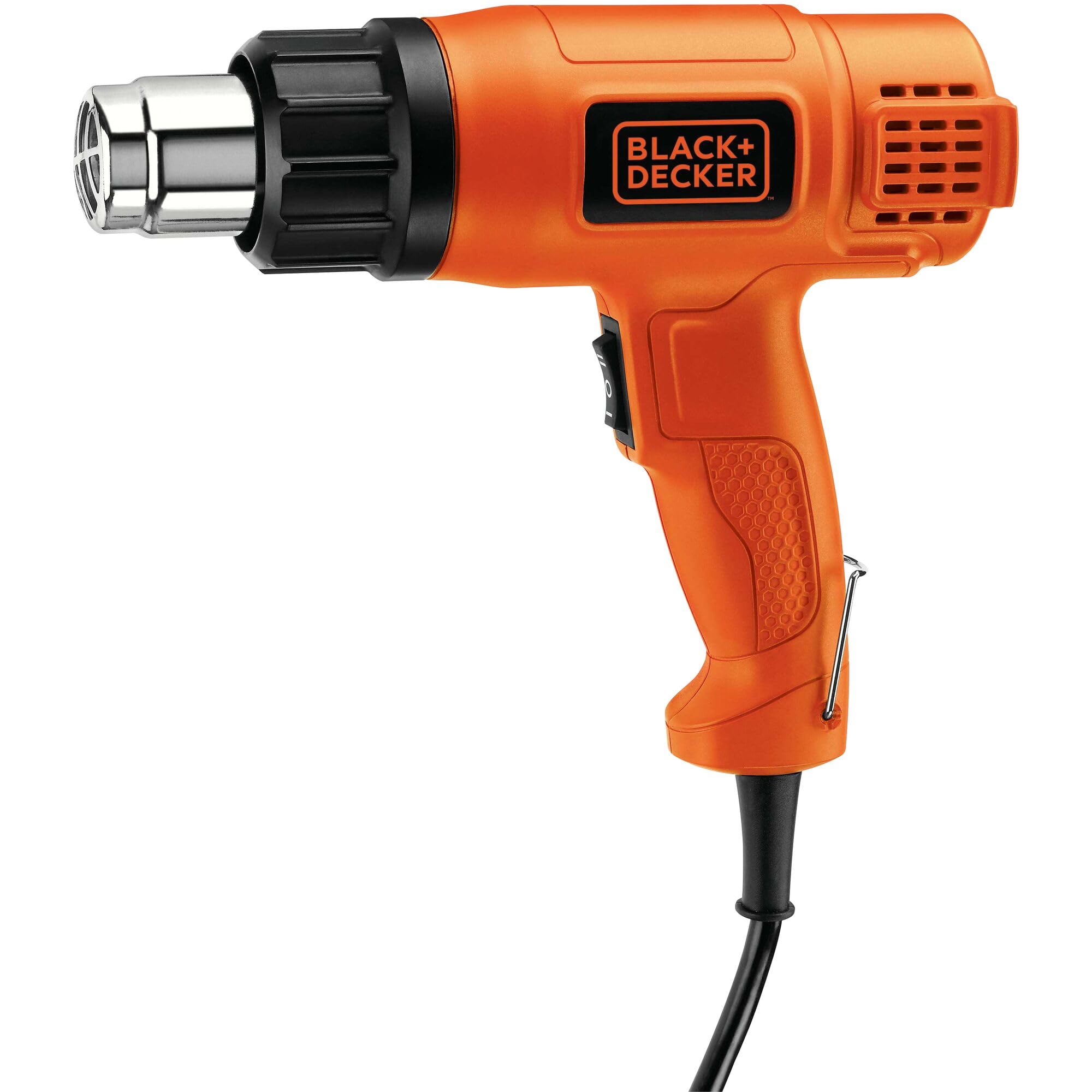
BLACK+DECKER HG1300

96 /100
Kirk Score Outstanding
Weight
1.63 lb
Wattage
1,350W
Warranty
2-year limited
Heat Settings
750°F / 1,000°F
Check Details on Amazon

Pros

  • Dual 750°F and 1,000°F settings
  • Light 739-gram body
  • Three-position side handle
  • Built-in stand for cooling

Cons

  • No nozzles included
  • Two presets limit fine control

Two settings is not a limitation if those settings are the two you need. The HG1300 keeps things to 750°F and 1,000°F, which covers paint softening, adhesive release, and most wire shrink work without a dial to fiddle with.

We appreciated the simplicity for a tool that gets handed between jobs; there is no dial to bump and no display to read. That makes it easy to teach someone else to use, and the 1,350W element is enough for household paint and caulk.

The 739-gram body is light enough to hold overhead while a paint edge lets go, and the side handle rotates to three positions so you can brace it differently. The built-in stand lets it cool without the nozzle touching the bench.

Early failure is the caveat. Some units fail early, and the two-year limited warranty is the backstop. We are comfortable recommending it for occasional use rather than daily production.

Bottom line: For paint stripping and simple household repairs, the HG1300 is the light, uncomplicated choice we hand to most DIYers.

Check Latest Price
#03

Best for Workshop Control

PORTER-CABLE PC1500HG

95 /100
Kirk Score Outstanding
Weight
2.5 lb
Wattage
1,500W
Fan Speeds
2
Temperature Control
Variable dial
Check Details on Amazon

Pros

  • Separate temperature dial and two fan speeds
  • Strong build quality for workshop use
  • Integrated stand for hands-free cooling
  • 1,500W element heats quickly

Cons

  • Heavier than the compact picks

The Porter-Cable separates heat and airflow: a red dial for temperature and a two-speed fan switch, so you can turn down the blast without turning down the heat. That is the feature we missed on simpler guns when working near loose material, and it is why this one stays in the workshop shortlist.

The build quality is the strongest in this group. The body has a planted, medium-duty feel, and the integrated support stand lets it sit upright for hands-free cooling.

The 1,500W element brings heat quickly, and the variable dial lets you sneak up on a temperature instead of jumping between presets. For stripping paint from trim, the wide fan setting moves the softened coating without scorching the wood; the low fan setting keeps the heat from blowing dust into the finish.

It is more gun than a crafter needs; the mini is easier to steer over resin. The lack of nozzles is the one thing we miss; add a concentrator if you do a lot of tubing. If you already own a nozzle set, the bare tool is a sensible buy.

Bottom line: For workshop repairs that need steady heat and adjustable airflow, the PC1500HG has the clearest control layout in this group.

Check Latest Price
#04

Best for Precise Temperature

DEWALT D26960K

95 /100
Kirk Score Outstanding
Wattage
1,550W
Included
Hard case and accessories
Warranty
3-year
Temperature Control
LCD, 50°F steps
Check Details on Amazon

Pros

  • LCD temperature control in 50°F steps
  • Hard case keeps accessories organized
  • Three-year warranty
  • Overload protection

Cons

  • Premium price
  • Heavier than the mini guns

The LCD is the reason to step up to the DEWALT: you set temperature in 50°F increments instead of guessing between two presets or watching a dial. The 1,550W element and overload protection give you a full-size tool with a more precise brain.

We found the 50-degree steps useful for heat-sensitive work where a 100-degree swing can mean the difference between softening adhesive and scorching the surface. The display is easy to read, and we liked being able to dial in a number and come back to it on a second pass.

The hard case is the detail that makes it feel like a kit rather than a bare tool. It holds the gun and the accessory nozzles together, and the case protects the display when the gun rides in a truck or a crowded shop cabinet.

The three-year warranty is the longest here, and it is the backstop for a tool built around an LCD. If you only strip paint, the simpler BLACK+DECKER is easier to justify.

Bottom line: For temperature-sensitive work and a kit that stays organized, the D26960K is the premium pick worth the extra outlay.

Check Latest Price
#05

Best Mini for Tight Spaces

SEEKONE 350W Mini

93 /100
Kirk Score Outstanding
Weight
13.7 oz
Wattage
350W
Cord Length
1.5 m
Temperature Settings
500°F / 842°F
Check Details on Amazon

Pros

  • Light 13.7-ounce body
  • 500°F low setting for delicate work
  • Reflector nozzle and overheat protection
  • UL listed

Cons

  • Reflector nozzle can work loose
  • No storage case included

The first time a heat gun needs to fit inside a cabinet or behind a dashboard, full-size tools stop being convenient. The SEEKONE mini is 13.7 ounces and 350W, with a 500°F low setting and an 842°F high setting. It heats quickly for a tool this small, and the narrow body is easy to hold at an angle.

The reflector nozzle spreads heat around a connector, and the overheat protection is reassuring in a body this small. The 1.5-meter cord is long enough for bench work, and the UL listing is a useful baseline. We could hold it for a few minutes while working around a wire bundle without feeling the weight.

The low setting is the part we value most. It is gentler than the 750°F floor on most full-size guns, which matters for heat-shrink tubing and small vinyl jobs. The limit is power: it will not strip paint or thaw a pipe, and that is a full-size job.

Bottom line: For shrink tubing, resin detail, and other small jobs, the SEEKONE mini is the compact gun we reach for first.

Check Latest Price
#06

Best Budget Full-Size Kit

TGK 1800W Heat Gun

93 /100
Kirk Score Outstanding
Weight
1.44 lb
Included
Nozzles, scraper, shrink supplies
Airflow Modes
250 / 500 L/min
Temperature Range
122°F–1,202°F
Check Details on Amazon

Pros

  • 1,800W with 122°F to 1,202°F range
  • Two airflow modes
  • Includes nozzles, scraper, and shrink supplies
  • Light 1.44-pound body

Cons

  • Long-term durability is the weak point
  • No storage case included

The TGK kit is the value play: 1,800W, a 122°F–1,202°F range, two airflow modes at 250 and 500 L/min, and a box that includes nozzles, a scraper, and shrink supplies. That is a lot of tool for a budget full-size gun, and the kit means you do not have to buy the extras separately.

At 1.44 pounds it is the lightest full-size gun here, which makes overhead work less of a chore. The stepless roller is easy to adjust with a thumb, and the UL listing and 5.25-foot cord are the right basics. The cord is not the longest here, but it is enough for bench work and most household jobs.

We keep the TGK on the shortlist for a first heat gun or a backup. The included scraper is the detail that makes it a paint-removal kit, not just a hot-air gun. The light body and broad heat range mean it can live on a shelf until a project calls for it, then handle the whole job.

Bottom line: For a budget full-size kit that covers paint, tubing, and shrink wrap, the TGK is the most complete package here.

Check Latest Price
#07

Best Simple Household Gun

Wagner HT1000

95 /100
Kirk Score Outstanding
Wattage
1,200W
Fan Speeds
2
Heat Settings
750°F / 1,000°F
Safety Listing
ETL listed
Check Details on Amazon

Pros

  • Two heat settings and two fan speeds
  • Integrated stand for hands-free cooling
  • ETL listed with two-year warranty
  • Corrosion-resistant nozzle

Cons

  • No nozzles included
  • No variable temperature

The HT1000 is the least fussy full-size gun here: two heat settings, two fan speeds, and an integrated stand. The controls are obvious enough to use with gloves on, and the gun heats with a steady, familiar feel.

The ETL listing and two-year home-use warranty are the details that make it easy to recommend for household repairs. The handle stays comfortable during longer passes, and the unit feels solid in hand.

The 1,200W motor is less powerful than the 1,800W guns, but for caulk, adhesives, and shrink wrap it has enough. The two fan speeds are separate from the heat, so you can drop the airflow without dropping the temperature.

We keep it on the shortlist for homeowners who want a simple gun for occasional repairs. The corrosion-resistant nozzle is a small thing, but it is the kind of detail that matters in a damp basement.

Bottom line: When the job is caulk, adhesive, or shrink wrap and you want two clear settings, the HT1000 is the no-fuss full-size gun we recommend.

Check Latest Price
#08

Craft detail

Yeegewin 380W Mini

92 /100
Kirk Score Outstanding
Wattage
380W
Cord Length
4.9 ft
Airflow Modes
100 / 500 L/min
Temperature Settings
480°F / 850°F
Check Details on Amazon

Pros

  • 480°F low setting for delicate work
  • Light 13.1-ounce body
  • UL listed with overheat protection
  • Reflector nozzle and built-in stand

Cons

  • Short 4.9-foot cord
  • No storage case included

The Yeegewin is the lightest mini here at 13.1 ounces, and its 380W motor is built for detail rather than heavy removal. It is for the jobs where a full-size gun is too much: embossing powder, vinyl decals, small shrink tube, drying paint between coats.

The 480°F low setting is the useful part; it gives you a gentler start than the 500°F SEEKONE mini and a much gentler one than a full-size gun. The 500 L/min high airflow is strong for a mini, so keep the nozzle moving.

The built-in stand lets it cool without tipping, and the UL listing and overheat protection are the right safety basics for a tool this small. It is easy to hold at an angle for a few minutes at a time.

For embossing, vinyl, and small tubing, that light touch is exactly what we want. What seals it is the combination of low heat and low weight; the gun stays easy to hold while you feather the air over a small area.

Bottom line: For delicate craft and detail work where a full-size gun is too hot and too bulky, the Yeegewin is the small, controllable pick.

Check Latest Price

How We Tested the Best Heat Guns

We started with roughly 30 heat guns on the market and cut the list by wattage, temperature range, included nozzles, and whether each one could stand on its own between uses, landing on eight that spanned the field: a couple of minis in the 350-to-380-watt range, three dual-setting guns, and three variable-temperature models up to 1,800 watts. Testing ran six months, and it happened alongside real house projects rather than on a bench.

Heating speed was the easy part to measure. I aimed an infrared thermometer at a steel plate and timed each gun from a cold start to its top temperature, then repeated the check after ten minutes of continuous running to see whether the output drifted. For temperature control, I changed settings mid-task wearing work gloves, since that's how you'll actually do it, and noted which dials were readable at a glance and which needed two hands.

The real work was paint and wire. We stripped paint from a salvaged doorframe and a length of baseboard, watching whether the paint softened and lifted or charred and smoked, then shrank tubing on 14-gauge wire and on a thicker battery cable. I softened a PVC fitting and lifted a vinyl decal off glass to see how narrow the heat pattern really was. Stability got its own check: each gun was set down mid-job on a workbench to see whether it stayed put or crept toward the edge, and every one ran ten minutes straight on high so we could feel how hot the housing got and whether the overheat protection tripped.

Build quality came down to small things — a nozzle that threaded on squarely, a housing that didn't flex under a firm grip, a cord long enough to reach an outlet without an extension. Since value here is mostly about what ships in the box, we noted whether nozzles, a reflector, and a case were included or sold separately.

How to Choose a Heat Gun

Start With the Size of the Job

A full-size gun in the 1,200W to 1,800W range has the muscle for paint stripping, loosening adhesives, thawing pipes, and shrinking larger tubing. A mini in the 350W to 380W range is easier to steer into a cabinet, behind a dashboard, or over a small resin pour, but it will not do the heavy jobs. If you work on both, buy the full-size gun first and add a mini later; the small one is a specialist, not a replacement.

Decide Between Presets and a Dial

Two heat settings are enough for repeat household jobs, as long as the low setting is not too hot for the material. Variable control is worth paying for when you work with vinyl, resin, craft paper, or anything that can scorch in seconds. A continuous dial lets you sneak up on the right temperature; a digital display with 50-degree steps is the most repeatable option here. Check the low end as carefully as the maximum: a 750°F minimum is a paint-stripping tool, not a delicate-craft tool.

Treat Airflow as a Separate Control

Airflow moves the heat, and more is not always better. A strong fan helps push heat into a paint edge or a rusted bolt, but it can blow resin, embossing powder, or thin vinyl before the heat does its job. Two fan speeds give you a gentler setting for detail work and a stronger one for stripping. Nozzles matter just as much: a concentrator focuses heat on tubing, a reflector wraps heat around a connector, and a deflector keeps heat off glass and trim.

Plan for Handling and Cool-Down

A heat gun stays hot after you switch it off, so a stable stand is not a luxury. The integrated stands on the BLACK+DECKER and Wagner let you set the gun down without the nozzle touching the bench; the Porter-Cable balances on its back end. Weight matters if you work overhead: the 739-gram BLACK+DECKER is easier to hold at arm's length than the 2.5-pound Porter-Cable. Check the cord length against your work area, and keep the cord away from the nozzle.

Check the Safety Listing and Duty Cycle

Heat guns are high-draw tools, and the better ones carry a UL or ETL listing. That is not a guarantee of longevity, but it is a baseline for the electrical parts. Mini craft guns often have short duty cycles; if the housing gets too hot to hold, stop and let it cool. Full-size guns handle longer sessions, but none of these is a production tool. A two- or three-year warranty is the clearest signal that the maker expects the gun to survive normal use.

Frequently Asked Questions

Final Verdict

For most DIYers, the SEEKONE 1800W is the heat gun to buy: its stepless temperature dial, two airflow ranges, and four nozzles cover paint stripping, shrink tubing, vinyl, and craft work without forcing you into two presets.

If your work is mostly paint and adhesive removal and you want the simplest possible gun, the BLACK+DECKER HG1300 is lighter and easier to hand off. For temperature-sensitive jobs, the DEWALT's LCD control is the upgrade worth paying for.