// data-verified

Best Staple Guns of 2026

The first ten staples go in like butter. It's staple eleven — fabric stretched over a dining chair seat, one hand holding the fold — that a cheap gun jams, and you spend the next twenty minutes digging a bent staple out of oak with a screwdriver. I've been there, and it's why I care far less about how a tacker looks on the shelf than about whether it fires flush into hardwood, how much palm pressure it takes to sink a staple, and whether the box actually contains the staples and remover you need to start the job.

We spent four months with 12 staple guns, from light-duty craft tackers to pneumatic models, running them through upholstery, fencing, and yard projects. A couple of things surprised me along the way: weight stops being a spec and becomes a real annoyance the moment you're stapling overhead, and the guns that jammed least were not always the most expensive ones. The detail first-time buyers overlook is staple size — a gun that takes only one width is a gun you'll outgrow by your second project. Below are the ones that earned a spot in the toolbox.

#01

Best Overall

DEWALT DWHT80276 2-in-1 Tacker

93 /100
Kirk Score Outstanding
Power Source
Manual
Body Material
Carbon fiber
Fastener Types
Staples and brad nails
Magazine Capacity
Full strip
Check Details on Amazon

Pros

  • Carbon fiber body stays light overhead
  • Low squeeze effort, less hand fatigue
  • Takes staples and brad nails
  • Feels solid and well built in hand

Cons

  • A stuck staple is awkward to clear
  • Costs more than the other manual guns here

The staple gun you want is the one you can still hold at the end of a job. Recovering a chair or tacking insulation across a ceiling is a few hundred squeezes, most of them above shoulder height, and the DEWALT is the tool in this group that makes that stretch feel manageable. The carbon fiber body keeps it light in the hand, and the squeeze takes noticeably less effort than the all-steel manual guns we worked alongside it.

It is a 2-in-1 tacker, so it takes staples and brad nails without a change of tool. For a first staple gun that has to cover a chair seat, a strip of trim and a loose panel, that flexibility earns its keep, and we found ourselves reaching for it for jobs that had nothing to do with upholstery. It feels tight and solid when you set it down, which is not something we can say about every gun at this size. It is a full-size tool at about 9.5 inches long, so plan on a toolbox rather than a kitchen drawer.

The nose is where it gives ground. A staple that hangs up there is fiddly to free, because you are picking at the exit rather than opening a magazine, and in harder material one occasionally does not seat flush. Pressing the nose flat and letting the tool do the work heads off most of it.

Where it earns its place is the second half of a job, when the other guns have you stopping to shake out your hand. Covering six dining chairs in an afternoon, that difference is the whole purchase. Two staples into a picture frame, it is not.

Bottom line: For most people buying one staple gun, this is the one we hand over: light enough for overhead work and easy enough on the hands to finish a whole sofa.

Check Latest Price
#02

Best Classic Manual

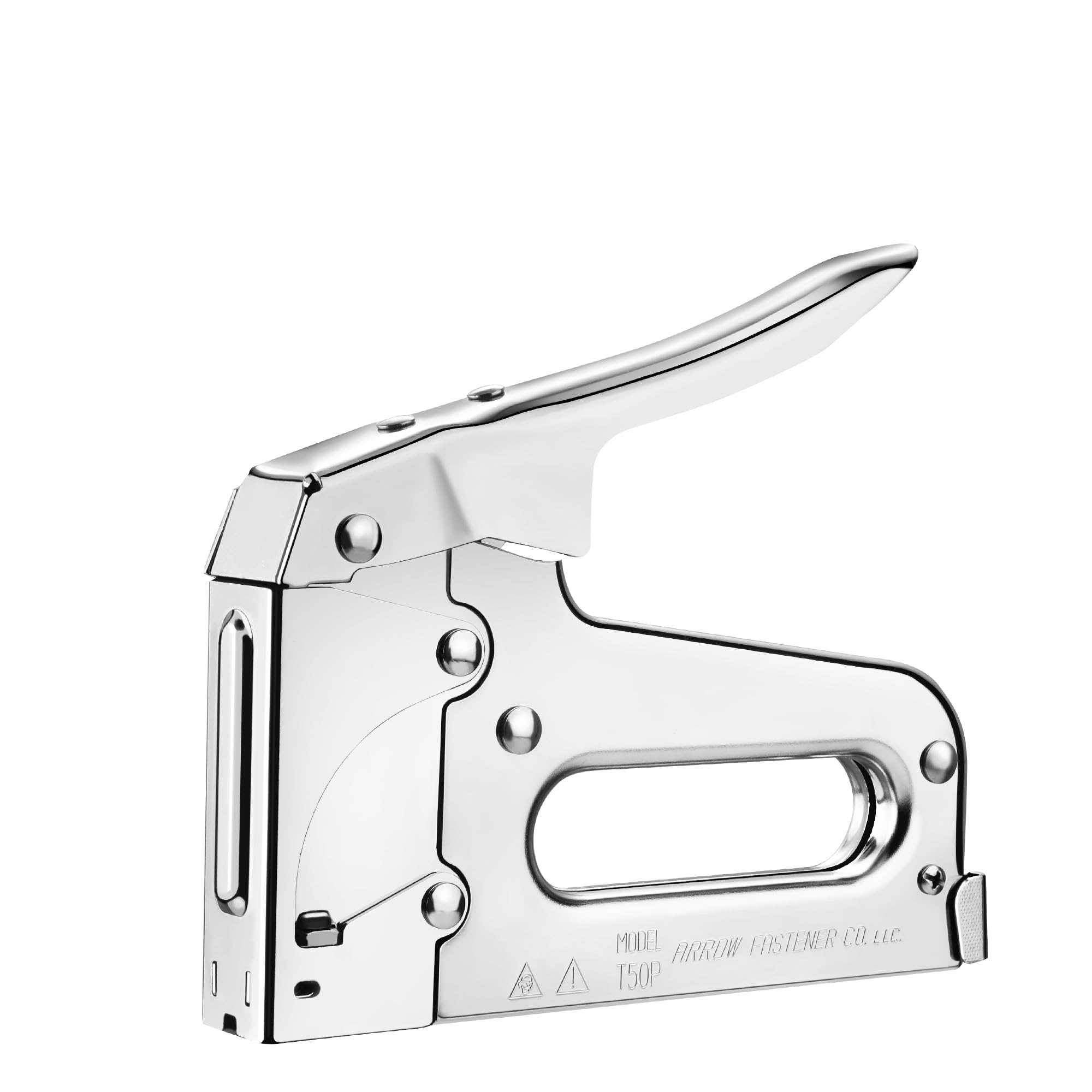
Arrow T50 Heavy-Duty

91 /100
Kirk Score Outstanding
Staple Type
Arrow T50
Power Source
Manual
Body Material
Chrome steel
Staple Leg Lengths
1/4" to 9/16"
Check Details on Amazon

Pros

  • T50 staples stocked almost anywhere, five lengths
  • High-leverage handle multiplies the push
  • Hardened chrome-steel body and working parts
  • Magazine window shows the remaining strip

Cons

  • Short 90-day warranty

Where the DEWALT is built around your hand, the Arrow T50 is built around the staple. It takes T50 staples in five leg lengths from 1/4 inch up to 9/16 inch, and that is the format behind half the staple guns sold, so refills are on the shelf at any hardware store. Nothing about this gun leaves you hunting for a proprietary strip on a Sunday afternoon.

The rest is old-fashioned in a way we like. The chromed-steel body has working parts hardened in a 1,500-degree furnace, the handle is a high-leverage design that multiplies your push, and the rear-load magazine has a window so you can see the strip running out before it does. There is nothing to adjust, nothing to charge and no lever to set wrong. It is the gun we point to when someone wants heavy-duty manual work and does not want to think about the tool.

Two things to know before you commit. Your arm supplies the power, so a few hundred staples into plywood will tire you out in a way the pneumatic Arrow will not. For a chair seat or a repair it is a non-issue; for a whole room of house wrap it is the wrong tool. And the warranty runs 90 days, which is short for something you expect to keep in the toolbox for years.

Bottom line: We recommend the T50 to anyone who wants one heavy-duty manual gun, a staple they can buy anywhere, and nothing to charge or adjust.

Check Latest Price
#03

Best Pneumatic

Arrow PT50 Pneumatic

94 /100
Kirk Score Outstanding
Weight
1.4 lb
Staple Type
Arrow T50
Power Source
Pneumatic, up to 100 psi
Staple Leg Lengths
1/4" to 9/16"
Check Details on Amazon

Pros

  • Bump fire covers large areas fast
  • Light 1.4-pound body, oil-free operation
  • Adjustable exhaust and two-trigger safety
  • Holds a steady depth across materials

Cons

  • Needs a compressor and air hose to run
  • Staples sold separately

Bump firing is the trick that makes this gun worth owning. Hold the trigger down, tap the nose along the work, and staples come out as fast as you can move your arm. Covering a wall in house wrap or running tack strip around a room stops being a test of grip strength and becomes a job you finish standing up straight.

In use it is a small, light tool at 1.4 pounds that runs off a home compressor up to 100 psi and does not need oil, so there is no maintenance ritual to keep up with. The adjustable exhaust cap lets you point the escaping air away from your face, and the two-trigger safety means it will not fire until the nose is pressed against something. Long runs went without a jam for us, and the depth stayed consistent from upholstery board to plywood.

The magazine is the part to watch. The strip is held by a small mechanism at the back, and if it slips the staples spill and you are reloading mid-run, so check the catch is seated before you start. Set against that, this is the gun that turns a weekend of stapling into an afternoon.

Bottom line: If you own a compressor and have a lot of stapling ahead, this is the gun we reach for: bump-fire speed, steady depth, and no oiling.

Check Latest Price
#04

Best for Crafts

HAUSHOF Light Duty

91 /100
Kirk Score Outstanding
Included
800 staples, remover
Staple Type
JT21 (No. 53)
Power Source
Manual
Staple Leg Lengths
1/4" to 3/8"
Check Details on Amazon

Pros

  • Light squeeze, comfortable for smaller hands
  • 800 staples and a remover included
  • Compact and light enough for a craft drawer
  • Uses widely stocked JT21 staples

Cons

  • Light-duty only: no hardwood or jobsite work

If your stapling is counted in dozens rather than hundreds, a light-duty gun is the right tool and a heavy-duty one is overkill. This is the one we keep coming back to for that work. It is light in the hand, easy to squeeze, and small enough to live in a craft drawer instead of a toolbox, which is exactly why it gets used for small jobs the big guns never get pulled out for.

It runs JT21 staples, also sold as No. 53, in 1/4-inch, 5/16-inch and 3/8-inch legs, and the box includes 800 of the 5/16-inch plus a remover, enough to finish a project before you buy anything else. The wide rubber handle spreads the squeeze across your palm rather than digging into it, and the quick-release bottom magazine makes a reload a couple of seconds. The plastic body is what keeps the weight down.

Know where it stops. It will seat a staple in softwood, upholstery board and fabric, and it will not drive into hardwood or survive a construction site. Feed it a strip that is not seated straight and it will jam, though the open magazine makes clearing quick. For screens, shelf paper and fabric over a frame it is exactly the right amount of tool, and the low price means you can own it alongside a heavier gun.

Bottom line: We keep this one for craft-scale stapling: it is light, easy to squeeze, and gentle enough for fabric, screens and shelf paper.

Check Latest Price
#05

Mixed-material projects

NEU MASTER NHT0050

89 /100
Kirk Score Excellent
Included
2,000 staples, remover
Power Source
Manual
Body Material
Chrome-plated steel
Fastener Types
Staples in three sizes
Check Details on Amazon

Pros

  • Stepless power dial for soft and hard material
  • All-steel body with rubberized grip
  • 2,000 staples and a remover included
  • Three staple sizes in one gun

Cons

  • About 2 pounds, heavy for overhead work

The dial on top is the reason to look at this one. A top-mounted knob lets you wind driving pressure up or down continuously, so the same gun can tap a staple into thin fabric without punching through and then sink one into a pine frame. The DEWALT and the Arrow T50 give you no depth control at all; this one and the SHALL do.

The rest of the package is sensible. The body is chrome-plated steel with a rubberized non-slip handle, the magazine loads from the bottom, and there is a jam-clearing mechanism built into the nose. It takes three staple sizes from 5/16 to 1/2 inch, and the box includes 2,000 staples and a remover, which makes it a real kit rather than a token bag of 50.

What we think: this is the manual gun for someone whose projects cross from fabric to wood in the same afternoon, a chair seat and then a drawer bottom, and who wants to set the depth rather than learn one fixed gun's feel. The trade-off is weight. At about 2 pounds it is heavier than the light-duty guns here, which steadies it over hardwood but makes overhead work a chore. If everything you staple is the same material, the simpler Arrow T50 does the job with less to fiddle with.

Bottom line: We point people to this when the work moves between fabric and wood, because the power dial lets one manual gun handle both without guesswork.

Check Latest Price
#06

Fine power control

SHALL 3-in-1

91 /100
Kirk Score Outstanding
Included
3,000 staples, remover
Power Source
Manual
Fastener Types
D, U and T fasteners
Power Adjustment
Stepless knob
Check Details on Amazon

Pros

  • Outlet markings show where the staple lands
  • Stepless power knob for mixed material
  • 3,000 staples and a remover included
  • Compact all-metal body

Cons

  • Jams more than the other guns here
  • Handle needs a firm push

This is not the gun for a whole sofa. It is the one for the odd jobs that do not justify a heavy-duty tool, a picture frame, a repaired cushion, a bit of craft work, and it carries a feature the bigger guns here do not: laser-etched marks at the nose showing exactly where the staple will exit. On a narrow frame or into a corner, that is the difference between a clean tack and a staple through the front of your work.

The kit is generous. You get 3,000 staples across D, U and T types plus a brad nail option, a staple remover, an all-metal body with an anti-slip grip, and a stepless power knob instead of a two-position lever. At under 10 inches long it handles like a hand tool rather than a hammer, and the knob lets you back the power off for thin fabric without changing staples.

Jamming is where it loses ground. This is one of the more jam-prone guns in this group, and the handle needs a firm, deliberate push rather than a casual squeeze, which our hand noticed on a longer run. For a dozen staples on a frame it is fine, and those outlet markings make it genuinely useful. For anything measured in hundreds, the DEWALT is worth the step up.

Bottom line: This earns its place on small jobs: outlet markings that show exactly where the staple lands, a power dial, and a full kit of staples and a remover.

Check Latest Price

How We Chose and Tested Staple Guns

We built the shortlist by scanning specs, price, and staple compatibility first, then filtering: any gun that only accepted a proprietary staple, or that had no path to replacement parts, got cut before testing. That left 12 guns — eight heavy-duty manual models, two light-duty craft tackers, and two pneumatic guns that run off an air compressor — which we used for four months.

Testing happened where staple guns actually live: re-covering six dining chair seats and a bench, stapling landscape fabric and house wrap along a backyard fence line, hanging canvas drop cloths, and a long stretch of craft projects. Each gun fired 200 staples into pine and 100 into oak so we could feel the difference between a staple that seats flush and one that stands proud.

We counted every jam and timed how long it took to clear one, since that's the number that decides a project's afternoon. We loaded each gun bare-handed and in work gloves to see how fiddly the channel was, noted how much palm force it took to sink a staple, and tried overhead and one-handed work to judge balance and weight. We also logged what came in the box — staple counts, remover, case — and whether the gun accepted multiple staple lengths and brad nails or locked you into one format.

For reliability, each gun stayed loaded in a toolbox between sessions, and we ran at least one full 1,000-staple sitting per model to watch for misfires once the mechanism got warm and dirty. We went back to the ones that felt best after a month of sitting to check nothing had seized.

How to Choose a Staple Gun

Match the staple to the material

Light-duty guns run JT21 staples, also sold as No. 53, in legs from 1/4 to 3/8 inch. That is the range for window screening, shelf paper, fabric over a frame and craft work. Heavy-duty guns run T50-type staples up to 9/16 inch for upholstery board, plywood, insulation and carpet tack strip.

The trap is buying by size rather than by job. A heavy-duty gun on thin fabric punches through and tears it, and a light-duty gun on hardwood bends staples and jams. Settle the duty level first, then check the tool lists the leg lengths your project needs, because most jobs want two or three lengths in the same session.

Choose a power source you can actually feed

A manual gun handles dozens to a few hundred staples comfortably and needs nothing but a box of staples. A pneumatic gun covers area: the Arrow PT50 runs off a home compressor at up to 100 psi, comes with the inlet fittings, and is oil-free so there is no lubrication routine.

The catch is that a pneumatic gun is only as useful as the compressor near it. A hose trailing up a staircase is the reason many people keep a manual gun in the toolbox as well. If the compressor stays in the garage, buy the manual gun and rent or borrow air for the one big job.

Weight and squeeze effort decide whether you finish

Stapling a chair seat is a hundred squeezes; stapling insulation overhead is several hundred with your arms raised. That is where a carbon fiber or plastic body earns its price, and where a wide rubber handle matters more than a fancy feature list. The DEWALT is in this guide because of that, not because of its specifications.

Our advice: if the work is above shoulder height, or if hand strength is a concern, put weight and squeeze effort ahead of depth control and kit size. A gun that hurts to use gets put down, and a half-stapled cushion is worse than a slower one.

Depth control and what comes in the box

Depth control matters when one gun has to handle both thin fabric and pine. A stepless knob, as on the NEU MASTER and the SHALL, lets you back the power off for a delicate job and wind it up for wood. A two-position lever is coarser; some guns, including the Arrow T50, give you no adjustment at all and rely on your squeeze.

Kits range widely: the HAUSHOF ships 800 staples and a remover, the NEU MASTER 2,000, the SHALL 3,000, while the Arrow T50, Arrow PT50 and DEWALT are sold as bare tools. Staples are a consumable, so check that the gun takes a staple you can buy locally and add a box in the leg length you actually need.

Frequently Asked Questions

Final Verdict

The DEWALT DWHT80276 is the staple gun we recommend first, because the two things that decide whether a stapling job gets finished, a light body and an easy squeeze, are the two things it does best.

If the budget is tighter and the work is heavy-duty, the Arrow T50 takes the same widely stocked T50 staples with nothing to adjust or charge. And if you own a compressor and have a lot of area to cover, the Arrow PT50 will outrun both of them.