// data-verified

Best Tool Belts of 2026

My first framing job ended with my tools in a bucket and my knees sore from squatting beside it. The fix is obvious: keep a tape, a square, and a box of nails within reach while both hands stay busy. But a bad belt is worse than the bucket — it drags your pants down, digs into your hips by noon, and sends you back to the truck anyway.

Most of it comes down to how the weight is carried. A padded waist and a wide belt spread the load; thin webbing under three loaded pouches does not. We've spent six months wearing 12 belts — leather sets, web belts, padded rigs, and clip-on systems — through cabinet installs, trim work, and one long weekend of framing.

Pockets are the easiest thing to sell and the hardest thing to use. What matters is whether the ones you reach for sit at hip height and open wide enough for a gloved hand, and whether the belt stays put after a hundred trips up a ladder. Sizing is the sleeper issue: a belt that adjusts in two-inch steps fits nobody well. The ones below stayed comfortable and kept my tools where I left them.

#01

Best Overall

Gatorback B240

93 /100
Kirk Score Outstanding
Weight
5 lb
Fits Waist
31–35 in. (Medium)
Belt Support
Ventilated back pad
Pockets And Slots
27
Check Details on Amazon

Pros

  • Box-shaped pouches stay open for one-handed access
  • Ventilated back pad breathes under a heavy load
  • 27 pockets across a tool bag and fastener bag
  • Rivets and bar-tack stitching at every stress point

Cons

  • Tape chain is the first part to break

A pouch that sags shut is a pouch you dig through one-handed on a ladder. Gatorback lines each bag with ABS so it keeps a box shape and stays open, and that's the detail we kept coming back to: reach in at hip height and your hand closes on the tool you wanted without looking. The B201 pouch carries 18 pockets and the B202 fastener bag adds 9 more, enough for a full electrician's kit without stacking pliers on top of a screwdriver.

We think the back pad is what justifies the price for anyone wearing this eight hours at a stretch. It's built over air channels with a foam backing and Lycra against your back, so it breathes where a plain nylon belt turns into a damp strip by mid-morning. Stress points get bar-tack stitching and metal rivets, the shell is 1250-denier nylon, and the seams have taken a loaded rig without complaint.

Sizing is the thing to settle before you order. The version we tested is a medium covering 31 to 35 inches, measured over your clothes rather than your pants size, and Gatorback's own advice is to ask for help if you land between. One more difference from the clip-style belts here: these bags stay bolted on, which suits a settled load-out and frustrates anyone who likes swapping bags between jobs.

Bottom line: The rig we recommend to anyone who wears a tool belt all day: bags that stay open, a back pad that breathes, and 27 slots for a full kit.

Check Latest Price
#02

Best for Heavy All-Day Loads

DeWalt 25-Pocket Rig

92 /100
Kirk Score Outstanding
Fabric
1680-denier with tarpaulin
Pockets
25
Belt Width
5.5 in. padded
Suspenders
Clip-on, removable
Check Details on Amazon

Pros

  • Removable suspenders take load off the hips
  • 25 structured pockets with high-visibility lining
  • Heavy fabric reinforced where it wears
  • Wide padded belt with a roller buckle

Cons

  • Waist belt won't cinch tight on a 32-inch frame

The suspenders are the reason to pick this one. Clipped over your shoulders, they carry a loaded rig up top instead of letting it drag at your hips and lower back, and they come off on the days you don't want them. We noticed the difference most on stairs, where a hip-heavy belt swings and a suspended one sits still.

The rest is built for speed: 25 pockets with wide-open structured mouths, yellow fabric inside so a black bit or a stubby screwdriver doesn't disappear, a 5.5-inch padded belt and a double-tongue roller buckle. The shell is 1680-denier with tarpaulin at the wear points, double-stitched and riveted. Empty, it's around 3 pounds — light for how much it swallows, and the pockets keep their shape once the rig is loaded.

Against the Gatorback you give up the ABS-lined box mouths and the ventilated pad, and you gain suspension for less money. For a remodeler or a framer who's up and down ladders all day, that's the better trade. For someone who wants the bags themselves to do the organizing, the Gatorback still wins.

Bottom line: We recommend it when the load is heavy: clip-on suspenders move the weight to your shoulders, and 25 structured pockets keep it all reachable.

Check Latest Price
#03

Best Premium Leather Rig

Occidental FatLip 8580

93 /100
Kirk Score Outstanding
Belt
3 in. Ranger work belt
Weight
5.2 lb
Bag Depth
10 in.
Pockets And Holders
25
Check Details on Amazon

Pros

  • Leather FatLip mouth keeps bags open
  • Hand-specific holders and a 2-in-1 hammer holder
  • 3-inch leather belt carries the load
  • Built to survive years of daily trade use

Cons

  • Tape pouch is snug on a FatMax 25 ft
  • Stiff leather needs breaking in

This is the most expensive rig here by a wide margin, and the first minute with it explains where the money went. The bags are 10 inches deep with a full leather boot and Occidental's FatLip mouth — a stiffened leather rim that holds the bag open the way canvas stops managing after a month of use.

Leather sits where it wears and industrial nylon where it doesn't: hand-specific tool holders, padded two-ply bags, a 2-in-1 tool and hammer holder, and the 3-inch Ranger work belt. Twenty-five pockets and holders, 5.2 pounds before you load a thing. Everything about it is aimed at someone who grabs the same four tools ten thousand times a year.

We think it earns that for a production carpenter and not for many other people. Leather takes a shape and keeps it, and it doesn't wear through at the corner where the chisel sits — that's what the outlay buys. For weekend work the weight and the price both work against you. Sizing is generous enough that an XL sits a 38- to 40-inch waist with holes left either way, so don't size up out of caution.

Bottom line: For a carpenter who wants one rig for the next decade, this is the leather set we point to; everyone else can spend far less and lose little.

Check Latest Price
#04

Best Belt for Pouches You Own

ToughBuilt ClipTech Belt

93 /100
Kirk Score Outstanding
Belt
Padded, steel buckle
Weight
1.1 lb
Fits Waist
32–48 in.
Pouch System
ClipTech clips
Check Details on Amazon

Pros

  • Pouches clip on and off in seconds
  • Heavy-gauge steel buckle
  • Cut-to-length belt with a steel tip
  • Wide padding spreads the load

Cons

  • Belt only; pouches sold separately

This arrives as a belt and nothing else, which is exactly what makes it useful: clip your own bags onto the ClipTech rail, unclip them when you change tasks, and swap a fastener bag for a drill holster without taking the belt off. We like it as the base of a system rather than a complete answer, and the wide padding spreads a loaded rig instead of cutting a line into your hip.

The hardware is the reassuring part. The buckle is heavy-gauge steel, not the plastic that fails on cheap belts, and the belt is cut to length with a steel tip so you trim the tail to your own waist rather than living with a foot of flapping webbing. A zip-off padding extension covers 32 to 48 inches, and the whole belt weighs 0.5 kg.

Cutting is one-way, so measure over the clothes you work in, with the padding in place, before the knife comes out. And budget for bags: a bare belt carries nothing, and two pouches bring you close to the cost of a complete rig. If you already own ClipTech gear, none of that applies — this is simply the belt those bags were designed for.

Bottom line: The belt to buy if you already own clip-style pouches: steel buckle, real padding, and a fit you trim down to your own waist.

Check Latest Price
#05

Best Budget Full Rig

AWP Carpenter Tool Rig

89 /100
Kirk Score Excellent
Weight
3.1 lb
Suspenders
Air-mesh padded
Maximum Waist
50 in.
Pockets And Loops
18
Check Details on Amazon

Pros

  • Two-sided rig with 18 pockets and loops
  • Air-mesh suspenders plus padded waist strap
  • Reinforced seams on 600-denier polyester
  • Complete setup for a modest outlay

Cons

  • Lighter fabric than premium rigs

Eighteen pockets, two bags on the hips, air-mesh suspenders and a padded waist belt: the AWP rig is a whole setup rather than a single pouch, and it's the one we point a new apprentice toward. Tiered pockets put fasteners at the front and tools behind them, and splitting the load across both hips keeps you from listing to one side by the end of the day.

The waist is the part to think about. It's one size with a listed 50-inch maximum, and the strap runs long on smaller frames, so the bags sit lower than you want until you work the adjustment in. Put it on over your work clothes and load it once before you commit.

What you get for the money is honest: 600-denier polyester, reinforced seams, 3.1 pounds empty. It won't outlast an Occidental and doesn't pretend to. For a homeowner finishing a basement, or a tradesperson who wants a second rig left loaded in the van, that's the right trade — you're buying organization and suspension, not leather.

Bottom line: For a full two-sided rig with suspenders at a modest price, this is our pick — best for new apprentices, second rigs, and serious home projects.

Check Latest Price
#06

Best Bare-Bones Belt

Klein 5705 PowerLine Belt

92 /100
Kirk Score Outstanding
Buckle
Metal quick-release
Maximum Waist
52 in.
Webbing Width
2 in.
Check Details on Amazon

Pros

  • Metal quick-release buckle that doesn't jam
  • 2-inch webbing spreads a loaded pouch
  • Fits waists up to 52 inches
  • Takes tunnel-loop and slotted pouches

Cons

  • Too wide to thread through jeans belt loops

Two inches of nylon webbing, a metal buckle that releases with a click, and enough length for a 52-inch waist. The PowerLine does the one job a belt has, without padding, pockets or hardware to get in your way. Pouches with tunnel loops or slots slide straight on, and it takes Klein's matching padded suspenders if you decide later that your hips want help.

What we appreciated is how little there is to go wrong. The buckle doesn't jam the way plastic ones do after a season of grit, the webbing hasn't rolled at the edges, and there's no padding to trap heat on a warm day. It's the belt you leave on all day and forget about, which is more than we can say for most of the rigs here.

It's the cheapest route into a proper tool belt, and for someone who already owns two pouches that's the whole calculation. The detail worth knowing: there's no keeper for the tail, so once you've cinched it the excess webbing hangs free until you add a velcro strap or a wrap of tape.

Bottom line: The belt we recommend when you already own pouches and want the simplest, longest-fitting, least expensive belt in this guide.

Check Latest Price
#07

Best for Bigger Waists

Dickies 8-Pocket Padded Belt

91 /100
Kirk Score Outstanding
Buckle
Plastic quick-release
Pockets
8
Belt Width
3 in. padded
Fits Waist
32–56 in.
Check Details on Amazon

Pros

  • Widest waist range here at 32–56 inches
  • 3-inch padded belt spreads the weight
  • Roomy pouch with interior and exterior pockets
  • Puncture-resistant back liner

Cons

  • Plastic buckle is the weak link under load

Thirty-two to fifty-six inches of waist is the widest range in this guide, and Dickies pairs it with a 3-inch padded belt and a roomy canvas pouch. That range is the headline for us: plenty of rigs top out around 48 inches, and a bigger-framed tradesperson ends up choosing between a bad fit and a custom belt.

The pouch is one large compartment with four interior pockets, three exterior ones including a zippered pocket, two big tool loops and a carabiner, which makes it better at bulky items than at a neat row of drivers. A 25-foot tape disappears into it with room to spare. The padding is what you notice after two hours — weight spread over three inches instead of a line cut into your hip.

It's a single bag on one side, so a heavy load pulls to one hip; if you want balance at this price, the AWP rig spreads it across both. For painting prep, electrical work and weekend jobs, one bag you can reach into beats two you can't.

Bottom line: Our pick for bigger waists on a budget: a 3-inch padded belt that reaches 56 inches and a pouch that swallows a 25-foot tape.

Check Latest Price
#08

Occasional home jobs

CLC IP489X Belt & Bag

93 /100
Kirk Score Outstanding
Weight
12.8 oz
Pockets
3
Material
Suede leather
Fits Waist
29–46 in.
Check Details on Amazon

Pros

  • Three suede pockets keep small tools visible
  • Hammer loop and tape clip outside the bag
  • Belt covers 29 to 46 inches
  • Light enough to forget you have it on

Cons

  • Seams can give way under a heavy load
  • Hammer loop is narrow for thick handles

Three pockets, a hammer loop, a tape clip and a 2-inch web belt: the CLC is the kit you grab when a job needs six tools and a handful of screws, not a full set. Suede leather, 9.5 inches wide and 8 inches tall, 12.8 ounces with the belt. It's the smallest thing we recommend, and most household jobs never need more.

The appeal is that it doesn't swallow your tools. Two main pockets take nails, screws and hardware, the smaller one fits pliers or a pencil and nail sets, and the hammer loop and tape clip keep the two things you reach for most outside the leather where you can see them. The belt covers 29 to 46 inches, so nearly anyone can wear it without hunting for a size.

It's all on one side, so a full pouch pulls at one hip and there's no second bag to balance it — for a day of framing that's the reason to look at a two-sided rig. For an afternoon of trim, drywall patching or a fence repair, it's the least risky purchase on this page.

Bottom line: For occasional jobs and light loads this little suede number is the sensible buy: three pockets, a hammer loop, and a belt that fits most waists.

Check Latest Price
#09

Service calls

LEFOR·Z 14-Pocket Belt

89 /100
Kirk Score Excellent
Magnet
Built into pouch
Weight
15.9 oz
Pockets
14
Fits Waist
31–48 in.
Check Details on Amazon

Pros

  • Magnet holds screws and bits in place
  • Detachable pouches slide along the belt
  • Wide padded waist band
  • Light at 0.45 kg empty

Cons

  • Soft waist belt folds and tangles when putting on
  • Six-month warranty only

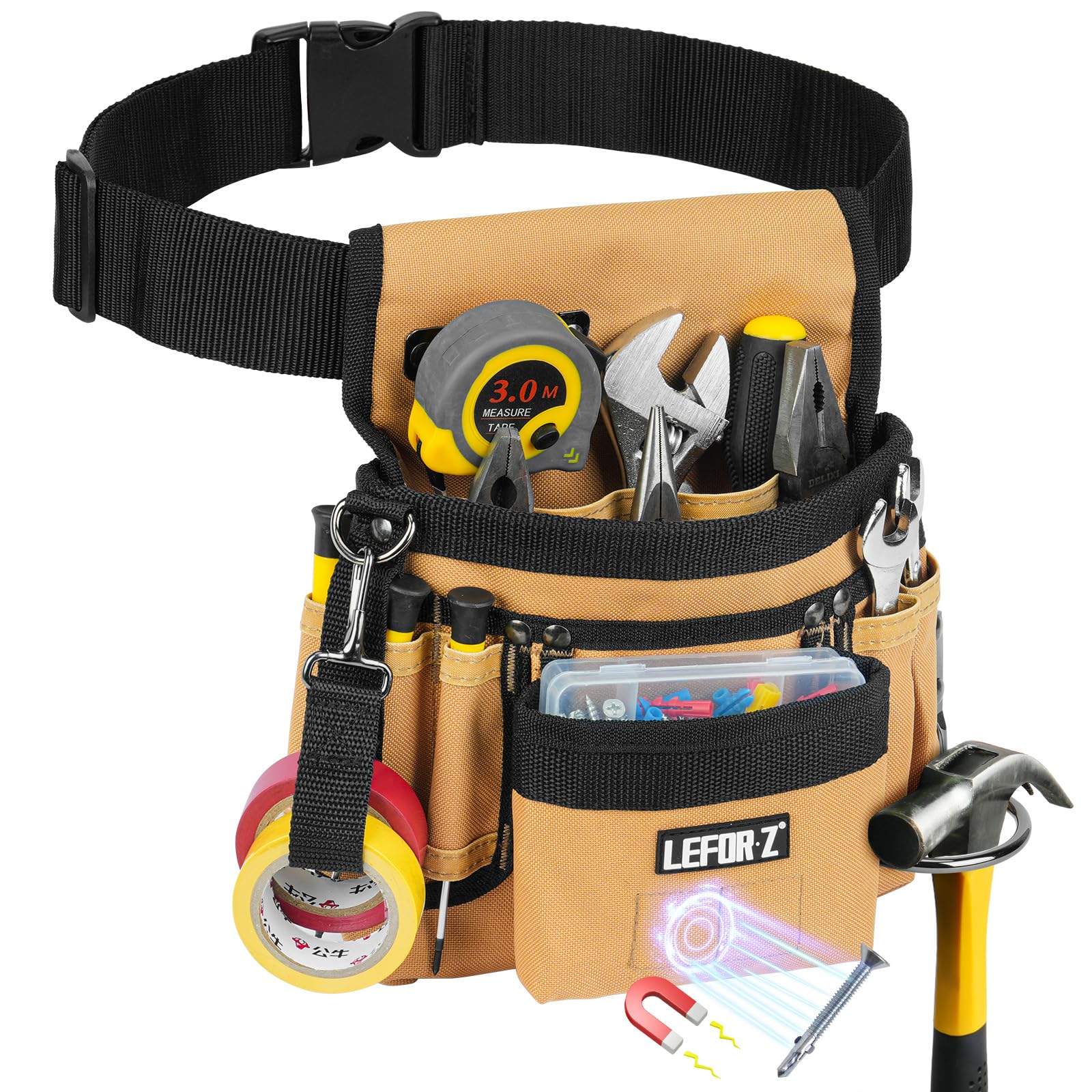
The magnet sewn into the front of this pouch is the detail we didn't expect much from and wouldn't give up now. Screws, bits and a tape end up stuck where you left them instead of rolling off a ladder shelf, and you're not patting down a pocket every time you turn around. Around it: 14 pockets, a steel hammer hole, a tape tether and a tape measure clip.

Detachability is the rest of the pitch. The pouches unclip and slide along the belt, so you can pull the load to the front for a tight ceiling space and push it back to the hip for trim work, and the wide waist band is more forgiving than the narrow webbing on cheap belts. It adjusts 31 to 48 inches and weighs 0.45 kg before you fill it.

It's a compact rig rather than a full one: a driver set, pliers, a tape and a hammer, and that's the ceiling. Carry a drill and a box of screws and you want the AWP or another two-sided setup. For service calls and small installs it's enough belt and nothing more, which is a compliment in a category full of overbuilt rigs.

Bottom line: A compact, magnet-equipped belt for service calls and small installs, at a price that makes it an easy second rig.

Check Latest Price

How We Tested the Best Tool Belts

We started by pulling every belt a working tradesperson would actually buy, then cut the list by belt width, adjustability range, usable pouch count, and material — leather, heavy canvas, and nylon webbing all made the cut. Twelve belts went out to people who wear one for a living, and testing ran for six months.

Each belt got worn through a cabinet install, a day of trim work, and a weekend of framing and demo. We weighed every belt empty, then loaded each one with the same kit — tape, square, driver bits, nails, pencil, utility knife — and wore it for full eight-hour days to see where it pressed and how fast the padding flattened.

With gloves on, we marked how many pockets we could reach without looking and timed how long each belt took to put on and take off. We checked whether the buckle stayed set after climbing, crouching, and crawling under a deck, and ran the suspender and clip-on models both with and without their harnesses to see if the extra hardware earned its weight.

Every week we ran a thumb down the strap edges for fraying, checked rivets for pull-through, and pressed on pouch mouths to see if they had gone soft. We sized each belt on people from 30- to 46-inch waists, and asked whether the leather sets did anything the canvas and webbing ones couldn't for what they cost.

How to Choose a Tool Belt

Fit the Belt to Your Waist, Not Your Pants Size

Waist ranges in this group run from 29 inches to 56, and they are measured over work clothes rather than over skin. A hoodie, a bib or a heavy shirt adds inches you need to account for, so measure where the belt will actually sit and compare that number to the range. On a fixed padded band you want to land in the middle of the range, with a couple of holes left in reserve. Leather behaves the opposite way: it starts stiff and takes your shape, so a belt that feels snug out of the box is the one that ends up comfortable.

Decide Whether Your Hips or Your Shoulders Carry the Load

Padding spreads weight around the waist; suspenders move it up onto the shoulders. For a rig that stays on all day, suspension is the biggest comfort upgrade in this guide, which is why the DeWalt and the AWP both build it in. For short jobs and light loads, a plain 2-inch webbing belt is easier to move in, traps less heat, and costs far less. Ventilated back pads, like the one on the Gatorback, earn their bulk only if you sweat through a nylon belt before lunch.

Pouch Structure Matters More Than Pocket Count

A 27-pocket rig with bags that fold shut is slower than a 14-pocket rig with bags that stay open. Look for a stiffened or lined mouth — the Occidental's leather lip is the most convincing version of this — and a reinforced bottom so a chisel doesn't wear through the corner. Pocket counts here run from 3 to 27. The question that decides it is whether you can get a hand into the bag you use most without taking your eyes off the work.

Match the Hardware to the Job

Metal buckles, roller or quick-release, outlast plastic and don't jam when they're full of dust. The plastic buckle on an otherwise sound budget rig is the part that ends the belt's life, and it's the first thing to check on a low-priced set. Two- to three-inch webbing and padding distribute weight better over a long day; narrower webbing is easier to move in. One trap worth naming: a 2-inch tool belt with a metal buckle won't thread through jeans loops, so it's worn over your work pants, not instead of a pants belt.

Buy a Base Belt or a Whole Rig

If you already own pouches, buy a belt. The Klein takes tunnel loops and slots, the ToughBuilt takes clip-on bags, and either saves you paying twice. If you're starting from nothing, a matched combo is cheaper than assembling one and sits together properly — the Gatorback's two bags and the Occidental's leather set are built around their own belts. Clip systems are the middle path, letting one belt carry different bags on different days.

Frequently Asked Questions

Final Verdict

After working through this set, the Gatorback B240 is the rig we recommend to anyone who wears a belt for a living: the bags stay open, the back pad breathes, and 27 slots take a full electrician's kit. If the load is heavy enough that your hips complain, the DeWalt's clip-on suspenders are the better answer for less money.

And if you already own pouches you like, neither is necessary — a ToughBuilt padded belt underneath them is the upgrade most people feel first.