// data-verified

Best Carpenter Tool Belts of 2026

A tool belt is easy to ignore until about hour six, when a loaded pouch starts sliding off your hip. Load one with a hammer, a tape, and a handful of fasteners and the gap between a good rig and a cheap one stops being cosmetic: the belt rolls, the pouches swing when you climb, and the padding quits by mid-afternoon. The right setup keeps that weight sitting on your hips, holds the buckle where you set it, and stays put when you kneel, squat, and go back up the ladder.

My team and I have spent six months wearing 12 of them — oil-tanned leather framer rigs, padded canvas belts, nylon setups with detachable magnetic pouches — through deck framing, drywall, and a lot of weekend shop work. Pocket count turned out to matter far less than pocket placement, and a magnet you actually trust beats three extra pouches when you're halfway up a ladder. The one thing to know before you buy: leather softens and stretches, so a belt that's already snug today may not be your friend by August. The picks below are the ones we kept reaching for.

#01

Best Overall

DeWalt DWST540602 Tool Rig

92 /100
Kirk Score Outstanding
Belt
5.5 in. padded
Pockets
25
Material
1680 denier fabric and tarpaulin
Suspenders
Included
Check Details on Amazon

Pros

  • Suspenders move the load off your hips
  • 25 structured, yellow-lined pockets
  • 1680D fabric, tarpaulin panels, rivets at stress points
  • Wide 5.5-inch padded belt with a roller buckle

Cons

  • About three pounds before any tools go in

The suspenders are why we hand this rig to working carpenters. A belt loaded with a framing pouch, a tape and a hammer pulls at your waistband all day, and clip-on shoulder straps are the simplest fix there is: they take the load across your shoulders and let the 5.5-inch padded belt get on with keeping the pouches from swinging. Both come off when you want a plain hip belt for a quick job.

Twenty-five pockets is the other half of the argument, and they're the right kind — wide-mouthed, structured, and lined in yellow so a driver bit or a pencil doesn't vanish into a dark hole. Rivets and double stitching sit where the strain is, and 1680-denier fabric with tarpaulin panels at the wear points is the toughest combination in this group. We've pulled enough tired canvas rigs out of a truck bed to know what one season does to them.

The waist belt is the part to sort out before you order. It runs small at the top of its range, and the fixed loop on the velcro belt can stop it cinching down on a 32-inch waist. Measure at the hip, where the belt actually sits, and if you're near the ceiling of the size, plan on a different belt rather than squeezing into this one.

There are cheaper ways into a full rig — the AWP below does the same job with lighter cloth and fewer pockets — but for anyone in bags five days a week, this is the one we reach for, and the extra heft of the fabric is part of the reason why.

Bottom line: If you're buying one rig for real carpentry work, we point you here: the suspenders carry the weight, the pockets stay open, and 25 slots keep a day's tools sorted.

Check Latest Price
#02

Best for Professional Framers

Occidental Seven Bag Framer Set

94 /100
Kirk Score Outstanding
Waist
Up to 34 in. (Medium)
Weight
5.6 lb
Pockets
23
Material
Top-grain leather
Check Details on Amazon

Pros

  • Top-grain leather with copper-riveted bags
  • 23 pockets including a deep fastener bag
  • Hand-specific holders speed up the working rhythm
  • Made in the USA with a two-year warranty

Cons

  • 5.6 pounds before you load a single nail

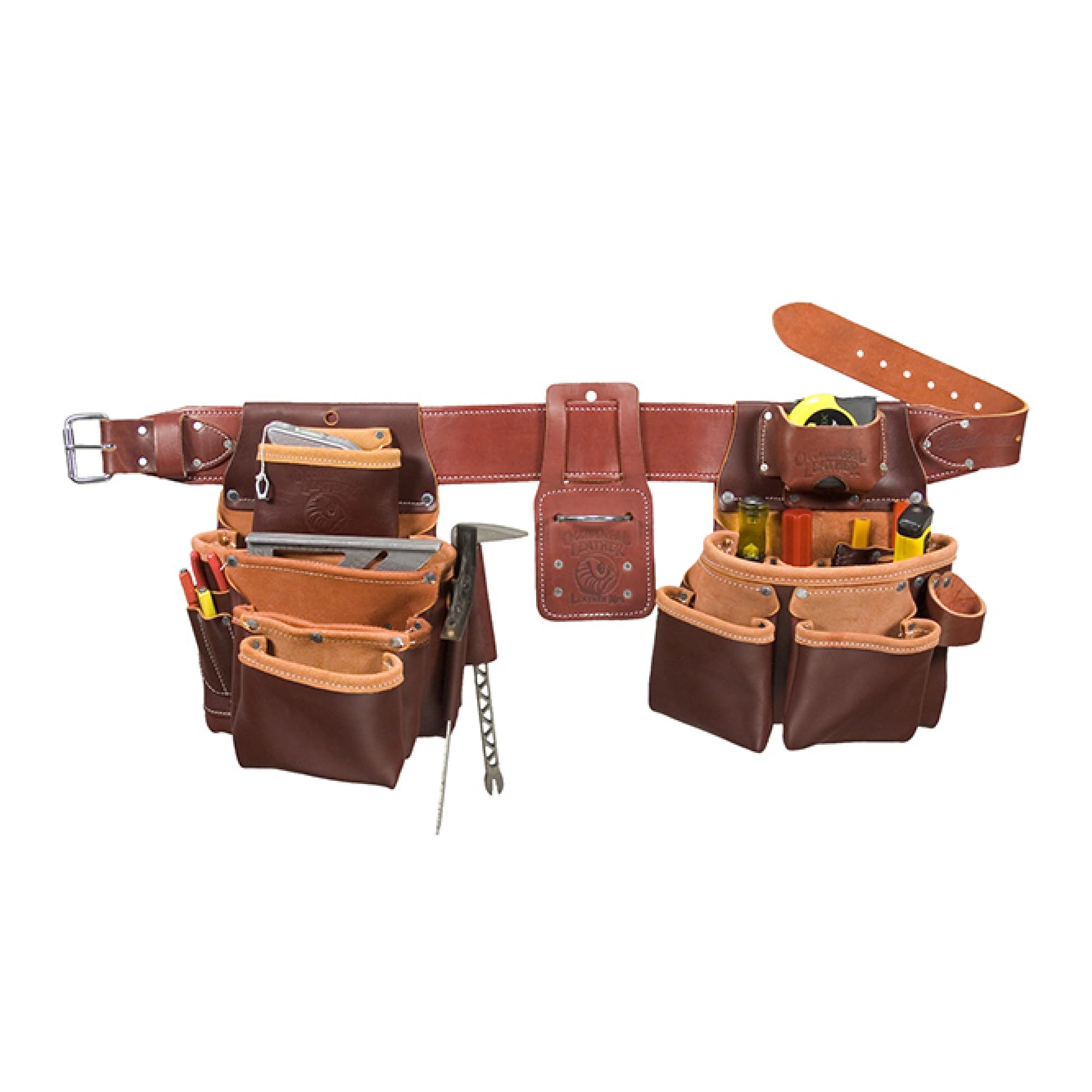
The price is the first thing to get past here, and it's the reason we list this set for working framers rather than for everyone. What the money buys is top-grain leather tanned to Occidental's own spec, copper rivets through the main bags, and a layout refined over decades of production framing — made in the USA, with a two-year limited warranty behind it.

The components matter more than the pocket total. A three-pouch tool bag sits on one side and a four-pouch fastener bag on the other, with a hammer holder and the 3-inch Ranger work belt carrying both. Hand-specific holders put the hammer where your hand falls rather than where the stitching was convenient, the no-spill system keeps a chisel or a nail set where you left it, and the fastener bag takes nails by the handful.

Twenty-three pockets and holders sounds excessive until you're carrying nails, a tape, pencils, a knife and a hammer at once — then it sounds about right. The leather is the real argument: it starts stiff and heavy, molds to your hip in a way nylon never does, and the bags hold their shape when empty so you can load them one-handed. That's what a framer is paying for.

Sizing is the practical catch. The Medium is listed to a 34-inch waist, a lower ceiling than anything else here, and the fit runs small on top of that, so go up a size rather than assuming you're a Medium. The belt is the part that will outlast the bags by years, which is worth knowing before you order the wrong one.

Bottom line: For a framer in bags ten hours a day, the leather, the copper rivets and the pouch layout are worth the outlay; anyone building a deck twice a summer can spend far less.

Check Latest Price
#03

Best Value Full Rig

AWP Carpenter Tool Rig

89 /100
Kirk Score Excellent
Waist
Up to 50 in.
Weight
3.1 lb
Pockets
18
Material
600 denier polyester
Check Details on Amazon

Pros

  • Air-mesh padding at shoulders, back and waist
  • 18 pockets and loops for a full load
  • Fits waists up to 50 inches
  • Padded suspenders at a budget price

Cons

  • One size, and it runs large on smaller frames
  • 600D polyester is lighter duty than our top pick

This is the DeWalt's shape at a much lower outlay: a full rig with air-mesh padding across the shoulders, back and waist, pockets on both hips, and suspenders carrying the load. Fewer pockets and lighter fabric, obviously — but if you want to find out whether a two-bag rig suits the way you work before spending like a pro, this is where we start people.

Eighteen pockets and loops is plenty for a remodel or a small crew. The tiered pockets are cut so you can see into them from above, which matters more than the raw count when you're on a ladder with gloves on, and the waist belt runs out to 50 inches — among the widest here. Add reinforced seams, carry handles for moving it between tasks, and 3.1 pounds empty.

It's one size, and it runs large: on a smaller frame you'll be pulling a lot of strap through the buckles and the bags will sit wide on your hips, because the belt tightens but the pouches don't shrink. The 600-denier polyester is also a step down from the 1680-denier cloth on our top pick. For a second setup, a helper's rig, or a homeowner's renovation, both trade-offs are easy to take.

Bottom line: Air-mesh padding, suspenders and 18 pockets at a budget price make this the easiest way to try a full rig without committing to one.

Check Latest Price
#04

Small jobs

UUP Magnetic Tool Belt

89 /100
Kirk Score Excellent
Waist
31 to 48 in.
Weight
1.9 lb
Pockets
26
Material
Oxford fabric
Check Details on Amazon

Pros

  • 26 pockets and three magnet zones
  • Magnets at the hammer holder and pouch fronts
  • Covers 31- to 48-inch waists
  • 1.9 pounds, so it adds little to the load

Cons

  • Rivets and buckle give way first
  • Woven belt can roll under load

Twenty-six pockets and three magnet zones is a lot of storage for the money, and the magnets are the part that earns its keep. One sits at the hammer holder and one across the front of each pouch, holding nails and screws while both hands are busy — a genuine speed advantage on small framing, hanging doors and punch lists.

What the price doesn't buy is hardware. Oxford fabric with double stitching and rivets at the stress points is the right idea, and the rivets are also the part to watch: they're what gives way first, and the quick-release buckle is stiff enough to fight you with gloves on. We rate it as a light-to-moderate load belt that will see you through a season of weekend work, not a framer's daily driver.

The belt itself is the third thing to know. It covers 31 to 48 inches, but the woven strap doesn't stay flat for everyone, and a belt that rolls under a loaded pouch digs in by afternoon. Swapping in a stiffer belt is the usual fix, which isn't a job you should have to do on something new.

Bottom line: Twenty-six pockets and three magnet zones put fasteners within easy reach on small jobs; the buckle and rivets won't stand up to daily framing.

Check Latest Price
#05

Trim work

LEFOR·Z 14-Pocket Tool Belt

89 /100
Kirk Score Excellent
Pouch
Detachable
Waist
31 to 48 in.
Pockets
14
Material
Nylon
Check Details on Amazon

Pros

  • Detachable pouch moves to either side
  • Magnet, hammer ring and tape clip up front
  • Widened belt spreads pressure
  • Fits 31- to 48-inch waists

Cons

  • Single pouch leaves a framing load behind
  • Six-month warranty is the shortest here

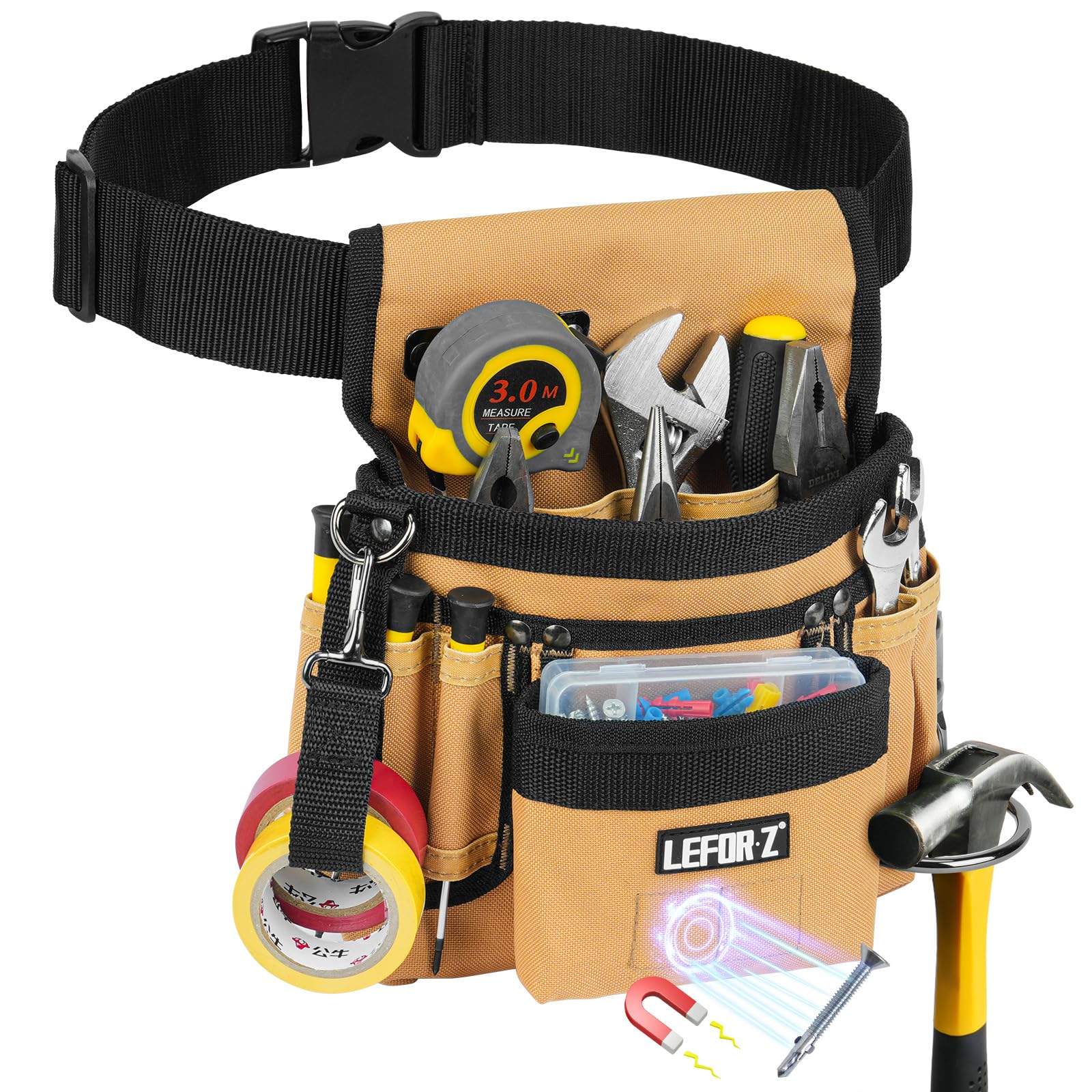
Not everyone wants pockets on both hips. If your day is trim, outlets, cabinet installs or a punch list, one pouch with fourteen slots and a hammer ring is faster than a full rig — you swing it to the front when you kneel and out of the way when you don't.

There's more here than the price suggests: a magnet in the pouch face for screws, a steel hammer hole, an electrical tape tether and a tape clip, all hung on a widened belt that spreads pressure across the waist. We noticed the pouch detaches and moves to whichever side you reach with, which is the detail that makes a one-pouch belt practical for two-handed work.

Treat it as a second belt rather than a first. The fourteen pockets are laid out well for hand tools, but there's no depth for a framing square and a hammer together, and the belt folds and tangles while you're getting it on. For small jobs and quick access, that's an easy trade, and it's the rig we hand to someone who isn't sure they want one.

Bottom line: For trim, electrical and punch-list work, one detachable pouch with fourteen slots beats a full rig — and this is the lightest route into it.

Check Latest Price
#06

Light carry

STRONGLAD Leather Tool Belt

91 /100
Kirk Score Outstanding
Waist
29 to 46 in.
Pockets
6
Material
Oil-tanned leather
Pouch Size
8 x 9 in.
Check Details on Amazon

Pros

  • Oil-tanned leather that breaks in and darkens
  • Main pocket takes a small drill
  • Two pencil sleeves and a knife pocket
  • Fits waists from 29 to 46 inches

Cons

  • No hammer holder in the six-pocket layout

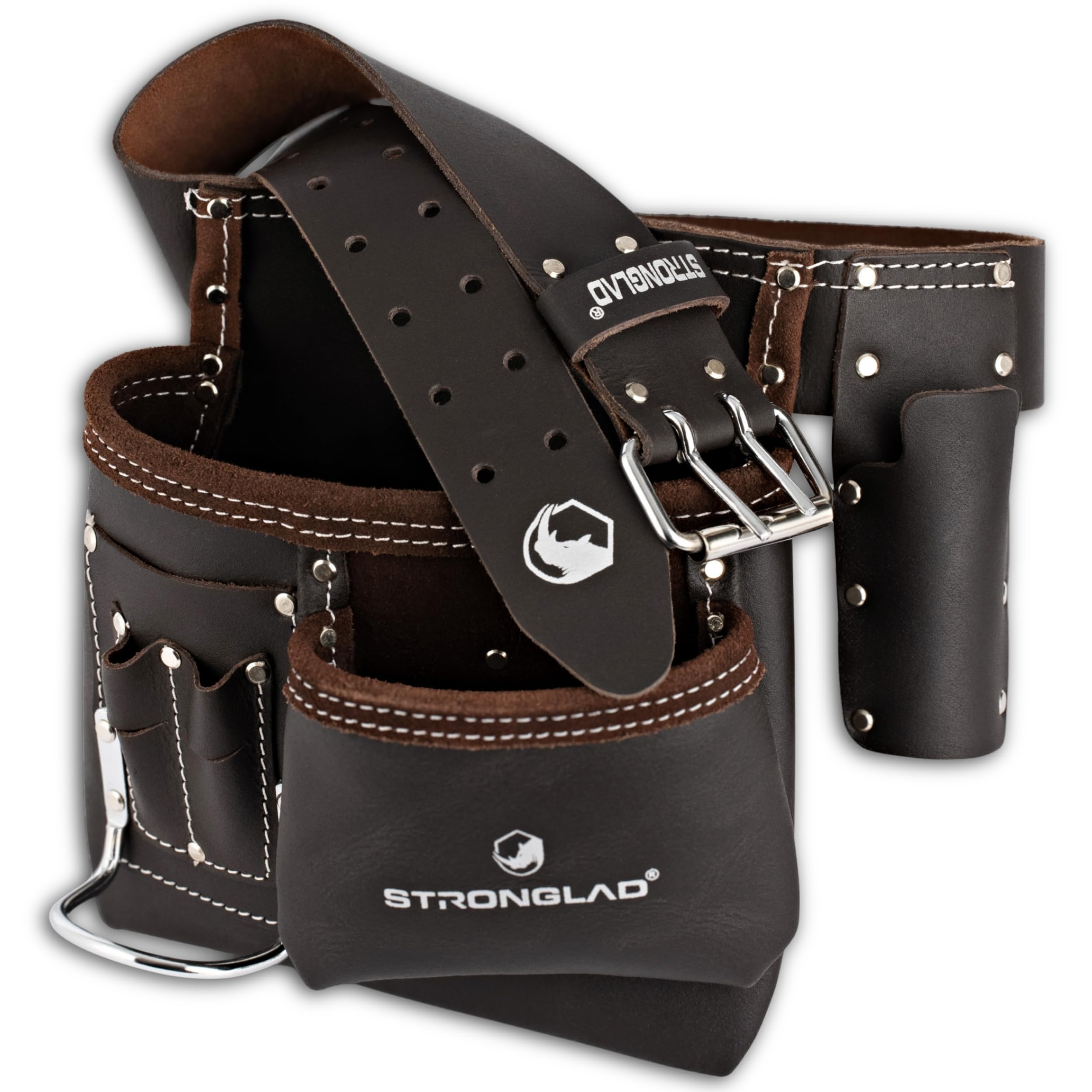
Oil-tanned leather is the whole pitch here, and it's a good one: the pouch arrives stiff enough to hold its shape, and it darkens and softens where your hand goes in and out. We pick it for the material first and the layout second, which is the right order for something you plan to wear for years.

The layout is deliberate — a nail pocket, a main pocket deep enough for a small drill or a fistful of hand tools, two pencil sleeves and a flat pocket that takes a Stanley knife. Six pockets in all, nothing wasted and nothing for a hammer, so it suits work where the hammer is in your hand more than on your hip.

The belt runs 29 to 46 inches, and the buckle is worth a look when it arrives: the metal tabs holding the frame are short, and a buckle that lets go mid-task makes the rest of the belt useless. The leather and the riveted pouch are the parts that will outlast the hardware.

Bottom line: If you want leather without a framer's rig, this six-pocket pouch carries the essentials and breaks in like a good pair of boots.

Check Latest Price
#07

Larger waists

Dickies 8-Pocket Padded Tool Belt

91 /100
Kirk Score Outstanding
Belt
3 in. padded
Waist
32 to 56 in.
Pockets
8
Material
Canvas
Check Details on Amazon

Pros

  • 3-inch padded belt spreads weight
  • Fits waists from 32 to 56 inches
  • Big main pocket takes a drill
  • Zippered exterior pocket and carabiner

Cons

  • Plastic buckle and belt-loop stitching are weak points
  • One pouch, so capacity trails a two-bag rig

A 3-inch padded belt that adjusts from 32 to 56 inches is the reason to look at this one. If you're a bigger frame, or you've had narrow webbing dig into your hip bone by lunchtime, the padding and the range do more for a working day than three extra pockets would.

Eight pockets are arranged around one wide main compartment: four inside for small tools, three outside including a zippered one, plus two large tool loops and a carabiner. The big compartment swallows a drill or a hammer, and the back panel is reinforced against punctures — the spot that usually wears through first on a canvas pouch.

Canvas at this price has a ceiling, and it's the plastic quick-release buckle and the stitching at the belt loop. Load it eight hours a day and those are the parts that end the relationship; hang it on a hook between weekend projects and it will outlast your to-do list.

We keep it on the list for two things the others don't do as well: fitting a 56-inch waist, and staying comfortable with a loaded main pocket through a long trim day. It's a one-sided pouch, so it won't replace a two-bag rig — but it's the easiest of these to live with if you carry a modest set.

Bottom line: The widest waist range here and a padded belt that doesn't dig in make this a sensible one-pouch setup for bigger frames and lighter days.

Check Latest Price
#08

Building your own

Klein 5225 Tool Belt

93 /100
Kirk Score Outstanding
Waist
Up to 48 in.
Weight
9.6 oz
Material
Polypropylene webbing
Belt Width
2 in.
Check Details on Amazon

Pros

  • Metal quick-release buckle
  • Takes tunnel-loop and slotted pouches
  • Fits waists up to 48 inches
  • 9.6 ounces, so it adds almost nothing

Cons

  • No keeper for the excess belt tail
  • Stiff webbing is a chore to thread through loops

There are no pockets here. This is a belt — 2 inches of polypropylene webbing, a metal quick-release buckle, corrosion-resistant hardware, sized to a 48-inch waist — and it exists to carry the pouches you already own or plan to buy separately.

That's a real job. The belt takes tunnel-loop and slotted pouches, which covers most of what's sold, and the metal buckle separates it from the plastic hardware on budget rigs: it releases cleanly and adjusts while you're wearing it. At 9.6 ounces it adds almost nothing to the load.

Two annoyances come with it. The webbing is wide and stiff enough that threading it through pant loops is a chore, so most people wear it over the waistband instead, and there's no keeper to hold the tail once you've cinched it — you'll be tucking or taping it.

Paired with a pair of pouches you already trust, it makes a better-fitting rig than most off-the-shelf sets, for less than the price of a midrange belt. We recommend it to anyone who already has opinions about their pouches.

Bottom line: If you already own pouches, this metal-buckle belt is the least expensive way to get them onto a proper waist belt.

Check Latest Price

How We Tested Carpenter's Tool Belts

We started with the belts that keep turning up on job sites and in reviews, then cut the list using spec sheets: waist ranges, pouch material, whether the pouches came off, how wide and how padded the belt was. That left 12 belts, which we wore for six months through deck framing, a drywall hang, some electrical rough-in, and a long stretch of weekend shop projects — over jeans, over bib overalls, and over a hoodie once the weather turned.

Each belt got loaded with the same kit — tape, speed square, hammer, cat's paw, fasteners, pencils, knife, driver bits — and then worn for a full day of real work. We noted whether the belt rolled forward when we bent to pick something up, whether the padding pressed into a hip bone by mid-afternoon, and how often we had to re-tighten. Buckles got clipped and unclipped dozens of times a day, and we watched for slipping after kneeling or climbing. Strap quality showed up in the small stuff: stretched leather, frayed webbing, rivets starting to pull.

For the magnets, we stuck a 16-penny nail, a driver bit, and a stubby level to each holder, then walked, climbed, and bent over — whatever was still there an hour later counted as usable. Detachable pouches came off and went back on until we knew which ones we'd genuinely swap between framing and trim, and we weighed each belt empty and loaded to see how much the suspenders were really carrying. At the six-month mark we went back over stitching, rivets, and padding, and asked whether the price had bought leather and hardware or just a bigger pocket count.

How to Choose a Carpenter's Tool Belt

Rig, Pouch, or Belt Alone

Three formats cover carpentry. A full rig puts pouches on both hips and adds suspenders to move the load off your waist — the right choice if you carry nails, a tape, a hammer and a nailer through a shift. A single pouch on a belt suits trim, electrical and punch-list work, where you need a handful of tools and speed of access. A belt on its own is for anyone who already owns pouches and wants better hardware under them.

If you finish most days with a red mark on your hip bone, suspension is the upgrade that changes the most about your working life, and it's why our top pick has it.

Fit Is Where These Go Wrong

Fit is the weakest part of this category, and the trap is reading the waist range as your pants size. These belts ride at the hip, over a waistband, so measure there rather than at the navel. Check the bottom of the range too: a belt that won't cinch down sits low and swings every time you turn.

The spread is wider than you'd guess — the Occidental set's Medium stops at 34 inches, the Dickies reaches 56, and the AWP is one size that runs large on a smaller frame.

Pocket Layout Beats Pocket Count

Twenty-six pockets are worthless if you can't see into them. Look for wide, structured mouths that stay open when the pouch is empty, a light lining that makes dark tools visible, and dedicated holders where you need speed: a hammer loop, a tape clip, a pencil sleeve.

Magnets earn their place for nails and screws on small jobs, less so on a crew that goes through fasteners by the box. Deep bags hold more; open pockets let you grab without looking. Choose according to whether your day is mostly carrying or mostly fetching.

Materials and Hardware Decide the Second Year

Four materials show up here: oil-tanned leather, 1680-denier fabric with tarpaulin panels, 600-denier polyester, and canvas. Leather starts stiff and heavy, then molds to you and keeps its shape when empty. The synthetics are lighter from day one and need no breaking in, but the lighter the denier, the sooner a nail bag wears through.

Whatever the material, look at the hardware. Metal buckles outlast plastic, and rivets plus double stitching at the stress points are what keep a pouch attached in year two. A plastic quick-release is the first thing to fail on a budget rig.

Frequently Asked Questions

Final Verdict

Our pick is the DeWalt DWST540602. The suspenders and the 25 structured pockets solve the two things that make a tool belt tiring — weight on your hips and tools you can't find — and the 1680-denier build is the toughest in this group.

If you frame for a living and want leather that lasts a decade, the Occidental Seven Bag set is the step up. If you're outfitting a first rig or a second setup, the AWP does the same job for far less.