// data-verified

Best Power Tool Batteries of 2026

A battery pack is a fuel tank with a latch on it: the amp-hour rating tells you how much charge it holds, and the voltage stamped on the side tells you which tools it will and won't click into. Buy the wrong platform and you've got a paperweight; buy too few amp-hours and you're swapping packs halfway through a deck build. My garage has three platforms running at once, which is exactly why my team spent eight months putting 14 batteries through circular saws, drills, and impact drivers instead of just reading spec sheets.

The numbers on the label turned out to matter less than the things nobody prints there — how a pack feels at the top of a ladder, how hot it runs during a long rip cut, whether the charger you already own will talk to it. Two-packs are usually the honest value play, and compatible replacements cost a fraction of OEM prices, which is also where the counterfeits hide.

Below you'll find light packs for punch-list work and high-output bricks for heavy cutting, all judged on run time per dollar rather than sticker bragging.

#01

Best Overall

DeWalt 20V MAX 5Ah 2-Pack

96 /100
Kirk Score Outstanding
Voltage
20V MAX
Capacity
5 Ah
Pack Count
2
Charge Gauge
3-LED indicator
Check Details on Amazon

Pros

  • Two 5.0Ah packs keep a tool running
  • Fits every current 20V MAX tool
  • Three-LED gauge shows charge at a glance
  • Backed by a three-year limited warranty

Cons

  • No charger in the box

Two packs in one box is the whole argument for the DCB205 set. A 5.0Ah pack is the capacity we keep reaching for on 20V MAX tools — enough for a circular saw to make a real run of cuts, light enough at about 1.4 pounds that a drill doesn't feel nose-heavy — and a second charged pack means the saw stops when you stop, not when the battery does.

We think this is the default buy for most people who already own yellow tools. DeWalt's 20V MAX is the widest platform in this roundup, and these packs slide into every current 20V MAX tool and charger without an adapter. The three-LED gauge on the back is a small thing that saves real time: a tap tells you whether the pack in your hand is the charged one or the one you meant to swap out before lunch.

Charging is the soft spot. A share of packs arrive unwilling to take a full charge, or fade inside the first few months, so put both on the charger the day they land and run each one down to empty and back once before you rely on it. The three-year limited warranty covers the ones that misbehave. There's no charger in the box, which is fine if you're replacing packs and a surprise if you're not.

Bottom line: Our pick for most DeWalt owners: two 5.0Ah packs fit the whole 20V MAX line and mean you're never waiting on a charger mid-job.

Check Latest Price
#02

Best Single-Pack Value

Milwaukee M18 RedLithium 5.0Ah

95 /100
Kirk Score Outstanding
Voltage
18V
Capacity
5.0 Ah
Pack Count
1
Charge Gauge
Onboard fuel gauge
Check Details on Amazon

Pros

  • Lowest per-pack cost of the premium brands here
  • Onboard fuel gauge shows remaining runtime
  • REDLINK overload protection built in
  • Fits every M18 tool and adapter

Cons

  • One pack only, so no spare
  • Some packs arrive unable to charge

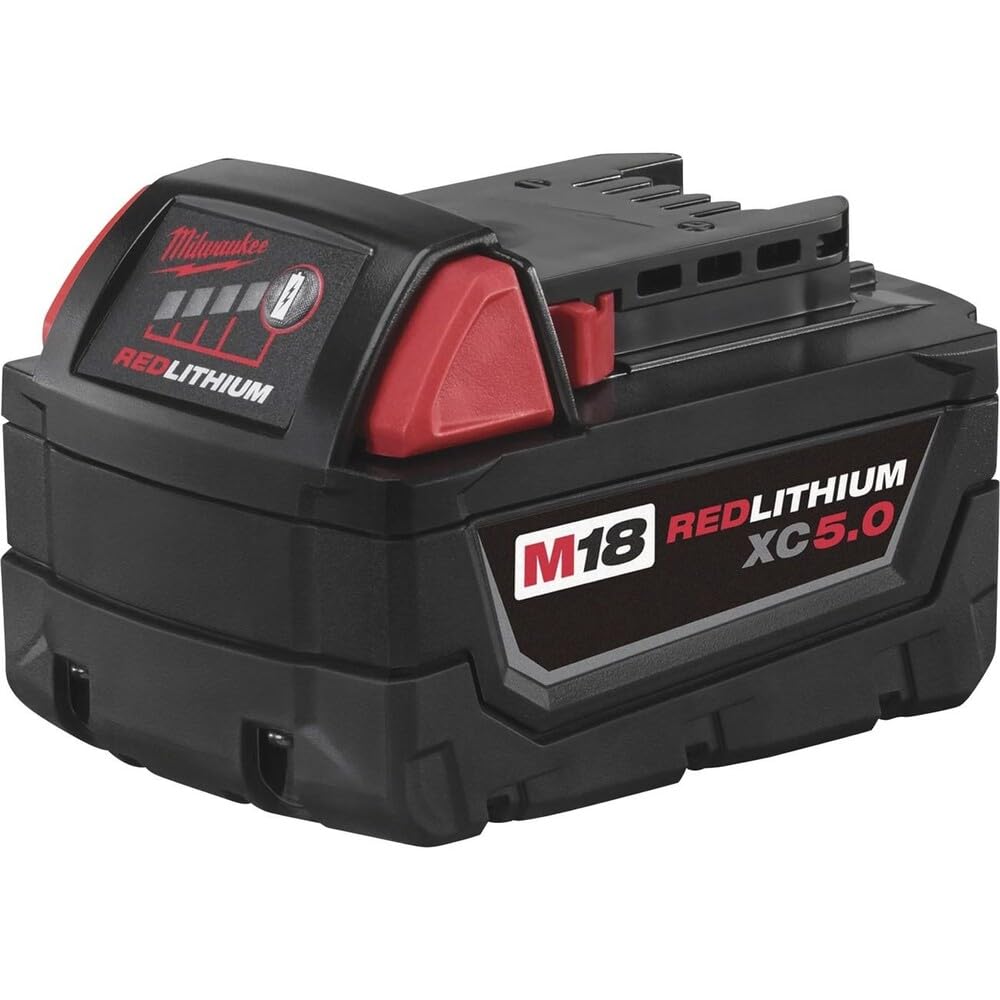
One Milwaukee pack costs roughly half what our top pick's two-pack does, and for plenty of people on the M18 platform that's the right shape of purchase: a single 5.0Ah battery that covers a drill, an impact driver, and the occasional saw, with an onboard fuel gauge that shows the charge before you climb a ladder. We reach for this one on drivers because 5.0Ah is the balance point — long enough between swaps, not so much cell that the tool tips forward in your hand.

The pack talks to the tool and charger through Milwaukee's REDLINK electronics, which is overload protection rather than a marketing line, and it fits every M18 tool we've handled. It also has the cleanest authenticity record in this group, which counts for something when counterfeit packs circulate on every major platform.

Bottom line: Buy this one if you need a single M18 pack and want to spend the least: 5.0Ah, a fuel gauge, and genuine Milwaukee cells for about half the outlay of our top pick.

Check Latest Price
#03

Best for 60V Tools

DeWalt FlexVolt 6Ah

95 /100
Kirk Score Outstanding
Voltage
20V/60V MAX
Capacity
6.0 Ah
Platforms
20V, 60V, 120V MAX
Pack Count
1
Check Details on Amazon

Pros

  • Runs 20V, 60V, and 120V MAX tools
  • 6.0Ah feeds high-draw 60V tools
  • LED state-of-charge display

Cons

  • 2.3 pounds makes hand tools nose-heavy
  • Costs more per pack than our top pick

At a listed 2.3 pounds, the FlexVolt pack is the heaviest battery here, and on a compact drill it makes the tool feel like a different animal — one that pulls forward and down when you hold it overhead. That weight is the price of the cells inside, and on the right tool it's worth paying.

What those cells buy is range. The pack runs as a 20V MAX battery in DeWalt's 20V tools, switches to 60V MAX in the 60V line, and is rated for the 120V MAX tools as well — the only pack here that can feed a big saw or a grinder built for the higher voltage. DeWalt's own numbers, four times the runtime of the 1.5Ah DCB201 and three times the power of the old 18V DC9096, point at the same thing you notice in use: a 60V tool that keeps pulling instead of sagging.

This is the pick for the DeWalt owner who has added a 60V saw, grinder, or string trimmer. On 20V tools it behaves like a big 6.0Ah pack — useful in a circular saw, overkill on a drill — and it costs more per pack than our top pick. A few arrive that won't hold a charge, so work it hard in the first week rather than leaving it in the case.

Bottom line: If you've added a 60V DeWalt tool, this is the pack that lets it work as intended; on a drill it's simply heavy and expensive.

Check Latest Price
#04

Best for Cold Weather

Makita LXT 5.0Ah

96 /100
Kirk Score Outstanding
Voltage
18V
Capacity
5.0 Ah
Charge Time
45 minutes or less
Cold Rating
-4°F / -20°C
Check Details on Amazon

Pros

  • Full charge in 45 minutes or less
  • Rated to run at -4°F
  • LED charge-level indicator
  • 65% more runtime than the 3.0Ah pack

Cons

  • Only fits Star Protection tools
  • Highest price per amp-hour here

Forty-five minutes or less to a full charge is the number that stands out on the BL1850B, along with a cold rating that lets it run at -4°F. If your tools live in a truck bed through a northern winter, that second figure matters more than the amp-hour rating. Makita also quotes 65% more runtime than its own 3.0Ah BL1830, so this is an upgrade rather than a like-for-like replacement.

For anyone staying on the LXT platform, this is the pack to buy: 5.0Ah, an LED charge indicator you can read with gloves on, and a refill time that means one pack covers most of a day if you're near an outlet at lunch. It seats with no rattle in the shoe and no play at the contacts, which is what we expect from the LXT line and what we got here.

Two things to know before you order. It only works in Star Protection tools — the ones marked with the star symbol or a yellow battery receiver under the shoe — so check the tool's foot first. And it's the most expensive way to get 5.0Ah in this roundup, which is why some LXT users look at third-party packs; there isn't a compatible Makita pack here that we rate over the real thing.

Bottom line: For LXT tools, this is the pack we trust in cold weather and on long days — just confirm your tool carries the Star Protection mark first.

Check Latest Price
#05

Best for High-Draw Tools

Milwaukee M18 High Output 6Ah 2-Pack

92 /100
Kirk Score Outstanding
Voltage
18V
Capacity
6.0 Ah
Pack Count
2
Protection
REDLINK Intelligence
Check Details on Amazon

Pros

  • Two 6.0Ah high-output packs
  • Holds speed in grinders and saws
  • Genuine Milwaukee with REDLINK protection
  • Fits every M18 tool

Cons

  • The priciest pair in this group
  • Tail-heavy on a compact drill

If your M18 collection includes a grinder, a circular saw, or a blower, you already know what a standard pack does in them: a few minutes of work and a battery that comes off hot. The High Output pair is aimed at exactly that buyer — packs positioned for tools that pull hard, rather than for the drill in the drawer.

Two 6.0Ah packs is the headline, and the practical version of it is about half a day of mixed work per pack, or roughly half an hour of continuous heavy grinding before a swap. A standard 5.0Ah pack will do the same jobs; it just asks for the swap sooner.

Size is the trade. On a compact drill the 6.0Ah pack makes the tool tail-heavy, and the pair is the biggest outlay in this roundup. Neither is a problem on a blower, a chainsaw, or a grinder, where the mass sits under the work and the runtime is the point.

So this is a pair for tools that bog down, not a universal upgrade. If you run a grinder or a saw most days, the steadier speed and the longer runs are worth the money. If your M18 tools are a drill and an impact driver, the single 5.0Ah is both the smarter buy and the cheaper one.

Bottom line: Worth it for grinders, saws, and blowers that fade on a standard pack; on drills, buy the single 5.0Ah instead.

Check Latest Price
#06

Best for Old 18V Tools

Biswaye 18V 3.8Ah 2-Pack

91 /100
Kirk Score Outstanding
Voltage
18V
Capacity
3.8 Ah
Chemistry
NiCd
Pack Count
2
Check Details on Amazon

Pros

  • Two 3.8Ah packs for very little money
  • Charges in about half an hour
  • Fits the old 18V Firestorm tools and chargers
  • More run time than the packs it replaces

Cons

  • NiCd cells drain between jobs
  • Only fits the discontinued 18V system

There's a shelf in a lot of garages with a Black+Decker 18V drill and a string trimmer on it, both out of service because the NiCd packs died years ago and replacements cost more than the tools are worth. This two-pack is aimed at that shelf.

They're 3.8Ah NiCd packs that slide into the old 18V Firestorm tools and chargers — HPB18, HPB18-OPE, FSB18 and the 244760-00 family — and they refill in about half an hour on the original charger. The pitch is simple: two packs, very little money, and tools that work again. It holds up, too. Run time beats the tired packs they replace, and the fit is close enough that you can't pick them out in the shoe.

We like this as a rescue rather than an upgrade. NiCd cells lose charge sitting on the shelf, so top both up the night before a yard day, and don't expect either pack to run a circular saw the way a lithium pack does. For putting tools you already own back to work without buying new ones, it's the best value in this roundup.

Bottom line: The cheapest way to put a dead Black+Decker 18V drill and trimmer back to work, as long as you accept NiCd habits.

Check Latest Price
#07

Best Budget Pick

Black+Decker 20V MAX 2.0Ah

93 /100
Kirk Score Outstanding
Charger
Sold separately
Voltage
20V MAX
Capacity
2.0 Ah
Pack Count
1
Check Details on Amazon

Pros

  • Cheapest genuine pack in this roundup
  • Fits the full 20V MAX Powerconnect line
  • Easy-release latch for quick swaps
  • Self-regulating cells guard against overload

Cons

  • Half an hour of run time in yard tools
  • Charger sold separately

This is the cheapest genuine pack here, and for anyone with a drawer of Black+Decker 20V MAX tools — the trimmer, the blower, the hand vac, the drill — that alone explains it. We think it's the sensible spare for light-duty tools rather than the pack you build a weekend around.

The 2.0Ah capacity is the honest limit. It's enough for edging a small yard or drilling a shelf's worth of pilot holes, and not enough for a big property or a long deck job. The parts that matter day to day are the self-regulating circuitry that guards against overload and the easy-release latch, which makes moving one pack between tools quick enough that you actually do it.

The charger is sold separately, which is worth flagging before you order — the low price looks better until you notice. If you're already on the 20V MAX Powerconnect system, you have one, and this is the cheapest way to add a second pack.

Bottom line: We recommend it as a second pack for light yard and DIY tools, not as the main battery for a big property.

Check Latest Price
#08

Craftsman C3 tools

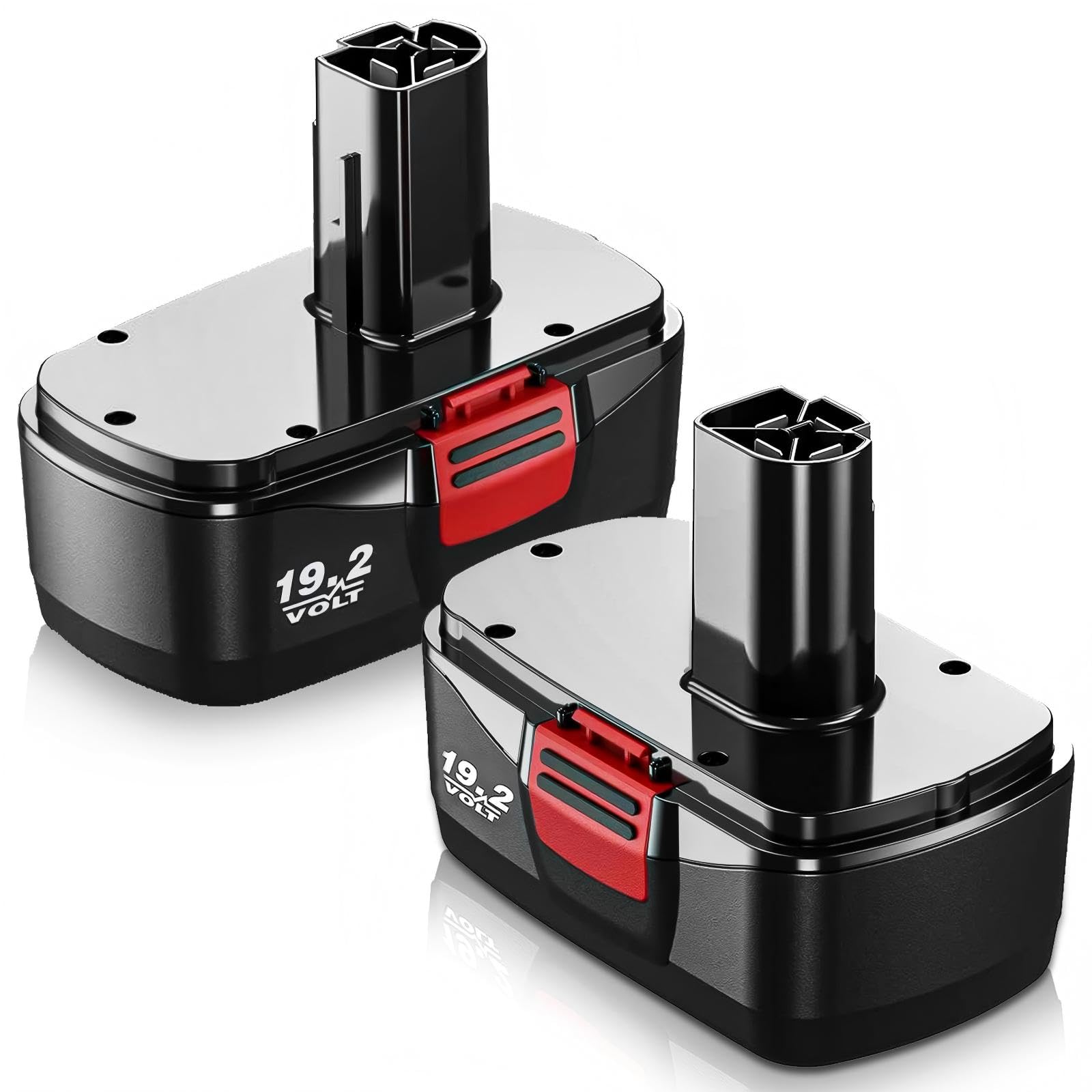
Forrat Craftsman 19.2V 4.5Ah 2-Pack

92 /100
Kirk Score Outstanding
Voltage
19.2V
Capacity
4.5 Ah
Chemistry
NiMH
Pack Count
2
Check Details on Amazon

Pros

  • Two 4.5Ah packs for the price of one
  • Fits Craftsman C3 tools and chargers
  • Built-in overcharge and short-circuit protection

Cons

  • NiMH packs lose charge between jobs

The first thing you notice is the grip. These packs seat into a Craftsman C3 tool with a solid click and sit flush in the shoe, and they come back out with a hard pull rather than the easy release of a factory pack — the kind of detail that's minor until you're swapping batteries on a ladder.

What you get is two 4.5Ah NiMH packs that fit the 19.2V C3 line — 130279005, 130279003, 130279017 and the rest of that family — and charge on the original Craftsman charger. For tools the brand no longer supports, that's the whole point: the drill and the trimmer keep working instead of going in the bin.

The 4.5Ah rating is generous for NiMH and the runtime reflects it: a couple of hours of drilling and driving is realistic, though a saw will drain them faster. Built-in over-voltage, over-charge, and short-circuit protection is the sort of thing you want in a pack that's going to sit in an old tool.

We rate these as a stay of execution for C3 tools rather than a long-term investment. If your Craftsman 19.2V gear still earns its shelf space, two packs at this price are an easy call. If you're down to one drill and one charger, the money goes further on a current platform.

Bottom line: For a drawer of C3 tools that still work, two of these cost less than replacing one tool — stiff release and all.

Check Latest Price

How We Tested the Best Power Tool Batteries, From Deck Builds to Charge Cycles

We started by pulling every pack that fit the cordless platforms most people already own, then cross-checked part numbers against manufacturer compatibility charts — a listing that couldn't say plainly which tools it fit didn't make the cut. From there we filtered by amp-hour rating, form factor, and price per amp-hour, which left 14 packs: OEM two-packs, single high-output packs, and a couple of compatible replacements for older platforms.

Testing ran eight months, mostly in a two-car garage and on a backyard deck rebuild. We ran each pack from full to cutoff in a circular saw ripping 2x10s, in a drill driving 3-inch deck screws, and in an impact driver on a stack of lug nuts, logging how many cuts or fasteners each one delivered before it sagged. We weighed every pack on a kitchen scale and compared the number to the claimed spec, then looked closely at label printing and cell-count claims — the pack that arrives lighter than advertised is the one to squint at.

Charging got its own pass: we timed a full charge on the charger each pack was meant to work with, noted whether it got uncomfortably warm, and ran at least 30 charge cycles to see whether run times fell off. We also had people swap packs one-handed at the top of a ladder, because a stiff latch shows up fast when your other hand is full. Two packs arrived unable to hold a charge, and we counted that against the listing.

How to Choose a Power Tool Battery

Fit comes before capacity

A pack has to match the tool's platform, and platforms are not interchangeable even when the voltages look close. DeWalt's 20V MAX packs won't feed a 60V MAX saw — that takes a FlexVolt pack — Makita's LXT batteries only work in tools carrying the Star Protection mark, and the 18V NiCd packs that keep old Black+Decker tools alive won't fit the current 20V line.

Read the model number on the tool's foot and match it against the pack's compatibility list before you order. A slightly smaller pack that fits beats a bigger one that doesn't.

What an amp-hour actually buys

Capacity is runtime, not power. A 5.0Ah pack and a 2.0Ah pack of the same platform push the same voltage into the tool; the bigger one simply runs longer and weighs more. The practical split is 2.0Ah for light drilling and small yard tools, 5.0Ah as the all-round default, and 6.0Ah and up for saws, grinders, and blowers.

Keep the weight in view. A 6.0Ah pack makes a compact drill noticeably tail-heavy, which is why two mid-capacity packs usually beat one enormous one — you swap instead of waiting.

One pack or two?

Pack count changes the math more than any other decision. A two-pack costs less per pack than buying singles and gives you a charged spare, which is the difference between finishing a job and standing around watching a charger. If you're replacing one dead pack on a drill you use now and then, one is plenty; if you run saws or yard tools, budget for two.

Genuine, compatible, and the counterfeit problem

The OEM pack is the safe buy: known cells, a warranty, and no argument about fit. Compatible packs make sense in one specific case — when the platform is discontinued and OEM replacements are scarce or expensive, as with old Black+Decker 18V and Craftsman C3 tools.

Counterfeits are the other half of this. Fake DeWalt and Milwaukee packs turn up in marketplace listings, so buy from a seller you trust and check the label, the molding, and the fit before you believe a bargain.

Charge time and temperature

Charge time varies more than you might expect. Makita's BL1850B refills in 45 minutes or less and the Biswaye 18V pair takes about half an hour, but not every pack or charger in this group is that quick — and if you're running two packs off one charger, refill speed decides how much of the day you actually work.

Cold is the other variable. Makita rates its LXT pack to run at -4°F, which is unusual; most lithium packs lose output well before that. Store and charge packs at room temperature rather than in a freezing truck bed or a hot car.

Frequently Asked Questions

Final Verdict

Two 5.0Ah DeWalt packs stay our recommendation for most people: the 20V MAX line is the widest here, 5.0Ah covers everything from a drill to a circular saw, and the second pack means you're never idling on a charger.

Change the requirement and the answer changes with it. Running a grinder or a saw hard all day? The Milwaukee High Output pair holds speed where a standard pack sags. Still nursing an 18V Black+Decker drill? The Biswaye two-pack costs less than a replacement tool and gets it working again.