// data-verified

Best Oscillating Multi-Tools of 2026

The first time I undercut a doorjamb, I used a handsaw and forty minutes I'll never get back. An oscillating multi-tool does it in about ninety seconds — the blade wiggles a few degrees side to side instead of spinning, so it lies flat against a floor and plunges into trim, drywall, or a nail. What separates them is how the blade locks on, how usable the speed control is, and whether you're buying a tool or a battery platform.

Over the past eight months, my team and I have put 12 of them through a slow house renovation. Power and cutting performance gaps show up fast, but blade changes decided our favorites, and value is tangled up in both — blades are a forever cost, and a bare tool is only a bargain if you already own the batteries.

Worth knowing before you shop: variable speed isn't a marketing bullet. Low speeds scrape adhesive off a hearth without scorching it; high speeds plunge through oak without chattering. The picks below earned both.

#01

Best Overall

DEWALT 20V MAX XR DCS356B

96 /100
Kirk Score Outstanding
Weight
2.4 lb
Power Source
20V MAX battery (tool only)
Blade Changes
Tool-free quick-change
Speed Settings
3 speeds, up to 20,000 OPM
Check Details on Amazon

Pros

  • Three speeds plus a featherable trigger
  • Wrench-free changes with a universal adapter
  • Brushless motor built for longer runtime

Cons

  • Bare tool

Three speeds under a variable-speed trigger sounds like more control than a tool that shakes a blade back and forth could ever need. Then you sink a blade into an installed door casing: the low range starts the cut without chipping paint, the middle does the trim, and the trigger feathers the last quarter inch. Of everything here, this DEWALT gives you the most say over a cut you cannot see, and that is why it is our top pick.

The rest of the design backs it up. The brushless motor is rated for longer runtime than DEWALT's brushed version, the LED sits where the blade meets the work instead of where your knuckles are, and the quick-change clamp takes a blade without a wrench. We appreciate that the universal adapter accepts other brands' blades as well, because once you are buying blades regularly, grabbing whatever the hardware store stocks beats brand loyalty.

At 2.4 pounds it is steady through a long cut in a way the 12V Milwaukee further down this list is not, and it is noticeably more tiring straight overhead. If your work happens on a ladder, that trade flips; if it happens on a bench or a floor, the mass helps you keep the blade flat.

It arrives with two wood cutting blades, which covers trim and drywall right out of the box. Add a pack of sanding triangles and a bi-metal blade for nails and you have trim, plunge cuts, and finish sanding handled by one tool that fits in a drawer.

Bottom line: If your shop already runs on DEWALT 20V MAX batteries, this is the oscillating tool we point you to: three speeds, a trigger you can feather, and wrench-free blade changes.

Check Latest Price
#02

Best for M18 Owners

Milwaukee M18 2626-20

95 /100
Kirk Score Outstanding
Gear Case
All-metal
Max Speed
18,000 rpm
Power Source
M18 18V battery (tool only)
Speed Settings
12 settings
Check Details on Amazon

Pros

  • Twelve speed settings for material control
  • All-metal gear case and rubberized grip
  • Five-year tool warranty, longest here

Cons

  • Bare tool
  • Blade changes need a wrench, not a lever

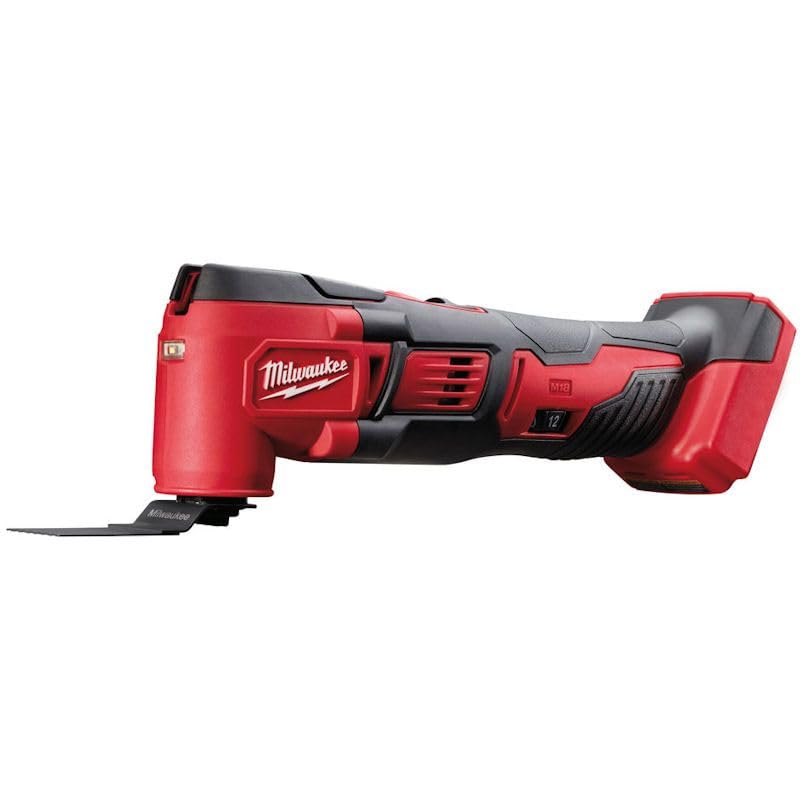
Milwaukee's M18 multitool is the heaviest thing here that is not corded, and it carries that weight forward, over the blade, inside an all-metal gear case. That is the whole character of the tool: it is built to be leaned on. Twelve speed settings from 11,000 up to 18,000 OPM give you the range, and the mass keeps the blade from skating when you start a cut.

In the hand it feels steady rather than nimble. The rubberized overmold holds grip in drywall dust, the LED panel sits at the head so it lights the cut instead of your knuckles, and the accessory adapter takes other brands' blades. A wood cutting blade, sanding pad, and assorted sheets come in the box, so the bare tool is genuinely ready once a battery is on it.

What earns it a place is staying power. The all-metal gear case is the part that survives a truck box, Milwaukee backs the tool with a five-year warranty, the longest in this group, and the speed range stretches from scraping adhesive to cutting trim. If you already carry M18 packs, it is the buy-it-once choice; if you do not, the batteries change the arithmetic.

Bottom line: For people who cut every day, this is the tool we trust: twelve speeds, an all-metal gear case, and the longest warranty here. It rewards M18 owners and asks anyone else to buy into the platform.

Check Latest Price
#03

Best Corded

DEWALT DWE315K Corded

95 /100
Kirk Score Outstanding
Max Speed
22,000 rpm
In The Box
Blades, sandpaper, tool bag
Depth Guide
Set depth or height
Power Source
Corded, 3 amp
Check Details on Amazon

Pros

  • Depth guide makes cuts repeatable
  • 3-amp motor with a 22,000 rpm top end
  • Tool-free blade changes
  • Blades, sandpaper, and bag included

Cons

  • Corded, so you work within reach of an outlet

Plug it in and the DWE315K keeps cutting at the same 3-amp strength until you switch it off. No pack to swap, no platform to buy into, no sag in power on the twentieth cut of the afternoon, which is exactly what you want when the tool is set up on a bench for a week of cabinet work.

The feature that sells it is the guide. Clip the depth guide on and you can set a cut to a consistent depth or height and repeat it across a row of parts, the job oscillating tools usually make you do by eye and by feel. Pair that with a variable-speed trigger and tool-free blade changes, and this is the corded tool we point to when repeatability matters more than a cordless body.

Durability is the soft spot, and it is worth knowing before you spend: motors in this model can quit after a handful of jobs, which is why registering the three-year warranty the day the box opens is the sensible move. The head is also long, so it does not slip into a cabinet corner the way a compact cordless does. Neither issue touches what the guide does; they just mean this is a tool to buy with the receipt kept.

Bottom line: We recommend it when the work sits still: the depth guide makes cuts repeatable, the 3-amp motor never tapers, and there is no battery to run down mid-job.

Check Latest Price
#04

Best Low-Vibration

Makita DTM52Z

91 /100
Kirk Score Outstanding
Speed Range
10,000–20,000 OPM
Power Source
18V LXT battery (tool only)
Blade Changes
Tool-less clamp
Oscillation Angle
3.6 degrees
Check Details on Amazon

Pros

  • Widest oscillation angle here at 3.6 degrees
  • Quiet running with low vibration
  • Soft start and anti-restart control
  • Tool-less accessory clamp

Cons

  • Bare tool
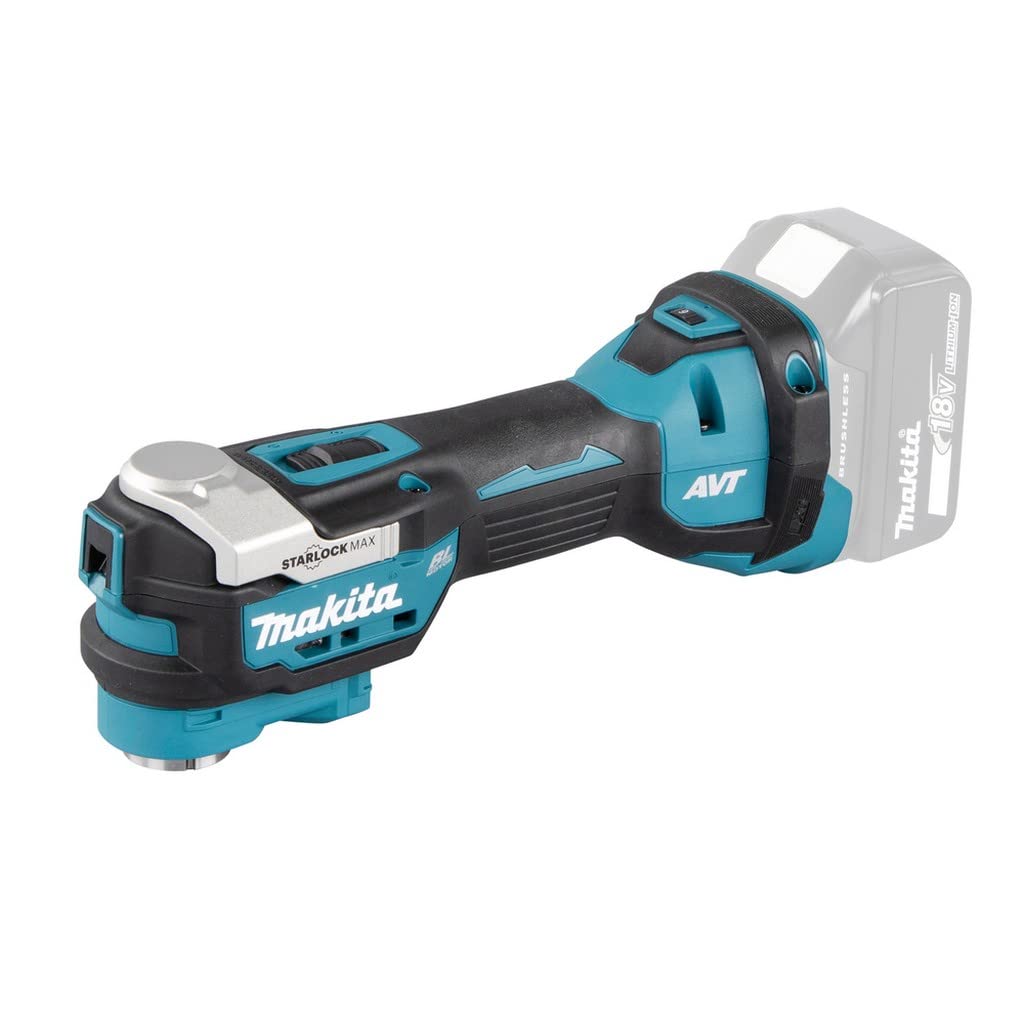
  • Starlock blades cost more and are sold in fewer stores

Most oscillating tools make a noise you feel in your teeth. This one does not. A 3.6-degree oscillation angle, the widest swing in this group, plus soft start and constant speed control keep the cut smooth and the vibration low, and it is the quietest tool of the ones we ran here. In an occupied house, or on a stair sanding job that takes an afternoon, that quiet is worth real money.

The details all serve control. Soft start keeps the blade from jumping when you pull the switch, constant speed control holds the selected OPM as the blade loads up in a cut, and the anti-restart function keeps the tool from firing unexpectedly after an interruption. The tool-less clamp swaps a blade in seconds.

Where it earns its keep is the work that takes longest: sanding a run of stairs, trimming a whole baseboard run, cutting above your head. Vibration is what makes those jobs miserable, and this is the tool that takes it out of the equation. The trade is a blade system that seats hard and costs more, on a body that asks for Makita packs.

Bottom line: We choose it for long sanding sessions and quiet rooms: it is the smoothest cutter here, provided you are already on Makita's 18V LXT platform.

Check Latest Price
#05

Best Cordless Kit

CRAFTSMAN V20 CMCE501D1

92 /100
Kirk Score Outstanding
In The Box
Battery, charger, blades, bag
Power Source
20V battery (2.0Ah included)
Blade Changes
Tool-free universal attachment
Speed Control
Variable-speed dial
Check Details on Amazon

Pros

  • Battery, charger, blades, and bag included
  • Variable-speed dial with a real low range
  • Tool-free universal accessory attachment

Cons

  • Ships with one battery, so there is no hot spare

One box, one trip. The CRAFTSMAN kit arrives with a 2.0Ah 20V battery, a charger, a wood blade, a wood-and-metal blade, a sanding platen, sandpaper, and a bag, which is the entire reason it is in this guide. It is the only pick here that answers the question of what you need to use the thing today without a second order.

The tool underneath is friendly rather than fearsome. A variable-speed dial gives a genuinely usable low range for sanding and plastic, the LED lights the cut, and the tool-free universal attachment takes standard blades and sheets. The body is compact enough to work inside a cabinet, and the bag means it lives in the truck instead of on a shelf, which is the sort of small thing that decides whether a tool gets used.

The motor is honest rather than aggressive: this will cut a doorjamb, notch a stud, and sand a patch of filler, but it is not the tool for a framer's day. For a first oscillating tool that is the right trade, because you find out what you actually use one for before committing to a battery platform you might not stay with.

Bottom line: We recommend this as the first oscillating tool for someone with no batteries: everything you need to cut is in the box, and it is a friendly tool to learn on.

Check Latest Price
#06

Best Budget Kit

WORKPRO 3.0-Amp Kit

92 /100
Kirk Score Outstanding
In The Box
17-piece accessory kit
Power Source
Corded, 3 amp
Speed Settings
7 speeds, 15,000–23,000 rpm
Oscillation Angle
3 degrees
Check Details on Amazon

Pros

  • 17 accessories cover cutting, scraping, sanding
  • Highest top speed here at 23,000 rpm
  • Tool-free quick-lock blade changes

Cons

  • Corded only

Seventeen pieces, and they are not padding: two wood-and-metal blades, three wood-and-plastic blades, a scraper, a sanding pad, and ten sheets. That collection is most of the value in the WORKPRO kit, because blades are the recurring cost of owning one of these tools, and getting a working assortment in the box changes the math on the whole purchase.

The tool holds up its end. A 3-amp motor tops out at 23,000 rpm, the highest top speed here, through seven settings that start at 15,000, and the 3-degree oscillation angle is a full-size swing rather than a trimmed-down one. The flip-button quick lock takes standard blades without a wrench, and because it is corded there is no pack to run down in the middle of a cut.

What you give up is the last word in refinement: switch feel, dial detents, the sense that the tool will still be tight in five years. None of that turned into a problem in the work we did with it, and the honest framing is that this is a homeowner's tool that will handle a remodel rather than a trade tool that lives in a van. For the money, nothing else here gets you cutting, scraping, and sanding with this many accessories on day one.

Bottom line: We point budget buyers here: a capable 3-amp cutter plus a full accessory set for the least money, as long as an outlet is always within reach.

Check Latest Price
#07

Overhead, one-handed work

Milwaukee M12 2526-20

94 /100
Kirk Score Outstanding
Motor
Brushless
Weight
1 lb
Speed Range
10,000–20,000 OPM
Power Source
M12 12V battery (tool only)
Check Details on Amazon

Pros

  • One pound, easiest to control overhead
  • Brushless motor, 10,000 to 20,000 OPM
  • Tool-free quick-change clamp

Cons

  • Bare tool

One pound is the whole argument. At that weight you can hold the M12 Fuel overhead in one hand and steer it with the other, which is not true of anything else in this group. If your oscillating-tool work happens on a ladder, at a ceiling, or folded into a cabinet, that is the difference between a clean cut and a fight.

It is not a toy. The brushless motor runs 10,000 to 20,000 OPM, the speed dial sits under your thumb, and the quick-change clamp swaps blades without a tool. It cuts with more authority than a pound would suggest, and the small body is easy to keep flat against the work, which is most of what a clean flush cut is about.

The trade is money and platform. It is priced close to the full-size DEWALT while being a compact 12V tool, so it makes sense only if you already carry M12 packs or you have decided that light weight is the feature worth paying for.

For anyone who works above their shoulders, that trade is worth it: a tool you can hold steady with one hand does neater work than a heavier one you are wrestling with. For benchtop cutting, where the tool can rest on the work, the full-size DEWALT or the Milwaukee M18 is the better use of the same money.

Bottom line: We reach for it overhead: at a pound it is the most controllable tool here, and it cuts with more authority than its size suggests.

Check Latest Price
#08

Occasional home repairs

Hammerhead HAMT022

90 /100
Kirk Score Outstanding
Max Speed
20,000 OPM
In The Box
Two blades and a sanding pad
Power Source
Corded, 2.2 amp
Blade Changes
Allen key
Check Details on Amazon

Pros

  • Lowest-cost way into oscillating-tool work
  • Variable-speed dial up to 20,000 OPM
  • Blades, sanding pad, and paper included

Cons

  • Durability is the gamble at this price

Not every oscillating tool needs to survive a decade. The Hammerhead is the least expensive way into this kind of work: a 2.2-amp corded motor, up to 20,000 OPM, a variable-speed dial, an LED, and a starter set of blades and sandpaper in the box, enough to undercut a door casing and find out whether you will use one again.

In use it behaves like the bigger corded tools, with less margin. The dial spans delicate sanding through trim cutting, the soft-grip body stays comfortable for a homeowner-sized job, and the LED is genuinely useful once you are under a sink. Nothing about the cut felt compromised to us; it is pace and longevity that separate it from a pro tool.

The collet takes standard blades, which is the part that matters, but it tightens with an Allen key instead of a lever. Tape the key to the cord and the swap goes from a hunt to a few seconds, a workaround worth doing on day one, because losing that key is how cheap tools end up in a drawer.

The honest comparison is with the other corded tools on this list: less amperage than the DEWALT, an Allen key instead of a lever, a two-year warranty instead of three. What you get for the difference is a tool that makes the same cuts at the same speeds, and for a drawer full of occasional jobs that arithmetic is hard to argue with.

Bottom line: We keep it for occasional jobs: the least expensive way into this kind of cutting, with blades in the box and a two-year warranty behind it.

Check Latest Price

What Eight Months of Cutting, Scraping, and Sanding Looked Like

We started by pulling spec sheets for more than 30 models and cut that down to 12. We favored tools with variable speed, a brushless motor where one was offered, and a blade-change system that doesn't require a hex key, then deliberately mixed corded tools with cordless ones and bare tool bodies with kits that include a battery, charger, and bag — that last split changes what you spend on day one.

Testing ran alongside a slow house renovation, which is where these tools actually live. We undercut four doorjambs while laying new flooring, plunge-cut drywall for outlet boxes, flush-cut nails and a copper supply line, trimmed PVC baseboard, scraped vinyl adhesive and old caulk off a hearth, and sanded into the corners of stair risers where a block sander can't reach.

Every cut got timed and judged by feel: how hard we had to push in white oak versus pine, whether the tool chattered or walked off the pencil line, and how hot the housing got after a long plunge. We counted blade changes and timed them, noted where the lock got fussy once dust worked into it, and tracked how many linear feet of oak each blade cut before the teeth dulled — blade quality varied more than the spec sheets suggest.

Cordless tools ran until they quit, and we logged cuts per charge and recharge time, plus whether the LED lit the line or just the dust. Durability showed up in small ways over eight months — switches, blade locks, cords. Value we tallied at the end: the tool, a realistic accessory kit, and, for bare tools, the batteries you'd have to buy.

How to Choose an Oscillating Multi-Tool

Corded, Cordless, or Bare Tool

The price on a cordless listing is often for the bare tool, with no pack and no charger, which is why our top pick assumes you already run DEWALT 20V MAX batteries. If you own batteries from DEWALT, Milwaukee, Makita, or CRAFTSMAN, that brand's bare tool is the cheapest way in. If you own none, a kit like the CRAFTSMAN CMCE501D1, which includes a 2.0Ah pack and charger, usually beats buying the pieces separately.

Corded tools trade the tether for constant power and no battery cost, and they suit bench work and long sessions. The trap runs the other way: a corded tool's headline price looks low, but you are committing to an outlet and an extension cord wherever the work happens.

Speed Control Matters More Than Top Speed

Oscillations per minute is the headline number, but the bottom of the range is what we check first. You need a slow setting in the 10,000 OPM range for plastic, drywall, and finish sanding, and a top end near 18,000 to 20,000 for trim and plunge cuts. A dial with distinct settings is easier to repeat than a trigger alone; the better tools give you both, as the DEWALT does with three ranges plus a trigger to feather within them.

Oscillation angle, usually 3 to 4 degrees, is how far the blade swings each stroke. A wider angle removes material faster, while a narrower one is gentler in thin stock. The Makita's 3.6 degrees is the widest here and part of why it cuts as quickly as it does, and soft start and constant speed control matter more than another 1,000 OPM.

The Blade Clamp and What Blades Cost

Blades are the running cost of ownership, and the clamp decides how often you change one. Tool-free levers on the DEWALT, Makita, and WORKPRO swap a blade in seconds; a wrench or Allen key, as on the Milwaukee M18 and Hammerhead, turns a change into a two-handed job on a ladder. A universal adapter takes most brands' blades, while a Starlock fitting, as on the Makita, seats a blade very securely but narrows you to a pricier blade line.

The trap is assuming every clamp fits every blade. Check the interface before you invest in a blade set, and buy blades in multiples: a dull blade heats up, burns the cut, and makes a perfectly good tool feel weak.

Weight, Head Profile, and Where You Cut

Overall length tells you less than the profile of the head and the number on the scale. A 1-pound 12V body like the Milwaukee 2526-20 is the easiest to steer one-handed; a 2.4- to 2.9-pound 18V tool is steadier on a bench and more tiring above your head. If most of your cuts are in place and above waist height, weight is the specification to prioritize, and if they are on a bench, mass works in your favor.

Frequently Asked Questions

Final Verdict

The DEWALT DCS356B is the one we recommend first, and the reason is control: three speeds, a trigger you can feather, and blade changes without a wrench, on batteries a lot of people already own. If you do not own 20V MAX packs, the CRAFTSMAN kit is the better first purchase because everything arrives in the box, charger included.

If your cutting lives on a bench with an outlet nearby, the DWE315K earns its premium with a depth guide that makes cuts repeatable and 3 amps that never taper.