// data-verified

Best Sander for Furniture of 2026

A sander can turn a curb-found dresser into a keeper, or it can gouge the veneer and leave a haze of dust on every surface in the garage. The best ones make the work feel controlled: the paper stays put, the pad follows the contours of a table apron, and the dust goes into the box instead of your lungs. That control is what I was looking for.

Over eight months, my team and I put 12 sanders through furniture projects — stripping a painted dresser, smoothing a reclaimed oak table, and sanding between coats on a set of built-ins. I watched for what a spec sheet won't tell you: whether the grip made my hand cramp after twenty minutes, how hot the motor housing got during continuous passes, if the dust collector kept up or clogged halfway through, and how the switch and cord held up. Value mattered too — a sander that includes a useful paper assortment and a dust box that seals is worth more than a cheaper one you have to fight. The picks below are the ones that earned a spot in my shop.

#01

Best Overall

DEWALT DWE6423K

96 /100
Kirk Score Outstanding
Speed
8,000–12,000 OPM
Amperage
3.0 amp
Power Source
Corded electric
Dust Collection
Dust bag
Check Details on Amazon

Pros

  • Low-vibration counterweight keeps the pad steady
  • Variable speed spans stripping and finish passes
  • Hook-and-loop pad changes paper quickly
  • Dust-sealed switch and comfortable overmold

Cons

  • Dust bag is small for full-size furniture

The separate counterweight is the first thing we notice on the DEWALT DWE6423K, and it is the reason this is our default furniture sander. The 3-amp motor and 8,000-to-12,000 OPM dial give you enough range to strip a painted tabletop and then slow down for veneer or a final pass. We kept the tool flat and let the pad do the work; the low-vibration body made that easier than the lighter, buzzier sanders in this group.

The dust bag is fine for a quick chair or shelf, and the 8-hole hook-and-loop pad makes paper changes quick. The dust-sealed switch is a small detail we appreciate because it keeps grit out of the one control you touch constantly. The rubber overmold gives your hand somewhere to sit, and the low profile lets you get close to the work without cocking your wrist.

It is not the quietest sander here—the Bosch is easier on the ears—but the DEWALT feels more assertive on old finish. The carrying case is basic, yet it keeps the bag, cord, and a few discs together between projects, which is the kind of small convenience we notice after the novelty of a new tool wears off.

Bottom line: We recommend the DEWALT DWE6423K as the default furniture sander for flat panels and refinished tops, especially if you want one corded tool to strip, smooth, and finish.

Check Latest Price
#02

Best for Clean Finishing

Bosch ROS20VSC

93 /100
Kirk Score Outstanding
Speed
7,500–12,000 OPM
Amperage
2.5 amp
Power Source
Corded electric
Dust Collection
Microfilter canister; vacuum adapter
Check Details on Amazon

Pros

  • Quiet operation for long finish sessions
  • Microfilter canister and vacuum adapter
  • Damped pad resists swirl marks
  • Variable speed from 7,500 to 12,000 OPM

Cons

  • Durability is uneven

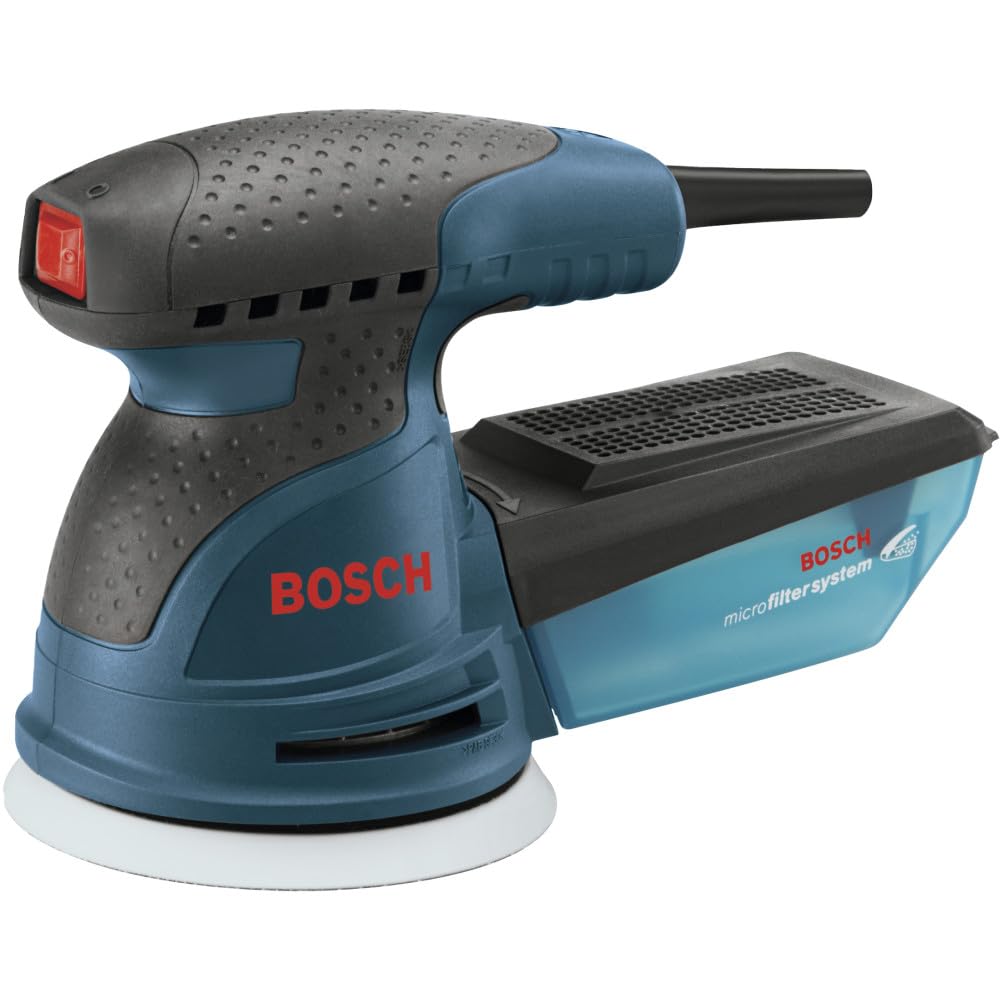
The Bosch ROS20VSC puts a dampening ring between the pad and the body, and that is the part we watch when a finish has to come out clean. The 2.5-amp motor runs from 7,500 to 12,000 OPM, so you can drop the speed for veneer or a thin coat and still have enough range for bare wood. It is also the quietest sander in this group, which matters when you are leaning over a table for an hour.

That damping is what sold us for furniture. Random orbital sanders can leave pigtails or swirl marks when the pad tips, and the Bosch stays flatter and calmer in the hand than the more powerful DEWALT. We still keep the tool moving and do not press, but the finish passes feel less risky. The DEWALT is faster at stripping; the Bosch is the one we choose when the next step is stain or paint.

Dust collection is a genuine strength. The microfilter canister traps fine dust, and the vacuum adapter lets you switch to a shop vac for a bigger piece. The canister is not magic—fine dust still settles around the work—but it is cleaner than a simple bag. The trade-off is the lower amperage on thick finish; this is a finish sander, not a stripper. For a full dresser, the vacuum adapter is the better setup.

Bottom line: We recommend the Bosch ROS20VSC for furniture you plan to finish rather than just strip, because its damped pad and microfilter canister keep the last passes cleaner and quieter.

Check Latest Price
#03

Best Budget

SKIL SR211601

91 /100
Kirk Score Outstanding
Amperage
2.8 amp
Power Source
Corded electric
Speed Control
Six-speed variable
Dust Collection
Cyclonic dust box
Check Details on Amazon

Pros

  • Six-speed control for finish work
  • 2.8-amp motor at 13,000 OPM
  • Cyclonic dust box is easy to empty
  • Low-vibration grip and counterweight

Cons

  • Dust box can work loose

The SKIL SR211601 is the value pick in this group, and the six-speed dial is why it does not feel like a compromise. The 2.8-amp motor turns at 13,000 OPM, and the lower settings are smooth enough for paint edges and veneer. We think it is the right first random orbital for occasional furniture projects.

The cyclonic dust box is easy to empty, and the transparent body lets you see when it is full. It catches a fair amount of dust, but it is not as clean as the Bosch canister. We empty it often and keep a shop vacuum nearby for a full dresser. The soft rubber grip and counterweighted body keep the vibration manageable, which is more than we expect at this level.

Paper changes are quick with the hook-and-loop pad, and the six speeds are easy to find without looking. Durability is the real trade-off: the motor and pad are fine for occasional use, but this is not the sander we reach for on a daily refinishing schedule. For a first sander, a second tool for odd jobs, or a budget setup that still has useful control, it earns its place.

Bottom line: We recommend the SKIL SR211601 as the budget random orbital for occasional furniture refinishing, because its six-speed control makes a first sander feel more capable than the price suggests.

Check Latest Price
#04

Best for Fine Finishing

DEWALT DWE6411

96 /100
Kirk Score Outstanding
Speed
14,000 OPM
Paper Size
1/4 sheet
Power Source
Corded electric
Dust Collection
Dust bag; locking vacuum port
Check Details on Amazon

Pros

  • Secure paper clamp holds sheets flat
  • 14,000 OPM for fast finish passes
  • Locking dust port for vacuum hookup
  • Low-profile, comfortable body

Cons

A 1/4-sheet sander is the flat, honest tool of furniture finishing, and the DEWALT DWE6411 is the one we reach for after the random orbital has done the heavy work. The 2.3-amp motor runs at 14,000 OPM, and the paper clamp holds a sheet tight across the pad instead of letting it creep. The low profile and rubber overmold make it easy to keep flat on a rail or tabletop.

The clamp is the detail we appreciate most. Hook-and-loop is faster, but a clamped sheet stays flat and does not curl at the edges, which matters on a final pass. The locking dust port is another practical touch: the bag is fine for a small job, and the port lets you switch to a vacuum for a bigger one without fighting the hose. We also like that the paper punch is included, so you can make your own sheets.

We recommend it as a finish sander, not a stripper. It leaves a flatter surface on flat panels and edges than a random orbital, and it is quieter and calmer in the hand than the bigger DEWALT. The trade-off is speed: a random orbital removes old finish faster, so this is the second tool in a two-step refinish, not the only one. If you are working on rails, drawer fronts, and between-coat smoothing, that trade is easy to make.

Bottom line: We recommend the DEWALT DWE6411 for final passes, edges, and flat panels where a random orbital's pad can round over details, not for heavy stripping.

Check Latest Price
#05

Best for Edges and Joints

WEN 6307

93 /100
Kirk Score Outstanding
Pivot
Up to 55 degrees
Belt Size
1/2 x 18 inches
Belt Speed
1,080–1,800 FPM
Power Source
Corded electric
Check Details on Amazon

Pros

  • Narrow belt reaches joints and profiles
  • Variable belt speed from 1,080 to 1,800 FPM
  • 55-degree pivot follows edges
  • Tool-free belt changes

Cons

  • Limited power for large surfaces

The WEN 6307 is not a general-purpose furniture sander, and that is exactly why we like it. Its 1/2-by-18-inch belt is narrow enough to drop into a chair joint, a mortise, or the curve of a leg, and the head pivots up to 55 degrees so the belt can meet an edge at an angle. The variable-speed dial runs the belt from 1,080 to 1,800 feet per minute, and the auto-tracking system keeps it centered without a tensioning ritual.

Where it earns its place is the work a 5-inch orbital cannot reach. We used it on edges and tight profiles where a round pad would bridge the gap or round over the detail, and the narrow belt cut where we pointed it. Tool-free belt changes are quick enough that switching grits does not break the flow. It is a specialist, not a replacement for the DEWALT on a tabletop.

The trade-off is heat: the body gets hot during sustained use, so we let it cool between passes. The 55-degree pivot is the detail that makes it more than a novelty: it lets the belt follow a rail or a curved edge instead of fighting it. For chair repairs, joinery cleanup, and shaping, that is worth the learning curve.

Bottom line: We recommend the WEN 6307 as a specialist for chair joints, mortises, and curved edges, not as the only sander in a furniture workshop.

Check Latest Price
#06

Corners and detail

SKIL SR250801

92 /100
Kirk Score Outstanding
Speed
12,000 OPM
Amperage
1 amp
Power Source
Corded electric
Dust Collection
Microfilter box; vacuum port
Check Details on Amazon

Pros

  • Pointed pad reaches into corners
  • Compact and light for one-handed detail work
  • Hook-and-loop paper changes
  • 1-1/4-inch vacuum port

Cons

  • Dust box lets fine dust escape

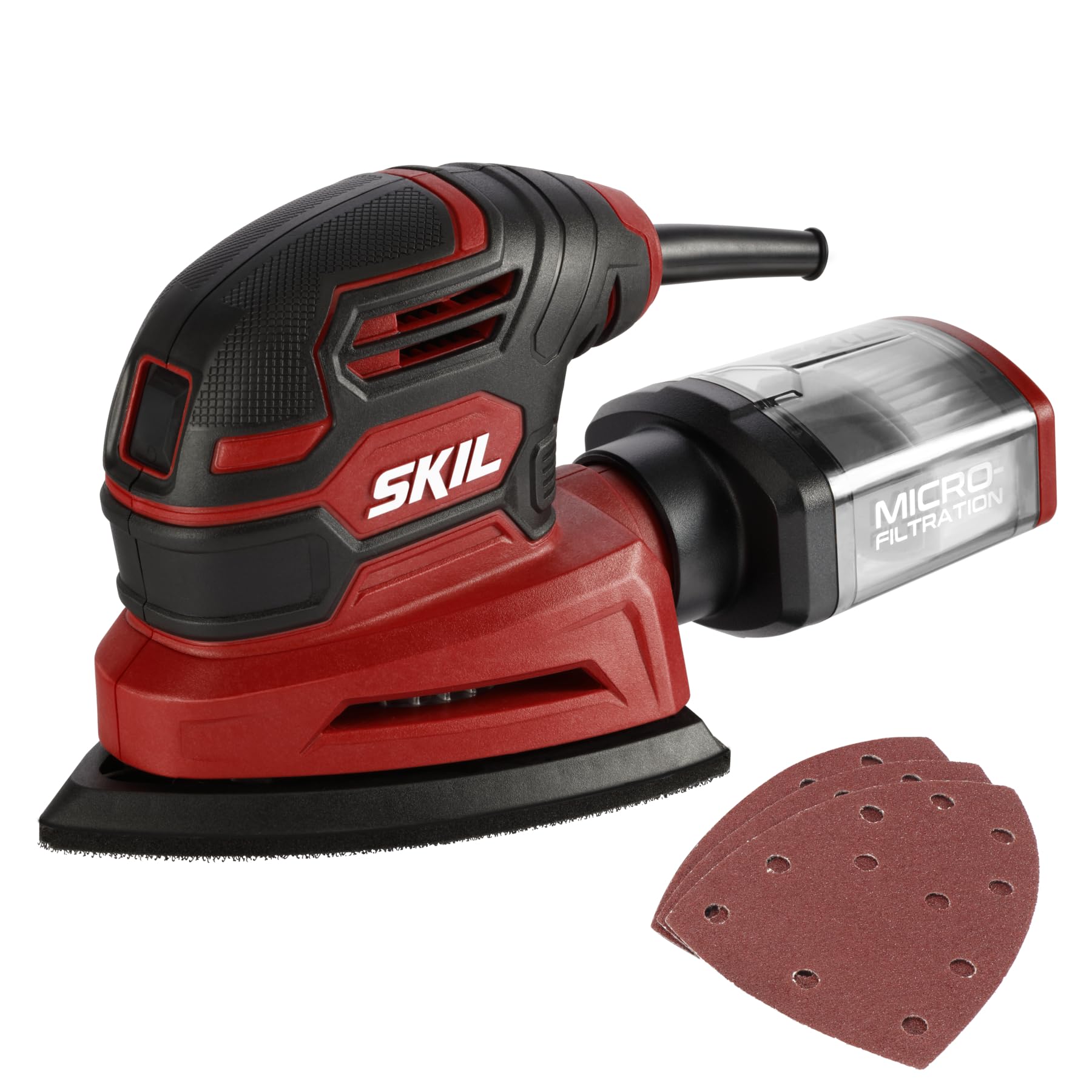
The SKIL SR250801 is shaped like a mouse for a reason: the pointed pad gets into corners, along spindles, and under chair rails where a 5-inch orbital simply cannot go. The 1-amp motor runs at 12,000 OPM, and the hook-and-loop pad makes paper changes quick. It is small enough to hold with one hand and light enough to keep steady on a vertical surface.

The dust box is easy to empty, and the 1-1/4-inch port lets you attach a vacuum when you are working inside a house. We found the grip comfortable for short detail passes, though the body is not as refined as the bigger sanders. The pointed tip is the part that earns its keep: it gets into a corner without gouging the adjoining face, as long as you keep the pad flat.

We recommend it for corners, spindles, and small repairs, not for stripping a tabletop. The 1-amp motor is modest, and the sander is happiest when you let the paper cut instead of leaning on it. Compared with the WEN file sander, this is the better choice for flat corner pads and small patches; the WEN is better on edges and curved profiles. For a furniture toolkit, the two make a useful pair.

Bottom line: We recommend the SKIL SR250801 for corners, spindles, and small furniture repairs, where its pointed pad reaches what a 5-inch orbital cannot.

Check Latest Price

How We Tested Furniture Sanders

We started by pulling a shortlist from brands we've used for years, then filtered by specs that matter for furniture work: pad size, orbit diameter, variable speed, and whether the dust port accepted a shop vac or bag. We also checked what came in the box — paper assortments, carry cases, adapters — because a sander that needs a $20 accessory kit to be useful isn't a value. From that list, we bought 12 sanders and used them for eight months on a rotating set of projects: a painted dresser, a reclaimed oak dining table, a pine bookshelf, and a set of kitchen cabinet doors that needed between-coat smoothing.

Each sander was used on horizontal surfaces, vertical aprons, and overhead edges. We noted how the grip felt after twenty minutes of continuous sanding, whether the motor housing became uncomfortable to hold, and if the on/off switch was easy to hit with a thumb. Dust collection was judged by how full the box or bag was after a session and how much dust settled on the surrounding bench; we also checked whether the filter clogged and needed emptying mid-project. Paper changes were timed — hook-and-loop vs. clamp — and we watched whether sheets stayed tight or slipped. For fit, we paid attention to whether the pad could reach into corners and how the paper aligned with the pad's holes.

After each session, we checked the cord strain relief, the switch action, and any unusual bearing noise. We also dropped each sander once from bench height onto a concrete floor (not a test we enjoyed) to see if the housing cracked or the dust box popped off. We noted whether the housing felt solid or plasticky, and whether the seams lined up. We checked the finish after each grit: whether the sander left swirl marks or sanded evenly. Value was assessed at the end: how the sander performed against its price, and whether the included accessories were actually useful or just filler.

How to Choose a Sander for Furniture

Match the Sander Type to the Job

A 5-inch random orbital sander is the default for tabletops, dressers, and flat panels because it removes finish without leaving the straight-line scratches of a sheet sander. A 1/4-sheet sander still earns a place for final passes on flat rails and edges, where its clamped paper stays tight and flat. For corners, spindles, and chair joints, a detail or file sander reaches where a round pad cannot. We keep at least two types on hand for a full refinish: an orbital for the field and a detail tool for the trim.

Prioritize Control for a Furniture Finish

Variable speed matters more on furniture than on a deck. Turning the dial down lets you ease across veneer, paint edges, and curved legs without burning through the surface, while the higher range handles bare-wood stock removal. Low vibration and a stable pad are just as important: a sander that bounces or tips leaves pigtails that show up under stain. We look for a separate counterweight or a damped pad, and we keep the tool flat rather than pressing. If you mostly finish, pay for control; if you mostly strip, power and dust collection move up.

Plan for Dust Before You Start

Every sander here has some dust collection, but none is a clean-room tool. A bag or canister is fine for a quick shelf or chair, while a full dresser or table produces enough fine dust that a shop vacuum and a hose adapter make the job cleaner and the paper last longer. Check that the port matches your vacuum or that an adapter is included. We empty bags and canisters before they are full; a packed bag stops capturing dust and starts spreading it. If you are sanding old paint, control dust before it becomes airborne.

Weigh Power Source, Weight, and Paper Changes

Corded sanders run as long as the project does, which is why we favor them for furniture. Cordless models are convenient in a driveway or a client's room, but the battery and charger often cost extra and add a platform commitment. Weight matters once you are holding the tool at eye level or working overhead; a lighter detail sander is easier on your wrist, while a heavier orbital stays planted on a tabletop. Hook-and-loop paper is faster to change than a clamp, but a secure clamp can hold a sheet flatter. Try the change system you will live with.

Frequently Asked Questions

Final Verdict

For most furniture projects, we recommend the DEWALT DWE6423K. Its separate counterweight keeps the pad steady, the 3-amp motor has enough headroom for stripping, and the variable-speed dial lets you back off for veneer and finish passes. If dust and noise matter more than stock removal, the Bosch ROS20VSC is the better fit. If you are working into chair joints or curved edges, add the WEN 6307; it is a specialist, not a replacement for the orbital.