// data-verified

Best Torque Wrenches of 2026

A torque wrench is the one tool in the box where being a little off costs real money. Too loose and a lug nut can back off on the highway; too tight and you've stretched a head bolt or cracked an aluminum oil pan, usually with no warning. What's frustrating is that accuracy, the number printed largest on the package, is the one thing you can't check in the aisle.

So my team and I spent the past eight months with 12 of them — on driveway tire rotations, oil changes done on ramps, and a couple of weekend engine jobs on motorcycles and bikes. We cared about how the click felt through a work glove, how smoothly the adjustment collar turned, and whether the dual-scale numbers stayed readable with grease on our hands.

One thing worth knowing: back a click wrench down to its lowest setting before it goes in the drawer. A spring left compressed all year is how a good tool quietly stops being accurate. The wrenches below are the ones we'd trust on our own vehicles.

#01

Best Overall

LEXIVON LX-183 Torque Wrench

95 /100
Kirk Score Outstanding
Length
17 inches
Accuracy
±4%
Drive Size
1/2 inch
Torque Range
10-150 ft-lb/13.6-203.5 Nm
Check Details on Amazon

Pros

  • Wide 10-150 ft-lb range on a 1/2-inch drive
  • Most legible scale in this group
  • Clear break at working torque values
  • Ships with a calibration certificate and case

Cons

  • Long-term durability is the soft spot

A 10-150 ft-lb range on a 1/2-inch drive is the sweet spot for car work: it reaches the 80-100 ft-lb most lug nuts ask for and still has room for brake caliper brackets and suspension bolts. The LEXIVON covers that span and puts it on the clearest scale in this group, high-contrast yellow numerals on black with ft-lb and Nm tracks you can read from arm's length. We set ours in a dim garage and never had to tilt it toward a light.

The click is the other half of the story. Above roughly a third of the scale it lands with a solid, unmistakable break you can hear over a running compressor; down near the bottom it goes soft, which is why small fasteners go to a 3/8-inch wrench instead. Ours arrived with a calibration certificate and a case solid enough to live in a trunk, and the electro-black finish is the sort that hides the scratches a socket drawer hands out.

Where it gives ground is longevity. The body, the ratchet head, and the handle all feel heavier than the money suggests, but a click mechanism is a wear item at any price, and this is a tool with a service life rather than a lifetime buy. For a home garage that torques wheels twice a year and a head gasket once, that trade is worth making.

Bottom line: Our pick for most garages: the range covers wheels and brakes, the scale is the easiest to read here, and the click is clear where it counts.

Check Latest Price
#02

Best for Accuracy That Lasts

Precision Instruments PREC3FR250F

95 /100
Kirk Score Outstanding
Length
25.5 inches
Weight
4.5 lb
Drive Size
1/2 inch
Head Style
Flex head
Check Details on Amazon

Pros

  • Split beam holds its setting between jobs
  • Flex head reaches awkward fasteners
  • 25.5-inch handle gives real leverage
  • Consistent factory calibration

Cons

  • Not a reversible ratcheting head

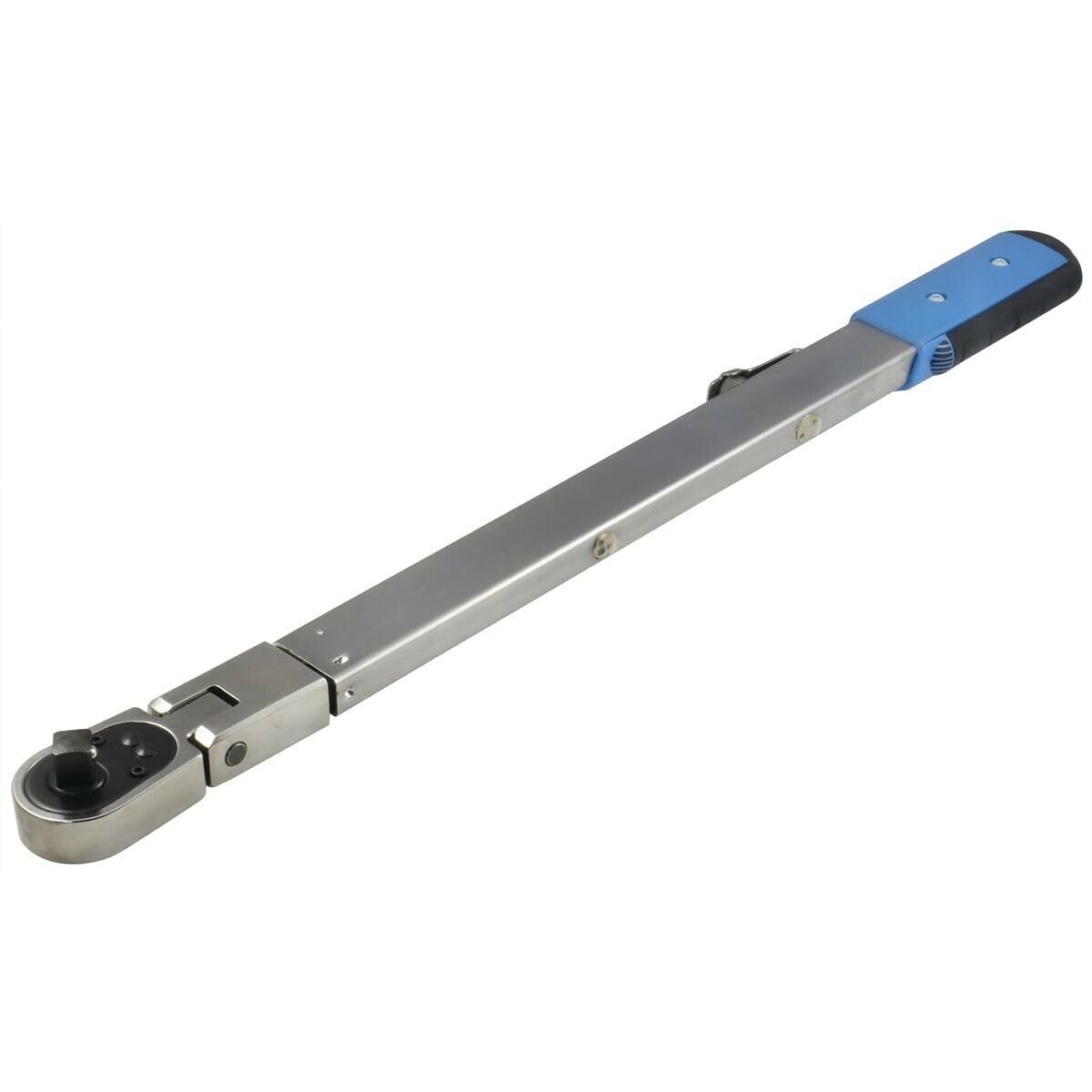
A split beam works differently from a click wrench, and the difference grows on you the longer you own one. Instead of compressing a spring and releasing it at a set value, the beam bends against a fixed reference and the head breaks over when you reach it. Nothing sits under load between jobs, so there is no winding the setting back to zero after every use, a ritual click wrenches demand and most people eventually stop performing.

The flex head is the feature we came back to. It puts a socket on a bellhousing bolt at an angle a fixed head cannot reach, and the adjustment knob turns smoothly enough that changing a setting mid-job costs a few seconds. Twenty-five and a half inches of handle and four and a half pounds of steel also mean you are leaning on torque rather than fighting for it.

It is not a reversible ratchet, and that is the one thing stopping it from being a universal answer here: left-hand threads and any job that wants a ratchet in reverse are out. It is also a professional-priced tool carrying a one-year repair warranty, which tells you where the maker expects it to live.

If you torque something most weeks, the gap between this and a budget click wrench stops being abstract somewhere in year two. If you do not, the money buys more elsewhere on this list.

Bottom line: For anyone torquing weekly, this is the long-term buy: a flex-head split beam that holds its setting and never needs winding down.

Check Latest Price
#03

Best High-Torque Kit

DEWALT DWMT45012 Torque Kit

93 /100
Kirk Score Outstanding
Length
30 inches
Pieces
12
Drive Size
1/2 inch
Torque Range
50-250 ft-lb
Check Details on Amazon

Pros

  • Breaker bar included for cracking lugs loose
  • 50-250 ft-lb covers truck lug specs
  • 30-inch body gives real leverage
  • Ten sockets in SAE and metric

Cons

  • 50 ft-lb minimum leaves small fasteners uncovered

The case holds a second tool, and that is the reason to buy this kit rather than a bare wrench: a 1/2-inch breaker bar. Lug nuts that have been on since the last shop visit need cracking loose first, and doing that with a torque wrench is how you shorten its life. Break with the bar, torque with the wrench, both from the same box.

The wrench is a 50-250 ft-lb micrometer type on a 30-inch body, which is exactly the length you want when a truck hub asks for a number north of 150. You are leaning into it rather than wrestling with it. Ten sockets run from 3/4 inch to 1 inch in SAE and 18 to 24 mm, covering most passenger and light-truck lugs, and the bi-material grip stays put in a work glove.

The 50 ft-lb floor is the catch. Spark plugs, valve covers, and most engine-bay fasteners fall below where this wrench starts, so it cannot be your only one. As a tire-and-suspension kit it is hard to argue with, and the head bumper and molded case mean it survives being thrown in a truck bed.

Bottom line: If the job is wheels, this is the kit: a 50-250 ft-lb wrench, a breaker bar, and ten lug sockets living in one case.

Check Latest Price
#04

Best for Tight Spaces

SUERCUP 3/8-Inch Torque Wrench

91 /100
Kirk Score Outstanding
Length
11.81 inches
Accuracy
±3%
Drive Size
3/8 inch
Torque Range
5-45 ft-lb/6.8-61 Nm
Check Details on Amazon

Pros

  • Compact 3/8-inch body fits tight spaces
  • 5-45 ft-lb range with a claimed ±3%
  • 72-tooth head works in a small arc
  • Clear markings, case and accuracy report

Cons

  • Durability does not match shop-level use

Just under a foot long and about a pound and a half, this is the wrench that fits where a 1/2-inch one cannot: caliper bolts, valve covers, motorcycle engine cases, ATV suspension. The 3/8-inch drive keeps the socket stack short, and the 72-tooth head needs so little swing that you can work it inside a wheel well where a coarser ratchet just binds against itself.

Five to 45 ft-lb is the useful half of the small-fastener world, and the claimed ±3% is tighter than several wrenches here that cost more. We read the scale at a glance without hunting for a mark, and the locking knob pulls down and rebounds on its own, so resetting between fasteners is a one-handed job.

Forty-five foot-pounds stops well short of a lug nut, so treat this as the second wrench in the drawer rather than the only one. Given how little room it takes up and how often the fastener that fights you is the small one, that is an easy second wrench to keep.

Bottom line: The second wrench worth owning: a compact 3/8-inch tool that reaches calipers and motorcycle cases the big wrenches cannot get near.

Check Latest Price
#05

Best Set

DISEN 9-Piece Torque Wrench Set

92 /100
Kirk Score Outstanding
Pieces
9
Accuracy
±3%
Drive Sizes
1/4, 3/8, 1/2 inch
Torque Ranges
20-220 in.lb, 5-45 ft.lb, 10-170 ft.lb
Check Details on Amazon

Pros

  • Three drive sizes cover inch-pound through lug work
  • Costs about what one mid-range wrench does
  • 72-tooth heads work in a five-degree arc
  • Everything lives in one case with a certificate

Cons

  • The 1/2-inch wrench has the least consistent click
  • Adapters feel lighter than the wrenches

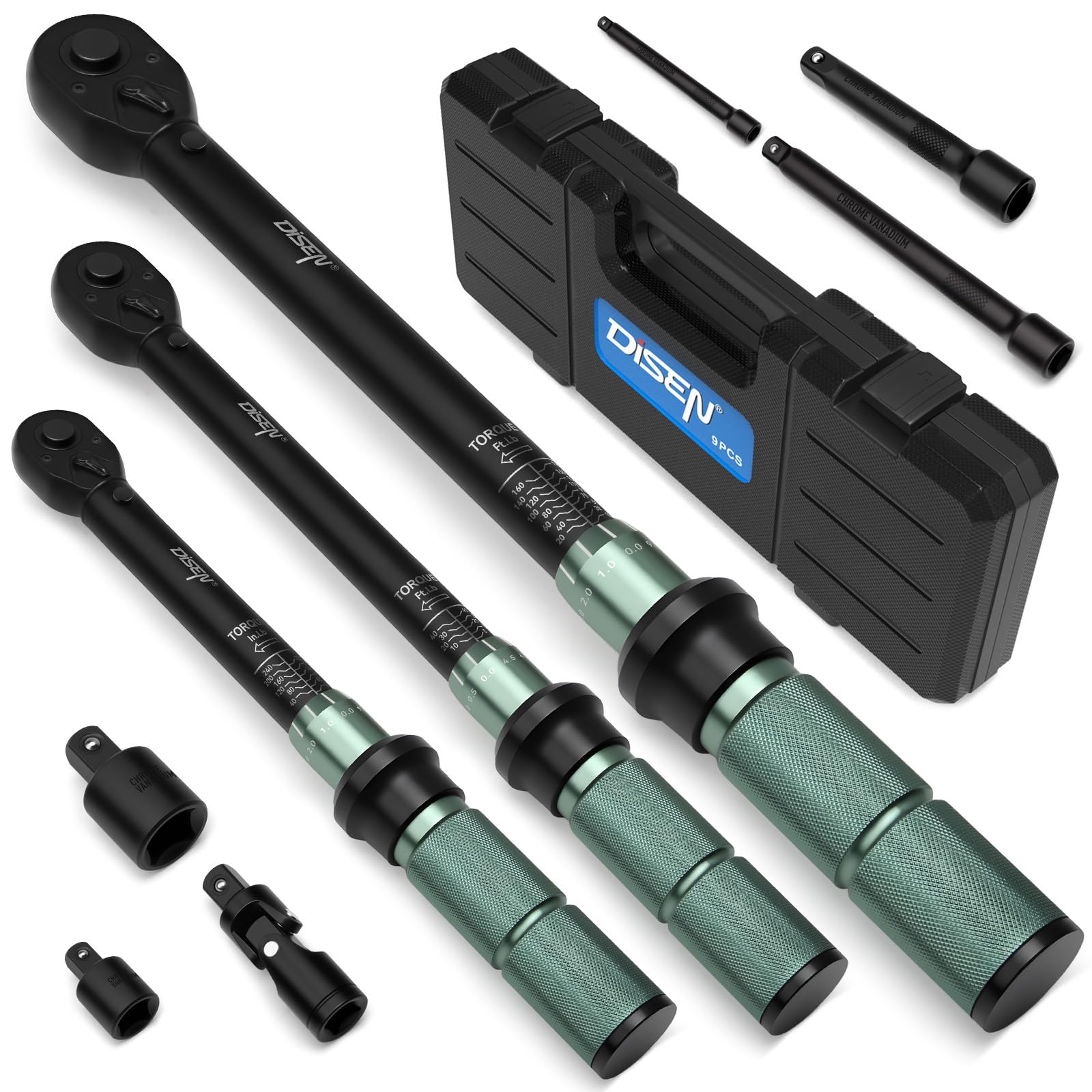
Buying three calibrated wrenches separately is the expensive way to solve this, which is why most garages end up with one 1/2-inch wrench and a lot of guesswork on everything smaller. This set puts a 1/4-inch inch-pound wrench, a 3/8-inch 5-45 ft-lb wrench, and a 1/2-inch 10-170 ft-lb wrench in one case with six adapters, for about what a single mid-range wrench costs.

The 1/4-inch one is the piece we got the most out of. Twenty to 220 inch-pounds is the range for valve covers, small engine work, and anything with a thread you do not want to strip, and it is the wrench most people never buy. All three use 72-tooth heads that turn in a five-degree arc, which is what lets you ratchet inside a space too tight for a coarse one.

Consistency across the three is where it gives ground. The 1/2-inch wrench is the least reliable of them at its upper settings, and the adapters feel lighter than the wrenches they plug into. Neither is a dealbreaker: the case keeps it all together, a calibration certificate comes with it, and having the right size on hand beats having one very good wrench and the wrong drive.

Bottom line: The one to buy if covering every fastener once appeals: three wrenches, adapters, and a case for about the price of one good 1/2-inch tool.

Check Latest Price
#06

First 1/2-inch wrench

EPAuto 1/2-Inch Torque Wrench

93 /100
Kirk Score Outstanding
Length
16.25 inches
Accuracy
±4%
Drive Size
1/2 inch
Torque Range
10-150 ft-lb/13.6-203.5 Nm
Check Details on Amazon

Pros

  • Full 10-150 ft-lb range for less than our top pick
  • Ships with a 5-inch extension bar and case
  • Simple to set and read

Cons

  • Click is easy to miss on low-torque fasteners
  • Durability trails the rest of this group

The setting collar on this one can back off while you work, and that is the thing to know before you buy. On a wheel it means confirming the number before each nut instead of setting it once and walking around the car; on anything with a sequence it means checking twice. That is the difference between a wrench you trust and a wrench you manage.

Everything else is competent for the money. The 10-150 ft-lb range matches our top pick's, the scale is legible if not as crisp, and the 5-inch extension bar in the case is a genuinely useful inclusion rather than filler. The plastic case is sturdy enough to keep it out of harm between jobs.

It costs less than the LEXIVON and posts the same numbers on the box. Where the saving shows up is the finish and the feel of the mechanism, which are a step behind, and in a click that is easier to miss at the bottom of the scale than the middle.

What we cannot promise is time. Of the wrenches here, this is the one with the shortest working life, and the price reflects that. Two wheel swaps a year for a decade is a reasonable ask; a full restoration is not.

Bottom line: A capable first 1/2-inch wrench that covers the range most car jobs need, at a price that makes the experiment cheap.

Check Latest Price
#07

Small fasteners

Wera Click-Torque A5

93 /100
Kirk Score Outstanding
Length
12.8 inches
Accuracy
±4%
Drive Size
1/4 inch
Torque Range
2.5-25 Nm
Check Details on Amazon

Pros

  • Precise 2.5-25 Nm range for small fasteners
  • Audible and tactile release at the set value
  • Accuracy to DIN EN ISO 6789-1

Cons

  • Ships without a case

Two and a half to 25 Nm works out to roughly 2 to 18 ft-lb, which is the world of small fasteners: engine covers, interior trim, motorcycle bodywork, anything threaded into aluminum. That is not the range most people have in mind when they search for a torque wrench, and it is exactly why this one is worth knowing about. It is the second wrench, and it is the one that saves a stripped thread.

The setting is the part we appreciated. You dial a value and hear and feel the scale tick as you turn, so you are never guessing at a number between two marks, and the release at the set torque is a distinct break rather than a vague nudge. In a tight spot that certainty is worth more than extra range.

The ±4% claim is measured to DIN EN ISO 6789-1, the standard the serious tool brands work to, and the 45-tooth head and two-component handle feel like a precision instrument rather than a ratchet with a scale printed on it. Not quite thirteen inches of tool also means it goes into places the big wrenches simply do not.

There is no case in the box, which is a strange omission on a tool this costly and the sort of thing you notice the first time it rides around a drawer with sockets. What you are paying for is the mechanism and the standard behind it, and on a motorcycle engine or a set of alloy covers that is the right trade. Just buy something to keep it in.

Bottom line: Not your only wrench, but the right second one for small fasteners: a precise 1/4-inch click tool that keeps aluminum threads from stripping.

Check Latest Price

How We Picked and Tested Torque Wrenches

We built the shortlist from spec sheets, not product pages, filtering by the torque ranges and drive sizes that match the jobs people actually do: quarter-inch for bike stem bolts, three-eighths for spark plugs and general engine work, half-inch for lug nuts and suspension. Anything whose usable range started so high that half the scale was decoration got cut. We kept both standalone wrenches and kits to judge what the extras were worth. That left 12 wrenches, which we've used for eight months.

Accuracy came first. Each wrench was checked at roughly 20, 50, and 90 percent of its stated range against a calibrated reference, and the mid-range check was repeated after four months to catch drift. A few clicked reliably but read low near the bottom of their scale; the ones that held tightest had narrower ranges. It's why we weigh range as heavily as the printed accuracy figure.

Every wrench got the same break test: set to one value, pulled to the click, reset, ten times running. We noted whether the break was a crisp snap you could feel through a glove or a soft give that made us pull twice. Collars were turned bare-handed and in nitrile gloves, then checked for lock-up without wiggle, and we watched for knobs that bound or stuck instead of moving smoothly through the range. Dual-scale markings were read with greasy hands.

Then we were deliberately unkind: dropped from waist height onto the garage floor, used on a rusted exhaust bolt, packed into a case or thrown loose in a tool bag. We watched for flaking chrome, ratchets that skipped under load, reverse levers that flipped mid-pull, and latches that quit. Value came down to what survived and what came in the box — sockets, adapters, a case worth keeping.

How to Choose a Torque Wrench

Start With the Range, Not the Payload

Click wrenches are most trustworthy in the middle of their scale and least trustworthy at the very bottom. That is the trap: a 50-250 ft-lb wrench reads like more tool for the money, but if half your work sits at 15-25 ft-lb, you are asking it to perform where its click is faintest.

Most automotive work lives between 10 and 150 ft-lb, which is why a 1/2-inch wrench in that range covers the most ground. Add a 3/8-inch 5-45 ft-lb wrench for the small stuff rather than trying to make one tool do both jobs.

Drive Size Decides What You Can Reach

1/2-inch drive is the default for wheels, suspension, and driveline bolts. 3/8-inch is the engine-bay size: shorter sockets, a smaller head, and a body that fits between a fender and a manifold. 1/4-inch is for inch-pound work on small fasteners.

Adapters let you mix drives, but each one you stack costs clearance and adds a joint that can rock under load. Buy the wrench in the drive size the job calls for rather than adapting a big one down.

What the Accuracy Number Does and Doesn't Promise

Most wrenches here claim ±3% or ±4%, and a certificate in the box records one test on one day. That is a starting point, not a warranty: a click wrench works by compressing a spring, springs take a set, and a drop on concrete can undo the calibration with nothing visible to warn you.

A split-beam wrench sidesteps the spring and holds its setting between jobs, which is what the professional-priced option here is charging for. Drop any of them and get it checked before the next engine job.

Length, Click Feel, and the Habits That Keep It Honest

Handle length is leverage: a 30-inch body makes 150 ft-lb feel routine, while an 11-inch one cannot get there comfortably. The trade is access, because long wrenches do not fit under a hood or inside a wheel well.

Then there is the break itself. What you feel through the handle at the moment of release matters as much as what you hear, because a shop fan or a compressor will drown out a marginal click. Set the value before you get under the car, not after.

Frequently Asked Questions

Final Verdict

The LEXIVON LX-183 is the wrench we point most people to. A 10-150 ft-lb range covers wheels, brakes, and most suspension work on a passenger car, the scale is the clearest in this group, and the click arrives unmistakably at the values that matter. Its durability is the one open question.

If you torque something most weeks, the Precision Instruments split beam is the better long-term buy: it holds its setting, needs no winding down, and the flex head reaches places a fixed head will not. And if the job is purely wheels, the DEWALT kit puts a breaker bar and ten lug sockets in the same case, which is worth more than a second wrench.