// data-verified

Best Digital Torque Wrenches of 2026

My first torque wrench was click-type, and I trusted it for years longer than I should have. It never told me whether I'd actually hit the number in the manual — it clicked, and I moved on. Digital wrenches show the torque climbing in real time, then beep and flash to confirm it, which is why I switched and never went back. Over the past eight months my team has run 11 of them through spark plugs, axle nuts, and motorcycle triple clamps.

The spec sheet won't tell you the half of it. A one- or two-percent accuracy claim only means something if the wrench still agrees with a reference after a winter in the toolbox, and peak versus track mode sounds like a nice bonus until you're mid-job without knowing which one you're in. Most of these also beep — some quietly enough to miss under a running compressor — and the included instructions range from genuinely clear to nearly useless. What separates them is rarely the name on the handle; it's whether the tool is quick to set, loud enough to trust, and honest about the number on the screen. Below are the ones that held up.

#01

Best Overall

GEARWRENCH 85077

87 /100
Kirk Score Excellent
Alert
Vibration, buzzer, LED
Accuracy
±2% CW / ±3% CCW
Drive Size
1/2 inch
Torque Range
30-340 Nm
Check Details on Amazon

Pros

  • 22 to 250 ft-lb covers wheels and engine work
  • Flex head and 5-degree ratchet arc for access
  • Vibration, buzzer and LED all confirm the target
  • Oil- and solvent-resistant handle and housing

Cons

  • 25.6-inch body is long for a crowded engine bay

The 85077 is the only single wrench here whose range reaches both ends of a home mechanic's list. Its 30 to 340 Nm works out to roughly 22 to 250 ft-lb, which takes in wheel nuts at 80 to 150 ft-lb, brake and suspension hardware, and the bigger engine fasteners a 3/8-inch wrench can't turn. Add the flex head and the 72-tooth ratchet with its 5-degree swing, and you have a tool that will work a caliper bracket at an angle where a fixed head gives up.

What kept it at the top for us is the alert system. A vibrating handle, a buzzer and a solid LED all fire at the target, and the vibration is the part that matters under a car with a compressor running twenty feet away. GearWrench is also specific about accuracy in a way we appreciate: plus or minus 2% clockwise between 20% and 100% of capacity, with the counterclockwise figure quoted separately instead of buried in a footnote.

In the hand it feels like a shop tool rather than a gadget. Three pounds, 25.6 inches long, with a handle and housing rated to resist oil and solvent — the two things that turn a rubber grip tacky in a home garage. Five measurement units mean the spec sheet in front of you is almost certainly covered, and the hang hole at the end means it goes on the board rather than in a drawer.

The reservation is calibration. Accuracy is warrantied for 90 days while the tool itself gets a full year, so have it checked against a known reference before you torque a cylinder head, and treat a drop onto concrete as the moment to recheck it. That's the trade for a readout that tells you where you are, rather than a click that tells you only that you got somewhere.

Bottom line: Our pick for anyone who wants one digital wrench for wheels, brakes and suspension — the range, the flex head and the triple alert do work a 3/8-inch tool can't.

Check Latest Price
#02

Best Value

SUZUME SM3204

88 /100
Kirk Score Excellent
Modes
Peak and Track
Accuracy
±2%
Drive Size
3/8 inch
Torque Range
2.21-44.25 ft-lb (3-60 Nm)
Check Details on Amazon

Pros

  • Clear audible and visual alert at the target
  • Peak and Track modes plus four measurement units
  • 11.6-inch handle steadies the pull
  • Calibration certificate included

Cons

  • Tops out at 44.25 ft-lb, short of wheel torque

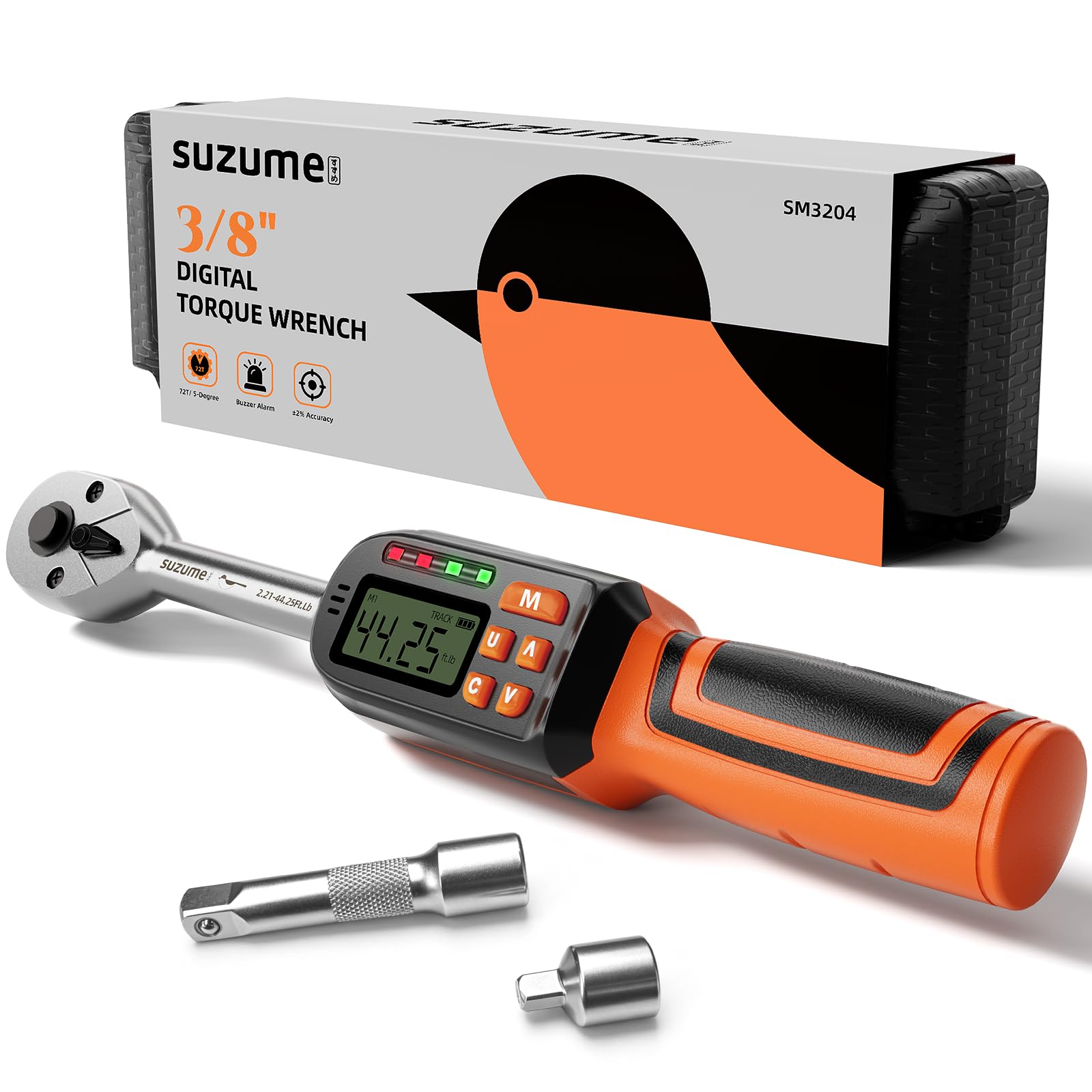
The display and the alert are what sell this one. Set a target and the SM3204 gives a clear audible and visual warning as you close in, then confirms when you arrive — the same information a click wrench gives you, except you can watch the number climbing instead of waiting for a break. We found the four measurement units and the Peak and Track modes cover how people actually work: Track when your eyes are on the readout, Peak when you're under the car and can't see it.

From 2.21 to 44.25 ft-lb, or 3 to 60 Nm, it sits squarely on engine-bay work: valve covers, brake caliper bolts, spark plugs, motorcycle case bolts. The 11.6-inch body is long enough to lean on without the springy feel of a stubby wrench, and 2.5 pounds is light enough to hold one-handed while you start a thread by feel. The maker credits the long rod with saving your wrists in awkward positions, and after a few jobs we believe it.

Chrome vanadium steel, a powder-coated finish and a calibration certificate in the box — nothing about the package reads as an afterthought. The habit worth forming is to put it through a real job inside the return window, because the electronics are what decide whether any digital wrench earns its keep. Against the Uharbour, we take this one for the easier setup and the longer handle.

Bottom line: Buy this if your torque work lives between 3 and 60 Nm — it is the friendliest wrench here to set and read, and it costs a fraction of the top pick.

Check Latest Price
#03

Best Two-Wrench Set

VEVOR SX3812

86 /100
Kirk Score Excellent
Case
Hard shell included
Accuracy
±2%
Drive Sizes
3/8 and 1/2 inch
Torque Range
2.2-44.25 ft-lb (3/8) and 8.1-162.26 ft-lb (1/2)
Check Details on Amazon

Pros

  • Two wrenches, 3/8 and 1/2 inch, in one case
  • 1/2-inch reaches 162.26 ft-lb
  • Reversible 72-tooth ratchet heads
  • Hard case protects two calibrated tools

Cons

  • 7.3-pound kit stays on the shelf, not in a bag

Open the case and there are two wrenches: a 3/8-inch for engine-bay fasteners and a 1/2-inch that reaches 162.26 ft-lb for wheels and suspension, each with a ±2% accuracy claim and its own calibration certificate. That's the pitch, and for a garage covering more than one vehicle it's persuasive — the alternative is buying the same coverage as two separate tools and finding shelf room for two cases.

What we appreciate most is not having to choose on the day. The 3/8-inch handles small fasteners without the 1/2-inch's bulk, and the 1/2-inch takes wheel torque without you wondering whether you're near the top of a smaller wrench's range. Reversible heads, 72-tooth gearing and five selectable units mean both behave like the same tool, which is the point of buying them as a pair.

The hard case is half the value: two calibrated instruments that don't live loose in a drawer, in a shell that takes a knock. It's also where the weight goes — 7.3 pounds for the pair — so this is a kit that lives on a shelf rather than rides in a bag. The printed instructions are brief, so expect to work the menus out by feel the first time.

Bottom line: The pick for a garage working on more than one vehicle: two calibrated wrenches, one case, and no gap between the small fasteners and the wheels.

Check Latest Price
#04

Best for High-Torque Jobs

CRAFTSMAN CMMT99436

88 /100
Kirk Score Excellent
Units
ft-lb, in-lb, Nm
Display
LED backlit
Drive Size
1/2 inch
Torque Range
50-250 ft-lb
Check Details on Amazon

Pros

  • Backlit LED display readable in shadow
  • 50 to 250 ft-lb covers truck wheel torque
  • Buttons switch between ft-lb, in-lb and Nm

Cons

  • 50 ft-lb floor rules out small fasteners

Fifty foot-pounds is where this wrench starts, and that number tells you most of what you need to know. It's a 1/2-inch drive tool built for lug nuts, suspension bolts and driveline hardware, running from 50 to 250 ft-lb — enough for a pickup's wheels with headroom to spare.

The LED-backlit screen turned out to be the feature we valued most. Wheel wells and the shadowed side of an engine bay are exactly where a torque wrench gets used, and a backlit readout means you're not hunting for a flashlight to confirm a number. Conversion between ft-lb, in-lb and Nm is a button press, and the beep sequence warns you as you approach the target rather than only at the end.

Within its range it's the most confidence-inspiring tool here. The 29.6-inch length and 5-pound body are what make 250 ft-lb achievable by hand rather than by standing on a breaker bar, and the hard case keeps the calibration paperwork with the tool. What it asks in return is room to swing, which suits wheels and suspension and very little else.

Bottom line: The right buy if wheels and suspension are the whole job — a backlit 250 ft-lb bar for trucks and SUVs, and nothing you'd want for a valve cover.

Check Latest Price
#05

Best for Low-Torque Precision

Uharbour UHXM011

86 /100
Kirk Score Excellent
Weight
1.7 lb
Accuracy
±1%
Drive Size
3/8 inch
Torque Range
0.66-44.29 ft-lb (0.9-60 Nm)
Check Details on Amazon

Pros

  • 0.66 ft-lb floor for small fasteners
  • ±1% accuracy claim with certificate included
  • 1.7 pounds and about 10 inches long
  • Dual-direction ratchet for left-hand threads

Cons

  • 44.29 ft-lb ceiling leaves wheels to a 1/2-inch wrench
  • Short body gives less leverage at the top of the range

Under 2 pounds and about 10 inches long, the UHXM011 is the smallest wrench here, and that's the argument for it. It fishes into a motorcycle frame, a footwell or the back of an engine bay where a 25-inch bar simply won't go, and it does it without asking you to hold three pounds at arm's length.

The range runs from 0.66 to 44.29 ft-lb, or 0.9 to 60 Nm, with a claimed ±1% accuracy — the tightest figure anyone claims in this group — plus four units, Peak and Track modes and a reversible head for left-hand threads. That bottom end is the part we keep coming back to. Two-thirds of a foot-pound is below where most torque wrenches stop being useful, and it's exactly where the fasteners on bikes, small engines and interior trim live.

Small, precise and quick to set, it suits anyone whose torque work is bicycles, motorcycles, small engines, or the 8 to 15 ft-lb fasteners on engine covers that the big wrenches can't resolve. File the calibration certificate with the tool: a ±1% claim is only worth something if you can point to the paper behind it, and this one ships with the paper.

Bottom line: Buy it if your torque values live in the single digits and low teens — nothing else here reads that low, and nothing else is this easy to get into a tight space.

Check Latest Price
#06

Torque record keeping

INGJER YJDIGI38120

89 /100
Kirk Score Excellent
Warranty
3 years
Drive Size
3/8 inch
Data Logging
500 readings, USB export
Torque Range
4.94-99.57 ft-lb (6.7-135 Nm)
Check Details on Amazon

Pros

  • Stores 500 readings with timestamps
  • Exports logs by USB to a spreadsheet
  • Three-year warranty, longest in this set
  • IP54 sealing against dust and splashes

Cons

  • Logs need a USB cable and a computer to be useful

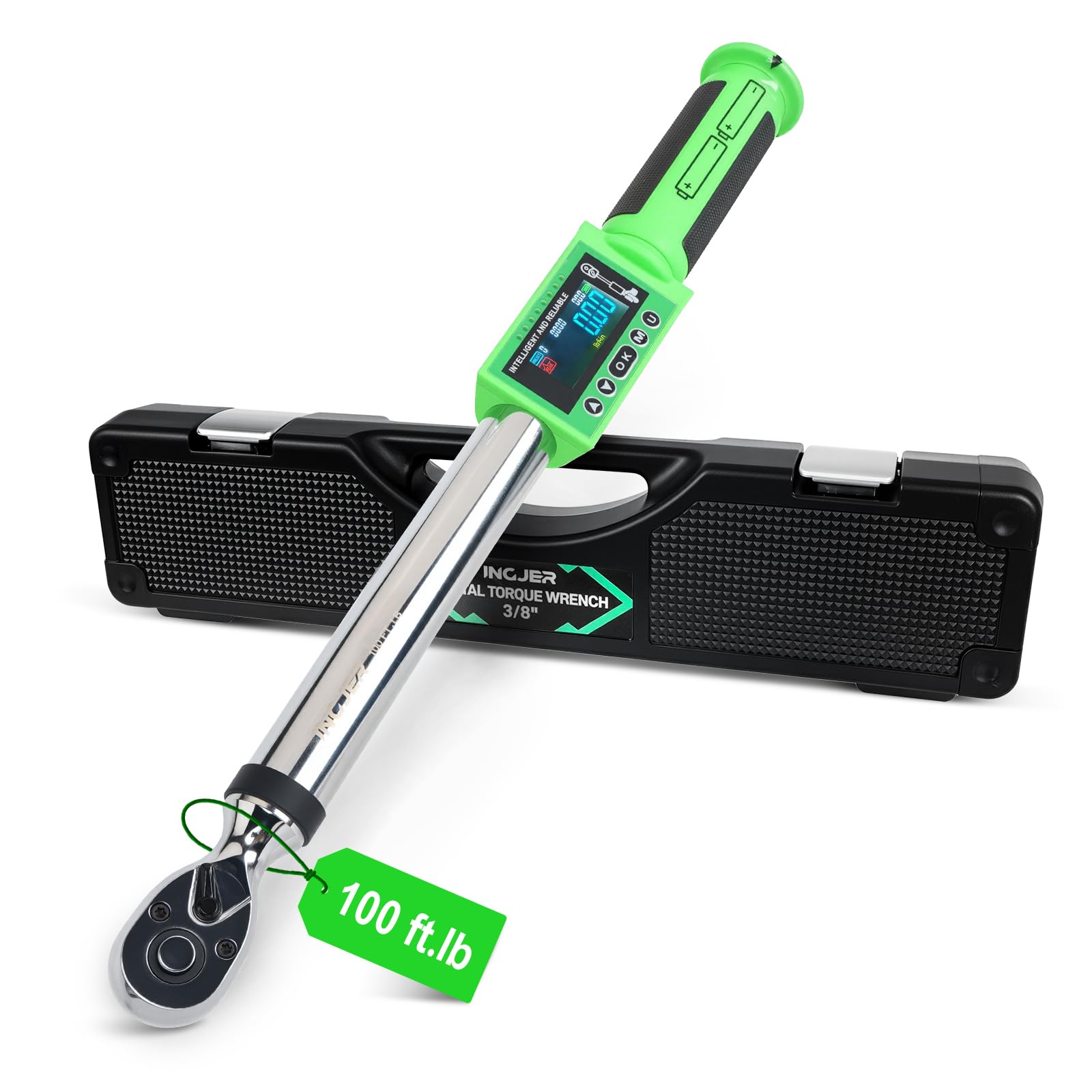
Torque logging is the odd feature out in this group, and it's the reason to look at the INGJER at all. The wrench stores up to 500 readings with timestamps and exports them to a spreadsheet over USB, a capability none of the others here offer. For anyone who has to show what was torqued and when — fleet work, a rebuild log, a shop with an audit trail — that changes what the tool is for.

The rest of the specification is competitive rather than remarkable: 3/8-inch drive, 4.94 to 99.57 ft-lb (6.7 to 135 Nm), ±2%, three modes including a pre-set alert, IP54 sealing, auto shutoff and a low-battery indicator. At 3.1 pounds with a 16.4-inch grip it has real leverage for a 3/8-inch body, and the three-year warranty is the longest in this set by a wide margin.

The reservation is the top of the range. A 3/8-inch square drive asked to deliver nearly 100 ft-lb is working at the edge of what that size is for, so treat the last stretch as occasional use rather than daily production; if wheels are on your list, a 1/2-inch wrench is the right tool anyway. Where it earns a place is a 3/8-inch wrench that has to reach farther than the SUZUME and can prove afterwards what it did.

Bottom line: Worth it only if you need a record of every torque value you applied — the logging is unique here, and the three-year warranty backs the gamble.

Check Latest Price

How We Tested Digital Torque Wrenches

I built the shortlist from spec sheets and owner reviews, then narrowed it to wrenches whose ranges covered the jobs people actually do — inch-pound settings for spark plugs and bicycle stem bolts, foot-pound settings for lug nuts and suspension hardware — and dropped anything with a vague accuracy claim or a manual that couldn't explain itself. That left 11 wrenches, which we used for eight months on real work: a four-cylinder tune-up, front axle nuts on a pickup, motorcycle triple clamps, and a full season of bicycle maintenance. We also weighed price against what the extra money bought, which was usually a wider range and a bigger display rather than better accuracy.

At the bench, we checked each wrench's reading against a calibrated reference at three points across its range and logged how far it drifted, then repeated the check after a few months of use. In the garage we watched the small stuff: whether the beep carried over a running compressor, whether the LEDs were readable under a dim hood, how the ratchet felt loading and unloading a bolt, and how many button presses it took to change the torque setting or switch between foot-pounds and newton-meters mid-job.

Durability got its own round of abuse. Every wrench was dropped onto concrete from waist height, left overnight in a cold truck bed, and wiped down with shop rags, and we noted which ones lost their settings after a knock. We read each manual start to finish and judged how plainly it covered calibration, the difference between peak and track mode, and what the alert tones were actually telling us — a surprising number of beeps mean something other than "you're there."

How to Choose a Digital Torque Wrench

Match the Range to Your Fasteners

GearWrench quotes ±2% between 20% and 100% of the 85077's capacity, and that phrasing is the honest version of every accuracy claim you'll read here: the bottom fifth of any wrench is its least trustworthy stretch. A 250 ft-lb wrench asked for an 8 ft-lb valve cover bolt is guessing, no matter what the display says.

Write down the highest and lowest torque values you actually set in a year. If they run from a valve cover to a wheel nut, no single wrench in this group covers both well — pair a 3/8-inch with a 1/2-inch, or buy the VEVOR kit that ships as a matched pair with one case.

Drive Size, Length and Access

Three-eighths is the engine-bay size and half-inch is the wheel size, and the difference isn't just the socket. A 1/2-inch wrench is longer and heavier because it has to deliver 150 ft-lb and up without flexing, which is why the CRAFTSMAN runs 29.6 inches and the Uharbour fits in 10.

Length is leverage and leverage is effort, so buy the size your work demands rather than the biggest one you can hold. If the job happens under a fender or inside a motorcycle frame, take the shorter, lighter tool; if it happens at a wheel, take the length. A flex head, as on the GearWrench, is the one extra worth having for caliper brackets and strut bolts.

Read the Alert, Not Just the Number

Every wrench here tells you when you've arrived, and how it tells you matters more than the size of the digits. A buzzer disappears under an impact gun; a vibrating handle reaches you through gloves and noise; an LED is what you want when the sun is behind you and the screen sits in shadow.

The CRAFTSMAN's backlit display and the GearWrench's vibrating handle are the two features worth paying for if your work happens in bad light or bad noise. Alerts that begin before the target are working as designed — they're a warning to slow down, not a fault to send back.

Accuracy Claims, Certificates and Care

±1%, ±2%, ±3%: the spread across these wrenches is wider than the difference you'll feel, and none of it means much without the window it applies to. Look for a calibration certificate in the box and keep it with the tool. Note, too, whether calibration is warrantied for less time than the wrench itself — GearWrench covers accuracy for 90 days against a year on the tool.

Plan on checking any of them against a known reference before a critical job, and treat a drop onto concrete as the moment it happened rather than something to find out later. Store it indoors, in its case, and take the batteries out if it's going to sit for a season.

Frequently Asked Questions

Final Verdict

The GEARWRENCH 85077 is the one we point most people to. Thirty to 340 Nm covers wheel nuts and suspension as well as engine work, the flex head reaches caliper brackets at an angle, and the vibrating handle tells you the target arrived even when you can't hear the buzzer.

If your work stops at the engine bay, the SUZUME SM3204 is easier to live with and covers everything under 44 ft-lb. If you need both ends and only want to buy once, the VEVOR SX3812 puts two calibrated wrenches in one case.