// data-verified

Best Digital Tape Measures of 2026

A laser measure does one plain thing: it fires a dot at the far surface, times the bounce, and puts the number on a screen — no hooking a tape over a bookcase, no asking someone to hold the zero end while you squint at a pencil mark. That sounds like a minor upgrade until you've spent a Saturday measuring a room by yourself. I've done that more times than I'd like, which is why my team and I spent six months working through 12 digital tape measures.

The spec sheets all push range — 100 feet, 165, 400 — but almost nobody measuring a kitchen or a closet ever gets near triple digits. What separates these tools is smaller and more practical: whether the screen is legible in an unlit basement, how many button presses it takes to get one clean reading, whether you can see the laser dot on a sunny deck, and whether the thing admits when it missed instead of handing you a confident wrong number. The ones below earned their place the boring way — by giving the same answer twice.

#01

Best Overall

Bosch GLM100-23

92 /100
Kirk Score Outstanding
Weight
3.03 oz
Display
Backlit LCD
Accuracy
±1/16 in
Measuring Range
100 ft
Check Details on Amazon

Pros

  • Pocketable 86-gram body
  • Two-button operation is easy to learn
  • Clear backlit display
  • ±1/16-inch accuracy to 100 feet

Cons

  • No dust or water protection

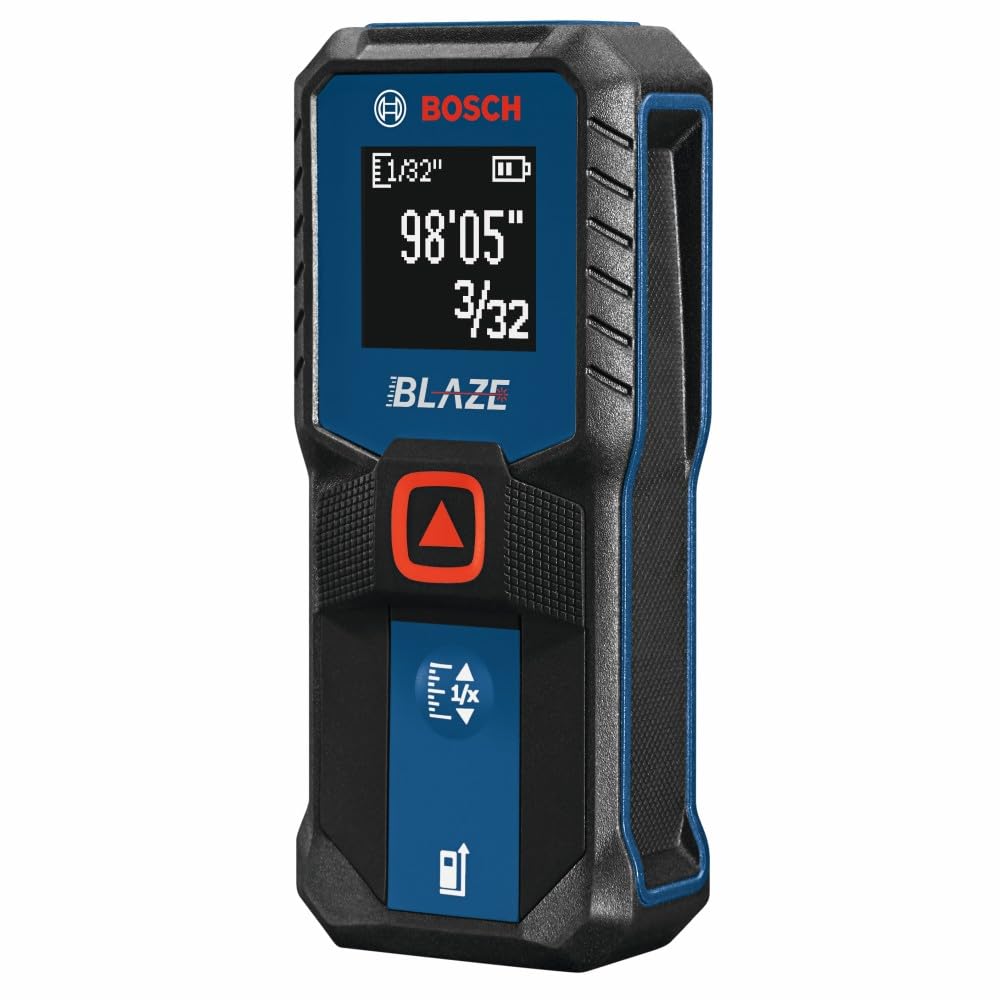
The Bosch GLM100-23 is a small blue rectangle with a backlit screen, a 100-foot range, and a stated accuracy of 1/16 inch. Bosch gives it two buttons: one to measure, one to round the result. There is no mode wheel or nested menu waiting for you at the top of a ladder.

That restraint is the right call for most people. When we measure a room, a window opening, or the run for a piece of trim, we want a reading we can trust without rereading a manual. The display is large enough to read in a dim hallway, and the body fits in a shirt pocket at 86 grams. It is the one in this group we kept picking up for quick checks because the next step was always obvious.

The 100-foot range covers nearly every indoor job, and the 1/16-inch accuracy is fine for blinds, shelving, and layout. It runs on two AA batteries, which is a small convenience we appreciate in a tool that may sit in a drawer for weeks. If you need area, volume, or Pythagorean calculations, the MiLESEEY D5 does more; for straight distances, the Bosch's simplicity is worth more than an extra mode.

Bottom line: For straight indoor measurements, this is the digital tape measure we reach for first: pocketable, dead simple, and accurate to the spec that matters.

Check Latest Price
#02

Best for Job Sites

Bosch GLM165-22

90 /100
Kirk Score Outstanding
Weight
3.52 oz
Accuracy
±1/16 in
Protection
IP65
Measuring Range
165 ft
Check Details on Amazon

Pros

  • IP65 dust and water resistance
  • 165-foot measuring range
  • Large color display
  • Rubber overmold protects impact points

Cons

  • Bulkier than pocket-size models

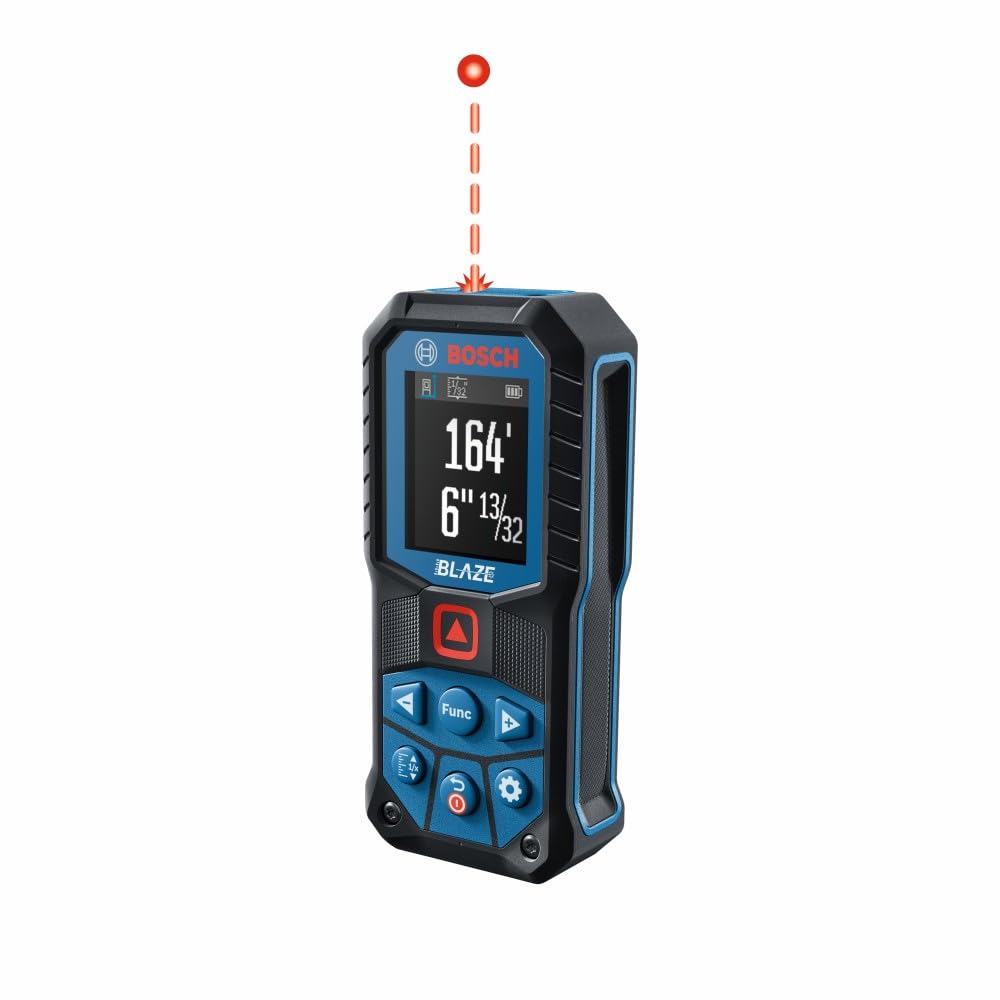
The Bosch GLM165-22 takes the pocket formula and wraps it in a rubber roll cage. It measures up to 165 feet to a stated 1/16 inch, has a color display, and carries an IP65 rating that covers dust and water spray. That is a different tool from the bare-bones GLM100.

We think the armor is worth paying for if the measure lives in a truck or a crowded tool bag. The overmold protects the corners, the screen stays readable in low light, and the 165-foot range gives you more room for outdoor layout. It feels like a tool you can set down on a job site without wincing.

For finish carpenters, inspectors, and anyone who measures in dusty rooms, that is the better bargain. The color screen and rubber shell are the details that make it feel like a tool rather than a gadget. It is a specialist's Bosch, and it earns the space in the bag.

Bottom line: If your laser rides in a tool bag rather than a desk drawer, this tougher Bosch is the one we trust with the job.

Check Latest Price
#03

Best for Room Layouts

MiLESEEY D5

91 /100
Kirk Score Outstanding
Weight
6.35 oz
Accuracy
±2 mm
Data Records
30
Measuring Range
229 ft
Check Details on Amazon

Pros

  • 229-foot range
  • Angle sensor for indirect measurements
  • 30-value memory
  • IP54 body

Cons

  • Heavier than pocket-size models

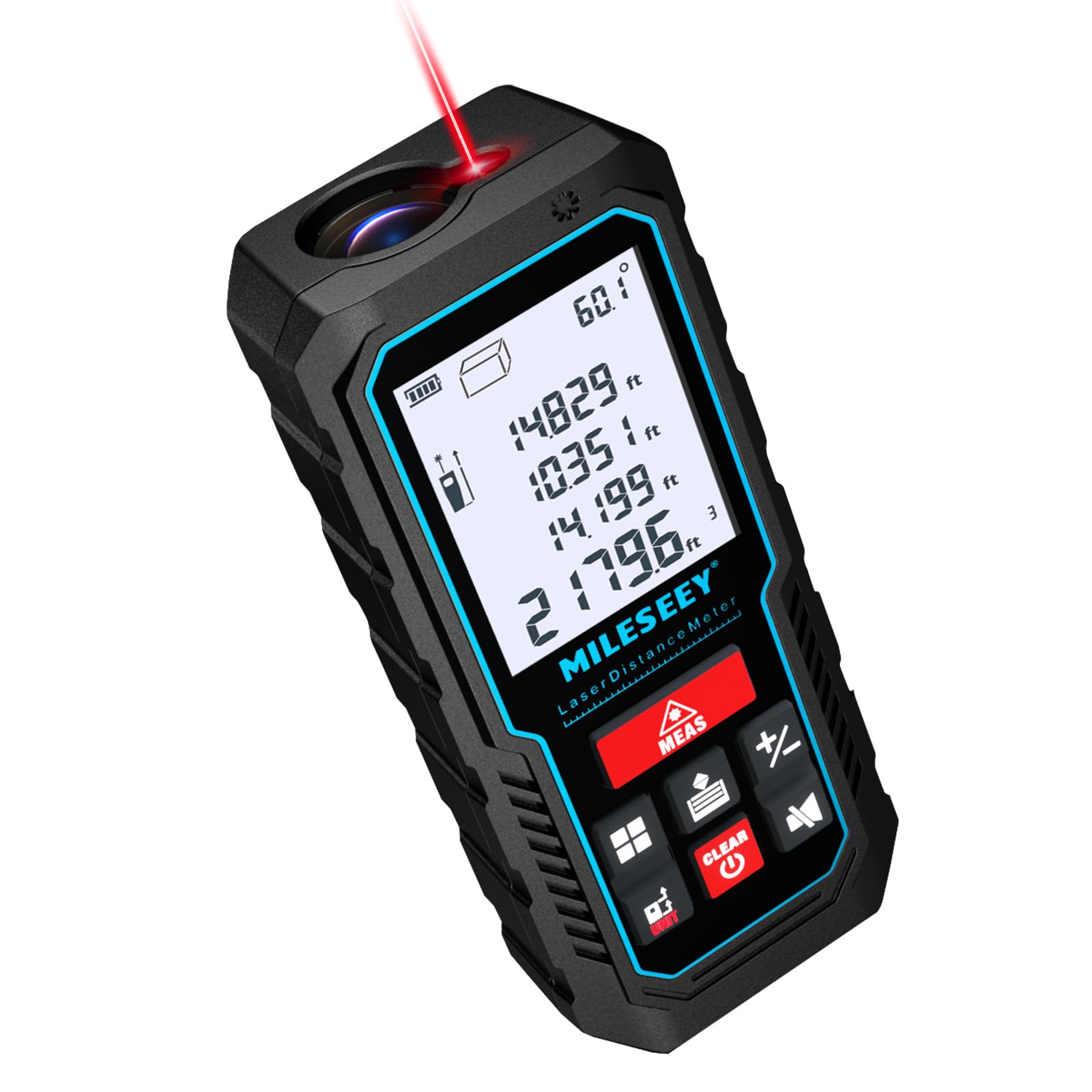
The MiLESEEY D5 is the one we choose when the job is a whole room rather than a single opening. It measures up to 229 feet to a stated 2 mm, and the built-in angle sensor helps with the calculations that usually send you back to a notepad.

The angle sensor is the feature that earns it a place here. It lets you work out horizontal and vertical distances indirectly, which is handy for ceiling heights, sloped ceilings, and anything you cannot walk across. The 30-record memory is more useful than it sounds when you are pacing a house and do not want to write down every number.

The 2-inch backlit screen and unit switching are welcome, and the IP54 body can handle a little dust and drizzle. The red laser is the limitation: it is easy to follow indoors, but it fades in bright sun. If your work is mostly outside, the green-beam S50 is the better fit; if it is room after room inside, the D5 gives you more measurement for less fuss.

Bottom line: For room layouts and long indoor spans, the D5's angle sensor and 229-foot range make it the more useful tool for the money.

Check Latest Price
#04

Best Pocket Laser

Klein 93LDM100C

89 /100
Kirk Score Excellent
Weight
2.29 oz
Accuracy
±1/16 in to 30 ft; ±1/8 in to 100 ft
Protection
IP54
Measuring Range
2 in to 100 ft
Check Details on Amazon

Pros

  • Pocket clip keeps it handy
  • Light 65-gram body
  • IP54 dust and water resistance
  • Simple for straight-line readings

Cons

  • Display is hard to read in direct sunlight

The Klein 93LDM100C is built to disappear into a pocket. It weighs 65 grams, has a metal pocket clip, and measures from 2 inches to 100 feet. The display is reverse-contrast, which makes the numbers stand out in dim rooms.

The single button is the whole interface: press once to turn on and measure, press again to stop the laser. For quick distances, that is faster than waking a multi-mode screen and hunting for the right setting. The IP54 rating means it can take dust and a splash, and the 100-foot range is enough for most interior work.

We think the Klein is the best choice when you want a measure that lives on you rather than in a drawer. The one-button design is also the catch: changing settings takes a sequence that is not obvious at first. If you mostly work indoors and want a tool you can clip to a pocket, that is a reasonable trade-off.

Bottom line: A pocket-clipped laser for fast interior readings, with a simple layout that suits quick checks more than complex ones.

Check Latest Price
#05

Best Digital-Readout Tape

ACPOTEL DT20

88 /100
Kirk Score Excellent
Units
6
Memory
20 values
Blade Length
16 ft
Digital Accuracy
1/16 in
Check Details on Amazon

Pros

  • Digital readout on a physical blade
  • 20-value memory
  • Six unit conversions
  • Rechargeable battery

Cons

  • No decimal-inch readout

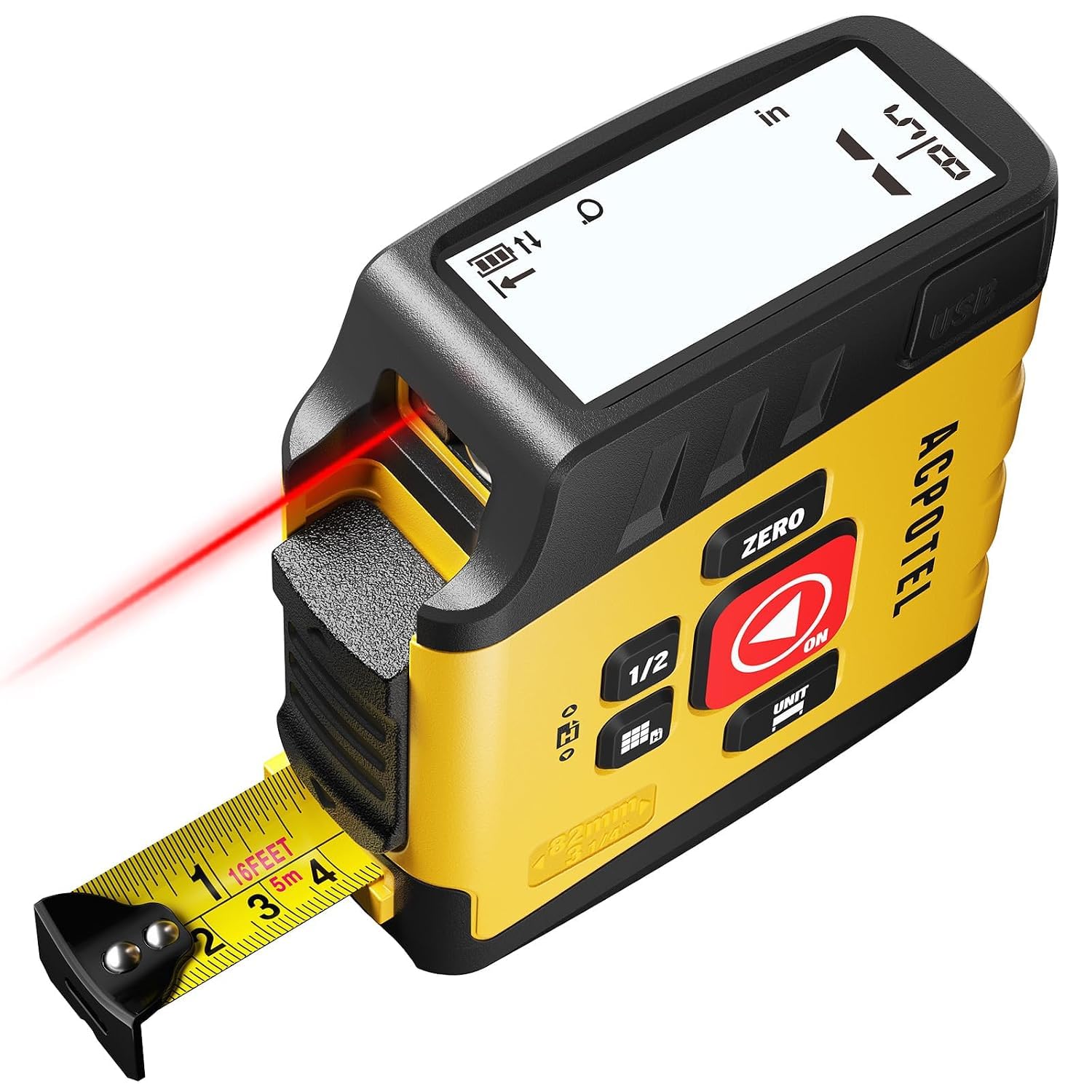
The ACPOTEL DT20 is the odd one here: it is a physical 16-foot tape with a digital readout built into the housing. We like that combination for measuring inside cabinets, window frames, or anything with an edge you can hook onto.

The 1.8-inch blade is wider than a lot of pocket tapes, so it stands out farther before it folds. The display takes the squint out of reading fractions, and the 20-value memory means you can take a run of measurements and write them down later. Six unit conversions cover the usual imperial and metric formats, and the rechargeable battery saves a trip for AAAs.

It is not a replacement for a laser on long open spans; 16 feet is the limit, and the blade still needs a surface to run along. For trim, framing, and interior layout, though, it is the digital tape we reach for when we want a physical blade.

Bottom line: For trim, cabinets, and anyone who wants a physical blade with a digital readout, the DT20 is the most natural fit here.

Check Latest Price
#06

Best Budget Laser

DTAPE DT50

91 /100
Kirk Score Outstanding
Accuracy
±1/16 in
Protection
IP54
Measuring Range
165 ft
Measurement Time
0.4 sec
Check Details on Amazon

Pros

  • Fast 0.4-second readings
  • Eight measurement modes
  • IP54 body
  • 180-second auto shutoff

Cons

  • Red dot is hard to see in bright sunlight

The DTAPE DT50 is the budget option that does not feel like a toy. It measures up to 165 feet, claims a 0.4-second response, and packs eight modes into a body that weighs about 0.21 kg. The backlit display and IP54 rating are more than you might expect at this end of the range.

The speed is the part we noticed first. Point, press, and the number appears; for room dimensions and quick estimates, that rhythm is hard to beat. The eight modes cover distance, area, volume, and Pythagorean measurements, and the 180-second auto shutoff gives you enough time to set up a second reading without waking the screen.

The DT50 is the right pick if you want a laser for occasional DIY and do not need the last word in build quality. The accuracy can vary, so check it against a steel tape on a known length before you trust it for finish cuts. For estimates, room dimensions, and quick layout, it is an easy tool to live with.

Bottom line: The budget laser we recommend for occasional DIY: fast, feature-rich, and easy to live with as long as you verify it before finish work.

Check Latest Price
#07

Best Premium Long-Range

MiLESEEY S50

88 /100
Kirk Score Excellent
Laser
Green beam
Battery
Rechargeable Ni-MH
Display
2.4 in IPS
Measuring Range
400 ft
Check Details on Amazon

Pros

  • Green beam is brighter than red
  • 400-foot range
  • 2.4-inch IPS display
  • Rechargeable battery

Cons

  • Green dot still fades in direct sunlight

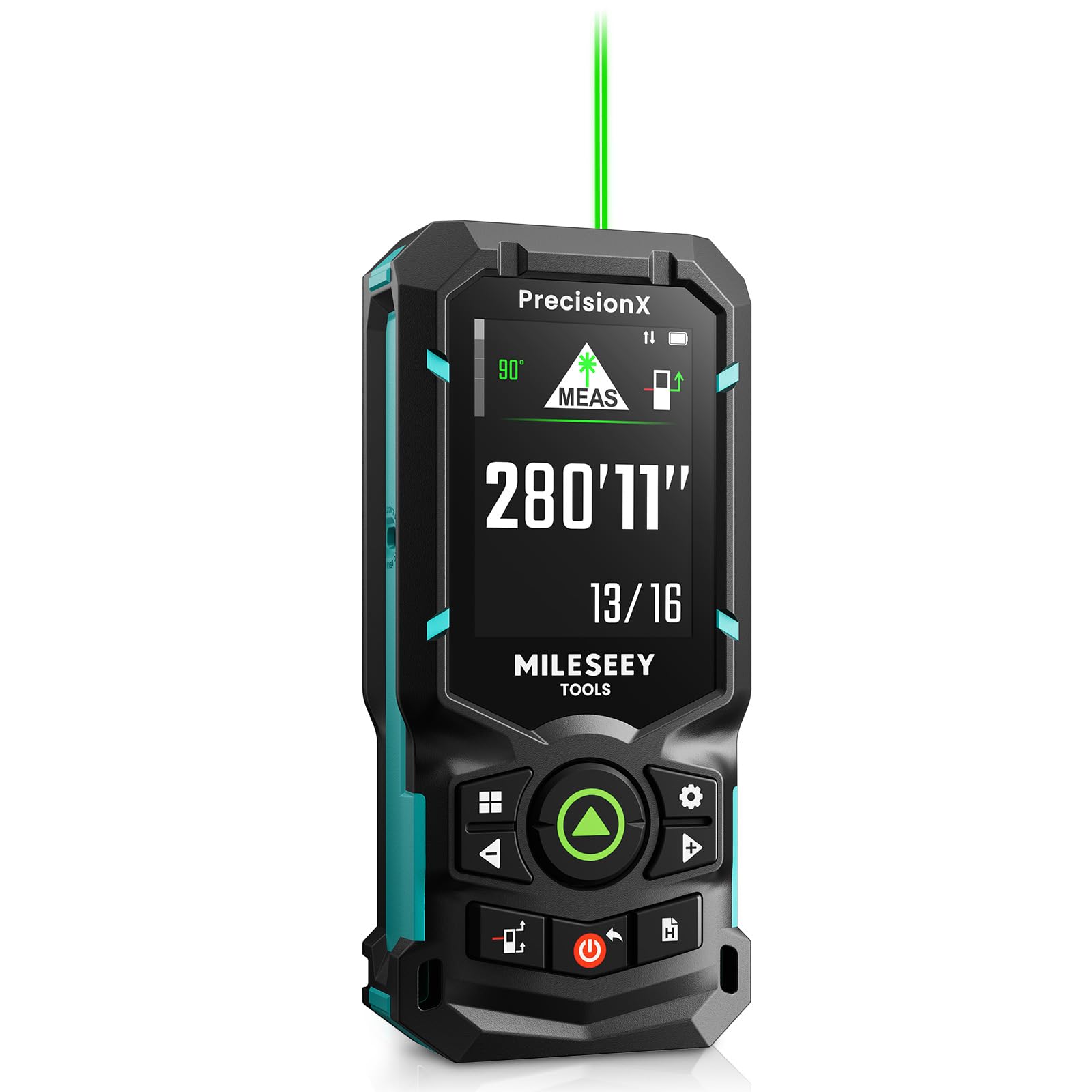
The MiLESEEY S50 is the most capable laser in this group on paper: a green beam rated for 400 feet, a 2.4-inch IPS display, and a rechargeable battery pack. It also has a side-laser alignment mode and four reference points, which is a lot of tool for a handheld measure.

The green beam is the headline. It is brighter than the red dots on the other picks, and the larger screen is easier to read at a glance, especially when you are holding the tool away from your body. The 18 modes and eight units cover area, volume, and indirect measurements, and the rechargeable battery means you are not hunting for AAAs on a job.

The trade-off is complexity. The menus take practice, and the tool rewards a little setup time before a big job. It is also heavier than the pocket models, but it still fits in a hand or a tool pouch.

The S50 earns its place for contractors and serious DIYers who measure long spans and want a bigger screen and a brighter dot. For a homeowner who mostly checks a room before buying furniture, the D5 or the GLM100 is easier to live with. The S50 is the one we pick when the measurement itself is the hard part.

Bottom line: For long spans and demanding jobs, the S50's green beam and big screen make it the premium laser we reach for.

Check Latest Price
#08

Lightweight long-range use

ACEGMET S9

90 /100
Kirk Score Outstanding
Weight
1.76 oz
Protection
IP54
Data Records
30
Measuring Range
229 ft
Check Details on Amazon

Pros

  • Very light 50-gram body
  • 229-foot range
  • 30-value memory
  • IP54 protection

Cons

  • Display can be hard to read in some conditions

The ACEGMET S9 weighs 50 grams, measures up to 229 feet, and has two bubble levels built into the housing. That combination makes it a natural fit for quick room checks and for anyone who wants a laser that disappears into a pocket.

The 30-record memory and IP54 rating are useful additions at this end of the market. The backlit LCD is easy enough to read indoors, and the bubble levels give you a rough visual check when you are setting the tool on a surface or trying to keep it level.

The S9 is not the most precise-feeling tool here; its accuracy is the thing to check against a steel tape before you trust it for finish work. It also lacks the angle sensor and larger screen of the D5, so it is a simpler instrument overall.

We see the S9 as a lightweight backup or a first laser for someone who mostly measures rooms and furniture. It gives you long range and a couple of handy levels without much bulk. If your work depends on repeatable precision, spend more on the Bosch or the D5; if you want a handy second measure, this one is easy to carry.

Bottom line: A lightweight long-range extra for room checks and quick estimates, not the first choice when repeatable precision matters.

Check Latest Price

How We Tested Digital Tape Measures in Real Rooms

We started by pulling spec sheets and manuals for every model we could find, then filtered the pile by the things that genuinely change how you use one: whether a unit handles area, volume, and indirect height calculations, whether it switches cleanly between feet, inches, and meters, and whether it runs on disposable batteries or recharges over USB. That left 12 units, bought at retail and handed out for six months of ordinary use — a basement renovation, a slanted attic office, a garage, and a back deck.

Accuracy and reliability got most of the attention. We compared each unit against a steel tape along a 10-foot reference line, then measured the same 20-foot hallway five times in a row to see how far the readings drifted from each other. We also aimed at drywall, at a hanging curtain, and past the end of a corridor to find out whether the tool flashed an error code or quietly returned a number that was simply wrong.

The rest came down to hands and eyes. Each unit went into an unlit basement and out into direct midday sun, where we judged the backlit display and asked the same question of the laser dot: can I actually see where this is landing? We counted button presses to a single reading and noted which controls needed a second thumb to reach. Over a month of weekend use we tracked how fast the batteries and the rechargeable units gave out, and whether the casing felt like something that would survive a toolbox. The units that made the list were the ones that stayed consistent when the light, the surface, and the user all changed.

How to Choose a Digital Tape Measure

Start with the measuring method

Laser measures shine on open spans: room lengths, ceiling heights, and anything you would otherwise need a helper to hold the far end of a tape for. A digital-readout tape keeps the familiar blade and hook, so it can sit in an inside corner or run along a board without a target to bounce off. We reach for the laser when the distance is longer than a tape can comfortably span; we reach for a digital tape when the measurement has an edge. Two-in-one tools look convenient, but they add bulk and often compromise one side of the job. Pick the method that matches most of your work first, then add the other only if you measure both ways often.

Range and accuracy are separate decisions

A 100-foot laser covers nearly every room in a house, while 165 feet and beyond is for long lots, barns, and outdoor layout. The accuracy spec matters more at the top of the range: 1/16 inch is the useful target for trim and blinds, but some models loosen to 1/8 inch near their limit. Check the number at the distance you actually measure, not just the headline. Visibility is the other half of accuracy. A dot you cannot see on a sunny wall is not a measurement you can trust. Green beams help, but none of these lasers is a substitute for a tape in direct sun.

Buttons, reference points, and the screen

The best interface is the one you can run without looking. Two buttons and a clear screen beat a deep menu when you are on a ladder. But fewer buttons can go too far: a single-button tool is quick for straight distances and fiddly when you need to change a setting. Check where the tool measures from, whether front, back, or a thread for a tripod, because a reference-point mistake throws off every reading after it. Backlit displays help in dim rooms, but contrast matters more in sunlight. If most of your work is outdoors, prioritize a bright screen and a laser you can actually see.

Build, power, and the features worth paying for

IP54 covers dust and splashes; IP65 adds more water protection and suits a tool that lives in a bag. AA or AAA batteries are easy to replace; a rechargeable pack saves disposables but eventually ages. Memory, area, volume, and Pythagorean modes earn their keep if you measure rooms or roofs regularly; for straight distances, they mostly add buttons. Run a known-length check before trusting any new digital measure. A steel tape over six feet will tell you whether the zero reference and the reading agree.

Frequently Asked Questions

Final Verdict

Most people should start with the Bosch GLM100-23. It is the least fussy way to get a reliable indoor measurement: pocketable, two buttons, and a 100-foot range that covers rooms, ceilings, and trim runs. We reach for it before the feature-heavy models because it never makes us stop and think about modes.

If the tool will live in a dusty bag or you regularly measure past 100 feet, the Bosch GLM165-22 is the tougher step up. If you want a physical blade with a digital display for cabinets and inside corners, choose the ACPOTEL DT20 instead. The right pick is the one whose method matches the measurement you make most often.