// data-verified

Best Zip Ties of 2026

Nothing announces its failure more quietly than a zip tie. The pawl slips a tooth, the tail snaps off at the head, and whatever you'd bundled — cables, a trellis, a bike rack — is loose again. The difference between a tie that holds and one that quits usually shows up on the second or third tightening, not the first.

My team spent four months with 16 packs: assorted 200- and 400-count bags, 1,000-piece boxes of a single length, and a mix of black, white, and clear. That spread matters, because the category splits between people who want a range of sizes in one bag and people who want a lifetime supply of one. We also checked whether the UV-resistant claims held up and whether the double-sided V-toothed designs actually gripped better than standard single-tooth ties.

One thing worth knowing before you buy: length is measured to the tip with the head included, so a 12-inch tie gives you noticeably less than 12 inches of reach. Size up if you're wrapping anything thick. The picks below are the ones that held — indoors, outdoors, and through a summer of direct sun.

#01

Best Overall

HAVE ME TD 400-Pack

93 /100
Kirk Score Outstanding
Color
Black
Count
400 (100 each)
Sizes Included
4, 6, 8, 12 in
Tensile Strength
18 to 40 lb
Check Details on Amazon

Pros

  • 100 ties in each of four useful lengths
  • Black nylon blends in indoors and out
  • Budget price for a 400-tie stash

Cons

  • 40 lb ceiling keeps it light-to-medium duty

Four hundred ties, split exactly even: 100 at 4 inches, 100 at 6, 100 at 8, and 100 at 12. That even split is rarer than it sounds, and it's the detail that decides how the box feels after a month. An assortment that front-loads the short sizes makes you hoard the long ones; this one treats a 12-inch tie as ordinary stock, so you grab it when it's right instead of making do with an 8-inch doubled up.

The stated strength is 18 pounds at 4 inches and 40 pounds from 6 inches up, which covers garden stakes, cable runs, a trellis, a bike rack, and the extension cord that lives coiled on a hook. The nylon is plain black, self-locking, and slick enough that the tail finds the head without a fight, and the color disappears against cable and outdoor hardware where white ties advertise themselves.

The bag lands just under two kilograms, which is the right way to think about this box: a shelf stash, not something you carry to a job site. Ours sits next to the toolbox, and the first thing we noticed is how little ceremony it takes to pull three ties out and get on with the task.

What earns it the top spot is the arithmetic of ordinary use. A box this stocked turns the third tie on a Saturday job from a decision into nothing at all. If your tying is heavy, permanent, or outdoors year-round, look at the JIANYANG and Rythcraft picks instead — that's a different job, and they're built for it.

Bottom line: The default we recommend: 100 ties in each of the four lengths household jobs actually need, in black, at a price that makes wasting one painless.

Check Latest Price
#02

Best for Heavy Loads

JIANYANG Heavy-Duty 400-Pack

95 /100
Kirk Score Outstanding
Count
400 (100 each)
Strap Width
0.19 in
Sizes Included
8, 12, 14, 18 in
Tensile Strength
100 lb
Check Details on Amazon

Pros

  • 100 lb rating handles real outdoor loads
  • Teeth on both faces, so no wrong-way threading
  • 100 ties in each size up to 18 inches

Cons

  • No 4- or 6-inch ties for small jobs
  • Highest up-front price in this group

At 100 pounds of stated tensile strength, these are the ties we want when the tie is doing structural work rather than tidying. The straps measure 0.19 inch wide — noticeably beefier than the 0.14-inch ties in the budget bulk packs — and the teeth run down both faces of the strap, so there is no wrong way to feed the tail into the head. That last detail matters more than it sounds when you're reaching behind a downspout with one hand and can't see what you're doing.

The size mix is the honest trade-off: 8, 12, 14, and 18 inches, 100 of each. There is nothing here for a bundle of speaker wire or a rolled poster, so treat this as a second box rather than a first one. What you get instead is reach — an 18-inch tie wraps a fence panel to a post or gathers a shrub without chaining two shorter ties into a knot that will rot.

We noted that these can snap if you keep cranking after the strap goes snug; a lever-action pull will beat nylon every time. Pull to contact, give it a quarter turn, and stop there. For fencing, trellises, and anything that has to sit through a winter, the 60 extra pounds over the budget assortments is the whole reason to spend more.

Bottom line: We reach for these when the tie is holding something that matters: 100 pounds of rated strength, teeth on both sides, and lengths out to 18 inches.

Check Latest Price
#03

Best Extra-Strength Hold

Rythcraft 200 lb Zip Ties

95 /100
Kirk Score Outstanding
Count
80
Length
12 in
Strap Width
0.3 in
Tensile Strength
200 lb
Check Details on Amazon

Pros

  • 200 lb rating with a 0.3-inch-wide strap
  • V-shaped double teeth resist shearing when folded
  • Holds up in wind, sun, and engine heat

Cons

  • Length can fall short of the stated 12 in

Three-tenths of an inch across, these straps are more than twice the width of the 0.14-inch ties that fill most bulk packs, and that width is where the 200-pound rating comes from. A wide strap spreads the load across more of whatever it touches, so it doesn't bite into a hose or saw through a soft cable jacket the way a narrow tie pulled just as hard will.

The V-shaped teeth are cut so the strap can fold over without the teeth shearing off — the failure that turns a heavy-duty tie into a two-inch stub. We paid close attention to how these hold on garden work, and the answers were reassuring: netting to a trellis, chicken wire to a post, a rolled mat that wants to unroll. The black nylon also doesn't go brittle in heat the way cheap ties do.

Where these earned their place for us is the 12-inch thick-bundle job a standard tie simply can't do — a coil of hose, a rolled shade cloth, a gate you're trying to immobilize for an afternoon. Eighty ties is a job-sized box rather than a garage stock, and that's about right for a project you're doing once and finishing properly.

Bottom line: Two hundred pounds and a strap twice the width of a budget tie — that's the case for keeping a box of these for thick bundles and outdoor anchoring.

Check Latest Price
#04

Best Small Pack

LOCKLOCK 200-Pack

94 /100
Kirk Score Outstanding
Count
200 (50 each)
Material
UV-resistant nylon
Sizes Included
4, 6, 8, 12 in
Tensile Strength
18 to 48 lb
Check Details on Amazon

Pros

  • 48 lb 12-inch tie, strongest of the budget sets
  • UV-resistant nylon at the lowest price here
  • Four sizes, small enough for a drawer

Cons

  • Only 50 of each size, so heavy users run out

Fifty ties in each of four lengths, 200 in the bag, in a pack small enough to live in a kitchen drawer. The per-size ratings climb the way they should: 18 pounds at 4 inches, 25 at 6, 40 at 8, and 48 at the 12-inch length — the strongest 12-inch figure among the budget-priced assortments in this group. The nylon is described as UV-resistant, which the cheapest boxes here don't claim.

Where these ask for a little care is tightening. Seat the tail square in the head and pull steadily rather than yanking, and check that the pawl has grabbed before you load the tie, because a tie that slips back hasn't fastened anything. Do that and this is the pack we hand someone who wants a drawer of ties rather than a lifetime supply: 50 of each size teaches you what you actually use, and then you buy the big box of that one length.

Bottom line: Our pick for a first box: 50 ties in each of four sizes, UV-resistant nylon, and a 48-pound 12-inch tie for the least money here.

Check Latest Price
#05

Best for Cable Bundles

Skalon 8-Inch 1,000-Pack

95 /100
Kirk Score Outstanding
Count
1,000
Length
8 in
Tensile Strength
40 lb
Max Bundle Diameter
2 in
Check Details on Amazon

Pros

  • 1,000 ties in one length for repeat jobs
  • 8-inch size suits most cable bundles
  • Nylon 66 rated -40°F to 185°F

Cons

  • 40 lb rating, light-to-medium duty only

One length, one thousand of them. A box like this only makes sense if you already know what you're tying — the network rack, the trailer wiring, the shelf of coiled extension cords — because there's no 4-inch tie in here for the small stuff and no 12-inch for anything bulky.

Eight inches long, 0.14 inch wide, rated for a 2-inch bundle diameter and 40 pounds. That's the middle of the road on paper, and in the hand it's the length most cable work actually wants: long enough to loop a bundle of Cat6 and still reach the head, short enough that the tail doesn't need three cuts to look tidy.

The catch is holding power under movement. These lock down fine on a stationary run, but a bundle that flexes or a load that pulses will work the pawl loose over time — route them where the tie isn't being shaken and they stay put. Anything that vibrates wants a wider strap and a heavier rating.

A thousand ties is years of household use, so this isn't the box for a kitchen drawer. It's the box for a bench, a van, or a job where you're cutting ties off and putting new ones on every week — and on cost per tie alone, that's what it's built for.

Bottom line: This is the box we point at workbenches and racks: a thousand 8-inch ties at one of the lowest costs per tie here.

Check Latest Price
#06

Repeat jobs

Armpow 12-Inch 1,000-Pack

89 /100
Kirk Score Excellent
Count
1,000
Length
12 in
Tensile Strength
60 lb
Max Bundle Diameter
3.2 in
Check Details on Amazon

Pros

  • 60 lb rating with a 3.2-inch bundle capacity
  • Rated -40°F to 185°F for garage and roof

Cons

  • One length only, with no small ties inside

Twelve inches, 60 pounds, a thousand of them, and a stated working range of -40°F to 185°F. This is the same single-length bet as the Skalon box, made in the length people reach for second: a 3.2-inch maximum bundle diameter covers a coil of garden hose, a bundle of conduit, or a rolled shade cloth without doubling up.

You buy a box like this when the length is already decided — a shop hanging the same sign the same way, a contractor bundling the same pipe every week. The 60-pound rating gives real headroom over the 40-pound bulk pack, the PA66 nylon is rated across a range that covers both a cold garage and a hot roof, and the straps are 0.18 inch wide rather than the bare minimum. If your tying is varied, the assorted box at the top of this list is the better first purchase.

Bottom line: We like these for anyone who already knows the length: 1,000 twelve-inch ties, 60 pounds rated, with a temperature range that covers a cold garage.

Check Latest Price
#07

Light-colored spaces

SiKuLin White 400-Pack

93 /100
Kirk Score Outstanding
Color
White
Count
400 (100 each)
Sizes Included
4, 6, 8, 12 in
Tensile Strength
18 to 45 lb
Check Details on Amazon

Pros

  • White straps vanish on painted surfaces
  • 100 ties in each of four sizes
  • Budget price for a 400-tie box

Cons

  • Teeth don't always catch on the first feed

For anything that ends up on a white wall, a light appliance, or the back of a pale desk, this is the box we grab. White nylon disappears against painted trim and cable trunking in a way black never will, and that is the entire reason to own it — the tie becomes a fastener rather than a visible repair.

The trade-off is body. These are thin straps, and the stated tensile range tops out well below the black heavy-duty picks here. For a bundle of charging cables behind a desk or a string of lights along a shelf, that's plenty. For anything outdoors under tension, or anything that could hurt when it lets go, buy a wider tie.

Four sizes, 100 of each, 400 total, so you aren't rationing 12-inch ties the way you do with packs that front-load the short ones. Once the box is on the shelf, the color stops being the reason you bought it and becomes the reason you keep reaching for it.

Bottom line: Our pick when the tie has to disappear: white straps for painted walls, appliances, and light cable runs where black would stand out.

Check Latest Price
#08

Long, thick bundles

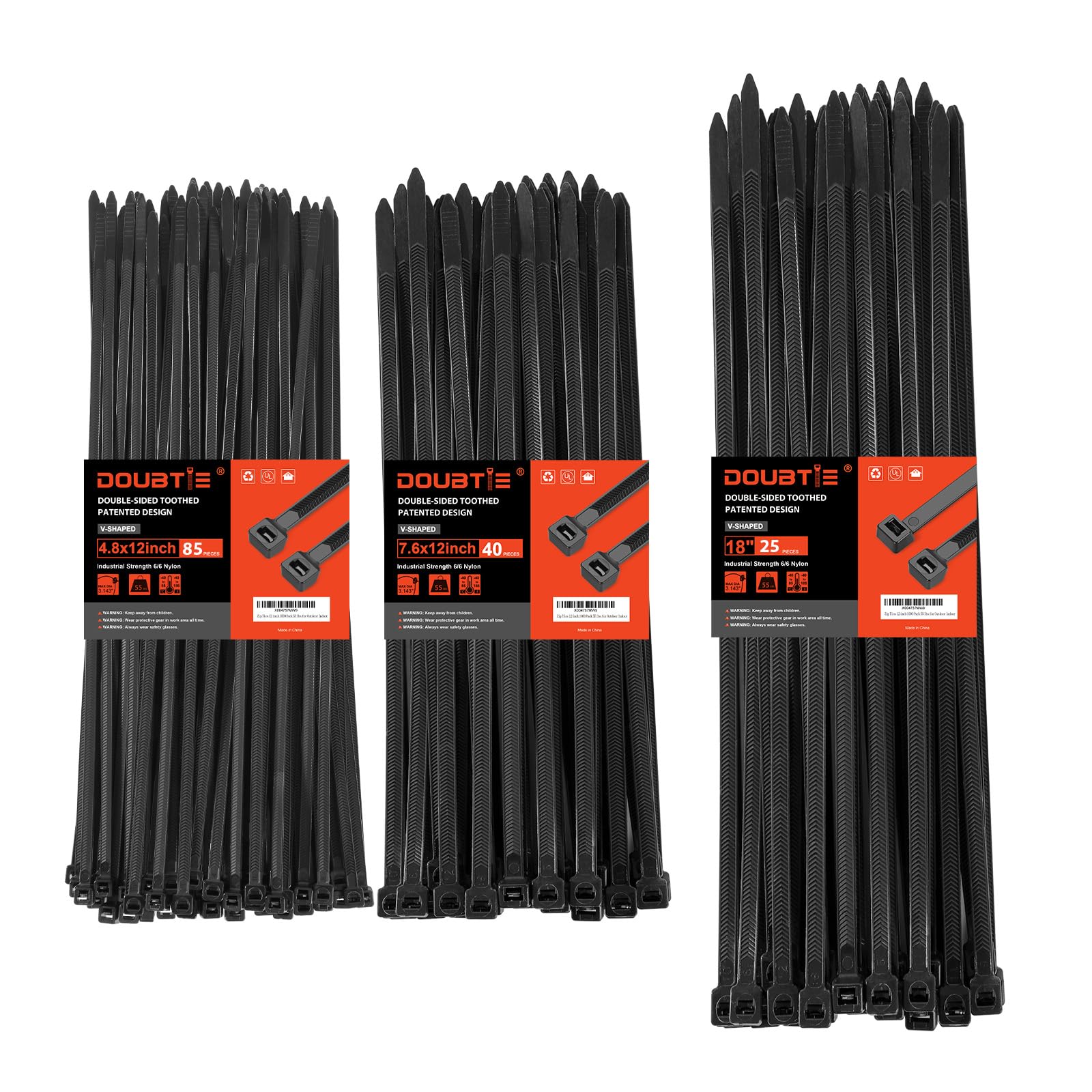
Doubtie 200 lb Assorted

91 /100
Kirk Score Outstanding
Count
150
Strap Width
0.3 in
Sizes Included
12 and 18 in
Tensile Strength
200 lb
Check Details on Amazon

Pros

  • 18-inch ties reach what 12-inch ties can't
  • 200 lb hold in a 0.3-inch-wide strap
  • Quality and durability feedback is strong

Cons

  • No small ties in the pack
  • Costs more per tie than the assorted budget boxes

Eighteen inches is the length that makes this box interesting. That's the tie that gathers a shrub, wraps a post, or reaches around a bike frame and a rack together — jobs where linking two 12-inch ties end to end is asking for trouble.

The straps are 0.3 inch wide with V-shaped teeth cut on both faces and a 200-pound rating, so the reach doesn't come at the cost of strength. The box mixes 12-inch and 18-inch ties, 150 in all, which suits work where you wrap something once and want it to stay wrapped through a season of weather.

What struck us about this box is how much of its value sits in one length. If your job needs 18 inches — a fence panel, a tree stake, a bundle of downspout — nothing else here goes that far, and the 12-inch ties you get alongside are useful rather than filler. If it doesn't, the general-purpose box at the top of this list covers more ground.

Bottom line: We think it's worth the premium when you need 18 inches of reach with 200 pounds behind it — fencing, tree stakes, and thick outdoor bundles.

Check Latest Price

How We Tested Zip Ties

We started by pulling every listing that surfaced for the category and reading the fine print — tensile rating, tooth pattern, UV claim, and what you actually get per bag at the listed price. From there we bought 16 packs and lived with them for four months: assorted bags in 200- and 400-counts, 1,000-piece boxes of a single length, black, white, and clear, and both standard single-tooth and double-sided V-toothed designs.

Testing happened where ties get used. Cables behind a desk, tomato stakes and a trellis in the garden, a bike rack on the back of a car, storage bins in a garage, and a workshop shelf where everything got bundled by size. For each tie we cinched it down until the pawl clicked, then pulled the tail hard in the opposite direction to see whether it held or slipped a tooth. We noted whether the teeth engaged smoothly or needed force, and whether the strap flexed or creased at the head under hard tightening.

Durability got a longer clock. A sample from each pack lived outdoors on a fence through four months of sun and rain, and we checked monthly for chalky surfaces, brittleness, and heads that had gone soft. Back inside, we ran each strap between thumb and forefinger to feel for thin spots, cut ends to see how cleanly they sheared, and looked at dye evenness across a pack, since a blotchy batch usually points to a sloppier mold. We also measured the assorted bags against their labels, because a tie sold as 12 inches is shorter than the number suggests.

How to Choose Zip Ties

Start With Length, and Measure the Bundle

A tie has to wrap the bundle and still reach the head, so the figure that matters is circumference plus about an inch, not how wide the bundle looks. The stated maximum diameters make it concrete: the 8-inch Skalon ties here are rated for a 2-inch bundle, the 12-inch Arm pow ties for 3.2 inches. Two lengths cover nearly everything at home — an 8-inch for cords and cable, a 12-inch for hose, conduit, and garden work. Buy the four-size assortment only if you genuinely don't know what you'll be tying.

Width Is Where Strength Actually Comes From

The cheapest way to add holding power is to add width. The progression in this group is easy to see: 0.14-inch straps rated at 40 pounds, 0.19-inch straps at 100, and 0.3-inch straps at 200. Width also spreads pressure, which is why a wide tie is less likely to crimp a soft cable jacket or cut into a hose than a narrow one pulled just as hard.

If the strap will rub against a rough edge, or the bundle gets pulled and released, skip the thin ties entirely. We treat any tie under about 0.15 inch as indoor, low-load stock and keep the wide ones for anything that has to hold.

Read the Count Per Size, Not the Total on the Bag

Don't assume the pieces in an assorted box are spread evenly; check the per-size count before you buy. The packs we rate highest here give 100 ties in each length, while the smallest pack gives 50 — same four sizes, very different staying power. If your work repeats at a single length, buy that length by the thousand instead of another assortment. A household that ties something once a week will not finish a thousand ties, and a shop that ties twenty a day will not notice a four-hundred-piece box.

Outdoor Ties Need a UV Claim and a Temperature Range

Sunlight is what finishes off a nylon tie left outside: the strap goes brittle and snaps at the head. Several picks here state UV-resistant nylon and a working range of -40°F to 185°F, and not every pick here states either. If a tie is going on a fence, a trellis, or a gutter, choose one that names those figures and go wide, because a thick strap has more material to lose before it fails. For a season of holiday lights, the budget boxes are fine.

Frequently Asked Questions

Final Verdict

Buy the HAVE ME TD 400-pack if you want one box that handles the ordinary run of household tying: four lengths, 100 of each, black, and inexpensive enough that you use the right size instead of the nearest one. It's the box we recommend by default because it's the one that runs out of nothing.

If your work is heavier or lives outdoors, step up to the JIANYANG at 100 pounds or the Rythcraft at 200 — those two are what will hold a fence panel through a winter. And if you're stocking a bench rather than a drawer, the Skalon bulk box beats everything here on cost per tie.