// data-verified

Best Drill Presses of 2026

A hand drill goes where you lean. A drill press goes where you aimed it — straight down, to the depth you set, as many times as you need. That only holds if the machine is stiff enough to resist the pull of the bit; a flexy column or a table that creeps under a hole saw turns a clean bore into an oval.

We've spent the past eight months with 11 benchtop presses, from 8-inch models that live on a shelf to 12-inch cast iron machines with variable speed, lasers, and tilting tables, drilling pine, oak, and mild steel. Capacity tells you less than you'd think: a 12-inch press with a light table can wander more than a smaller, heavier one, and the laser most of these ship with is a convenience, not a replacement for a center punch.

Assembly is the other thing the spec sheet hides — bolting the column to the base and squaring the table to the spindle is where a press feels wobbly or true. The picks below are the ones that held a line and held still.

#01

Best Overall

BUCKTOOL 12-Inch Benchtop Drill Press

88 /100
Kirk Score Excellent
Motor
6.2 A, 3/4 hp
Swing
12 inches
Speed Range
580–3,200 rpm
Chuck Capacity
5/8 inch
Check Details on Amazon

Pros

  • 12-inch swing handles wide work
  • 6.2 A, 3/4 hp motor for wood and light metal
  • Lever variable speed with digital readout
  • Laser, work light, and safety switches

Cons

  • 2-inch spindle travel limits deep-hole reach

The 12-inch swing and 6.2-amp, 3/4-hp motor are what make the Bucktool DP12VL our default recommendation for a home workshop. That combination gives you room to drill into the middle of a cabinet side and enough torque for hardwood and light steel without the machine feeling strained. We also appreciate that the speed changes with a lever from 580 to 3,200 rpm and shows the actual spindle speed on a digital readout; matching the bit to the material becomes a five-second adjustment instead of a belt change.

The rest of the package is built for repeat work. The laser and work light help you line up a hole and see it without clamping a lamp to the table, and the flat table rotates 360 degrees and bevels 45 degrees for angled cuts. We found the depth stop and the emergency-stop and no-voltage-release switches reassuring when drilling a run of holes, and the 5/8-inch keyed chuck takes the standard bit sizes most home shops keep on hand.

The cast base and 86.5-pound build sit solidly on a bench, and the table locks down for repeat work. This is a press you site once and leave in place, not a portable tool. For the everyday mix of cabinet parts, shop jigs, and light metal brackets, it has the capacity and power we want; the 12-inch swing is the feature that keeps it useful as the work gets wider.

Bottom line: For most home workshops, the Bucktool DP12VL is the drill press we recommend: 12 inches of swing, a 3/4-hp motor, and lever-controlled variable speed cover wood and light metal without a belt change.

Check Latest Price
#02

Best for Long Stock

WEN 4214T 12-Inch Drill Press

90 /100
Kirk Score Outstanding
Swing
12 inches
Speed Range
580–3,200 rpm
Chuck Capacity
5/8 inch
Spindle Travel
3-1/8 inches
Check Details on Amazon

Pros

  • 12-inch swing with 3-1/8-inch spindle travel
  • Continuous 580–3,200 rpm with digital readout
  • Roller table extension supports long stock

Cons

  • Belt can slip in heavy cuts
  • 85-pound head needs a solid bench

The roller extension on the WEN 4214T's table is the detail that separates it from most 12-inch benchtop presses. It gives long boards a place to rest while you drill, and the 9-1/2 by 9-1/2-inch table still bevels for angled work. The 5-amp motor, 12-inch swing, and 3-1/8-inch spindle travel put it in the same size class as the Bucktool and JET, while the mechanical variable speed runs from 580 to 3,200 rpm with a digital readout.

The laser crosshair and overhead light are genuinely useful when the bench is crowded, and the speed dial stays where you set it. Assembly is straightforward, and the head goes onto the column without drama. We like that the table roller extension is there when you need it and out of the way when you do not; it is a better solution for long stock than stacking scrap under the far end.

Where it lands for us is a light-to-medium-duty 12-inch press with a useful long-stock feature. The 5-amp motor handles wood and light metal, and the continuous speed control makes it easy to match the bit to the material. If your work is cabinets, jigs, and the occasional bracket, it is a lot of drill press for the money; for thick steel, the Bucktool's extra power is the safer bet.

Bottom line: The WEN 4214T is our pick for a light-to-medium-duty 12-inch press with long-stock support; its roller table and continuous speed control make home-shop drilling easier, provided you are not hogging thick steel.

Check Latest Price
#03

Best Premium

JET JWDP-12 Benchtop Drill Press

87 /100
Kirk Score Excellent
Swing
12 inches
Warranty
5 years
Speed Range
530–3,100 rpm
Chuck Capacity
5/8 inch
Check Details on Amazon

Pros

  • No-belt speed changes from 530 to 3,100 rpm
  • Digital readout and laser crosshair
  • Five-year warranty

Cons

  • Must be bolted to a bench
  • Fasteners can loosen and rattle

The JET JWDP-12 is the premium option here, and the speed lever is the reason. It changes spindle speed from 530 to 3,100 rpm while the motor runs, with a digital readout showing actual rpm. There is no belt to move and no interruption to the setup. The cast-iron base and table, laser crosshair, LED light, and 5-year warranty round out a package aimed at a shop that will use the press regularly.

We think the JET earns its premium for anyone who changes speed often and wants a press that stays set up. The 1/2-hp motor is not a metal-fabrication powerhouse, and the convenience and warranty are the draw for a furniture or cabinet shop. If you drill a few holes a month, the cheaper 12-inch presses make more sense; if the press is central to your work, the no-belt speed change is the feature you will feel every day.

Bottom line: The JET JWDP-12 is the premium pick for a shop that changes speeds constantly: the lever-adjustable 530–3,100 rpm range, digital readout, and 5-year warranty justify the spend if the press lives on one bench.

Check Latest Price
#04

Best Compact

WEN 4206T 8-Inch Drill Press

90 /100
Kirk Score Outstanding
Swing
8 inches
Speeds
5 speeds, 750–3,200 rpm
Weight
32 lb
Chuck Capacity
1/2 inch
Check Details on Amazon

Pros

  • Compact 32-pound frame
  • Five speeds from 750 to 3,200 rpm
  • Beveling 6.5-inch table with key storage

Cons

  • Plastic quill stop can break

Eight inches of swing is the whole story with the WEN 4206T, and for a small shop that is the point. The 8-inch swing and 2-inch spindle travel let it sit on a shelf or a cramped bench, and at 32 pounds it is manageable to move. The 2.3-amp motor, five speeds from 750 to 3,200 rpm, and 1/2-inch keyed chuck cover the small holes, pilot holes, and light metal work that send most people looking for a drill press in the first place. The 6.5 by 6.5-inch table bevels 45 degrees each way, and the chuck key stores onboard, which is the kind of detail that keeps the key from disappearing.

We like this press for a garage shop where it will not live permanently, because it is easy to move and does not demand a dedicated bench. The 8-inch swing means about 4 inches from the column to the bit, so wide panels and centered holes in cabinet doors need a different setup. For small holes, pilot holes, and hobby work, it is a smart buy; for furniture-scale joinery, the 12-inch presses here are the better fit.

Bottom line: The WEN 4206T is the compact 8-inch press we recommend for tight shops and small holes; it is light enough to move and budget-friendly, as long as your work fits within its 4-inch reach.

Check Latest Price
#05

Best Lightweight

VEVOR 8-Inch Benchtop Drill Press

88 /100
Kirk Score Excellent
Swing
8 inches
Speeds
5 speeds, 750–3,200 rpm
Weight
25.4 lb
Chuck Capacity
1/2 inch
Check Details on Amazon

Pros

  • 25.4-pound frame is easy to move
  • LED work light
  • Five speeds and a tilting table

Cons

  • Small elevation crank is fiddly

At 25.4 pounds, the VEVOR 8-inch is the press we move from shelf to bench without thinking about it. That light weight is the reason to choose it over the WEN 4206T if you need to store the press between jobs. It has a 2.5-amp motor, five speeds from 750 to 3,200 rpm, a 1/2-inch chuck, and an LED work light. The 45-degree tilting table and depth stop cover routine holes, and the compact base fits a narrow bench.

The 2.5-amp motor and five-speed range are enough for wood, plastic, and light metal, and the LED light is a genuine help when the bench is under a shelf. We like the 45-degree tilting table for angled holes, and the compact base leaves room for a clamp. It is not the press for a production shop or repeated large holes in steel; that is a job for the 12-inch models. For occasional DIY work, the light weight and low price are the right trade.

Bottom line: The VEVOR 8-inch is the lightest press here and the easiest to stash between jobs; choose it for occasional DIY holes, not for repeated heavy drilling.

Check Latest Price
#06

Mid-size power

SKIL DP9505-00 10-Inch Drill Press

84 /100
Kirk Score Excellent
Motor
6.2 A
Swing
10 inches
Speeds
5 speeds, 610–2,800 rpm
Features
Laser and work light
Check Details on Amazon

Pros

  • 10-inch swing in a smaller footprint
  • 6.2 A motor for mid-size work
  • Laser and work light

Cons

  • Five-speed belt changes take time

The SKIL DP9505-00 sits between the compact 8-inch presses and the 12-inch machines, with a 10-inch swing and a 6.2-amp motor. That motor is the biggest here for a 10-inch press, and the five speeds run from 610 to 2,800 rpm. The laser alignment system and work light are included, along with an adjustable depth stop and a table that moves for height.

The 10-inch swing gives you more reach than an 8-inch press without the bench footprint of a 12-inch model. The 6.2-amp motor is the strongest in this size class, and the laser and work light are useful for repeat hole locations. For a shop that drills wood and light metal at a few repeat settings, that size and power are the point.

We see the SKIL as a mid-size press for someone who wants more power and reach than a compact 8-inch but does not want to give up the bench space of a 12-inch. It is also the least expensive way into a 10-inch press with a laser and work light in this group. For a home shop that drills wood and light metal at a few repeat settings, that is a sensible middle path.

Bottom line: The SKIL DP9505-00 is a strong mid-size choice when a 12-inch press is too much bench and an 8-inch is too small; the 6.2-amp motor and laser guidance make it a practical step up.

Check Latest Price
#07

Heavy-duty value

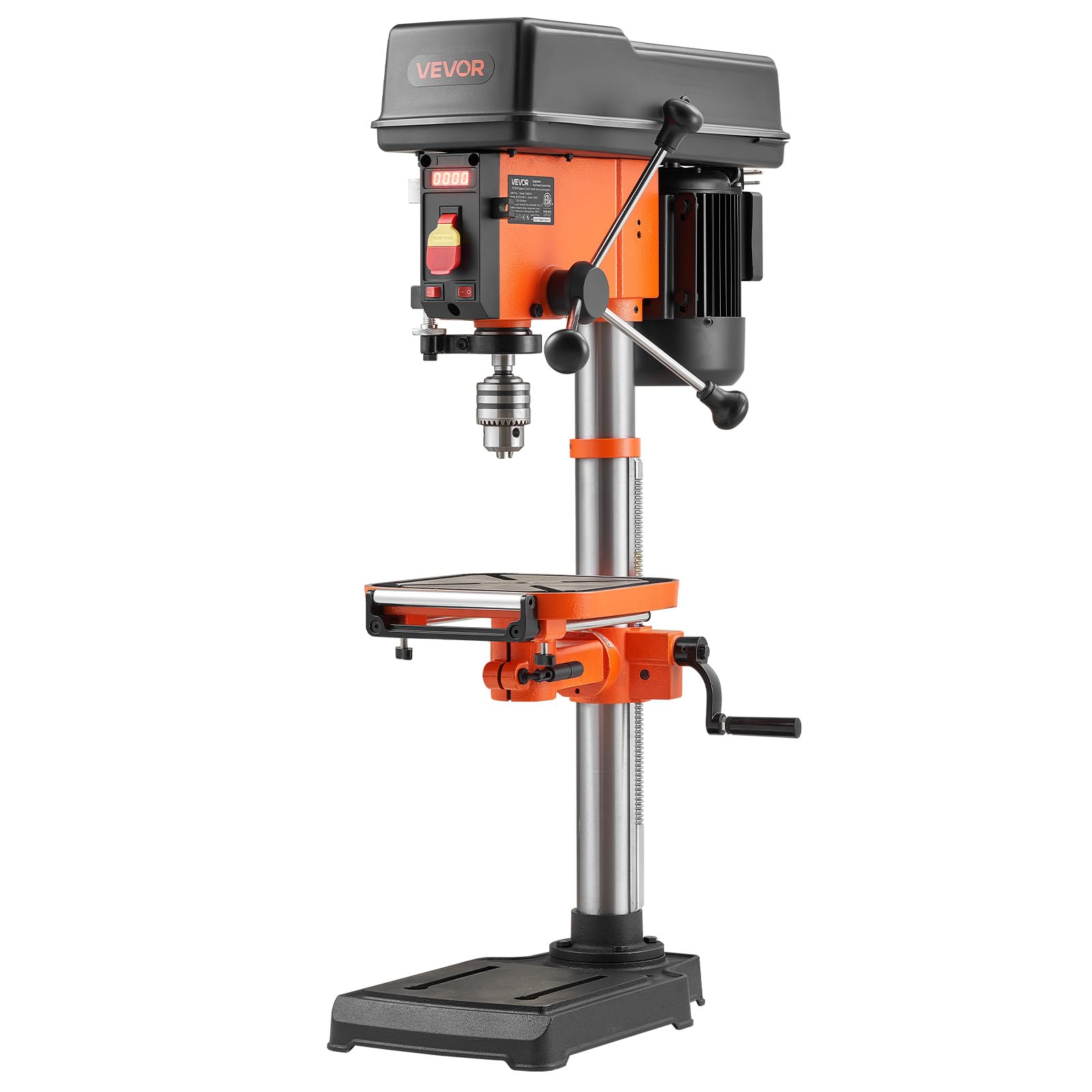
VEVOR 1216BVS 12-Inch Drill Press

88 /100
Kirk Score Excellent
Motor
6.2 A, 1 hp
Swing
12 inches
Speed Range
530–3,140 rpm
Chuck Capacity
0.6 inch
Check Details on Amazon

Pros

  • 1-hp motor with 12-inch swing
  • 530–3,140 rpm variable speed
  • Digital readout with laser and LED
  • Tilting table and keyed chuck

Cons

  • Heavy 84.3-pound build

The 1-hp motor and 12-inch swing are the headline on VEVOR's 1216BVS, and they put it right alongside the Bucktool in size and power. The 6.2-amp motor drives a 530 to 3,140 rpm range with a digital readout, and the press includes a laser guide, LED work light, and a table that tilts to 45 degrees. The 0.6-inch chuck is close to the 5/8-inch size most home shops use.

The table tilts to 45 degrees, the head has a digital readout, and the laser and light are positioned to help with repeat holes. The layout is familiar; if you have used a 12-inch press, you will not need to relearn much.

Where it gives up ground is in the details we could verify. The spindle travel is not specified, so check it against your bit length if deep holes are a priority. The 0.6-inch chuck is close to the 5/8-inch size most home shops use, but it is not identical. Those are small caveats rather than dealbreakers.

We rank the VEVOR 12-inch as a value alternative for a shop that wants 1 hp and a 12-inch swing without premium pricing. The 530–3,140 rpm range, digital readout, and laser are the right features for wood and light metal. The Bucktool remains our default because its spindle travel and table hardware are a known quantity; the VEVOR is worth a look if the feature set fits and you have a permanent bench spot.

Bottom line: The VEVOR 1216BVS is a compelling 1-hp, 12-inch value if you want variable speed and laser guidance at a midrange price, but its 84.3-pound build and unspecified spindle travel make it a second look rather than our default.

Check Latest Price

How We Chose and Tested Benchtop Drill Presses

We started by pulling every benchtop press with a real review base and sorting them by size class, motor amperage, chuck size, spindle travel, whether the table tilts, and how much of the machine is cast iron rather than stamped steel. That cut a long list down to 11 machines we bought ourselves and ran for eight months.

Each got the same first day: out of the box, onto the bench, assembled solo with a stopwatch running so we knew how long it took to get from cardboard to first hole. Bolting the column to the base and squaring the table to the spindle is where these go wrong. We checked runout by chucking a length of drill rod and holding a square against it while the spindle turned, and checked column flex by leaning on the head with the quill fully extended.

Then we drilled: three-quarter-inch bores through pine and oak with Forstner bits, half-inch holes through mild steel with step bits, and repeated stopped-depth holes to see whether the depth stop held between parts. A 2-inch hole saw in oak told us whether the motor bogged or held; we timed speed changes (belt moves versus a dial) and metered noise at ear height. The lasers and work lights got their own test — mark a punch, line up the dot, raise and lower the table, see if it was still on the mark.

Over the months we logged play in the quill, belt glaze, and any drift in the table angle after tilting to 45 degrees and back. By month seven the question was simple: does it still drill where you point it, and did the money buy enough motor, chuck, and table?

How to Choose a Benchtop Drill Press

Start with swing and chuck size

The swing figure is twice the distance from the column to the spindle, so an 8-inch press gives you about 4 inches of reach from the column to the bit; a 12-inch press gives you about 6. Measure from the edge of your widest workpiece to the hole center. If most holes sit within 4 inches of an edge, the compact WEN 4206T makes sense. Cabinet sides, wide jigs, and centered holes need the 12-inch Bucktool or WEN 4214T. A 1/2-inch chuck covers most home bits; step to 5/8 inch if you use larger shanks.

Match power and spindle travel to the work

Amperage is a rough guide, not a guarantee: a 2.3-amp press like the WEN 4206T is fine for wood, pilot holes, and light metal, while the 6.2-amp Bucktool has more reserve for hardwood and steel. Spindle travel matters for deep holes. The Bucktool's 2 inches is shorter than the 3-1/8 inches on the WEN 4214T and JET, so if you drill deep mortises or thick stacked stock, check that figure before you buy. For routine bracket and cabinet work, 2 inches is usually enough.

Choose fixed speeds or variable speed

Five-speed belt drives are the simplest and least expensive way to change speed; you move the belt to one of the fixed steps and get back to drilling. That is fine if you set up for a batch of wood or a batch of metal and stay there. Variable-speed models let you dial from low to high without stopping, which is why the Bucktool and WEN 4214T are easier for mixed materials. The WEN's belt can slip when you push a large bit hard; the JET's lever drive avoids belt changes entirely, at a premium.

Plan the bench around weight and workholding

Benchtop presses run from about 25 pounds to 86 pounds. A light model such as the VEVOR 8-inch is easy to move and store, but it needs a solid bench and a clamped workpiece to feel stable. The 12-inch models are heavy enough to stay put, and the JET is meant to be bolted down. Check the table for a tilting mechanism, a depth stop, and enough slots or T-track to clamp a vise. If you drill long boards, the WEN 4214T's roller extension is a practical alternative to stacking scrap under the far end.

Pay for precision features that earn their keep

A laser crosshair is a positioning aid, not a substitute for a center punch and a test hole. The work light is more consistently useful, especially on a bench under a shelf. A depth stop earns its place for repeat holes, and a digital readout helps when you change speed for different materials. If two presses are close, put the money toward a depth stop, a stable table, and a warranty you can use. The JET's 5-year warranty is the standout here; the budget presses ask you to accept a shorter safety net.

Frequently Asked Questions

Final Verdict

For most home workshops, the Bucktool DP12VL is the drill press to buy: 12 inches of swing, a 3/4-hp motor, and lever-controlled variable speed cover wood and light metal without a belt change. If you change speeds constantly and want a 5-year warranty, the JET JWDP-12 is the premium alternative. If bench space is the constraint, the WEN 4206T is the compact 8-inch press we recommend, as long as your holes sit within about 4 inches of the column.