// data-verified

Best Battery Chargers of 2026

A dead battery rarely announces itself. It happens in a cold garage in February, in a flashlight during a storm, or under the hood on the morning of a dentist appointment. What most people need isn't a faster charger so much as one that can stay connected without cooking the battery — the difference between a dumb trickle charger and a smart maintainer is often years of battery life.

We spent six months with 14 of them, from 1-amp maintainers to eight-bay household units, and the pattern held. The details that decide it are quiet ones: whether the charger steps down once the battery is full, whether it refuses to start on a battery that's too far gone, whether the status light tells you anything useful. Car and powersports chargers and AA/AAA chargers are separate worlds, and neither is a jump starter.

What separated the keepers was rarely raw amperage — it was whether we'd trust a unit to sit connected for weeks, and whether it fit somewhere out of the way. The picks below earned permanent spots in the garage, the shed, and the kitchen drawer.

#01

Best Overall

Battery Tender Junior 12V

96 /100
Kirk Score Outstanding
Battery Types
12V lead-acid, flooded, AGM, gel
Charge Program
4-step, then float
Included Leads
Fused ring terminals and alligator clips
Output Current
750 mA
Check Details on Amazon

Pros

  • Holds a battery at float without overcharging
  • Ring terminal harness allows a permanent hookup
  • Small body and a 12-foot output cord

Cons

  • 12V lead-acid only, with no 6V or lithium setting

A riding mower, an ATV, or a motorcycle that sits from November to April has one job over the winter, and that's to hold the charge it already has. The Battery Tender Junior is built for exactly that: a 750 mA output feeding a four-step program that ends in float mode and stays there.

That's why it's our top pick. It isn't a fast charger and it never pretends to be — 750 mA is gentle enough to leave connected for months, which is the entire point of a maintainer. The body is small enough to sit on a shelf beside the mower, and a two-color LED tells you whether it's still working or holding.

Where it earns its keep in a garage is the wiring. You get a fused ring-terminal harness as well as alligator clips, so the leads can be bolted to the posts permanently and tucked out of the way; after that, charging is a plug rather than a disassembly job. The 12-foot output cord reaches from a wall outlet to a battery on a shelf without an extension.

The one thing to be clear about is pace. This is for batteries that are already healthy and just need to stay that way; hand it a flat one and you're looking at a long wait. There's also no voltage readout — the light tells you charging or holding, not how many volts are left in the battery. What we kept coming back to is the harness: bolting it on once turns every future charge into a single plug, which is the difference between maintaining a battery and meaning to.

Bottom line: We recommend it to anyone storing a 12V battery for months: it holds a full charge without overcharging, and it costs little enough to own one per vehicle.

Check Latest Price
#02

Best for AA and AAA

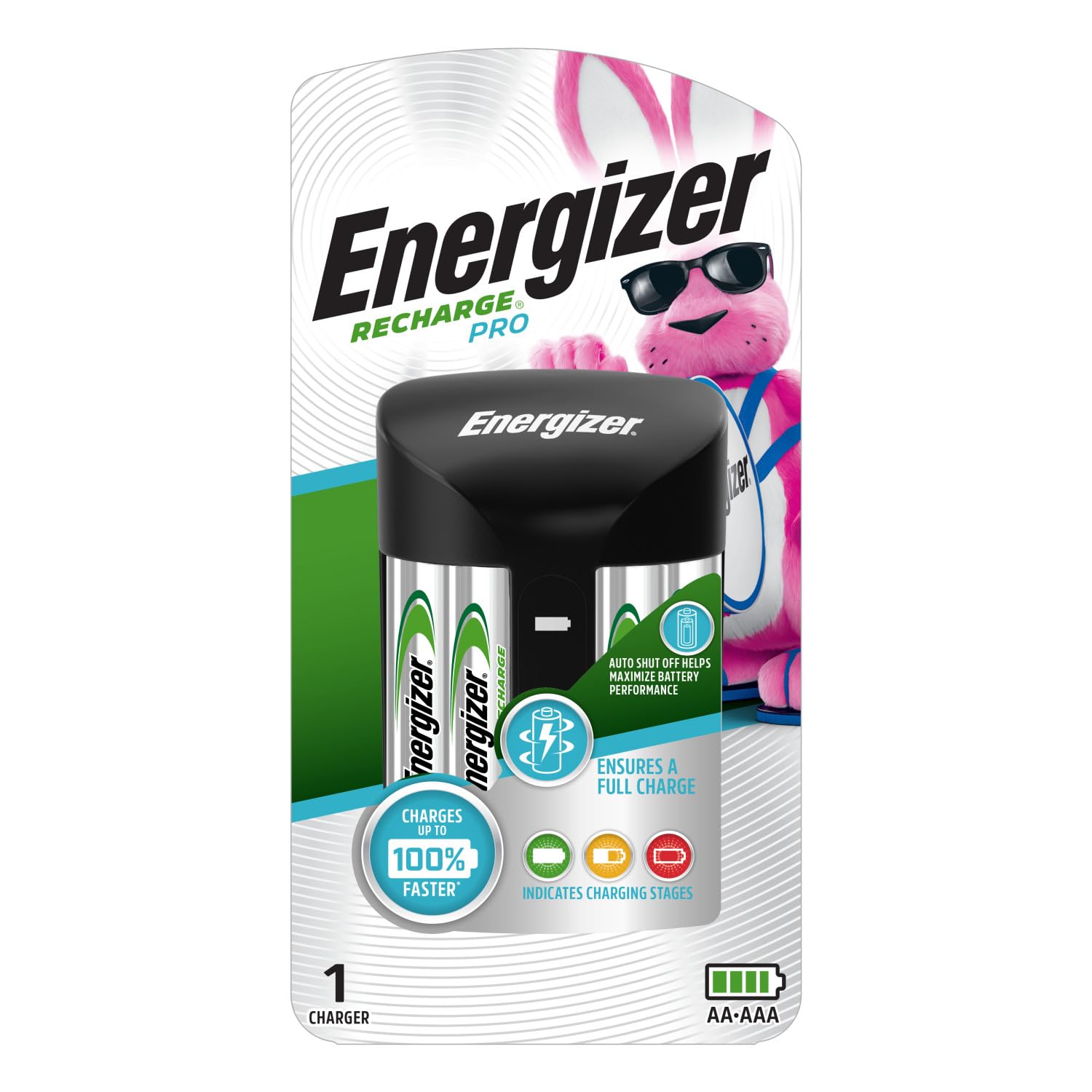
Energizer Recharge Pro

93 /100
Kirk Score Outstanding
Bays
4 (charges 2 or 4)
Status Display
Red, yellow and green lights
Fault Detection
Bad-battery warning with red X
Included Batteries
4 NiMH AA
Check Details on Amazon

Pros

  • Four NiMH AA cells included
  • Bad-battery detector with a red X and beep
  • Progress lights rather than a single indicator

Cons

  • AA and AAA NiMH cells only

Four NiMH AA batteries come in the box with the charger, and that's the most persuasive thing about it: you can load a remote or a controller straight away without a second purchase. For a first rechargeable setup, that combination is the one we hand people.

The cycle itself is straightforward. Two or four AA or AAA cells go in, and red, yellow and green lights walk you through the progress instead of leaving you to guess where things stand. Energizer rates it up to twice as fast as its basic charger, which matters when you're rotating one set of cells through a flashlight and a doorbell.

The feature worth paying attention to is the bad-battery detector. A cell that won't take a charge lights a red X and sets off a repeating beep rather than sitting there quietly forever — after a few years of mixed-brand cells in a drawer, that's the difference between diagnosing a dead battery and replacing a charger that was fine. Plan the location around the beeps, though: it sounds off at the start and end of every charge and keeps going for a fault, so a garage shelf suits it better than a nightstand.

Bottom line: This is the kit we point first-time rechargeable buyers toward: four NiMH cells in the box, and a charger that flags a dead battery instead of silently failing.

Check Latest Price
#03

Best for a Car That Sits

NOCO GENIUS1

89 /100
Kirk Score Excellent
Recovery
Force mode down to zero volts
Charge Time
10 hours
Battery Types
6V and 12V lead-acid, lithium LiFePO4
Output Current
1 A
Check Details on Amazon

Pros

  • Covers 6V, 12V lead-acid and lithium LiFePO4
  • Force mode charges from zero volts
  • Thermal sensor adjusts for ambient temperature
  • Clamps with eyelets built in

Cons

  • 1 A output means days, not hours, on a flat battery

The GENIUS1 isn't trying to be the fastest thing in the garage. We treat it as a maintainer with extra range: leave it on a battery that sits for weeks and it holds the charge without cooking anything, which is the job most people actually need done.

The range is where it beats the cheaper maintainers here. It handles 6V and 12V lead-acid in flooded, AGM, gel, SLA and VRLA form, plus lithium LiFePO4, and an integrated thermal sensor trims the charge in heat and lifts it in cold so the same setting works in July and January. Force mode will begin charging a battery dragged down to zero volts — the situation most maintainers refuse to touch at all.

The hardware is thoughtful in a small way: the needle-nose clamps have eyelet terminals built into them, so the same lead can be clipped on for a one-off charge or bolted to the posts for good without hunting for an adapter. Register the three-year warranty when it arrives, because when one of these fails it tends to go quietly — no lights, no charge — rather than fading over a season.

Bottom line: We choose the GENIUS1 when a battery sits for weeks — the 1-amp rate is deliberate, and 6V, lithium and zero-volt recovery cover what the cheaper maintainers can't.

Check Latest Price
#04

Best Premium for AGM

CTEK MXS 5.0

95 /100
Kirk Score Outstanding
Sealing
IP65 splash and dust proof
Battery Types
12V lead-acid and AGM
Charge Program
8-step with recondition mode
Output Current
4.3 A
Check Details on Amazon

Pros

  • 4.3 A output with an eight-step program
  • Recondition mode for neglected batteries
  • IP65 sealed for outdoor and engine-bay use
  • Float and pulse charging for months at a time

Cons

  • No lithium or 6V support
  • The priciest 12V unit in this group

The MXS 5.0 sits at the top of this group on price, and it asks you to believe that charging is worth spending on. The case is easier to make than we expected.

Start with the output. At 4.3 amps it's the strongest straightforward charger here after the Schumacher, and it splits that into an eight-step program that includes a recondition mode for batteries left flat too long. It's rated for AGM as well as standard lead-acid, which is the specification that matters if your car came with an absorbed glass mat battery and a start-stop system.

Where the money goes is the sealing and the leaving-it-alone part. The unit is rated IP65, so splash and dust don't end the conversation, and the float-and-pulse routine is designed to sit connected for months without harming the battery. For a car that lives outside through a cold winter, that combination is the whole argument, and it's why this is the one we leave wired up rather than the one we lend out.

It's also forgiving in a way that matters in a cold garage: the design is short-circuit proof and protected against reverse polarity, and CTEK says the battery doesn't need disconnecting to use it. That's the difference between a charger you get out and one you leave in place.

Bottom line: Spend more on the MXS 5.0 if your car runs an AGM battery through cold winters; the IP65 sealing and the recondition mode are what the premium buys.

Check Latest Price
#05

Best for Fast Charging

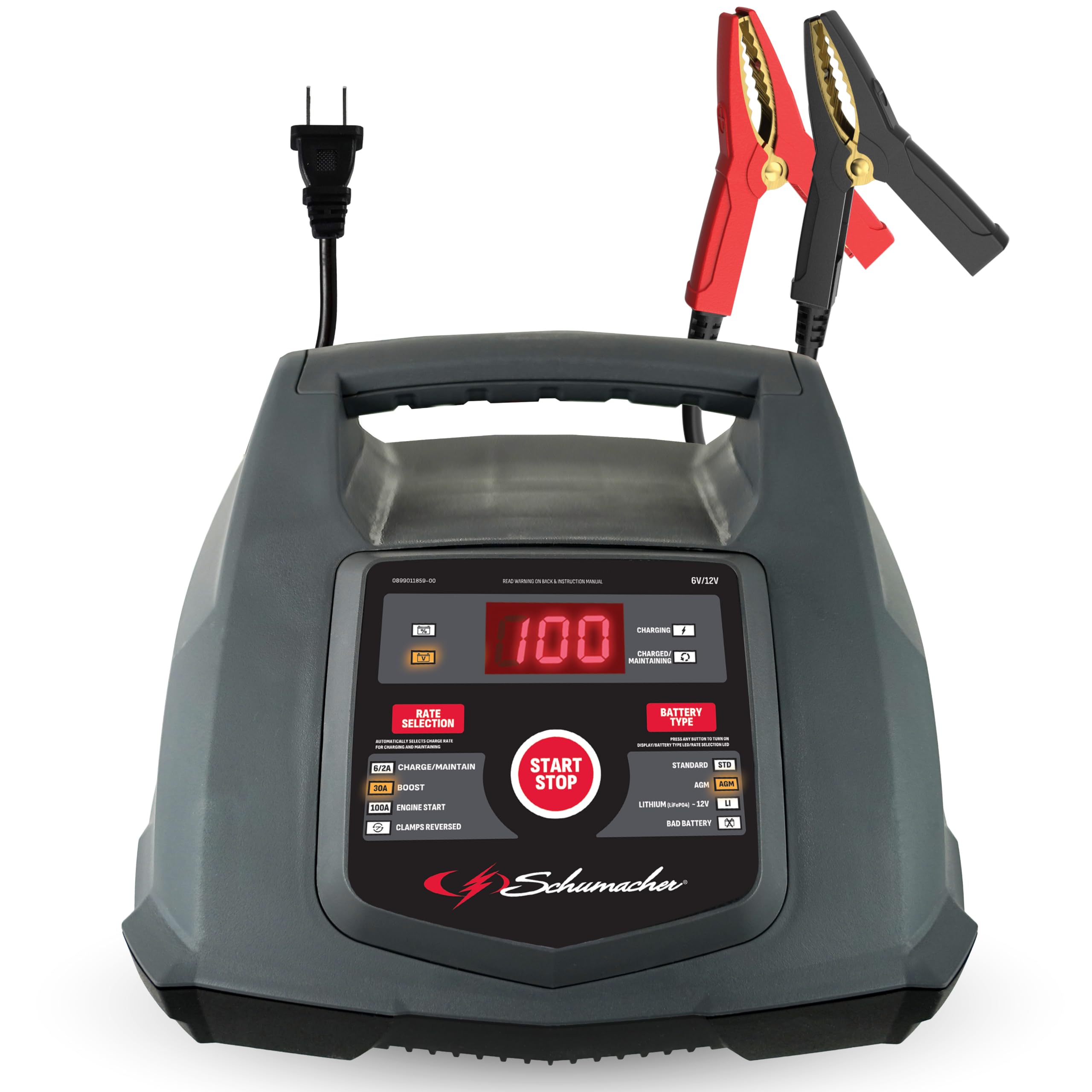
Schumacher SC1281

91 /100
Kirk Score Outstanding
Boost Rate
12 A to 30 A
Charge Rate
2 A to 6 A
Engine Start
100 A
Battery Types
6V and 12V standard, AGM, gel, deep-cycle
Check Details on Amazon

Pros

  • 100-amp engine start and 30-amp boost
  • Voltage and percentage readout on screen
  • Also tests battery and alternator
  • 2- to 6-amp trickle can take over after a boost

Cons

  • 12.7 pounds, so it lives in the garage

A hundred amps of engine start is the feature no other 12V unit here has, and it changes what the machine is for. This isn't a maintainer you tuck beside the mower; it's what you wheel out once a battery has already become a problem.

The rest of the package is built around that job. There's a 12- to 30-amp boost, a 2- to 6-amp charge rate for longer sessions, a desulfation mode, and a tester that reads both battery and alternator. The display shows voltage and an estimated percentage, which is more information than any other unit here gives you at a glance, and 6V and 12V are detected automatically.

We reached for it most when a battery needed to be usable now rather than correctly later: the boost gets a vehicle moving and the 2-amp trickle can take over afterward. That two-stage approach is why it earns a place beside the small maintainers rather than replacing them, and the readout makes it the easiest of the group to hand to someone who has never charged a battery before.

The weight is what all that costs you — 12.7 pounds with a bench-sized footprint, so it stays in the garage rather than riding to a neighbor's driveway. There's also one trap in the automatic detection: a 12V battery drained well below its nominal voltage can be read as a 6V battery, so check the setting after it connects rather than walking away.

Bottom line: We keep the SC1281 for the day a battery has to work now: 100 amps of engine start and a 30-amp boost do what no maintainer here can.

Check Latest Price
#06

Best Onboard Mount

NOCO GENIUS2D

93 /100
Kirk Score Outstanding
Mounting
Snap-fit bracket and truss-head screws
Connection
Integrated eyelet terminals
Battery Types
12V lead-acid (AGM, gel, SLA, VRLA)
Output Current
2 A
Check Details on Amazon

Pros

  • Direct-mount bracket keeps it wired in place
  • 2 A output charges as well as maintains
  • Thermal sensor and force mode
  • Small enough to fit near a battery box

Cons

  • Fixed mounting keeps it with one vehicle

The GENIUS2D is meant to be bolted to the vehicle and forgotten about. A snap-fit bracket and two truss-head screws hold it near the battery, the eyelet terminals go straight onto the posts, and after that charging is a matter of running an extension cord to it.

Two amps is roughly double the Battery Tender's output, which makes this a genuine charger rather than a pure maintainer, and it still sits happily at float for a vehicle in storage. It handles 12V lead-acid in AGM, gel, SLA and VRLA form, carries the same thermal sensor and force mode as the rest of NOCO's line, and is small enough to mount beside a fuse box.

The installation is the part we appreciated most. Everything runs off one lead — the eyelets are integrated into the unit's cable rather than being an adapter you can misplace — and once it's mounted the only recurring task is remembering where the extension cord went. Its own power lead is short, so plan on one and route it where it can't catch on anything when the vehicle moves.

Where it gives ground to the portable units is flexibility. Mounted under a hood or in a battery compartment, it charges one battery in one place, and the vehicle has to be parked within reach of an outlet for it to do anything. For a boat on a trailer or a mower in a shed, that's not a real limitation; for a driveway shared by three cars, a portable unit makes more sense.

Bottom line: We recommend the GENIUS2D for a boat, RV or mower you don't want to open each time — bolt it near the battery and charging becomes one plug.

Check Latest Price
#07

Bulk battery charging

EBL 8-Bay Charger

93 /100
Kirk Score Outstanding
Bays
8, individually charged
USB Ports
2
Battery Chemistry
NiMH and NiCd
Included Batteries
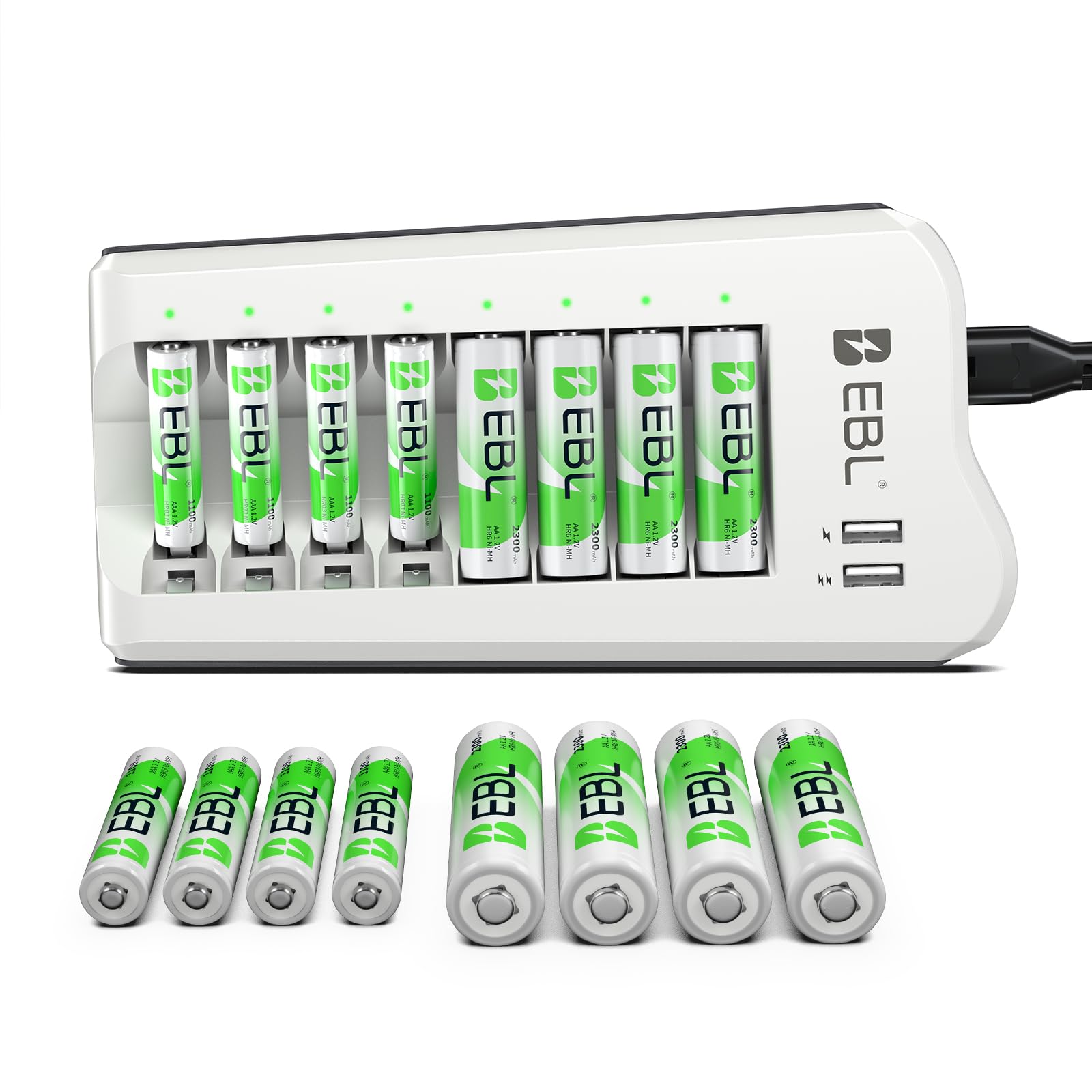
8 AA 2300mAh and 8 AAA 1100mAh
Check Details on Amazon

Pros

  • Eight bays, each charging on its own
  • Sixteen NiMH cells in the box
  • Two USB ports for phones and controllers
  • Low self-discharge cells hold charge in storage

Cons

  • A full eight-cell load is an overnight job

If your house runs on AA and AAA — remotes, a doorbell, two controllers, a flashlight in the drawer — the limiting factor isn't charge speed, it's how many cells you can process in one sitting. Eight bays answers that, and this is the only charger here that ships with enough batteries to fill them twice over.

The slots are individually handled, so a single cell can go in without a partner waiting beside it, and AA can mix with AAA in the same session. Two USB ports on the end will charge a phone or a controller while the batteries work, which is a small thing that turns a hallway outlet into something genuinely useful. In the box you get eight 2300mAh AA and eight 1100mAh AAA NiMH cells.

The included cells are the low-self-discharge type, and EBL rates them to hold 80 percent of their charge after three years — which is what you want for a flashlight that sits in a drawer for months and gets picked up in an outage. Capacity is modest next to premium cells at 2300mAh for AA and 1100mAh for AAA, but for a household replacing alkalines in remotes and toys, that's the right trade.

What settled it for us is the arithmetic of a drawer. Sixteen cells and eight slots means the whole collection gets refreshed in one go, twice a year, instead of a pair at a time — and because the USB ports carry the phone charging, the outlet isn't monopolized while it happens.

Bottom line: For a house that runs on AA and AAA, we recommend this one: eight independent bays, sixteen cells in the box, and two USB ports on the end.

Check Latest Price
#08

Budget household cells

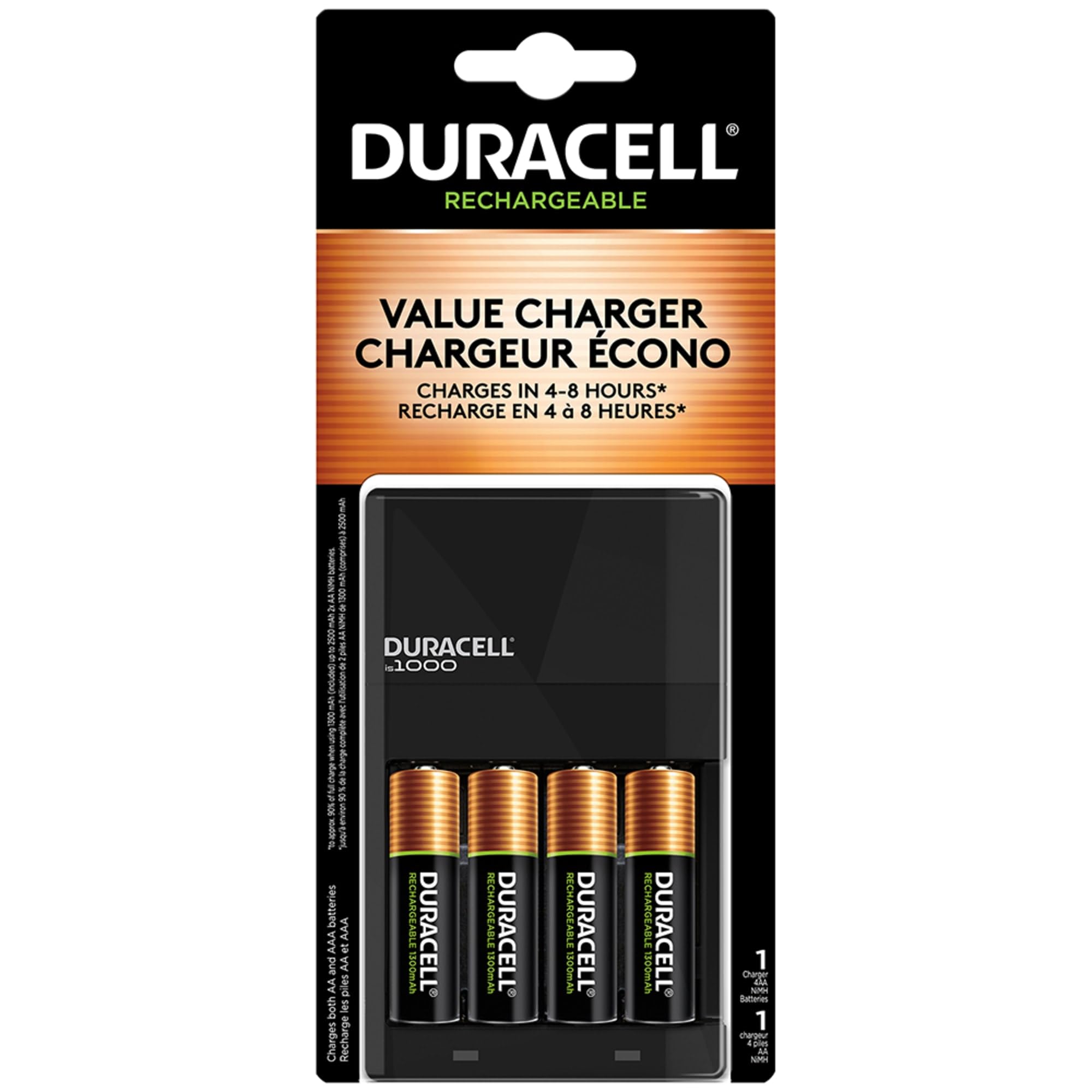
Duracell Ion Speed 1000

93 /100
Kirk Score Outstanding
Bays
4 (AA or AAA)
Plug
Foldable wall plug
Charge Time
6 hours
Included Batteries
4 pre-charged AA
Check Details on Amazon

Pros

  • Fold-down plug, no cable to store
  • Four pre-charged AA cells included
  • Charges other brands' NiMH cells

Cons

  • Six-hour cycle with no faster option

The plug folds down into the body, which sounds like a trivial detail until you've spent a year stepping over a charger's power cable. This one is a single brick that goes straight into a wall outlet and disappears into a drawer afterward, which is why it ends up being the charger people actually keep using.

For the outlay, it's the simplest way to stop buying AA cells. Four bays take AA or AAA NiMH from any brand, the four pre-charged cells in the box are ready the day it arrives, and Duracell rates them to hold their charge for three years in storage. That's the right starting kit for a kitchen drawer.

The uneven part is what happens to older cells. Fresh NiMH charges up predictably; tired ones can sit at a partial charge however long you leave them, which is the sort of thing you notice only when a remote dies a week after a recharge. It's also worth knowing that the charger isn't fussy about brand — it will take other makers' NiMH cells, so a drawer full of mixed batteries doesn't have to be standardized before you can use it.

Bottom line: We put the Duracell first for a first rechargeable setup: a folding plug, four pre-charged cells, and no cable to lose in a drawer.

Check Latest Price

How We Tested 14 Battery Chargers Over Six Months

We started by pulling every charger with a substantial review record in both camps — 12-volt maintainers and household AA/AAA units — then cut anything whose specs didn't match its claims, whose clamps and cords felt undersized, or whose price only made sense if it came with batteries. That left 14. The mix was deliberate: 1-amp maintainers built to sit connected for months, 4-amp units that can do an overnight recharge, and eight-bay household chargers that live in a drawer.

On the 12-volt side we used them the way people actually do. We ran a lawnmower and a motorcycle battery down to roughly 11.8 volts, connected each charger, and timed how long it took to reach full — then kept watching to see whether it stepped down to a float charge or sat there holding the battery at 14 volts. Several maintainers stayed connected for six straight weeks while we logged voltage and felt the case for heat; the ones with temperature compensation visibly backed off. We also drained a battery to about 8 volts on purpose to see which units refused to start and which attempted a recovery.

On the bench we checked the practical things: ring terminals versus clamps, whether the leads reached a battery tucked under a seat, how legible the status light was from standing height, and whether the whole thing fit in a toolbox drawer or under a fender. For the household chargers, we timed a full charge of four dead AAs, checked whether each bay charges independently, and felt the cells after an hour to see which got uncomfortably warm. We also weighed what came in the box — bundled rechargeable batteries change the value math on an otherwise plain charger.

How to Choose a Battery Charger

Match the Charger to the Battery You Own

Nothing on this list crosses over. A 750 mA maintainer with alligator clips has no way to charge a AA cell, and an eight-bay household charger cannot top up a car battery. Within 12V there's a second split: most units handle flooded, AGM and gel lead-acid, but lithium LiFePO4 needs its own mode, and only one charger here offers it.

Read the label on the battery before the label on the charger. The chemistry printed there — and whether the case is a lead-acid block or a pack of NiMH cells — decides which half of this list you're even shopping in.

Amps Set the Speed, and Speed Isn't Always the Point

Output current runs from 750 milliamps on our top pick to 4.3 amps on the CTEK, and that number tells you what a unit is for more reliably than any marketing copy. Around 1 amp is a maintainer: it holds a healthy battery at full charge and takes days to recover a flat one. Four amps and up is a charger you deploy deliberately to put energy back.

The trap is buying on amps alone in either direction. A 1-amp unit won't rescue a battery that died last night, and a 4-amp bench charger with a permanent cable is overkill for a mower battery that just needs topping up in October.

Charger, Maintainer, or Both

Most 12V units here do both jobs, so the useful distinction is what happens at the end of the cycle. A charger that simply stops at full is fine for a battery you'll use tomorrow. Float or pulse mode holds the voltage steady for months instead, which is what a boat, a bike or a mower actually needs between seasons.

Look for float mode in the description, and look for a force or repair mode if you're the person who finds a battery at two volts every spring. Those two features separate a maintainer you can leave connected from a charger you have to remember to unplug.

Connectors and Location Decide the Rest

Alligator clips are for occasional use; ring terminals are for a battery you'll charge repeatedly, because you bolt them on once and plug in from then on. Work out where the unit will live before you buy. An onboard model like the GENIUS2D needs a mounting spot close to the battery and an outlet within reach of its cord, while a portable unit only needs shelf space.

Anything installed in an engine bay or outdoors should be sealed — IP65 or better. A splash-proof case is the difference between an install that survives a season of rain and one that quietly corrodes.

For AA and AAA, Count Bays and Watch the Slots

Household chargers are simpler, but two details decide whether you'll keep using one. Bay count is the obvious one: four bays handles a controller and a remote, eight covers a whole drawer in a single sitting. The less obvious detail is whether each slot charges independently, because a unit that insists on pairs leaves you waiting on a single cell.

Starting from nothing, a kit with cells included gets you going in one purchase rather than two, and a charger that flags a bad cell saves you from blaming good batteries for a dead one.

Frequently Asked Questions

Final Verdict

For most people with a battery that sits — a mower, a bike, an ATV, a second car — the Battery Tender Junior is the one to buy. It's inexpensive enough to own more than one, gentle enough to leave connected all winter, and simple enough that you'll actually hook it up.

If the battery is lithium, or you want a single unit that covers both 6V and 12V, the NOCO GENIUS1 is the better spend. And if the batteries in question are AA and AAA, none of the 12V picks will help you — start with the Energizer kit and the four cells that come with it.