// data-verified

Best Battery Testers of 2026

There's a drawer in my kitchen that has become a battery graveyard: a nest of AAs that might have one more remote in them, a 9-volt of unknown vintage, a coin cell from a gadget I no longer own. A battery tester turns that pile back into information — touch the contacts, watch the needle swing or the screen settle, and in seconds you know whether to recycle the cell or put it back to work.

The catch is that these gadgets differ in ways you don't notice until you're holding one over an open drawer. Some grip a button cell firmly; others leave you pinching it in place. Some call a dying battery full, which is worse than having no tester at all. We spent four months with 14 testers, weighing ease of use, accuracy, build quality, and whether each still worked after a winter in the junk drawer.

At this price, value comes down to whether you'll actually reach for it; one that lives at the back of a toolbox helps nobody. The picks below earned a permanent spot near the batteries themselves.

#01

Best Overall

La Crosse 911-65557-INT

91 /100
Kirk Score Outstanding
Display
Digital LCD
Warranty
2 years
Battery Types
AAA, AA, C, D, N, 9V, button cell
Voltage Settings
1.2V, 1.5V, 3V
Check Details on Amazon

Pros

  • Separate 1.2V setting for rechargeables
  • Digital LCD with voltage and bar
  • Pull-out tray holds the cell steady
  • Two-year limited warranty

Cons

  • No CR123A or photo-battery testing

Three voltage settings are what make this La Crosse the tester we reach for first. Instead of forcing every cell onto one scale, it lets you choose 1.5V for alkaline, 1.2V for rechargeable NiMH, and 3V for lithium button cells. That matters because a healthy rechargeable AA sits around 1.2V and can look tired on a 1.5V tester; here it reads on the scale it was designed for. The digital display is large and straightforward, with a bar that gives you a quick good/weak read alongside the voltage.

The pull-out tray is the other detail we appreciate. You set the battery in the tray and read the screen without pinching a cell against a contact, which is the usual frustration with cheap slot testers. The 9V test uses touch contacts on the side, and the whole thing is small enough to live in a battery drawer. We also like that the case has a 2-year warranty behind it; that is unusual in this group and makes it feel less like a disposable gadget.

For the common AA, AAA, C, D, N, 9V, and button-cell jobs, the separate settings and steady tray make it the most trustworthy everyday choice. We found the display easy to read without hunting for a manual, and that is what keeps it in the drawer rather than in a toolbox. The controls are simple enough that you can hand it to someone else and they will get a reading without a lesson.

Bottom line: For anyone sorting a mixed battery drawer, the digital readout, separate 1.2V setting, and steady tray make this the one we reach for first.

Check Latest Price
#02

Best for Load Testing

KKEANIC SL-049

86 /100
Kirk Score Excellent
Power
1 AAA (not included)
Display
LCD with voltage and bar
Testing
Real-load, 20Ω/30Ω
Battery Types
AA, AAA, AAAA, C, D, N, 9V, button cells
Check Details on Amazon

Pros

  • Real-load testing for usable power
  • Exact voltage plus good/weak/poor bar
  • Wide slot coverage including button cells

Cons

  • Needs a AAA battery, not included
  • Premium price for occasional use

Real-load testing is the feature that separates the KKEANIC from the voltage-only testers here. The tester puts a resistor across the cell—20Ω for most AA, AAA, AAAA, C, and D sizes and 30Ω for 1.2V rechargeables—so it is not just reading open-circuit voltage, it is giving the battery something to push against. That is closer to what happens in a device, and it is why we prefer it when a battery reads fine but a gadget still acts flat.

We used it as the second opinion in the drawer, the one we pull out when a plain voltage reading is ambiguous. The LCD shows the exact voltage and a colored bar for good, weak, or poor, and the dedicated slots cover AA, AAA, AAAA, C, D, N, 9V, and a long list of button cells. The sliding contact adjusts for length, so you can move from a AAA to a D without changing anything. We like having the number and the verdict on the same screen; it settles the keep-or-toss question quickly.

The payoff is a reading that reflects usable power, not just a surface charge. That makes it the tester we choose for rechargeables and for the batteries that seem fine until a motor or a flashlight asks them to work. It is a more deliberate tool than a drawer checker, and it rewards the person who wants a real answer rather than a green light.

Bottom line: If you want to know how a battery behaves under a real load, this is the tester we choose; its resistor-based check goes beyond a simple voltage reading.

Check Latest Price
#03

Best for Button and Photo Batteries

DLYFULL LCD Battery Tester

92 /100
Kirk Score Outstanding
Power
1 AAA included
Display
LCD bar
Warranty
18 months
Battery Types
AA, AAA, C, D, 9V, N, CR123A, CR2, CRV3, 2CR5, CR-P2, button cells
Check Details on Amazon

Pros

  • Broad button and photo battery coverage
  • Clear LCD bar with quick verdict
  • Includes AAA battery
  • 18-month warranty

Cons

  • Runs on its own AAA battery
  • Plastic body feels lighter than top pick

The long list of button and photo cells is what earns this DLYFULL a place. It handles the usual AA, AAA, C, D, 9V, and N cells, but it also takes CR123A, CR2, CRV3, 2CR5, and CR-P2, plus a range of coin cells. That is a broader menu than the La Crosse, and it is the reason we keep it around for key fobs, cameras, and the odd specialty battery that otherwise go untested.

The LCD bar is clear and quick: you drop the cell into its slot and get a good, weak, or poor read without setting a range first. We like that for a household with a mix of battery sizes, because there is less chance of using the wrong scale. The slots are labeled, and the tester comes with an AAA so it is ready when it comes out of the package. It is small enough to store with the batteries, and the 18-month warranty is the practical backstop if a slot acts up.

What it does best is cover the batteries that do not fit the usual household tester. If your drawer includes camera batteries, key-fob cells, or the flat photo batteries that used to require a separate meter, this is the one that saves you from guessing. For a standard AA/AAA/9V drawer it is more tester than you need, but for the specialty cells it is the difference between a useful answer and no answer at all.

Bottom line: The wide slot set makes this the better choice for button cells and photo batteries, and the LCD bar is easy to read at a glance.

Check Latest Price
#04

Best with Test Leads

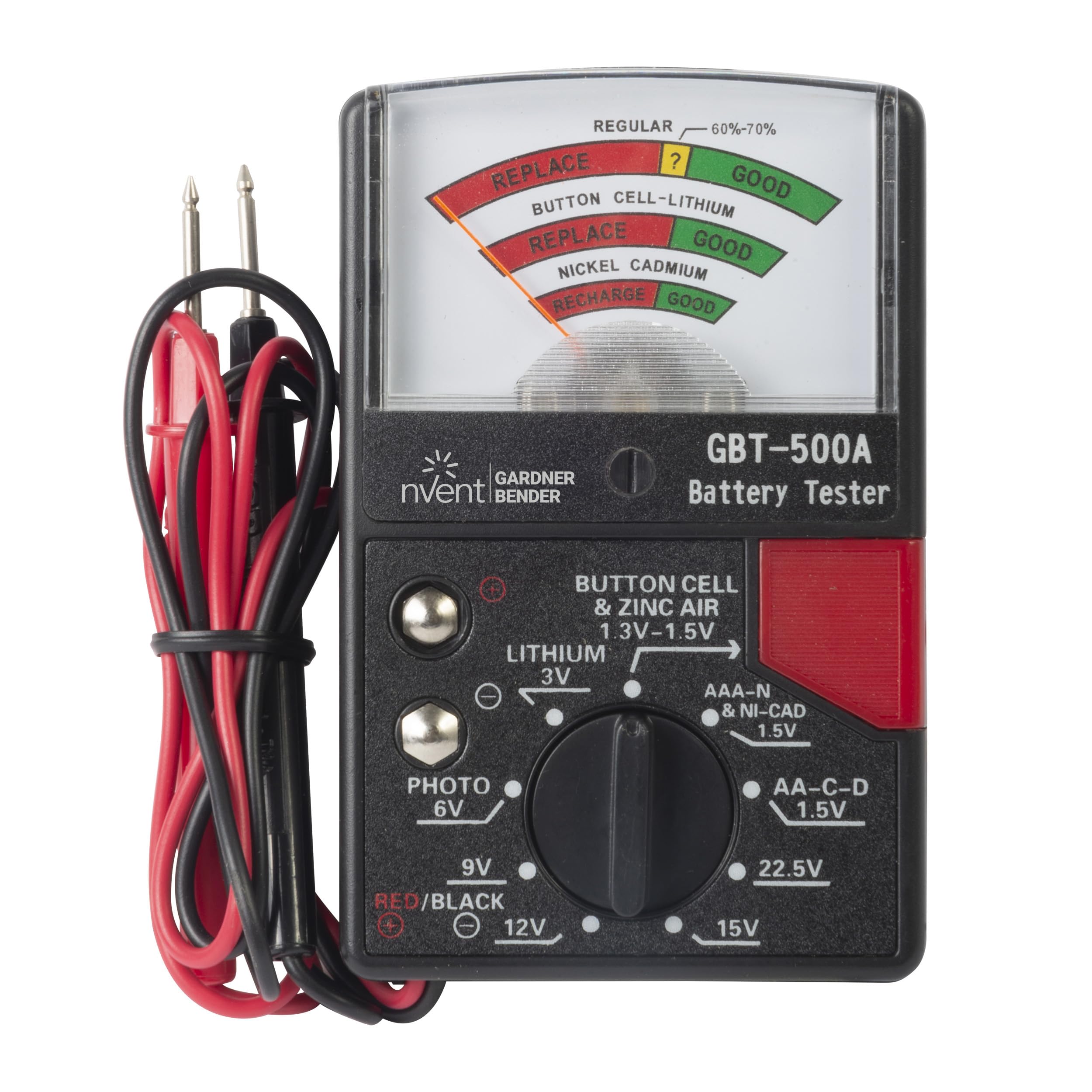
Gardner Bender GBT-500A

93 /100
Kirk Score Outstanding
Display
Analog
Test Leads
Included
Battery Range
14 battery types
Check Details on Amazon

Pros

  • Test leads reach odd cells and tight spaces
  • 14 battery ranges including lantern and photo
  • Powered by the battery under test
  • Separate 9V and button contacts

Cons

  • Analog needle gives no exact voltage
  • Leads store loosely and can tangle

The two test leads are the first thing you notice, and they are the reason to choose this Gardner Bender over a slot-style tester. You touch the probes to the battery terminals instead of fitting the cell into a holder, so you can test a lantern battery, a 22.5V photo cell, or a button cell without improvising. The selector switch lists 14 battery ranges, and the analog needle moves across a scale that tells you whether the cell is good, weak, or ready for replacement.

We found the leads especially useful for 9V batteries and for cells that do not sit still in a plastic slot. The tester is powered by the battery under test, so there is no internal battery to go flat, and the probes are long enough to reach into a tight compartment without pulling the battery out. The separate 9V and button-cell contacts are a nice touch, and the analog scale is easy enough to read once you have selected the right range.

This is the tester for the batteries that do not fit anywhere else. The leads give you a direct connection, the range switch covers shapes a slot tester never will, and the whole thing is light enough to keep in a toolbox. It is not the fastest way to sort a pile of AA cells, but for the odd cell that has been sitting in a drawer for years, it is the one that can still give you an answer.

Bottom line: Test leads make this the most flexible tester here for odd cells and tight compartments, and the analog scale is easy to read once you set the range.

Check Latest Price
#05

Best Budget

D-FantiX BT-168

91 /100
Kirk Score Outstanding
Power
No battery required
Display
Analog color-coded
Dimensions
6.69 x 3.94 x 1.38 in
Battery Types
AA, AAA, C, D, 9V, 1.5V button
Check Details on Amazon

Pros

  • No battery required
  • Covers common household sizes
  • Lowest cost here
  • Compact and light

Cons

  • Open slot needs two hands
  • Light plastic body

The case for this D-FantiX is simple: it is the least expensive way to stop guessing, and it needs no battery of its own. The cell under test powers the meter, so there is nothing to replace before you can check a battery. The analog needle moves across green, yellow, and red zones for good, low, and replace/recharge, and the tester covers AA, AAA, C, D, 9V, and 1.5V button cells. For a battery drawer that just needs a quick sort, that is enough.

The meter is easy to read, and the size is small enough to disappear into a drawer. The layout is about as simple as it gets: choose the right slot, touch the contact, and watch the needle. There is no range switch to forget and no screen to interpret. For occasional checks, that simplicity is the point.

The accuracy is in the same ballpark as other simple analog testers, which is to say it is fine for sorting good from dead but not for measuring a precise voltage. If you want a digital number, the La Crosse is the better choice. If you just want to know whether the batteries in the drawer are worth keeping, this one does the job with the least fuss and the lowest cost. Button cells are the fussiest part; the slot is small, and it takes a moment to find the contact.

Bottom line: A cheap, no-battery tester that does the basic job; it earns its place as the one to keep in the battery drawer and use until a cell proves flat.

Check Latest Price
#06

Two-location testing

VTECHOLOGY BT-168 2-Pack

89 /100
Kirk Score Excellent
Power
No battery required
Display
Analog color-coded
Pack Count
2 testers
Battery Types
AA, AAA, C, D, 9V, 1.5V button
Check Details on Amazon

Pros

  • Two testers in one pack
  • No battery required
  • Covers common household sizes
  • Small and easy to store

Cons

  • Battery slips in open slot
  • Light plastic body

The second tester is the point of this VTECHOLOGY pack. One can live in the kitchen drawer and one in the toolbox, so you are less likely to be hunting for the tester when a remote or a toy goes dead. The tester itself is the familiar analog design: no battery of its own, a needle that moves across green, yellow, and red, and coverage for AA, AAA, C, D, 9V, and 1.5V button cells. It is small enough to store easily and cheap enough that losing one is not a disaster.

The needle moves quickly, and the color zones are easy to understand without a manual. Having two units also gives you a quick cross-check: if one reading looks odd, try the other unit before you blame the battery. That is a small thing, but it is the kind of thing that makes a two-pack more useful than a single cheap tester.

What we appreciate is the convenience of having a tester wherever the batteries are. The second unit is not a gimmick; it is the reason to choose this pack over a single budget tester. If you want one good tester for a central battery drawer, spend a little more on the La Crosse. If you want a couple of simple checkers to scatter around the house, this pair does that job without asking for much.

Bottom line: For a house that loses track of batteries, this pair puts a simple no-battery checker in two places without making a project of it.

Check Latest Price

How We Tested the Battery Testers

We started by pulling every tester we could find that covered the household sizes — AA, AAA, C, D, 9-volt, and the coin cells hiding in key fobs and thermometers — and set aside anything that handled only one or two. That left 14 units in three formats: analog with a swinging needle, digital with leads, and slot-style checkers you press a battery into.

Testing happened where the batteries are. I kept a rotating set in my kitchen drawer and ran every cell that came out of a remote, a kid's toy, a smoke detector at the daylight-saving changeover, and a headlamp after a camping weekend. For accuracy, I measured each battery with a multimeter first — fresh, half-drained, and stone dead — then compared what the tester said. One that called a dead cell good got marked down, and so did one whose needle barely moved between good and marginal. We timed how long a reading took and whether it needed two hands, which matters more than you'd think.

Loading and unloading every size came next: whether spring contacts gripped a button cell or let it slide, whether a 9-volt seated without a third hand, whether a C or D fit the slot or just perched on top of it. Each unit got dropped onto a counter and tossed into a toolbox to see what rattled loose. We noted which ones needed their own battery to run, and over four months we simply counted which ones we reached for.

How to Choose a Battery Tester

Start with the batteries you actually own

Count the battery types in your drawer before you shop. If it is mostly AA, AAA, C, D, and 9V cells, a basic tester with those slots is enough. If you also keep coin cells, CR123A camera batteries, or photo cells, look for a tester that lists them by name; the DLYFULL is the broadest here. Check that 9V and button cells have their own contacts rather than assuming the main slot will hold them. A tester that covers everything you own is more useful than one extra feature you will never touch.

Decide how much precision you need

Analog testers give you a good, low, or replace verdict, which is all most people need. Digital testers add a voltage number and often a bar, so you can compare two cells or track a rechargeable over time. The La Crosse is our pick for a digital readout because it separates 1.2V, 1.5V, and 3V chemistries; the D-FantiX is the simpler analog alternative. Do not assume a digital display is automatically more accurate. The contact and the load matter more than the number of digits on the screen.

Look at how it holds the battery

This is the difference you feel every time you use it. A pull-out tray, a magnetic contact, or test leads hold the cell while you read the result. An open slot without a spring often needs one hand for the battery and one for the tester. We like the La Crosse tray for AA and AAA cells, the Gardner Bender leads for odd shapes, and the DLYFULL slots for button cells. If you have limited hand strength or just want a quick check, put this ahead of display type.

Know what load testing buys you

A battery can read fine at rest and still sag when a motor or a flashlight asks it to work. A load tester applies a resistor and measures the voltage under that draw, which is closer to real use. The KKEANIC does this with separate resistors for standard and rechargeable cells. For a drawer full of remote controls, a plain voltage tester is usually enough. If you are sorting rechargeables or chasing a device that cuts out, the extra check is worth paying for.

Match the setting to the chemistry

Rechargeable NiMH cells sit around 1.2V, alkaline cells around 1.5V, and lithium button cells around 3V. A tester with only one scale can make a healthy rechargeable look weak. Choose a model with a 1.2V setting if you use rechargeables, and a 3V setting if you test coin cells. The La Crosse makes this explicit with three ranges. If you only use alkaline cells, you can skip this and save the complexity.

Frequently Asked Questions

Final Verdict

For most households, the La Crosse is the one to buy: its 1.2V setting keeps rechargeables from reading falsely low, the tray holds the cell, and the digital display removes the guesswork. If your drawer includes camera or photo batteries, choose the DLYFULL for its wider slot set; if you want to test under load, the KKEANIC is the better tool. The D-FantiX remains the cheap spare for a second drawer.