// data-verified

Best Shop Fans of 2026

Nobody buys a shop fan for its looks. It earns its place by moving enough air to make a stifling garage or barn bay tolerable, and the trade-off is that the ones that push hardest are usually the ones you have to shout over. I've spent enough July afternoons with a fan at my back to know the CFM number on the box tells you almost nothing about how the air feels six feet away.

For the past seven months, my team and I have run 14 shop fans where they really live: a garage woodshop, a home gym, a covered patio, a barn bay that bakes in afternoon sun. We built every one, ran them for hours at a stretch, and listened to them more than we wanted to.

One thing first-time buyers get wrong: the CFM rating is measured at top speed, the setting you'll use least. How a fan behaves on low and medium, and how far the airstream actually carries, decides whether you leave it running all afternoon or switch it off after ten minutes. The picks below got both right.

#01

Best Overall

Lasko U15617 Pivoting Blower

95 /100
Kirk Score Outstanding
Speeds
3
Weight
12 lb
Airflow
375 CFM
Outlets
Two 120V grounded
Check Details on Amazon

Pros

  • Focused, aimable column of air
  • Two grounded outlets and a 10-amp breaker
  • Milk-crate footprint with a wide handle

Cons

  • Loud on the higher speeds

Lasko describes this one as about the size of a milk crate, and that's the right picture: roughly 11 by 14.5 inches at the base, 14.5 inches tall, 12 pounds, with a single wide handle across the top. What makes it our pick for a working shop is the shape of the air rather than the volume — the blower throws a tight column you can put on a bench, a wet floor, or a doorway, from a footprint you can nudge under a bench with your foot.

Three speeds run through a rotary dial on the side, and Lasko rates the top one at 375 CFM and 57.6 dB. In a garage that reads as a stream you feel well across a bay, not a wash that stirs every corner. We stopped comparing it with the 20-inch floor fans here on raw airflow and started comparing it on placement: it goes where the work is, tips up or down, and doesn't need a clear square of floor to do it. For a shop where you're usually cooling one person at one bench, that's the right trade.

The housing turns it into a tool rather than an appliance. Two grounded outlets sit on the side, so a work light and a battery charger can run off the same cord, and a 10-amp circuit breaker with a reset button covers them. The cord is 10 feet, long enough for most garage receptacles without an extension.

The warranty is the soft spot: a single year, as short as cover gets in this group, on a fan that will spend its life on concrete. Nothing about the housing feels disposable and the pivot has held its position through a season of bench work, so we're comfortable recommending it anyway — just know what you're buying.

Bottom line: Our pick for most shops: a focused, pivoting blower that fits under a bench, with two outlets and a breaker that make it a real workbench tool.

Check Latest Price
#02

Best for Large Shops

DEWALT DXF2042 Drum Fan

89 /100
Kirk Score Excellent
Speeds
3
Weight
18.7 lb
Airflow
5000 CFM
Warranty
5-year limited
Check Details on Amazon

Pros

  • Five-year limited warranty
  • 180-degree tilting metal drum
  • Aluminium blades and rubber-padded base

Cons

  • Heavy at 18.7 pounds to move

Five years is the number that separates this DEWALT from everything else on the page. The limited manufacturer warranty runs longer than any other fan here except the little Vornado, and on a tool that sits in a garage running for hours at a stretch, cover is worth more than a couple of hundred CFM.

The rest is built like equipment: a metal barrel with a trumpet-shaped mouth, three aluminium blades, rubber pads under the base, and a head that tilts through 180 degrees. Rated at 5000 CFM and 1400 RPM, it's the biggest-air fan in this set on paper, and the drum does what the shape promises — the stream holds together across a shop floor instead of ballooning out a few feet from the grille. That focus cuts both ways. This is a fan you stand in front of, not one that evens out a room; set it in a corner aimed down the bay and it's a gale, while the person working off to the side of the stream will tell you it does nothing.

Assembly is a ten-minute job with a wrench: the handle and base bolt on before first use, and the rubber pads keep it planted once it's there. Set it and leave it — that's the drum-fan life, and it suits a bay where the air needs to move all day.

Bottom line: Buy it for the cover as much as the air: five years of protection on a metal 20-inch drum that tilts through 180 degrees.

Check Latest Price
#03

Best Cordless

DEWALT DCE512B Jobsite Fan

96 /100
Kirk Score Outstanding
Weight
6 lb
Airflow
650 CFM
Runtime
Up to 4.5 hours
Ingress Rating
IP54
Check Details on Amazon

Pros

  • Runs on DEWALT 20V battery packs
  • IP54-rated motor for dust and splashes
  • Integrated hook for hanging anywhere

Cons

  • Up to 4.5 hours per battery

If you already own a stack of DEWALT 20V batteries, the arithmetic on this fan changes completely. It's tool-only — no battery, no charger in the box — which is a real expense starting from nothing and close to nothing if you've got packs on the shelf from a drill and an impact driver.

What arrives is a 9-inch cube that weighs 6 pounds and moves up to 650 CFM on a variable-speed dial. The IP54 rating covers the motor against dust and splashes, which is the spec that matters when you're sanding or working outdoors, and an integrated hook lets it hang from a ladder, a joist, or the rail of a lift instead of taking up floor.

We treat it as the fan that goes where the work is rather than the one that cools a bay. It covers the person at the bench, not the room around them, and the 9-inch opening won't stand in for a 20-inch floor fan. Used that way — on a job, in a truck, on a bench with no outlet handy — nothing else here comes close.

Bottom line: If you already run DEWALT 20V batteries, this is the fan to hang over a bench — sealed, cordless, and at home on a jobsite.

Check Latest Price
#04

Best for Whole-Room Circulation

XPOWER FC-300 Air Circulator

91 /100
Kirk Score Outstanding
Timer
3 hours
Speeds
4
Weight
13 lb
Airflow
2100 CFM
Check Details on Amazon

Pros

  • Four speeds plus a three-hour timer
  • 360-degree pivoting housing
  • 13 pounds with a grab handle
  • Tight stream that carries across a room

Cons

  • The priciest fan in this set

A three-hour timer is an odd thing to find on a shop fan, and it's the feature we ended up using most. Set the FC-300 for an hour after mopping a floor or blowing dust out of a room and it shuts itself off — the kind of small convenience that turns a fan into equipment.

The rest of the package is built around moving a whole room's air. XPOWER rates it at 2100 CFM, well down on the 20-inch floor fans here, but the spiral grille and blade design keep the stream tight so it still has force across a big shop. The housing pivots through 360 degrees, the 10-foot cord wraps onto the body, and it arrives fully assembled.

Where it earns its keep is a shop where you want the air aimed and timed: four speeds let you dial in something you can work under, and the bottom two are quiet enough to leave running while you think. At 13 pounds with a grab handle, it moves between jobs without a second trip.

Speeds three and four are loud, and if all you need is a gale through a garage door, a 20-inch floor fan does that for far less. Buy the FC-300 for control — the timer, the extra speed, the tight stream — not for maximum air.

Bottom line: Worth it if you want to set a fan and walk away: four speeds, a three-hour shutoff, and a stream that carries across a big room.

Check Latest Price
#05

Best Budget 20-Inch

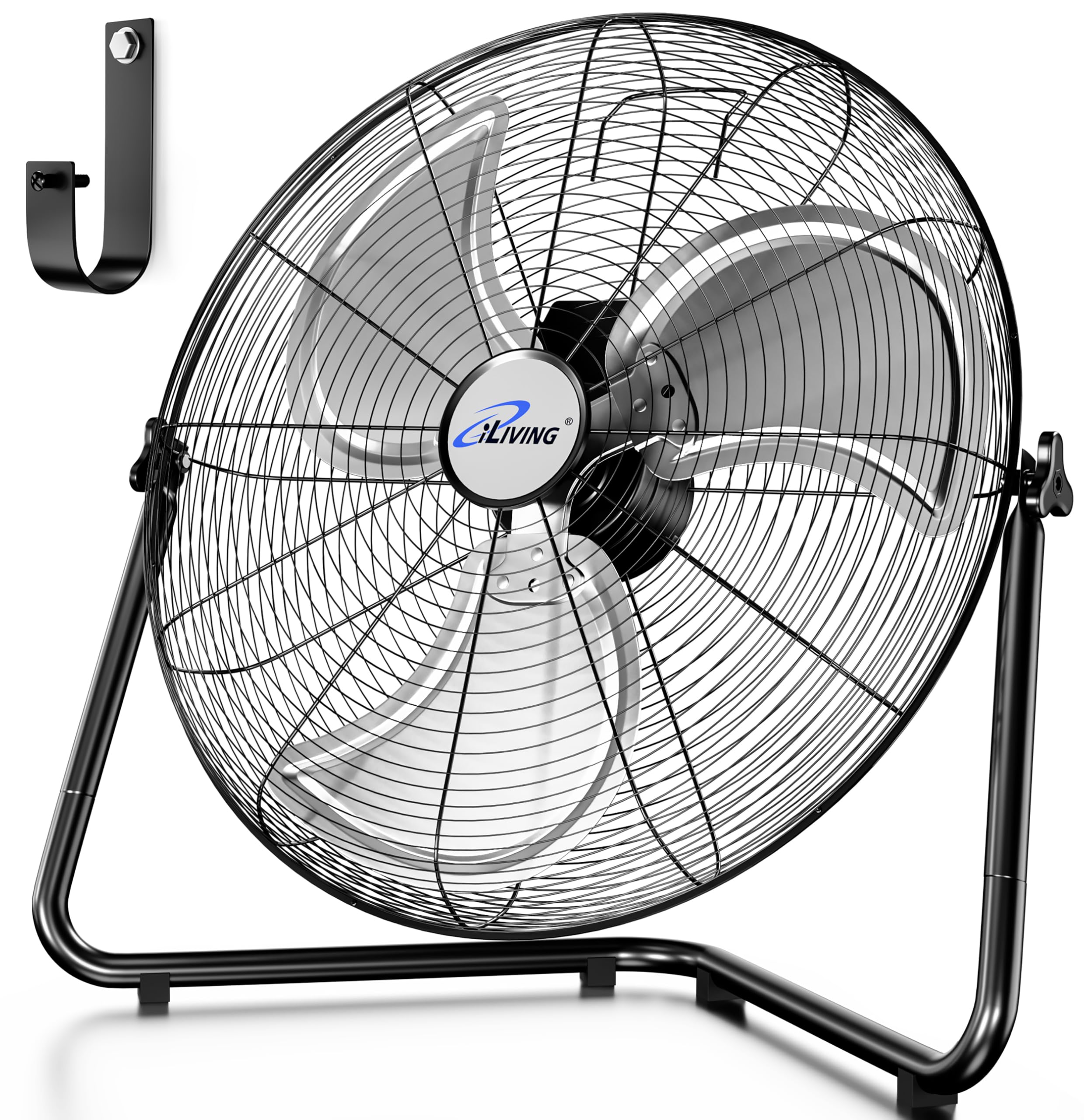
iLIVING ILG8F20 Floor Fan

88 /100
Kirk Score Excellent
Speeds
3
Weight
10.6 lb
Airflow
5800 CFM
Mounting
Floor or wall
Check Details on Amazon

Pros

  • Wall bracket included in the box
  • Metal housing with aluminium blades
  • 10.6 pounds, light enough to hang
  • UL and cUL listed

Cons

  • Loud enough to rule out a quiet room

The wall bracket in the box is what puts this fan on our list. iLIVING includes a mount, so the same fan that sits on the floor for a big job can go up on the wall of a small shop and stop eating floor space — and at the bottom of this group's prices, it's the cheapest way here to get 20 inches of air moving.

The rest is conventional and sound: a metal housing with aluminium blades, three speeds on a toggle, a head that tilts through 360 degrees, and a rated 5800 CFM. It's 10.6 pounds, light enough to lift onto a bracket one-handed, and it's UL and cUL listed.

Assembly is the part to budget for: the base goes together with a handful of bolts and the instructions are thin, so give it ten minutes and a second pair of hands. Once it's together it behaves like a 20-inch fan should — strong airflow, and a tilt that stays where you set it.

Bottom line: The least expensive way here to move 20 inches of air, and the included bracket gets it off the floor — just plan around the noise.

Check Latest Price
#06

Best Compact

Vornado EXO51 Shop Fan

88 /100
Kirk Score Excellent
Speeds
3
Airflow
786 CFM
Warranty
5-year
Ingress Rating
IP54
Check Details on Amazon

Pros

  • IP54-sealed motor for dusty shops
  • Five-year replacement warranty
  • Steel base, non-slip feet, 8-foot cord
  • 7.5 pounds and easy to hang

Cons

  • Top speed is loud for its size

An IP54-rated motor and a five-year replacement promise in a 7.5-pound case — that's the whole argument for the EXO51, and it's a good one in a shop full of dust. Vornado built this one for job sites: a sealed motor, an exoskeleton case, a steel base with non-slip feet, and an 8-foot grounded cord.

It's a small circulator, 12.9 inches wide with a 7-inch blade, rated at 786 CFM. That's a fraction of what the 20-inch fans here claim, and it's the wrong comparison anyway. Think of it as the fan that fits: on a bench end, in a stairwell, in a window, or on the floor of a one-car garage where a 20-inch fan would be in the way.

The details are what you're paying for. The controls are glove-friendly, and the case, base, and cord all feel specified for a job site rather than a bedroom. It's the fan we reach for when the space is tight and the surface is dirty.

The trade is coverage: a 7-inch blade moves a column of air, not a room's worth. As a second fan in a big shop, or the only fan in a tight one, it earns its keep — and the five-year replacement promise is the longest cover here alongside DEWALT's drum fan.

Bottom line: Where floor space is tight and the dust is not negotiable: a sealed IP54 motor, five-year replacement cover, and 786 CFM from a 7-inch blade.

Check Latest Price
#07

Moving a room's air

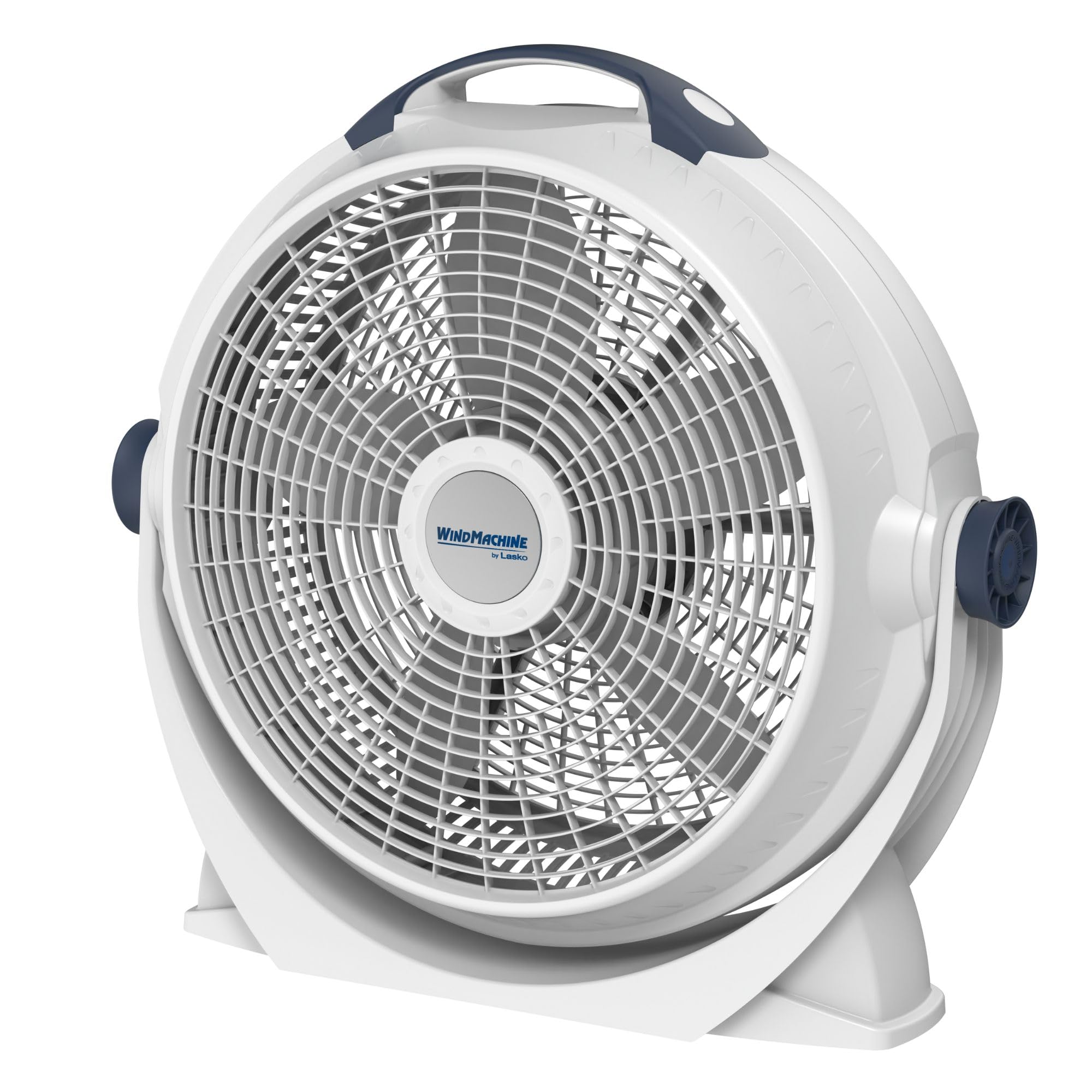
Lasko 3301 Windmachine

89 /100
Kirk Score Excellent
Speeds
3
Weight
6.5 lb
Airflow
2000 CFM
Blade Diameter
20 inches
Check Details on Amazon

Pros

  • 6.5 pounds with a 20-inch blade
  • Arrives fully assembled
  • 360-degree pivoting head

Cons

  • Weakest durability record here, one year of cover

Six and a half pounds for a 20-inch fan is the number that gets your attention. The Windmachine is mostly plastic, and that's what buys the weight — you can carry it from the garage to the patio with one hand and set it down without thinking about your back.

It arrives fully assembled, which is a small pleasure after wrestling bases onto other fans. Three speeds on a toggle, five blades, and a head that pivots through 360 degrees, so it works aimed at a bench or turned into a corner to bounce air off the wall. Lasko rates it at 2000 CFM on 105 watts.

The blade sweep is the point. A 20-inch fan spreads air across a room instead of throwing a column, and at this weight it's easy to reposition until the whole bay is moving. That's a different job from what the blowers here do, and for a garage you walk in and out of, it's usually the more useful one.

Where it fits is the garage you pass through, the patio, or a workshop where the fan is background rather than a tool you aim. It's a lot of air for the money, and it's the fan we hand someone who wants to feel a breeze without thinking about it.

Bottom line: It's the lightest way here to move a room's worth of air, and it arrives assembled and ready to run.

Check Latest Price
#08

Two-bay garages

Simple Deluxe 20-Inch 2-Pack

93 /100
Kirk Score Outstanding
Pack
2 fans
Speeds
3
Weight
11.7 lb
Airflow
4650 CFM
Check Details on Amazon

Pros

  • Two all-metal 20-inch fans per order
  • Aluminium blades and reinforced grilles
  • No assembly required

Cons

  • Sold only as a pair

Two fans arrive in one order. That's the idea: a pair of 20-inch all-metal floor fans with aluminium blades, three speeds on a rotary switch, and reinforced grilles, sold as a set rather than one at a time.

For a two-bay garage, a shop plus a barn, or a basement with two ends, that's more useful than a single better fan. Each one is 11.7 pounds with a 23-inch span, and the all-metal housing with aluminium blades is exactly what we look for in a dusty space.

They come out of the box ready to plug in, with a tilt head and a rotary switch on the side. Rated at 4650 CFM each, they're the kind of air mover you point at a bay and forget about until the end of the day.

The one thing to watch is heat at the motor. On the units where the housing behind the blade runs hot, it gets uncomfortable to touch, so leave clearance around it and don't leave it pressed against a curtain or a stack of cardboard. Given room to breathe, two of these cover a two-bay shop in a way one fan can't.

Bottom line: Two metal 20-inch fans in one order, which suits a two-bay garage better than anything else here — just give the motor housings room.

Check Latest Price

What We Put Every Shop Fan Through

We started by pulling every shop fan we could find that had a metal housing, at least three speeds, and a head that could be aimed somewhere other than dead ahead, then cut anything with a pattern of cracked grates or a motor that sounded strained. Fourteen made the cut.

Fourteen fans, seven months. They ran in a garage woodshop, a home gym, a covered patio, and a barn bay that bakes in afternoon sun, and we hauled them between those spots the way anyone would. Each one got at least four hours at a stretch, and we judged the air at six feet, twelve feet, and across the room instead of trusting the number on the box, while noting how much of the space the head could actually redirect.

Airflow turned out to be the easy part. The harder questions were the ones you live with: how much of a conversation you can hold three feet away on high, whether the motor housing gets too hot to touch after a long afternoon, and whether the grille, base, and cord still feel solid after a season of being dragged across concrete.

We assembled every fan ourselves and timed it, since a couple were plug-in-and-go and others took twenty minutes and a screwdriver. Then we asked each one a blunt question: for what it costs, does it do anything a cheaper fan can't? The ones below answered yes.

How to Choose a Shop Fan

Match the shape of the airflow to the job

A 20-inch floor fan and a 12-inch blower both move air, and they do different things with it. The big fan spreads a wide wash across a room; the blower throws a tight column you can put on a bench, a wet floor, or a doorway. Rated CFM figures in this category are measured inconsistently between brands, so we treat them as a rough guide and choose by shape first: spot cooling and drying want a blower, and a whole bay wants blade diameter.

Buy more blade and run it slower

Noise is where these fans take the most criticism, and the fix is usually counterintuitive. A larger blade moves more air per revolution, so a 20-inch fan on its lowest setting is easier to be next to than a small fan screaming on high. If the fan will sit within a few feet of where you work, prioritize blade size and a low setting over a compact body. If it's going in a bay you walk through, plan the placement instead and buy for airflow.

Weight the warranty — this is how they fail

Shop fans fail at the motor or the switch after a season or two of dust, which is why the warranty says more here than it does on a hand tool. Cover in this group runs from a single year on most models to five years on the DEWALT drum fan and the Vornado. Treat a one-year warranty as the maker's own estimate of life and price the fan accordingly; a metal housing and aluminium blades help, but the cover is the part you can actually claim against.

Decide where it lives before it arrives

Floor space in a shop is never free, and a 20-inch floor fan takes roughly two feet square plus the room to tilt it back. If the answer is not on the floor, the field narrows fast: the iLIVING ships with a wall bracket, the DEWALT cordless has an integrated hook, and the Vornado can hang. Everything else sits on the floor and tilts, so measure the bench end or the walkway before you order.

Corded, cordless, and what it draws

Every fan here runs on a standard 120-volt circuit at 53 to 172 watts, so the fan alone won't trip a breaker. Add a shop vac or a table saw on the same circuit and its draw starts to matter — which is where the on-board outlets on the Lasko blower earn their keep, though you're then sharing one circuit between the fan and whatever you plug in. Cordless is a different calculation: the DEWALT is tool-only, so budget for batteries and a charger unless you already run that platform.

Frequently Asked Questions

Final Verdict

We give the top spot to the Lasko U15617 because it fits the most shops: a focused, pivoting blower on a 12-pound body you can tuck under a bench, with two outlets and a breaker that make it part of the toolkit rather than an appliance.

If your shop is a two-car bay and you want air moved across all of it — or you want five years of cover instead of one — the DEWALT drum fan is the better buy, as long as you can live with the weight.