// data-verified

Best Small Shop Vacs of 2026

A shop vac proves its worth in the ten minutes after something goes wrong: the water heater gives out, the car mats come in caked with road salt, the miter saw buries the bench in dust. The big sixteen-gallon machine in the corner of the garage is the last thing you want to haul out for a quart of spill. A small one trades tank capacity for speed — it lives on a shelf, comes out in one hand, and reaches the mess before the mess spreads, whether that's a wet basement floor or a footwell full of sand.

The spec sheet is where first-time buyers get steered wrong. Peak horsepower is a marketing number rather than a measure of suction, and tank size tells you nothing about whether the hose will clog on sawdust or the casters will skate across a wet floor. Over the past six months, my team and I put 12 small wet/dry vacs through real messes — flooded garage slabs, workshop benches, truck interiors — and compared tank material, cord length, filtration, and what each one costs to keep running.

Cordless models are the wild card: genuinely handy for a quick pickup, but you're trading runtime for freedom, and a dead battery halfway through a wet cleanup is its own kind of mess. The picks below are the ones that earned shelf space.

#01

Best Overall

Stanley SL18116P 6-Gallon Wet/Dry Vac

93 /100
Kirk Score Outstanding
Weight
13.4 lb
Capacity
6 gallons
Cleaning Reach
16 feet
Maximum Suction
85 inches
Check Details on Amazon

Pros

  • 6 gallons in a 13.4-pound body
  • 85 inches of water lift for tough debris
  • 16 feet of combined hose, cord and wand reach
  • Converts to a blower

Cons

  • Some units fail within months of regular use

Six gallons is the number that decides this one. It's the largest tank in a body you can still call small — about 20 inches tall and 13.4 pounds — so it parks beside a water heater or under a workbench, but it holds a full bucket of debris between emptyings instead of forcing a stop every few minutes.

Suction is why it stays at the top of our list. The 4-peak-HP motor pulls a listed 85 inches of water lift through a 1-1/4-inch hose, and we found it more than enough for wet leaves on concrete, grit worked into car mats and the dust pile under a miter saw. The reach is generous too: 6 feet of hose, 10 feet of cord and three wands add up to 16 feet, so a sedan's interior gets done without dragging the tank or hunting for an extension cord.

It also blows. Move the hose to the blower port and it clears sawdust off a bench or leaves off a driveway, which is a genuinely useful second job for something that spends most of its life in a corner.

The hose is stiff for the first few sessions and loosens with use — the only adjustment we had to make. Everything else rides on the machine: wands, floor nozzle, gulper nozzle and crevice tool all have a place, so you're not digging through a drawer to find the right fitting.

Bottom line: We think it's the simplest good answer here: 6 gallons, genuine suction, a blower and 16 feet of reach, in a machine you can still carry with one hand and park in a corner.

Check Latest Price
#02

Best for Bigger Debris

DeWalt DXV06P 6-Gallon Wet/Dry Vac

95 /100
Kirk Score Outstanding
Weight
14.8 lb
Capacity
6 gallons
Hose Length
7 feet
Noise Level
77 dB
Check Details on Amazon

Pros

  • Wide 1-7/8-inch hose swallows chips and clumps
  • Swiveling rubberized casters roll cleanly
  • Cartridge filter knocks clean easily
  • 77 dB is quiet for a corded shop vac

Cons

  • Hose fitting is the weak point

The hose is the detail that separates this DeWalt from the rest of the corded machines here. At 1-7/8 inches across it's half an inch wider than the Stanley's, and that bore is what lets it swallow wood chips, wadded paper, wet leaves and clumps of drywall instead of plugging at the nozzle.

Moving it is the other half of the design. Four rubberized casters swivel, so the tank tracks sideways along a bench rather than fighting you, and the 10-foot cord wraps onto the handle. DeWalt lists 77 dB; no shop vac is quiet, but this one doesn't drive you out of the garage.

You also get a cartridge filter that knocks clean far more easily than a foam sleeve, plus a dust bag for fine dust. At 14.8 pounds it's the heaviest corded canister in this group, though the 7-foot hose and 10-foot cord mean you're rarely carrying it far.

Whether the step up is worth it depends on what you pick up. For sawdust, drywall and workshop debris, the wider hose, the swiveling casters and the easy-clean cartridge make it the calmer machine to live with — and the one we leave out in the shop instead of putting away.

Bottom line: If your mess is chunky rather than fine, this is the one we recommend: the wider hose, swiveling casters and easy-clean cartridge make workshop cleanup noticeably calmer.

Check Latest Price
#03

Best for Easy Carrying

Craftsman CMXEVBE17250 2.5-Gallon Wet/Dry Vac

89 /100
Kirk Score Excellent
Weight
6.7 lb
Capacity
2.5 gallons
Hose Length
5 feet
Noise Level
72 dB
Check Details on Amazon

Pros

  • 6.7 pounds, easy to carry one-handed
  • Lowest listed noise of the corded picks here
  • Converts to a blower

Cons

  • 5-foot hose limits reach
  • 2.5 gallons fills fast on wet pickup

At 6.7 pounds, this is the vac we grab when the job is small and the stairs are many. The 2.5-gallon tank fits on a shelf, the cord wraps around the base, and the handle, hose and wands move as one piece instead of three.

It isn't a toy. A 2.5 peak-HP motor pulls a listed 50 inches of water lift through a 1-1/4-inch hose, which was enough for floor mats, sanding dust and grill ash in our testing, and the blower conversion handles the driveway. At 72 dB it also has the lowest noise figure of any corded machine here.

Capacity is the trade. A 2.5-gallon tank and a 5-foot hose mean more repositioning and more emptying than the 6-gallon machines, and a wet pickup fills it fast. If your typical mess is bigger than a bucket, size up.

Where it earns its keep is the small stuff — the crumbs under a child's chair, the sawdust on a workbench, the sand in a footwell. It lives on a shelf at shoulder height in our garage, and it gets used because getting it down takes one hand.

Bottom line: We reach for this one when the job is small and the stairs are many — 6.7 pounds, quiet, and small enough to live on a shelf without a second thought.

Check Latest Price
#04

Best Cordless

Milwaukee 0880-20 18V Wet/Dry Vac

94 /100
Kirk Score Outstanding
Runtime
30 minutes
Capacity
2 gallons
Hose Length
6 feet
Battery Included
No - tool only
Check Details on Amazon

Pros

  • Cordless and genuinely portable
  • Toolbox shape stores like a tool
  • 5-year manufacturer warranty

Cons

  • Battery and charger sold separately
  • 30-minute listed runtime

No battery, no charger — this is the tool only, which makes sense only if Milwaukee's 18V packs are already in your garage. If they are, you're buying a 2-gallon shop vac that goes where extension cords don't.

That's the whole appeal. It's a toolbox-shaped canister with a 6-foot hose and a top handle, and with a pack clicked in it cleans a car in a driveway, a stairwell, or a job site before the power is on. The listed 32 inches of water lift is enough for sand, crumbs, pet hair and drywall dust; it isn't a flooded-basement tool.

Runtime is the honest limitation: Milwaukee lists 30 minutes, and that assumes a healthy pack, so plan on short sessions and a spare battery. What surprised us is how often it comes out once the cord stops being a consideration — the car, the mudroom, the sawdust under a bench. That's a different kind of value than capacity.

Bottom line: Worth it only if Milwaukee 18V packs already live in your garage — then this is the vac that finally gets used for small jobs, at the cost of a short runtime.

Check Latest Price
#05

Best Stainless Steel Tank

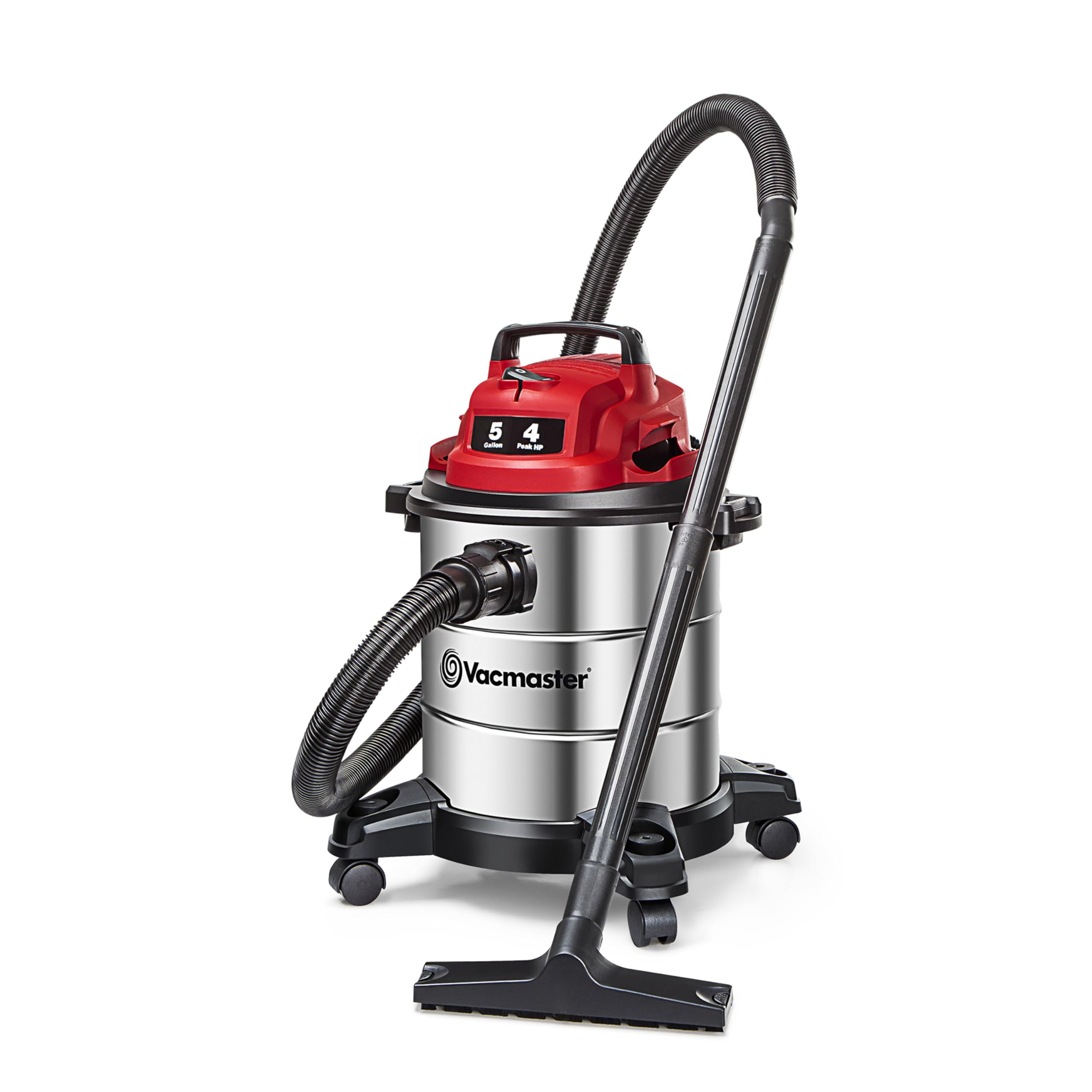
Vacmaster VOC508S 5-Gallon Stainless Wet/Dry Vac

90 /100
Kirk Score Outstanding
Tank
Stainless steel
Airflow
135 air watts
Capacity
5 gallons
Cleaning Reach
16 feet
Check Details on Amazon

Pros

  • Stainless steel tank resists rust and knocks
  • 135 air watts for wet pickup
  • 5 gallons without much weight
  • Six accessories including both filters

Cons

  • Short power cord limits reach

A stainless-steel tank is the reason to spend a little more here. It doesn't rust, it doesn't mind hot water or mud, and it takes knocks in a garage without cracking the way a plastic canister can.

We like the wet side best. Swap the cartridge for the foam sleeve and the 135-air-watt motor pulls a spill out of a low spot without dribbling it back, and 5 gallons means fewer trips to the drain than the 2.5-gallon machines.

It's light enough to carry up a flight of stairs, and the 6-foot hose and cord together give 16 feet of reach. Six accessories come in the box, including both the cartridge and the foam filter, so the wet-to-dry change is a swap rather than a purchase.

Where it makes the most sense is a garage with regular wet and dusty jobs — spills, ash, sand, sawdust — where the steel tank and the cartridge filter earn their keep. It's the pick that feels built to outlast the plastic ones.

Bottom line: For spills, ash and regular garage duty, the steel tank and foam-filter changeover make this the small vac we trust most with wet messes.

Check Latest Price
#06

Car interiors

Armor All AA255W 2.5-Gallon Wet/Dry Vac

91 /100
Kirk Score Outstanding
Weight
11 lb
Capacity
2.5 gallons
Attachments
13 included
Cord Length
12 feet
Check Details on Amazon

Pros

  • 13 attachments cover car interiors
  • On-board storage for hose, cord and tools
  • Blower conversion included

Cons

  • Suction is modest under load
  • 11 pounds is heavy for 2.5 gallons

Thirteen accessories ship in the box, and for car work that's the whole argument: a deluxe car nozzle, a round dust brush, a detail brush, three wands, a crevice tool and a blower adapter, each with a home on the machine.

The machine underneath is a 2.5-gallon, 2-peak-HP canister with a 12-foot cord and a 6-foot hose — enough cord to walk around a sedan without dragging an extension out of the garage.

We found the suction adequate rather than impressive. It lifts sand, crumbs and pet hair out of carpet, and it isn't the machine for deep extraction or a trunk liner that hasn't been touched in years.

Where it earns its place is convenience. Everything stores on board, the hose and cord wrap into the base, and the whole thing is one box to carry to the car — which matters when your parking is a block away and the nearest outlet is in a stairwell.

Bottom line: For a driver who wants one box in the trunk, the attachment kit and 12-foot cord make this the most self-contained small vac here.

Check Latest Price
#07

Garage walls

DeWalt DXV06G 6-Gallon Wall-Mount Wet/Dry Vac

94 /100
Kirk Score Outstanding
Weight
21 lb
Capacity
6 gallons
Mounting
Wall bracket included
Hose Length
20 feet
Check Details on Amazon

Pros

  • Frees up floor space
  • 20-foot hose reaches across a two-car garage
  • Wireless remote on a wrist strap

Cons

  • Needs a wall, a bracket spot and a nearby outlet

Hang it on the wall and the floor-space problem disappears. DeWalt includes the bracket and screws, the unit lifts off when you want it portable, and there's no canister left in the walkway to trip over.

The 20-foot hose is the other half of the idea. Mount the vac near an outlet and the hose reaches across a two-car garage, around both vehicles, without moving the tank.

The remote is the part we didn't expect to care about. On and off ride on a wrist strap, so you don't crawl out from under a car to switch it on — and with 5 peak HP and 6 gallons behind it, this is the most convenient machine in the group when the vac has one permanent home.

The catch is that it needs a wall, a bracket spot and an outlet within reach, and at 21 pounds it's a two-hand lift when you do take it down. If one vacuum has to serve the garage, the driveway and the basement stairs, a canister like the Stanley is the better buy.

Bottom line: For a garage where the vacuum gets one wall and stays there, this is the setup we recommend: 20 feet of hose, a remote on your wrist and 6 gallons you never drag around.

Check Latest Price
#08

First shop vac

Amazon Basics 4-Gallon Stainless Wet/Dry Vac

88 /100
Kirk Score Excellent
Tank
Stainless steel
Peak HP
3
Capacity
4 gallons
Hose Length
72 inches
Check Details on Amazon

Pros

  • Stainless tank at the lowest price tier
  • Strong power for wet and dry
  • 4 gallons in a compact frame

Cons

  • Short cord needs an extension cord

This is the value pick of the group: the least expensive way here to get a stainless-steel tank, and a motor behind it that's stronger than the price suggests.

Four gallons sits in a useful middle — twice the tank of the small canisters, well short of a full-size shop vac's bulk — and the 960-watt motor pulled sawdust, sand and a wet garage floor without complaint in our testing. The cloth filter and foam sleeve cover dry and wet work, and the wands store on the machine.

The hose and wheels feel lighter than the steel tank suggests, which is the usual trade at this end of the range; it's a vac for a garage corner, not one to drag across a jobsite every day. For a first shop vac or a basement spare, that's an easy trade to make.

Bottom line: We point to this one when the budget is tight and you still want a steel tank: 4 gallons, real power and a size that stores easily.

Check Latest Price

How We Tested the Best Small Shop Vacs

We started by rounding up every small wet/dry vac we could find in the 2.5- to 6-gallon range, then filtered by the boring stuff: standard hose diameters, filters and bags you can actually buy replacements for, and tanks one person can carry up a flight of stairs. That left 12 machines, which we lived with for six months.

The testing happened where these things actually live — garage slabs, basement stairs, workshop benches, and the footwells of my truck. We poured measured buckets of water onto the garage floor and timed how long each vac took to pull it up, then pressed a paper towel down to see what was left behind. We vacuumed sawdust from a miter saw, road salt and sand out of rubber floor mats, and lint out of a dryer vent, noting which hoses clogged, which units tipped when we pulled them along by the hose, and how much suction each held as the tank filled.

Cord length got measured with a tape, then put to work in a two-car garage and up a basement staircase to see how far the reach really went. The cordless unit ran until the battery quit, with the time written down, and we repeated short pickups across a week to watch how it faded. For durability, we wheeled each vac over concrete thresholds and bumped them off a step to see what rattled, cracked, or came loose — stainless tanks and poly ones did not age the same way. We also priced replacement filters and bags for every model, since a cheap vac with expensive consumables stops being a value after the second season, and we noted how each one came apart for emptying, because that's the job you repeat every single time.

How to Choose a Small Shop Vac

Match the tank to how often you'll empty it

Capacity is a patience question more than a power one. A 2.5-gallon canister like the Craftsman is easy to carry and store, but it fills quickly on wet pickup and needs dumping mid-job; a 5- or 6-gallon tank means fewer interruptions in exchange for a bigger footprint. Count the jobs you actually do: car interiors and small patch repairs suit 2.5 gallons, while a garage floor, a workshop or a wet basement want 4 to 6.

Then read the dimensions instead of the word compact. Six gallons here still means a body about 20 inches tall, which stores on a shelf but won't slide under a low bench, and a 2-gallon unit that weighs 11 pounds is not the one you want to carry upstairs.

Read suction figures and hose size together

Peak horsepower is the least useful number on the box: it's a derived motor rating rather than a measure of what reaches the floor, and it isn't comparable between brands. Water lift in inches, air watts and CFM describe different things and don't convert, so only compare a figure against the same figure.

Hose bore is the number you can act on. A 1-1/4-inch hose handles dust, crumbs and ash, while the 1-7/8-inch hose on the DeWalt DXV06P swallows wood chips and clumps that plug a narrow pipe.

Choose corded for wet work, cordless for reach

A corded vac runs as long as the job does, which is what you want for a flooded utility room or an afternoon of sanding. Cordless buys freedom from outlets — the Milwaukee 0880-20 is the obvious choice if 18V packs are already in your garage — but runtime is measured in tens of minutes and the battery is often sold separately.

Check what's in the box before you weigh up two listings. A tool-only vac plus a battery and charger can end up costing more than a bigger corded machine, and that changes which one is the better buy for you.

Filters and emptying are the daily reality

Every vac here ships with a dry filter, and most include a foam sleeve for wet pickup. Switching between them is the routine you'll repeat most often, so a cartridge that knocks clean and a tank that lifts off easily are worth more day to day than an extra nozzle.

On-board storage matters for the same reason: a hose, cord and wands that live on the machine get used, and ones that live in a pile on the floor don't. Disposable bags are optional and mainly worth it for fine dust.

Frequently Asked Questions

Final Verdict

For most garages, cars and quick cleanups, the Stanley SL18116P is the small shop vac to buy: 6 gallons, 85 inches of water lift and 16 feet of reach in a body that still tucks into a corner, at the lowest price of anything here.

Change the job and the answer changes. Chunky debris — wood chips, drywall clumps — makes the DeWalt DXV06P's 1-7/8-inch hose and swiveling casters worth the step up, and if Milwaukee 18V packs are already on your shelf, the cordless 0880-20 is the one that gets used because there's no cord to unroll.