// data-verified

Best Tool Boxes of 2026

A toolbox is a purchase you make hoping you'll never think about it again — until a latch pops open on the stairs and half your sockets end up on the landing. I've carried a loaded box by a handle that flexed under the weight, and I've watched a cheap lid crack the first time it sat out in the rain. What a good one buys you is boring: it holds what you put in it, it stays shut, and it lets you reach the tool you want without dumping everything out on the floor.

The mistake most people make is buying for capacity when they should be buying for how they move. A deep box that lives on a shelf is a different animal from one you haul up from the basement every weekend, and stackable systems only pay off if you commit to a single platform. We loaded, stacked, hauled, and dropped 12 tool boxes over eight months to sort that out.

Two things surprised me along the way. The removable tray you lift out a hundred times matters more than an extra inch of depth, and a latch you can work with gloves on matters more than either. The picks below split along that line — grab-and-go for quick jobs, rolling and stackable for the whole kit.

#01

Best Overall

DEWALT TSTAK Deep Box

96 /100
Kirk Score Outstanding
Capacity
22.71 liters
Dimensions
17.3"L x 11.9"W x 13"H
Maximum Load
44 lb
Water Resistance
Water resistant
Check Details on Amazon

Pros

  • 22.71 liters of open, usable space
  • Metal front latches hold under load
  • Water-resistant shell rated to 44 pounds
  • Clips onto other TSTAK units

Cons

  • Single open cavity with no dividers or drawers

A circular saw fits. That's the test we run on every box in this guide, and the TSTAK deep box is one of the few here that passes without a fight: drop in a saw, add a drill and a pouch of bits, and there's still air above them. The listed capacity is 22.71 liters, and because this is a deep rectangle rather than a molded case with shaped recesses, most of that volume is open space you can actually drop a tool into.

The tray on top lifts out with one hand, which is how we keep the screwdriver and tape measure from sinking under everything else. Below it sits a single open cavity, with no drawers and no dividers. Loose screws will find their way to the bottom unless you add a small parts case of your own. The two front latches are metal and close with a firm cam action, and a loaded box carried by the handle doesn't shift or pop open on the way out to the truck.

At 17.3 by 11.9 by 13 inches it slides behind a truck seat or onto a shelf, and DEWALT rates it to 44 pounds, which is more than most of us want to carry by a handle for long. The side latches are what keep this from being a dead end: clip a drawer unit or a second box on top and this becomes the base of a stack rather than a box you outgrow.

Bottom line: Our default pick: a deep, straight-walled box that swallows a circular saw and a drill, seals against a damp garage floor, and stacks when your kit grows.

Check Latest Price
#02

Best Weather-Sealed

Milwaukee Packout Large Tool Box

96 /100
Kirk Score Outstanding
Dimensions
22.1"L x 11.3"W x 16.1"H
Item Weight
12.1 lb
Maximum Load
99.2 lb
Weather Seal
IP65 rated
Check Details on Amazon

Pros

  • Gasketed lid rated IP65
  • 45 kg load rating on a hand-carry box
  • Interior organizer tray included

Cons

  • Single compartment; the tray is the only divider

Milwaukee puts a gasket in the lid and rates the seal IP65, which no other box here claims. That's the reason to buy it. A box that rides in a truck bed or sits in an unheated garage takes dust and condensation, and a lid that closes on rubber keeps both off the tools inside.

The rest is a single straight-sided cavity, 22.1 by 11.3 by 16.1 inches, with the organizer tray included and a load rating of 45 kg, enough for a full socket set and a hammer without the sides bowing. Empty, it weighs 12.1 pounds, which is the honest cost of that much reinforced plastic.

This is the box for someone whose tools live outdoors. If yours live on a shelf in a dry garage, the DEWALT gives you more volume for a fraction of the money and the gasket buys you nothing. You also get less interior space for that higher price and a pound or two more to carry before anything goes in. That's the decision in one line: pay for the seal when the weather is going to test it.

Bottom line: We recommend it when your tools ride in a truck bed: the gasketed IP65 lid and 45 kg rating are what you're paying for, and nothing else here seals as well.

Check Latest Price
#03

Best Rolling

Milwaukee Packout Rolling Tool Box

95 /100
Kirk Score Outstanding
Dimensions
22.1"L x 18.9"W x 25.6"H
Item Weight
23.4 lb
Maximum Load
249.1 lb
Water Resistance
Water resistant
Check Details on Amazon

Pros

  • 113 kg rated load on a rolling base
  • Telescoping handle with industrial-grade extension
  • Lid seals against rain and dust

Cons

  • No interior organizer tray included
  • Tall 25.6-inch body won't slide under a bench

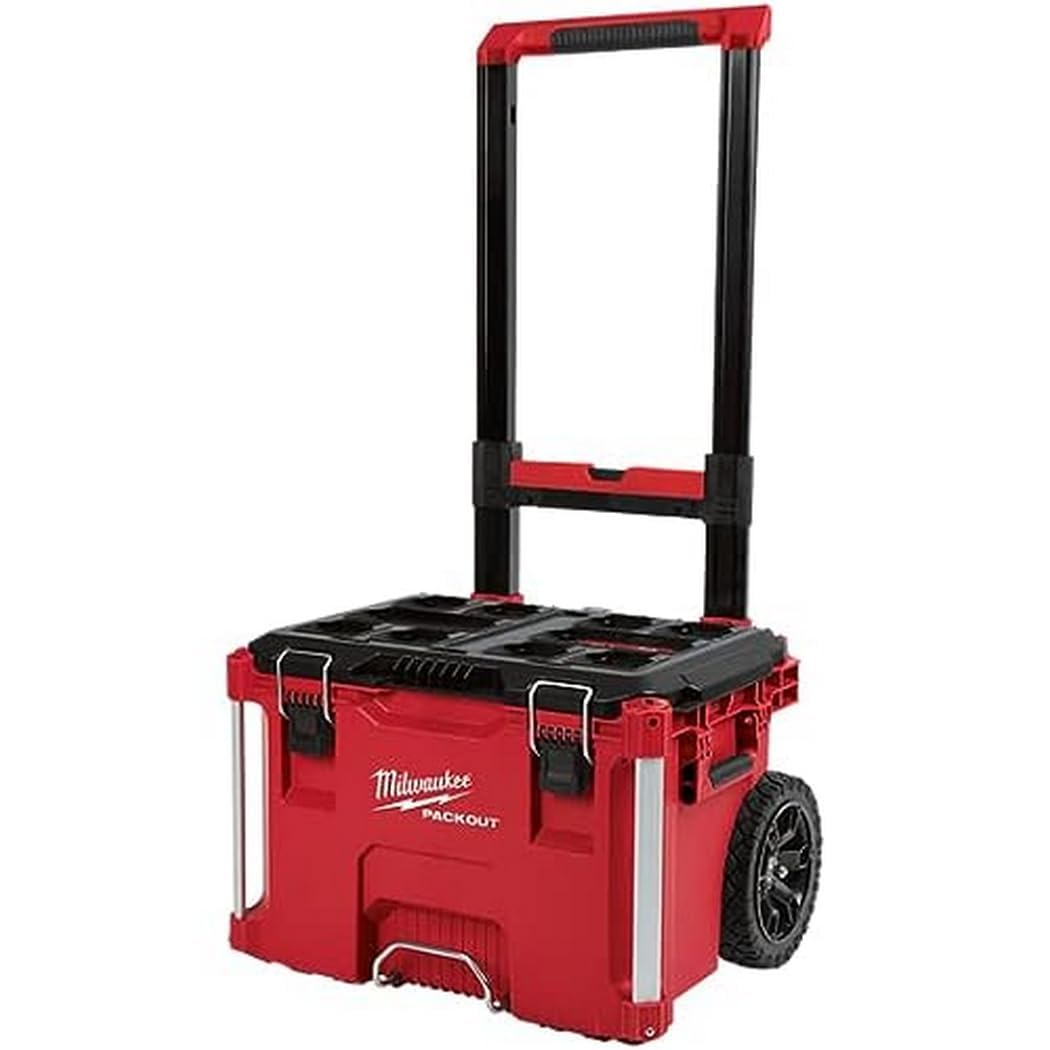
Empty, this box weighs 23.4 pounds, and the one moment you feel it is lifting it into a truck bed. The rest of the time the weight is the point: a base rated to carry 113 kg, a telescoping handle with an industrial-grade extension, and a lid that seals against rain and dust.

Our carrying limit runs out long before 113 kg does, and that's precisely the case this box is built for: the kit that got too heavy to tote but isn't worth splitting into three trips. Move a cordless drill, a saw, and a charger between jobs and the handle takes the load, not your shoulder. The top of the lid is flat and square, so a second Packout unit clips on and rides along.

What you get for the money is the rolling hardware and the load rating, not extra compartments. This is the most expensive box we recommend, and it buys mobility rather than cleverness. If your tools stay in one garage and never leave it, a hand box does the same work for far less.

Bottom line: For tools that travel, this is the one: 113 kg of rated capacity on wheels and a telescoping handle that takes the load off your shoulder.

Check Latest Price
#04

Best for Small Kits

Plano Grab-N-Go 16-Inch

94 /100
Kirk Score Outstanding
Dimensions
16"L x 7.5"W x 9.5"H
Item Weight
3 lb
Maximum Load
11 lb
Water Resistance
Water repellent
Check Details on Amazon

Pros

  • Clear top case keeps fasteners visible and separate
  • Lift-out tray over a cavity that fits a hammer
  • Three pounds empty, easy one-hand carry
  • Least expensive box in this group

Cons

  • 5 kg rating limits it to hand tools
  • Water repellent rather than sealed

A clear case rides on the lid of this box, slides out on its own, and holds the screws and anchors that otherwise sink to the bottom of a toolbox. That small piece of plastic is the best idea in the design: you can see what's inside without opening anything, and carry it to the shelf while the box stays put.

Sixteen inches long, 7.5 wide, and 9.5 tall, it's the size we hand someone whose toolkit is a hammer, a screwdriver set, a tape measure, and a bag of nails. The lift-out tray takes the small stuff and the space beneath it swallows a full-size hammer. Empty, it weighs three pounds, so a loaded box still comes up in one hand.

Where it stops is the job site. This is the box that lives in a hall closet and comes out to hang a picture, and the plastic, the single latch, and the load rating are sized for that life rather than for a truck bed in February. It's the one we hand someone who doesn't own a toolbox yet, and the one that stays in the closet when the big box goes to the garage.

Bottom line: We reach for this one for small household kits: a lift-out tray, a clear top case for fasteners, and a footprint that fits a closet shelf.

Check Latest Price
#05

Best All-in-One System

beyond by BLACK+DECKER 3-Piece Set

93 /100
Kirk Score Outstanding
Dimensions
20"L x 15.75"W x 29"H
Maximum Load
10 lb
Set Includes
Rolling tote, deep toolbox, small toolbox
Water Resistance
Not water resistant
Check Details on Amazon

Pros

  • Three units that lock into one stack
  • Quick-release splits the stack apart
  • Rolling tote with telescoping handle
  • Each unit works on its own

Cons

  • 10-pound listed load rating is modest
  • Not water resistant

Where our top pick gives you one big cavity, this set gives you three: a small case for bits and fasteners, a deep toolbox for hand tools, and a rolling tote that carries both. Auto-lock latches clip the units into a single stack, and a quick-release on each latch splits them apart when you only want the top box in the house.

Assembled, the stack stands 29 inches tall and rolls on the tote's telescoping handle, so a full load moves in one trip instead of three. Take the top two units off and the tote becomes a crate. We like that each piece works alone, because a stack that can't be broken down is just a cabinet with wheels.

The set earns its place as a first full toolkit: a new house, a first apartment, a kid heading into a trade program. Buying three pieces separately rarely stacks this neatly. It isn't a heavy-duty system, though. The job-site abuse that a Packout shrugs off will show up here as flexing plastic and a latch that rattles once it has been dropped a few times.

Bottom line: A first tool collection is where this set pays off: three stackable units, a rolling base, and a place for everything from bits to a hammer.

Check Latest Price
#06

Small parts storage

DEWALT TSTAK Double Drawer

94 /100
Kirk Score Outstanding
Drawers
2
Dimensions
17.3"L x 12.3"W x 6.9"H
Item Weight
9.2 lb
Maximum Load
16.5 lb
Check Details on Amazon

Pros

  • Two ball-bearing drawers with removable dividers
  • Clips onto the TSTAK deep box
  • Drawers lift out to carry to the work

Cons

  • 16.5-pound limit keeps it to small parts
  • Not water resistant

Two drawers in a box 6.9 inches tall: this isn't a tool box in the way the rest of this list is, and that's exactly why we keep it around. It clips onto the TSTAK deep box, or sits on a shelf alone, and gives the fasteners, bits, and drill accessories that rattle around in a big cavity a place of their own.

The drawers run on ball bearings, and the removable dividers split each one into separate compartments, so a tray of screws travels to the work instead of a handful at a time. One caution: if something sits above the drawer rim, the drawer catches on the way out. Keep the contents below the lip and the slides stay smooth. It's the least expensive way to add real organization to a stack you've already started.

Bottom line: We pair it with a bigger box rather than using it alone: two ball-bearing drawers that keep fasteners sorted and clip onto the TSTAK stack.

Check Latest Price

How We Tested 12 Tool Boxes in Garages and Truck Beds

We started by pulling together every box a real shopper would compare — compact hand boxes, deep drawer units, and rolling carts — and cut the list by footprint, usable internal volume, and how the latch and tray were built. That left 12. Each one got the same load: a hammer, a drill, a socket set, screwdrivers, a tape measure, a level, and the loose hardware everyone accumulates. We weighed every box loaded, then lived with them for eight months in garages, basements, and truck beds.

Durability showed up first. We opened and shut each lid hundreds of times, hung on the handles with the box fully loaded, and let each one tip off a tailgate onto concrete. For the boxes that claimed weather resistance, we ran a hose over the closed lid for a few minutes and checked whether anything inside came up damp. We also stacked them — snapping units together where the system allowed it — and gave each stack a shove to see how much it shifted with weight up top.

Organization and capacity got the same treatment. We packed identical kits and noted what didn't fit, whether the removable tray cleared the tools underneath, and whether small parts stayed in their compartments after a carry across a gravel driveway. Ease of use came down to small things: working the latch with gloves on, lifting a loaded box one-handed, and whether the lid stayed open while I reached in. Rolling boxes were pulled over thresholds, off curbs, and up stairs. The ones still on this list are the ones that hadn't annoyed us by month eight.

How to Choose a Tool Box

Measure the longest tool first

A liter rating tells you almost nothing if the box is two inches too short for the tool you reach for most. Start with the longest thing in your kit. A circular saw wants a cavity close to 13 inches deep; a hammer, a screwdriver set, and a tape measure fit in something nearer 10. Our top pick gives you 22.71 liters in a box 13 inches tall, which is why a saw and a drill sit in it together, while the 16-inch Plano is sized for hand tools only.

Then look at the shape of the walls. Molded cases with tapered sides and deeply ribbed lids eat usable space at the bottom, and the tools you want get wedged in the narrow part. A deep rectangle with a flat floor is worth more than a couple of extra liters on the label.

Decide whether you carry it or roll it

Load ratings don't tell you what the box weighs in your hand. They tell you where the design expects the weight to go. The DEWALT deep box is rated to 44 pounds, the Plano to 5 kg, and the rolling Packout to 113 kg, and those three numbers describe three different jobs. Under about 40 pounds of tools, a balanced box and a broad handle are all you need.

Past that, wheels stop being a luxury. A rolling base means you lift the box twice a day instead of carrying it all day, but it also adds 23.4 pounds of hardware before a single tool goes in and makes a body too tall to store under a bench. Be honest about the walk from the truck.

Match the seal to where the box lives

Water resistance comes in grades that sound alike and aren't. Water repellent means splashes bead up and sit there. Water resistant means the shell and lid cope with rain. An IP65 rating means a gasketed lid that keeps out dust and directed water. A box on a garage shelf needs the first; a box riding in an open truck bed needs the last.

This is the one place where paying more buys something you can name. The Milwaukee Packout large box costs far more than our top pick, and the extra goes into that gasket. If your box never leaves a dry shelf, that money is better spent on volume.

Plan where the small parts go

Every box here is a big cavity at heart, and a big cavity turns screws and bits into a layer of gravel at the bottom. There are three fixes: a lift-out tray, as on the DEWALT deep box and the Plano; a drawer unit that clips onto the stack, which is exactly what the TSTAK double drawer is for; or a clear case riding on the lid, the Plano's best trick.

Buy the organization with the box where you can. Add-on dividers and trays usually cost more than choosing a box that already separates its small parts, and they rattle when they don't fit properly.

Buy into a stack, not a one-off

Stackable systems only work inside their own brand. TSTAK latches fit TSTAK, Packout fits Packout, and the beyond by BLACK+DECKER pieces fit each other; none of them clip onto a rival's base, and the latches rather than the dimensions decide what sits on top. If you expect to add a drawer unit or a second box in a year, choose the system now — a box that can't join the stack becomes the odd one out.

The catch is that a system's first box isn't always its best value. Our top pick is a good example: a deep box that happens to be one of the least expensive ways into a stack that can keep growing.

Frequently Asked Questions

Final Verdict

The DEWALT TSTAK deep box is the one we point most people to. It takes the tools that make a box worth owning, a saw and a drill and a hammer, and it does it with straight walls, metal latches, and a 44-pound rating, then clips into a stack when your kit outgrows it.

If your tools live in a truck bed rather than a garage, the Milwaukee Packout large box earns its premium for the gasketed lid alone. And if the whole toolkit is a hammer, a screwdriver set, and a bag of nails, the Plano is all the box you need.