// data-verified

Best Wet/Dry Vacuums of 2026

Every wet/dry vacuum runs on the same idea: a motor pulls air through a hose and drops what it grabs into a tank. Everything that makes one worth owning sits around that idea — a float that cuts the motor before water reaches it, a hose cuff that stays seated when you drag the machine around a corner, wheels that still roll once the tank is loaded with wet sawdust.

I once cleaned a flooded basement with a borrowed vac that quit halfway through, and I've pushed a bag of sawdust around with a broom instead of hauling out the shop vac. Over the past eight months, my team and I have put 12 wet/dry vacuums through that same kind of mess, and the differences came down to what happened once the tank got heavy, not the peak-horsepower figure printed on the box.

Size is the spec that trips up first-time buyers most. A 2.5-gallon unit is a one-hand carry to the car or up the stairs; a six-gallon tank is what you want when there's actual standing water to pull. Cordless models free you from an outlet but trade away runtime, so it's worth knowing how long one runs on a charge before anything else. The picks below cover both kinds of mess, and plenty of households end up wanting one of each.

#01

Best Overall

Stanley SL18116P

93 /100
Kirk Score Outstanding
Capacity
6 gallons
Hose Length
6 feet
Item Weight
13.4 lb
Maximum Suction
85 inches
Check Details on Amazon

Pros

  • Six-gallon tank holds bigger messes
  • 85-inch water lift for tough pickup
  • Long reach from hose, wands, and cord
  • Blower and useful attachments included

Cons

  • Durability is the weak spot

A six-gallon tank, 85 inches of listed water lift, and about 16 feet of total reach is the combination that makes the Stanley SL18116P our default wet/dry vacuum. We think that mix is the sweet spot for a garage or workshop: the tank holds a real mess without becoming a two-handed lift, and the 13.4-pound body still rolls and carries easily. The 6-foot hose, three wands, and 10-foot cord add up to enough reach for most garage bays without chasing an outlet.

The 4-peak-HP motor is paired with a gulper nozzle, floor nozzle, crevice tool, foam filter, and dry filter. We especially like the blower conversion for clearing sawdust off a bench or leaves off a walkway; it makes the vacuum useful after the pickup is done. The 80 dB rating is not quiet, but it is in line with the other six-gallon machines here.

We wish the warranty ran longer than one year, because this is a machine you expect to keep. The capacity and reach are the reasons it stays at the top, but the short coverage is the compromise.

Bottom line: The Stanley SL18116P is our default for most garages and workshops: six gallons, strong listed water lift, and long reach at a budget price.

Check Latest Price
#02

Best Quiet Upgrade

DeWalt DXV06P

95 /100
Kirk Score Outstanding
Capacity
6 gallons
Hose Length
7 feet
Noise Level
77 dB
Maximum Suction
50 inches
Check Details on Amazon

Pros

  • Quieter 77 dB operation
  • Smooth rubberized casters
  • Six-gallon tank with dust bag and blower

Cons

  • Less listed water lift than the Stanley
  • Hose fitting is the part to watch

If the Stanley's 80 dB rating is the part you notice, the DeWalt DXV06P is the quieter six-gallon alternative at 77 dB. It has the same 6-gallon capacity, a 7-foot hose, a 10-foot cord, and four rubberized casters that swivel instead of dragging. The 14.8-pound body is a little heavier than the Stanley, but the handle and casters make that difference easy to live with.

We think the DXV06P earns its higher price when the vacuum lives in a basement or garage where you run it often. The 4-HP motor and 50 inches of listed water lift are enough for sawdust, drywall dust, and small wet spills, and the cartridge filter with a dust bag is a cleaner setup for fine debris than a bare foam filter. We also appreciated the built-in blower port for clearing a workbench.

We think the DXV06P is the comfort pick in this set: the quiet motor and smooth casters make it easier to live with than the Stanley, and the six-gallon tank still handles a real garage mess. It is the one we choose when the vacuum stays out and gets used often.

Bottom line: The DXV06P is the six-gallon pick for a garage where noise and rolling matter: it runs quieter than the Stanley and swivels easily, though it costs more and lists less water lift.

Check Latest Price
#03

Best Small Budget

Craftsman CMXEVBE17250

89 /100
Kirk Score Excellent
Capacity
2.5 gallons
Hose Length
5 feet
Item Weight
6.7 lb
Peak Horsepower
2.5 peak HP
Check Details on Amazon

Pros

  • Weighs just 6.7 pounds
  • Quiet 72 dB operation
  • Three-year limited warranty

Cons

  • Filter bags add a recurring cost

At 6.7 pounds, the Craftsman 2.5-gallon is the vacuum we carry one-handed and tuck into a closet without rearranging the shelf. We think that is the right trade for a small household: it handles car mats, dryer lint, crumbs, and a spilled plant without asking you to drag out a full-size shop vac. The 2.5-gallon tank is small enough to lift and empty without a wrestling match.

The 2.5-peak-HP motor, 5-foot hose, and 1-1/4-inch tools are sized for close work, and the 72 dB rating is low for a shop vac. We also like the three-year limited warranty, which is longer than the Stanley's one-year coverage. The filter bag keeps dry debris contained and makes emptying cleaner.

For a full garage floor or a flooded basement, the tank fills quickly and the short hose has you moving the vacuum more often. That is the boundary: this is a small-mess vacuum, not a whole-garage workhorse. We reach for it when the job is five minutes, not fifty.

Bottom line: The Craftsman 2.5-gallon is the easiest small vacuum here to carry and store, with a three-year warranty, though it is not a whole-garage machine.

Check Latest Price
#04

Best Wall-Mounted Garage Vac

Bissell Garage Pro

91 /100
Kirk Score Outstanding
Amperage
12 amps
Capacity
4 gallons
Hose Length
32 feet
Item Weight
6.3 lb
Check Details on Amazon

Pros

  • 32-foot hose reaches around a car
  • Wall mount frees floor space
  • Seven attachments and blower

Cons

  • Premium price for a garage-only setup
  • Motor is not the strongest for heavy wet pickup

The Garage Pro's 32-foot hose is the feature that changes the job: you can leave the 4-gallon canister on the wall and walk around a car, down a driveway, or across a garage floor without dragging a wheeled tank behind you. The wall-mount kit keeps the unit off the floor, and the 6.3-pound body is light enough to hang without a helper.

We think it earns its place in a dedicated garage bay. The 12-amp motor and seven attachments cover floor mats, upholstery, crevices, and bare concrete, and the blower conversion is handy for clearing dust off a workbench. The long hose is the reason to choose it over a canister; the canister is not the reason.

The 4-gallon tank is small for a full garage cleanout, but the wall mount and 32-foot hose make up for it by keeping the unit out of the way. This is a vacuum for reach and convenience, not for dragging into the middle of the floor.

Bottom line: The Garage Pro is the pick for a dedicated garage bay: its 32-foot hose reaches around a car without dragging a canister, and the wall mount keeps the floor clear.

Check Latest Price
#05

Best Stainless-Steel Tank

Vacmaster VOC508S

90 /100
Kirk Score Outstanding
Motor
135 air watts
Capacity
5 gallons
Hose Length
6 feet
Tank Material
Stainless steel
Check Details on Amazon

Pros

  • Stainless-steel tank resists dents
  • Five-gallon capacity
  • 135 air watts of listed suction

Cons

  • Hose is stiff at first

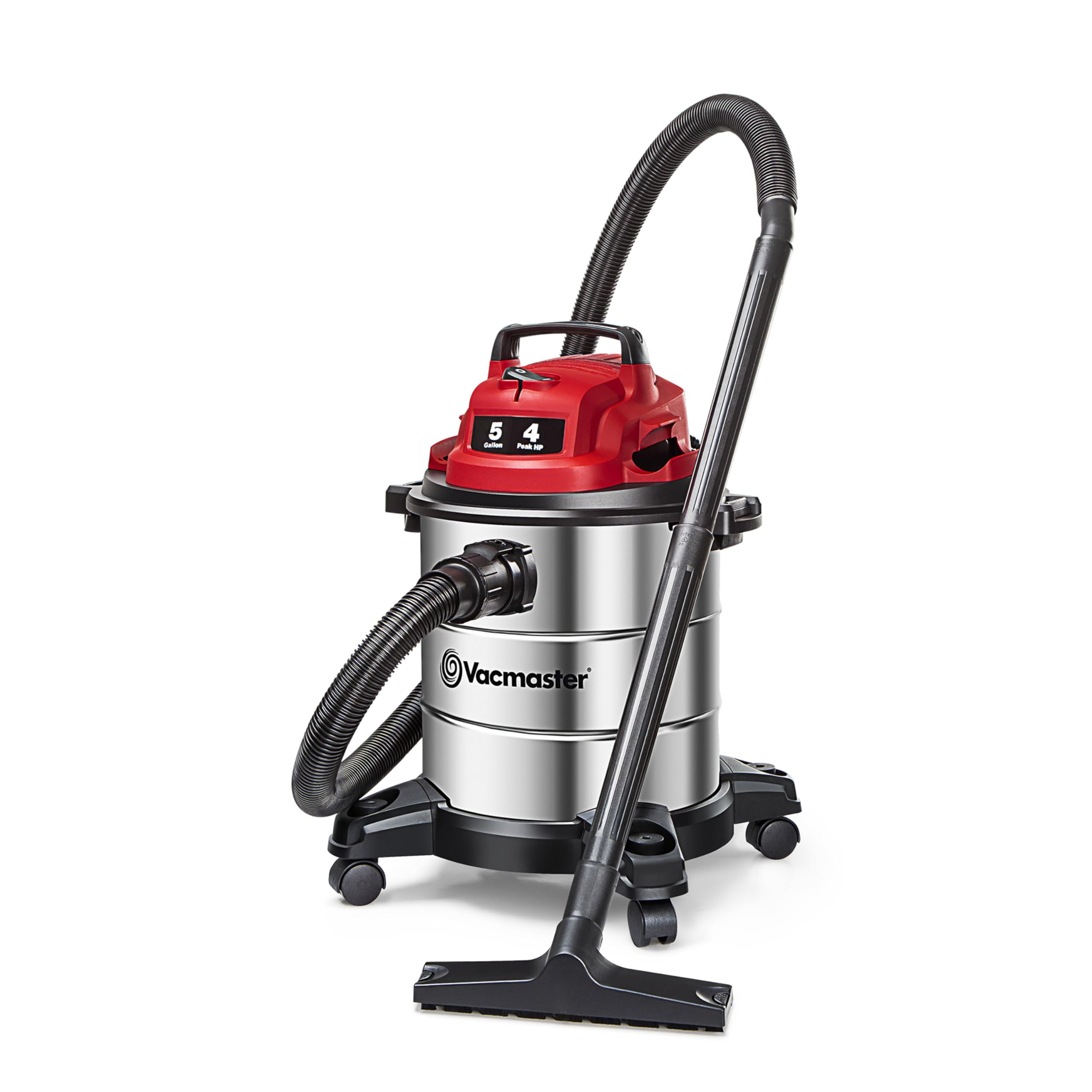
The stainless-steel tank is the first thing you notice on the Vacmaster VOC508S, and it is more than a looks upgrade: it resists the dents and rust that can shorten a plastic shop vac's life. The 5-gallon body sits on four wheels, weighs 5.3 kg, and carries a 6-foot hose and six accessories, including cartridge and foam filters.

The 135-air-watt motor is the other reason it belongs here. That is enough suction for sawdust, pet hair, sand, and small wet spills, and the 77 dB rating is middle-of-the-pack for this group. We like the separate foam and cartridge filters because they make the wet-to-dry switch straightforward.

We think the VOC508S is the midrange pick when you want a metal tank without moving up to a premium garage setup. The power cord is short enough that we treat an extension cord as part of the kit. That is the main adjustment; the rest of the package is ready to work.

Bottom line: The VOC508S is our midrange pick when the tank has to take a beating: stainless steel, five gallons, and strong listed suction in a package that rolls easily.

Check Latest Price
#06

Best for Car Interiors

Armor All AA255W

91 /100
Kirk Score Outstanding
Capacity
2.5 gallons
Cord Length
12 feet
Hose Length
6 feet
Peak Horsepower
2 peak HP
Check Details on Amazon

Pros

  • 13 accessories for car detailing
  • 12-foot cord adds reach
  • Compact 2.5-gallon body

Cons

  • Hose can kink and feels light-duty

The 13-piece accessory kit is the reason to look at the Armor All AA255W before the other compact vacuums. You get a 6-foot hose, three extension wands, a crevice tool, a blower adapter, a deluxe car nozzle, a round dust brush, and a detail brush, plus integrated storage for the hose, cord, and nozzles. For car interiors, that is a more useful set than a bigger tank.

The 2.5-gallon tank and 11-pound body fit in a trunk or on a garage shelf, and the 12-foot cord gives you more room to work around a vehicle than the short cords on some compact models. The 2-peak-HP motor is fine for crumbs, sand, pet hair, and small spills, and the blower conversion helps clear a windshield or floor mat.

We think the AA255W is the car-cleaning specialist here, not the all-purpose shop vac. For a soaked basement or a full garage floor, a larger canister is the better tool. For the messy footwell and the gritty trunk, the accessory count and long cord make it the easier one to grab.

Bottom line: The Armor All AA255W is the car-interior specialist here: 13 attachments, a 12-foot cord, and a compact tank make quick valet work easier.

Check Latest Price
#07

Cordless quick jobs

DeWalt DCV580H

89 /100
Kirk Score Excellent
Battery
Tool only
Runtime
25 minutes
Capacity
2 gallons
Filtration
HEPA rated
Check Details on Amazon

Pros

  • Runs on DeWalt 20V batteries
  • HEPA-rated washable filter
  • Light 8-pound body

Cons

  • Tool only; battery and charger sold separately
  • Runtime and suction trail corded models

The DCV580H is the cordless answer for the times when the mess is far from an outlet: a car in the driveway, a closet shelf, a job site corner. The 2-gallon tank, 8-pound body, and 5-foot hose are sized for quick pickup, and the 20V MAX battery platform means you can use the packs you already own. The listed runtime is 25 minutes.

The HEPA-rated filter is the detail that makes it more useful than a bare cordless canister: DeWalt says it traps 99.97% of particles at 0.3 microns, and the filter is washable and reusable. We like that for drywall dust, sawdust, and car cleanup where you do not want a cloud blowing back into the room.

The 2-gallon tank is sized for quick pickup, not a full garage cleanout. We see it as a second vacuum for DeWalt 20V owners, the one you grab when the outlet is the obstacle.

We recommend it for DeWalt 20V owners who need a vacuum away from outlets; the HEPA filter and light body are the reasons it earns a spot. It is a companion to a corded canister, not a replacement for one.

Bottom line: The DCV580H is for DeWalt 20V owners who need a vacuum away from outlets; it is light and HEPA-rated, but it is not a heavy-duty shop vac.

Check Latest Price
#08

Budget mid-size

Amazon Basics 4-Gallon

88 /100
Kirk Score Excellent
Capacity
4 gallons
Hose Length
72 inches
Tank Material
Stainless steel
Peak Horsepower
3 HP
Check Details on Amazon

Pros

  • Stainless-steel tank
  • Four-gallon capacity
  • Strong 3-HP motor

Cons

  • Durability is uneven

A stainless-steel tank at a budget price is the reason the Amazon Basics 4-gallon stands out. The 4-gallon body, 3-HP motor, and 960 watts put it in the same mid-size class as the more expensive canisters, and the 72-inch hose gives it enough reach for a car or a workbench. It weighs 4.56 kg, so it is easy to move from shelf to floor.

The cloth filter and foam wet filter are included, and the on-board storage keeps the wands and nozzles together. We like the metal tank for a garage vacuum because it shrugs off the knocks that plastic tanks take when you pull them over a threshold. The four wheels roll well on concrete.

The power cord is short enough that we keep an extension cord on the same shelf. That is a small annoyance rather than a reason to pass, but it is worth planning for if your garage outlet is not near the work.

We think the Amazon Basics is the budget mid-size pick when you want a metal tank without moving up to a premium canister. For a first garage vacuum, the metal tank is the part that makes it feel more substantial than the price tier suggests.

Bottom line: The Amazon Basics 4-gallon is the budget mid-size pick when you want a metal tank without moving up to a premium canister.

Check Latest Price

How We Tested Wet/Dry Vacuums: Sawdust, Spills, and Floor Mats

We started by pulling specs on more than 40 machines and sorting them by tank size, corded versus cordless, tank material, and what actually comes in the box — hose, cartridge filter, bags, blower port. From that shortlist we ordered 12 and rotated them through a garage, a basement, and two vehicles over eight months. Every unit saw the same set of jobs.

Each vacuum spent a weekend on real cleanup: sawdust and offcuts from a shelving build, a spilled bucket of water across a concrete floor, drywall dust, and the grit that collects in floor mats and a truck bed. We timed how long it took to clear a set scoop of sawdust and a measured spill, then opened the tank to see what had been left behind. We watched the float cut the motor as water rose and noted whether it shut off before anything reached the filter. Hoses got yanked at the cuff to see if they held, we used the blower port on the models that had one to clear a workbench, and we measured how far each cord actually reached from the outlet.

Power we judged by behavior rather than the number on the box: whether the motor bogged down when a nozzle sealed against a mat, and whether suction held through ten minutes of drywall dust or needed a filter change to recover. Cordless units ran continuously on a full charge until they died, timed to the minute. Size and value got the unglamorous treatment — we weighed each tank full, carried it up and down stairs, and compared price against what was included. Stainless tanks wiped clean after a wet pickup; poly tanks held grit in the corners and needed a rinse.

Durability showed up over months rather than minutes: casters that developed flat spots, latches that stopped sealing, hoses that cracked at the cuff. The ones that went through all of it without complaint are the ones below.

How to Choose a Wet/dry Vacuum

Match Tank Size to the Mess

A 2.5-gallon vacuum like the Craftsman or Armor All is for car mats, dryer lint, and quick spills; it is easy to carry and store, but you will empty it often on a garage floor. A 4- to 6-gallon canister like the Stanley, DeWalt, or Bissell is the better default for workshop debris and wet pickup. Bigger tanks hold more but get heavier when full. We prefer to empty a mid-size tank twice than wrestle a full one once.

Measure Total Reach, Not Just Hose Length

Hose length is only part of the reach. Add the cord and any wands: the Stanley's 6-foot hose, 10-foot cord, and three wands give about 16 feet, while the Bissell's 32-foot hose is built for walking around a car. A short cord is the more common annoyance on compact models, so plan for an extension cord if the outlet is not close. Check the hose diameter too: 1-1/4-inch tools fit into tight car spaces, while larger hoses move bulky debris faster.

Read Suction Ratings Carefully

Peak horsepower is a marketing number, not a cleaning guarantee. We pay more attention to water lift and airflow, which describe different parts of the job: water lift is how high the vacuum can pull liquid, while airflow moves dust and debris. The Stanley lists 85 inches of water lift, the DeWalt DXV06P lists 50, and the Vacmaster VOC508S lists 135 air watts. Those figures are not interchangeable, but they do tell you the six-gallon Stanley is the stronger wet-lift pick of the two.

Set Up Wet and Dry Pickup Differently

A wet/dry vacuum is not a set-and-forget tool. Use the foam or wet filter for liquid, and switch to a cartridge or cloth filter for dust; a wet filter left in for dry debris can clog and pass dust. Empty and dry the tank after wet pickup, and do not store it with a damp filter. Filter bags make dry cleanup cleaner, but they add a recurring cost, which is why we note them on the compact models.

Weigh Portability Against Durability

Weight matters most on stairs and in tight cars. The Craftsman is 6.7 pounds, the Bissell is 6.3 pounds, and the six-gallon Stanley is 13.4 pounds; wheels and a top handle change how those numbers feel. Durability is the harder quality to judge from a listing, and it is the weak spot on several of these vacuums. Check the hose connection, the switch, and the warranty before you commit. A three-year warranty, like the Craftsman's, is worth more on a budget vacuum than an extra peak horsepower.

Frequently Asked Questions

Final Verdict

Start with the Stanley SL18116P if you want one vacuum for garage, workshop, and car cleanup. Its six-gallon tank, 85-inch listed lift, and long reach are the most useful combination here, and the budget tier makes it easy to justify. If noise and smooth rolling matter more, choose the DeWalt DXV06P; if you want a permanent garage installation, the Bissell Garage Pro's 32-foot hose is the difference.