// data-verified

Best Spray Paint for Plastic

Plastic is a slippery thing to paint. There's no grain for a coating to grab, so a can that looks fine on day one can bead up, blister, or peel away in sheets by the end of the season — usually right after you've finished the second chair. I've watched it happen to a set of faded stacking chairs that ended up looking worse than they did before I started. The right can does two things: it bites into the plastic instead of sitting on top of it, and it holds both color and sheen once the weather turns.

Over the past four months, we worked through 14 cans on patio chairs, planters, storage totes, a mailbox, and a few resin toys that had gone chalky. Two things I'd tell anyone before they buy: the color on the cap is a suggestion, not a promise, so spray a test card first, and gloss magnifies every scratch underneath it — satin forgives a lot. Clear is its own job, too; a topcoat has to dry water-clear and stay that way. The picks below are the cans that earned a second purchase.

#01

Best Overall

Rust-Oleum Painter's Touch 2X Ultra Cover

95 /100
Kirk Score Outstanding
Finish
Gloss black
Dry To Touch
20 minutes
Stated Surfaces
Plastic, wood, metal, ceramic, masonry
Coverage Per Can
12 sq ft
Check Details on Amazon

Pros

  • Levels to a smooth, even gloss
  • Touch-dry in about 20 minutes
  • One formula for plastic, wood, metal, and ceramic

Cons

  • 12 sq ft per can runs short on furniture
  • A can here and there arrives with a bad nozzle

Gloss black in an ordinary aerosol can is not a glamorous purchase, and it's still the can we reach for first when a plastic side table, a set of planters, or a faded lamp needs to look new again. Rust-Oleum's 2X goes on wet and levels itself out instead of sitting on the surface as a pebbled film, and it's dry to the touch in about 20 minutes, so a second coat goes on the same afternoon rather than the next day. That combination is what makes it the default here.

The 12 square feet the can claims is the number to plan around, and it shrinks once you're coating both sides of a chair — buy two cans and keep the receipt rather than stretching one thin. What we appreciate most is how little the plastic type seems to matter: the same can covers plastic, wood, metal, and ceramic without a separate primer, which is handy on furniture that mixes materials. Flexibility is the one reservation worth carrying into the project. On wicker and resin that gives under a hand, a gloss like this can chip along the high points, and a scuff plus three thin coats is what keeps it in place.

The any-angle spray earns its billing on the underside of a table or inside a deep planter, and the wide comfort tip is easier on a finger than the small button on a standard can when you're holding it through two coats. Against the Krylon Fusion below, it gives up some stated coverage and a little adhesion on slick plastic, but it dries far faster and the finish is more forgiving of an imperfect hand.

Bottom line: Our pick for most plastic projects: a forgiving gloss that levels out, dries to the touch in 20 minutes, and keeps working on wood and metal too.

Check Latest Price
#02

Best for Slick Plastics

Krylon Fusion All-In-One

93 /100
Kirk Score Outstanding
Finish
Gloss black
Dry To Touch
2 hours
Stated Surfaces
Plastic, laminate, glass, wicker, metal
Coverage Per Can
Up to 25 sq ft
Check Details on Amazon

Pros

  • Formulated for laminate and slick plastic
  • Up to 25 sq ft per can, the most here
  • All-in-one formula skips a separate primer

Cons

  • About two hours to touch, slowest color coat here

Some plastic actively rejects paint. Laminate, vinyl, and the shiny molded shells on patio chairs are the usual offenders, and Krylon's Fusion line is built for exactly those surfaces: the can lists plastic, laminate, glass, and wicker alongside wood and metal, and the formula is designed to bond without a separate primer. If the piece you're painting has a slick, non-porous skin, that makes this the safer of the two color cans here.

Coverage is the other reason to pick it. Krylon claims up to 25 square feet per can, roughly double what our top pick states, so a full chair or a pair of planters can be one can instead of two. The trade-off shows up in the dry time: about two hours to the touch against 20 minutes for the Rust-Oleum. On a breezy day that's long enough for grit and leaves to land in the finish, so plan to spray somewhere sheltered rather than out in the open yard.

Both cans are gloss black, so the decision comes down to the plastic rather than the look. Rigid, slightly textured plastic — a molded chair back, a planter, a toolbox lid — is comfortable ground for either. Smooth, sealed plastic that ordinary paint beads off is where this one earns its place, and where the slower dry is a fair price for adhesion.

Bottom line: The can to buy when the plastic is slick, shiny, or laminated, since it's designed to bond without a separate primer and covers more per can.

Check Latest Price
#03

Sealing outdoor pieces

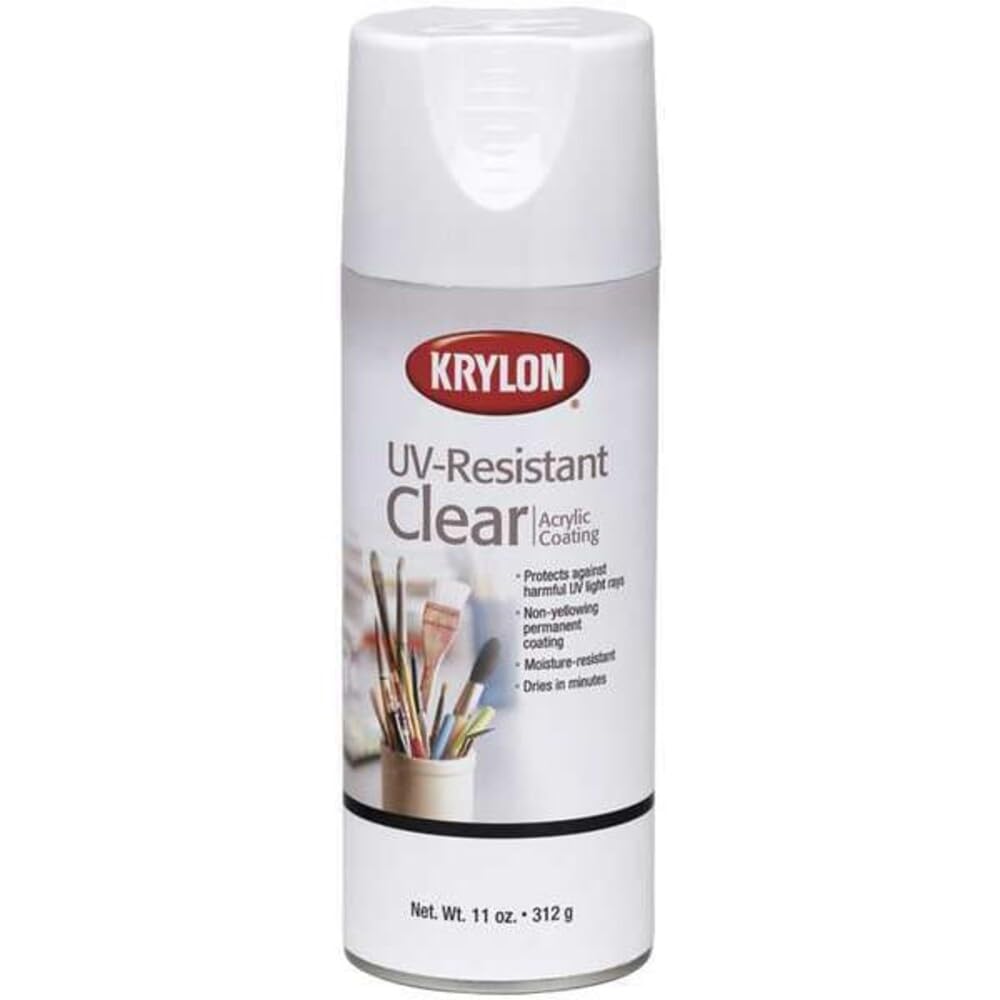
Krylon UV-Resistant Clear Gloss

95 /100
Kirk Score Outstanding
Dry Time
5 hours
Protection
UV and moisture resistant
Stated Surfaces
Plastic, wood, metal, glass, ceramic
Coverage Per Can
15 sq ft
Check Details on Amazon

Pros

  • UV-resistant clear gloss for outdoor plastic
  • Seals a finish against moisture
  • Sprays on smoothly and dries in about five hours

Cons

  • Pricier than either color can here

This is not the can you buy to change a color; it's the one you buy afterward. Krylon's UV-Resistant Clear is a gloss topcoat for sealing a finished piece, and on plastic that lives outdoors — planters, chairs, garden ornaments — the UV resistance is the whole point, since sun is what fades and chalks a painted surface. It sprays on smoothly, needs about five hours to dry, and a couple of light passes finish a small piece in one session.

Clarity is where our enthusiasm cools. A clear coat should disappear, and this one can dry with a faint haze or frosted look, especially over dark colors, leaving some pieces duller than they started. That's a thing you find out on the last coat, so test a scrap of the same plastic or the underside of the piece before committing. Layered over fully cured color — not tacky paint — in thin passes on a dry day, it does what a topcoat should: seals the finish and slows fading.

Fifteen square feet per can covers a couple of small pieces and not much more, and the price sits above either color can here. We think of it as the finishing step on an outdoor project rather than something to keep on the shelf: buy it when something painted is going to sit in the sun, and skip it for indoor plastic that never sees daylight.

Bottom line: Buy this one after the color, not instead of it: a UV clear gloss that slows fading on outdoor plastic, provided a test patch dries clear.

Check Latest Price

How We Tested Spray Paint for Plastic

We started with a shelf's worth of cans — every formula sold for plastic, indoor and outdoor rated, in gloss, satin, and clear — and cut the field to 14 based on what the labels actually promised, the price per ounce, and whether plastic was named on the can or buried under a vague multi-surface claim. Testing ran four months, from the first warm weekend of spring through a summer of sun, sprinklers, and thunderstorms.

Every can got the same prep: a wash with dish soap, a light scuff with a fine pad, and a wipe-down. Then we sprayed in the driveway on mornings between 65 and 80 degrees, counting how far a single can went across chair slats, planters, and marked squares on scrap panels. Some formulas went on wet and thin and needed three passes before the old color stopped showing through; others covered in two. We also noted how each nozzle behaved — fanning evenly or spitting — and whether the can kept spraying when tipped toward the underside of a chair.

For color and finish, we sprayed test cards and held them against the cap in daylight, then looked at sheen a day later for uniform gloss, drips at the edges, and any soft tack. Clear coats went over black and white panels and were checked for haze and yellowing after several weeks in the sun. Durability came from leaving the finished pieces outdoors, then scratching hidden areas with a coin and a thumbnail at one week and again at the end, paying closest attention to edges and corners, where paint lifts first.

How to Choose Spray Paint for Plastic

Check the surface list before the color chart

Almost every all-surface aerosol mentions plastic somewhere on the label, but plastic covers everything from a molded resin chair to a laminated cabinet door, and those are not the same job. Bonding formulas such as Krylon Fusion aim at hard-to-adhere surfaces — laminate, vinyl, glassy molded shells — while a general gloss like our top pick handles textured, mixed-material pieces with less fuss.

Nothing bonds permanently to plastic that flexes, so on wicker or a resin chair that gives under your hand, expect touch-ups along the high points. Tape off a hidden patch and spray that before you commit to the whole piece.

Prep is most of the result

Paint fails on plastic for boring reasons: mold release agents, fingerprints, silicone polish, and a surface too slick to grip. Wash the piece with a degreaser, scuff the gloss with a fine abrasive pad, wipe off the dust, and let it dry completely.

Then build the finish in three thin passes rather than one wet one — the difference between a smooth coat and a run that sags before it sets. Spray in mild, dry weather out of direct sun, because cold plastic and humid air both dull the gloss. Where our top pick has chipped, it has usually been on a surface that got a wipe instead of a scuff.

Coverage math, and why you buy two cans

Coverage figures assume a single thin coat, and plastic generally wants two or three. That turns a stated 12 square feet into something closer to six once you're coating both sides of a chair, so a furniture-sized project is a two-can job whatever the label claims.

Buy the second can at the same time — running out mid-project means a batch change partway through — and keep the receipt on the spare.

Topcoats and outdoor plastic

Sun, not rain, is what kills a painted plastic finish outdoors: UV breaks down the color and leaves it chalky. A clear UV topcoat slows that and seals pinholes in the color coat, which is the reason to add one step to a garden project.

Clear coats have their own failure mode, though — a hazy or frosted film that shows worst over dark colors. Apply it over fully cured color, in thin passes, not on a humid day, and test a scrap first.

Frequently Asked Questions

Final Verdict

Most plastic projects should start and end with Rust-Oleum's 2X. It levels out, it's touch-dry in 20 minutes, and it doesn't care whether the piece is plastic, wood, or metal — which is why it stays our default.

Reach for Krylon Fusion instead when the surface is slick, laminated, or sealed, since adhesion beats convenience there. Add the UV clear coat only when the finished piece will sit in the sun, and test it for haze before the final pass.