Best Overall
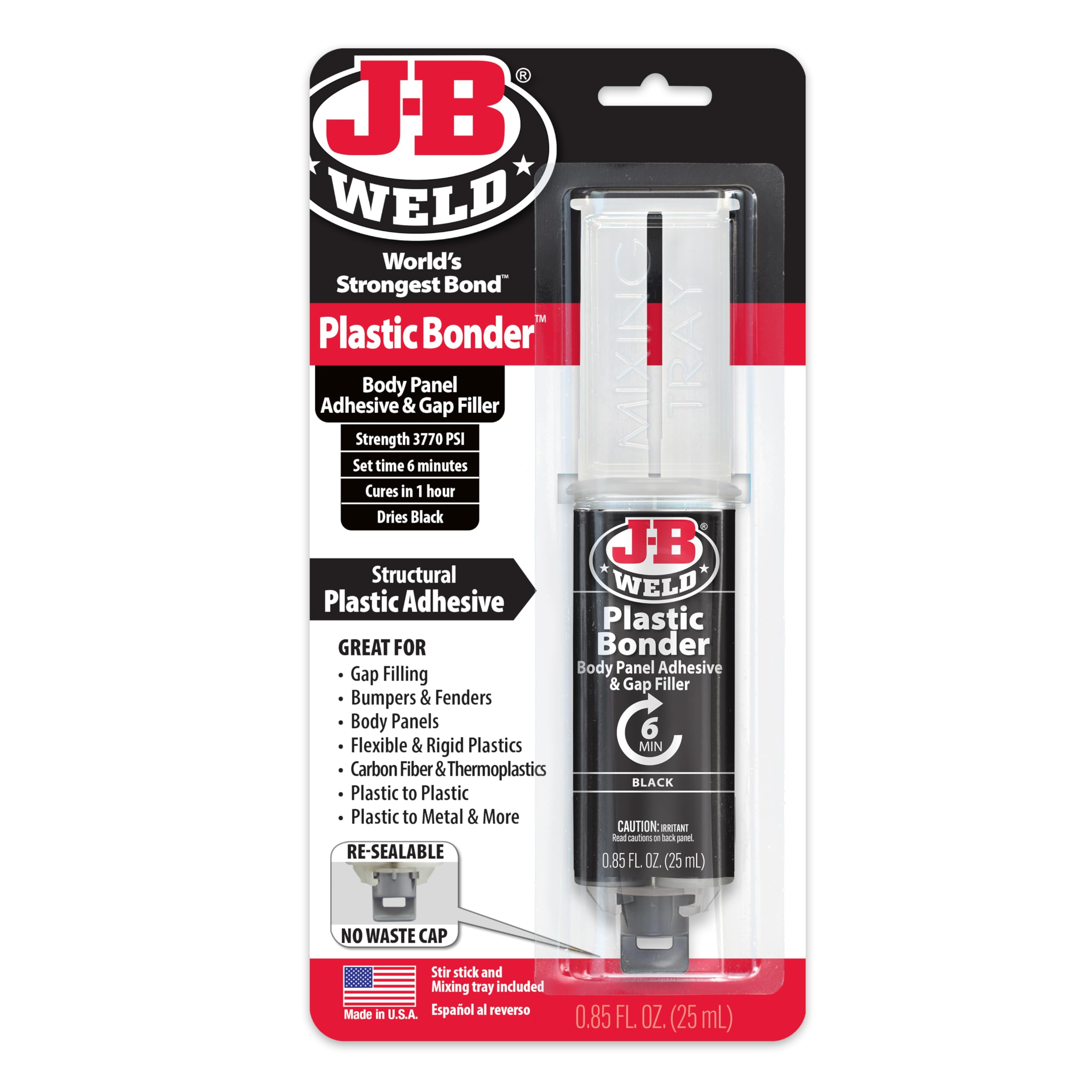
J-B Weld Plastic Bonder
- Set Time
- 15 minutes
- Container
- 25 ml syringe
- Cured Color
- Black
- Tensile Strength
- 3,770 psi
Pros
- Formulated around thermoplastics, with coated metals listed too
- Gap-filling bead sands flush after 30 minutes
- 1:1 syringe with a stir stick in the pack
- Stated 3,770 psi tensile strength
Cons
- Cures black, so it shows on pale or visible parts
- Parts need clamping or support for the first 15 minutes
The plastic is the hard half of a plastic-to-metal repair. Metal will take almost anything you put on it; the joint usually lets go at the plastic face, which is why glues built around steel and hope disappoint people. Plastic Bonder is formulated the other way round — a two-part urethane whose own material list leads with thermoplastics and composites and includes coated metals in the same breath — and that ordering is why it tops this page.
What we appreciated most in use is how much slop the joint tolerates. You get about fifteen minutes before it sets, so brackets, clips, and split mounting tabs can be lined up rather than snatched into place, and the cured bead sands at thirty minutes — enough to file a repaired tab back to fit. It is a real gap filler too, so a missing chunk of plastic gets bridged instead of needing a perfect mating surface.
It is not a universal answer. A polyethylene or polypropylene part shrugs this off the way it shrugs off everything else, so check the molded code before you commit. For a structural repair — a bracket, a hinge plate, a panel tab — a hard, shapeable black bead that outlasts the plastic around it is a fair trade for one detail: it is a black bead, and on a pale housing it will show.
Bottom line: When the plastic is the fragile half of the repair, this is the one we reach for: a urethane made for thermoplastics that also holds coated metal, with a bead you can sand flush.
Check Latest Price