// data-verified

Best Spray Adhesives of 2026

There are two very different products hiding behind the same three words. A permanent spray adhesive grabs and doesn't let go; a repositionable one holds your layout steady while you decide, then releases without tearing the paper. Choose wrong and you either wreck a mock-up you meant to adjust or watch a hem lift by morning — and the can itself matters too, since some lay down a fine mist while others spatter or throw cobweb-like strings across the piece.

I've leaned on both kinds for years, most memorably re-covering a headboard and patching the carpet in a car trunk. This time my team and I ran 16 cans through three months of real projects, from photo mounting to fabric and foam repairs, watching how each one sprayed, how long it stayed workable, and whether the bond held once it cured.

One thing worth knowing before you buy: most bonds people call failures are just impatient ones. Nearly all of these need a minute or two to turn tacky before you press, then keep strengthening for a day, and some solvents will eat foam or thin plastic — test a scrap first. What follows is sorted by the job you're doing, not by brand.

#01

Best Overall

3M Super 77

93 /100
Kirk Score Outstanding
Bond
Permanent
Bond Time
15 seconds to 30 minutes
Cure Time
24 hours
Net Weight
16.8 oz
Check Details on Amazon

Pros

  • Bond window runs 15 seconds to 30 minutes
  • Industrial-grade grab on heavy and light materials
  • Water resistant for shop and outdoor work
  • Midrange price for an industrial formula

Cons

  • Permanent once the open window passes
  • Full cure takes 24 hours before loading

The number that tells you most about Super 77 is the bond window: 15 seconds to 30 minutes. Spray both surfaces, let them flash, and you choose how long you wait before you press — a few seconds for a fast grab, or most of half an hour for a panel that needs lining up.

That range is why we recommend it as the default can for a home repair kit. Most spray adhesives sit at one end or the other: an instant grab that punishes a crooked placement, or a wet film that never quite takes. Super 77 does both jobs, and 3M rates the formula industrial grade, so the tack behind that window is real rather than polite.

In use, the grab arrives fast once the solvent flashes and the bond does not slide afterward, so press from the center out and keep your palm flat. The material list covers the ground a general repair can should: paper, cardboard, fabric, insulation, foam, felt, fiberglass, leather, plastic, metal and wood. It's also rated water resistant, which is why it turns up on automotive trim and shop work as often as on craft projects.

The solvent carrier is what buys that fast tack, and it's the part that demands a little respect: plan on an open window or a garage door, mask the edges of anything you don't want misted, and wipe overspray while it's still wet. That's the price of an industrial formula, and for a can that handles everything from felt to laminate it's a fair one.

Bottom line: Our default can: an industrial-grade permanent bond with a working window short enough for a fast grab and long enough to fix a crooked panel.

Check Latest Price
#02

Best for Repositionable Crafting

Gorilla Heavy Duty Spray

89 /100
Kirk Score Excellent
Bond
Permanent after repositioning
Size
14 oz
Finish
Clear, non-yellowing
Reposition Time
Up to 10 minutes
Check Details on Amazon

Pros

  • Ten minutes of repositioning before the bond sets
  • Clear, non-yellowing, photo-safe finish
  • Controlled fine mist from a wide pad nozzle

Cons

  • Foam and plastic bonds carry label conditions

Ten minutes is a long time in spray-adhesive terms, and it's the reason this is the Gorilla can we keep within reach. Spray, place, lift, shift, press again — the bond doesn't commit until the window closes, so a wrinkled sheet of felt or an off-center photo becomes a fixable mistake instead of a ruined one.

The rest of the can suits the same buyer. Gorilla fits it with a wide pad nozzle that lays down a controlled fine mist rather than a stringy web, and the formula dries clear, with non-yellowing and photo-safe claims behind it — worth knowing if you're mounting prints or working with white felt. Paper, cardboard, fabric, foam board and cardstock are its natural materials.

Don't mistake the window for a removable bond. After ten minutes this is a permanent adhesive, and the ten-minute cure Gorilla lists means you shouldn't test the joint early. For work that needs an instant, high-tack grab on heavier material — laminate, insulation, a headliner — a web spray like 3M Hi-Strength 90 is the better tool.

Bottom line: We recommend it for anything you might need to shift: ten minutes of repositioning makes wrinkled felt, crooked photos and off-center foam board recoverable.

Check Latest Price
#03

Best for Heavy-Duty Repairs

3M Hi-Strength 90

92 /100
Kirk Score Outstanding
Bond
Permanent contact
Net Weight
17.6 oz
Resistance
High heat and moisture
Spray Pattern
Variable-width web
Check Details on Amazon

Pros

  • High-tack web grabs heavy material fast
  • Rated for high heat and moisture
  • Variable-width pattern covers large areas quickly

Cons

  • Web pattern is harder to lay evenly than a mist
  • Not sold in California and some other states

A high-solids contact adhesive that sprays as a web is a different animal from the craft cans here. 3M labels Hi-Strength 90 for industrial use, and the variable-width web is the giveaway: thick strands that build fast instead of a fine, even film.

That pattern is exactly right when the material is heavy or the surface is uneven. A web lays down more solids per pass, fills the texture of insulation and particle board, and 3M rates the formula for high temperature and moisture — which is why it turns up on laminate, office partitions and headliners. Treat it as a contact adhesive: coat both surfaces, let them flash, then join.

We reach for it when the material fights back. On a sheet of laminate or a strip of duct insulation, the extra grab and the heat resistance are worth the premium; on paper, felt or a poster the web is overkill and much harder to control than a mist.

Control is the thing to practice. Hold the can further back than a mist adhesive needs and work in overlapping passes, because the web lands in strings when the nozzle is close. Then plan the cure into the job — 24 hours before the bond takes a full load is a long time to leave a panel flat.

Bottom line: We buy this one for heat, moisture and heavy materials rather than paper, and its industrial labeling means checking state restrictions before you order.

Check Latest Price
#04

Best for Car Headliners

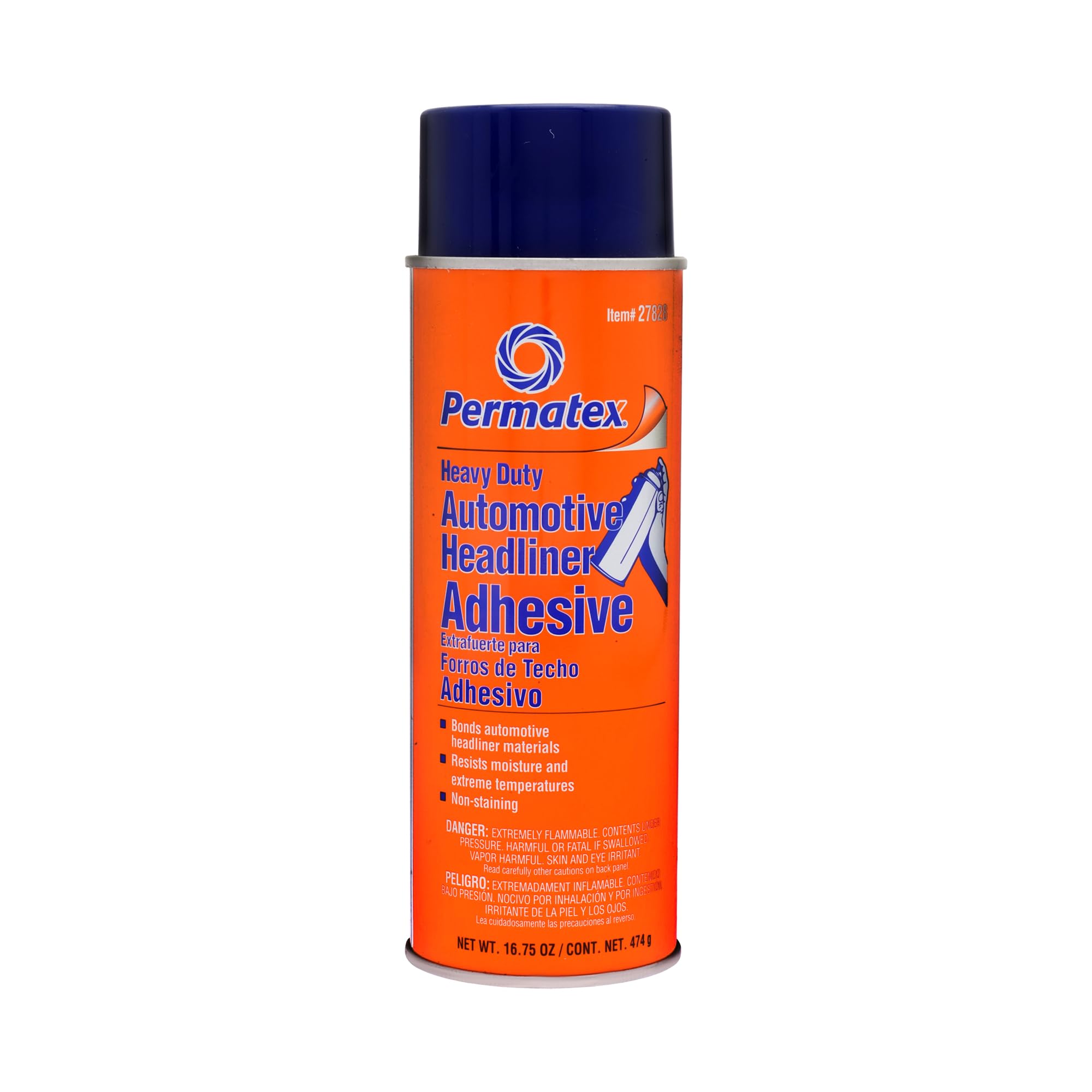
Permatex Headliner Adhesive

89 /100
Kirk Score Excellent
Bond
Permanent
Size
16.8 oz
Cure Time
24 hours
Heat Rating
Up to 170°F
Check Details on Amazon

Pros

  • Holds to 170°F in hot car interiors
  • Dries clear on headliners and carpet
  • Water-resistant formula for door panels and trunks

Cons

  • Slow initial grab; overhead fabric needs holding

A headliner that sags onto the back of your head is why most people buy a can this size, and for interior fabric Permatex is the one we point to first. The number that matters is 170°F: it's the temperature the formula is rated to hold at, and it's the difference between a repair that survives a summer in a parking lot and one that lets go.

The rest is technique. You're bonding fabric to a fiberglass or cardboard shell, often overhead — pull the panel out of the car and lay it flat if you can. Coat the fabric and the shell, let both flash for a minute, then work from the center outward and press with a roller or your palm.

Color is the one thing to test before you commit. High-solids adhesive can ghost through pale fabric as a whitish bloom, so spray a scrap of the same material, let it cure, and check it in daylight. Dark and mid-tone fabrics are far more forgiving, and on those the clear-drying formula does what the label promises.

Bottom line: For a sagging headliner or a loose door panel we start here: a 170°F rating and a clear dry, provided you test the fabric on a scrap first.

Check Latest Price
#05

Best Budget Craft Spray

Elmer's Craft Spray

90 /100
Kirk Score Outstanding
Bond
Permanent
Size
11 oz
Spray
Wide coverage pattern
Finish
Clear, acid-free
Check Details on Amazon

Pros

  • Acid-free and dries clear on paper
  • Wide, even spray for full sheets
  • Lowest price in this group

Cons

  • Built for paper and cardboard, not heavy repair

This is the cheapest can in the group, and it's the one we hand to someone covering a poster board, a foam-core sign or a classroom project.

What the money buys is an even, wide spray, a clear dry and an acid-free formula — the three things that matter when the material is paper and the goals are no wrinkles and no yellowing by spring. Elmer's also lists fast grab on Styrofoam and foam board specifically, which is where cheap craft sprays tend to slide while you're still smoothing.

The pattern is generous, which is the point on a full sheet and a nuisance on a two-inch felt shape: keep a scrap of cardboard behind small pieces and a rag for the overspray, and the reach stops being a problem. It's a solvent aerosol, so a window or a fan is still worth having even at craft-table scale.

Bottom line: We keep this on the craft shelf for paper and foam board: acid-free, clear-drying, even coverage, and the least money of anything in this group.

Check Latest Price
#06

Best for Stencils and Cutting Mats

Krylon Easy Tack

90 /100
Kirk Score Outstanding
Bond
Repositionable
Size
10.3 oz
Reuse
Adjust, remove, reapply
Finish
Clear, non-wrinkling
Check Details on Amazon

Pros

  • Repositionable tack lifts and re-sets repeatedly
  • Non-wrinkling and low odor for indoor work
  • Works on stencils, foam, glass and photos

Cons

  • Grip drops off on rough or dusty surfaces

Where Super 77 commits, Easy Tack lets go. They solve opposite problems: one is a permanent bond with a short working window, the other a light repositionable tack you can lift and re-set as often as the job needs — Krylon says the tack holds through the life of the bond.

It's the can for stencils, templates and cutting mats. A stencil sprayed on the back sits flat against a wall or a board without creeping while you work, and the low-odor, non-wrinkling formula means you can do it at the kitchen table rather than in the driveway. It also handles glitter, trims and craft foam, which are the materials that tend to slide.

The job we buy it for is the one that has to come apart cleanly afterward: stenciled walls, temporary signage, a template reused across six more boards. What it isn't is a glue. It holds material flat rather than under load, and for anything permanent you want an entirely different can.

Bottom line: We reach for this one when the job has to come apart again: a light, low-odor tack for stencils, templates, and cutting mats.

Check Latest Price
#07

Best for Temporary Mounting

Scotch Spray Mount

91 /100
Kirk Score Outstanding
Bond
Removable
Size
10.3 oz
Finish
Acid-free, photo safe
Residue
Rubs off when dry
Check Details on Amazon

Pros

  • Acid-free and photo safe for archival work
  • Excess adhesive rubs off cleanly
  • Fine mist with minimal overspray

Cons

  • Temporary hold only, not a permanent bond

Acid-free, photo safe and won't yellow: Spray Mount's claims are all about what the work looks like in ten years rather than how fast it grabs today. That's the right priority for a can aimed at photographs, proofs and presentation boards.

Removable is the operative word. You get a secure tack that lets you lift and re-place a print while you line it up, and the excess rubs off with a thumb or a soft eraser once it's dry — which is what keeps a finished mat looking clean instead of grubby at the corners.

The mist is the finest of anything here. 3M describes an even, fine spray with minimal overspray, and that tracks with what we saw: you can hit the back of a print without a fog of adhesive settling over the face of it. A little covers more paper than you expect.

It's a specialist's can at a specialist's price, and for photo mounting and layout work that's a fair trade — the clean lift and the acid-free chemistry are the reason to pay it. For a kid's poster or a quick template, the cheaper craft cans here do the same job.

Bottom line: For photographs and layouts that have to lift clean, this is our pick — acid-free, removable, and the finest mist in this group.

Check Latest Price
#08

Large flat panels

Krylon All-Purpose Spray

89 /100
Kirk Score Excellent
Bond
Permanent
Size
11 oz
Finish
Acid-free, non-yellowing
Open Tack
Extended
Check Details on Amazon

Pros

  • Extended open tack for large panels
  • Non-wrinkling, non-yellowing and acid-free
  • Dries clear in about 30 minutes

Cons

  • Not water resistant, so indoor use only

Extended open-tack time is the phrase on the can, and it's the reason to pick this one over a cheaper craft spray. On a large sheet — a poster, a backing panel, a piece of decoupage — the film stays workable long enough to smooth from the center out and chase a bubble to the edge without starting over.

The rest of the spec sheet is aimed at paper: non-wrinkling, dries clear, non-yellowing, acid-free and archival safe. Krylon lists scrapbook layouts, paper crafts on cardboard, fabric, balsa, felt, photos and decoupage, and the 30-minute cure keeps a flat project flat.

We keep it for panels bigger than a sheet of paper, where a slow film is an advantage rather than a test of patience. On small pieces the extra open time buys you nothing, and Elmer's does the same job for less.

Against the other craft cans here it's the slower, more deliberate one, and that's the trade: you wait longer for the bond to set in exchange for the time to get a large sheet down flat. If wrinkles are the enemy, the wait is worth it.

Bottom line: We choose it for large paper panels where the film needs to stay workable; small pieces gain nothing from the long open time.

Check Latest Price

How We Tested Spray Adhesives

We began by splitting the category into its actual jobs: permanent bonding, temporary holding, high-tack structural work, and craft or photo-safe mounting. From there we filtered by the materials each can claims to handle — paper, cardboard, foam, fabric, laminate, metal, wood, carpet — and by price per usable ounce, then bought 16 cans spread across those groups. Testing ran three months.

Each can was used where these things really get used: on the garage bench for cardboard and laminate, at the kitchen table for photo mounting and craft paper, and in an older car for a sagging headliner and loose trunk carpet. We sprayed scrap panels from about ten inches out and noted whether the can laid down an even mist, spattered, or threw strings, and whether the nozzle clogged between sessions.

Tack got checked by pressing strips at one minute, five minutes, and half an hour, recording whether the glue was still wet, stringy, or properly sticky. Bonds cured for 24 and 72 hours, then took a hand pull and, where it made sense, a hanging weight. Paper samples sat in a sunny window for two weeks so we could see which ones yellowed.

For value, we weighed cans before and after each project to see how much adhesive actually left the nozzle — a cheap can that half-works is the most expensive thing in this category.

How to Choose a Spray Adhesive

Permanent, Repositionable, or Removable

These three words are not marketing filler. A permanent spray such as 3M Super 77, Elmer's or Krylon All-Purpose is the right choice for anything structural: headliners, laminate, mounting board, insulation. A repositionable tack such as Krylon Easy Tack holds material flat but lets you lift and re-set it, which is what you want under a stencil. A removable adhesive such as Scotch Spray Mount stays temporary by design and lifts clean.

The trap is the middle ground. 'Repositionable' on a permanent can like Gorilla Heavy Duty means you have minutes to adjust, not months to change your mind. Read which of the three you're actually buying before you spray the first panel.

Working Time: Seconds, Minutes, or Half an Hour

Working time is the gap between spraying and pressing, and it decides how large a piece you can handle alone. A fast grab suits small parts and vertical work; a long window suits full sheets that need smoothing from the center out. 3M Super 77 spans both, from roughly 15 seconds to 30 minutes depending on how long you let the film flash.

If you're covering anything bigger than a poster, spray a test strip first and time how the film feels as it sets. That two-minute experiment tells you more than any claim on the can.

Mist or Web: Match the Pattern to the Material

A fine mist is the right pattern for paper, photographs, felt and fabric. It wets the surface without soaking through, and soak-through is what causes wrinkles, bleed and ghosting on pale material. A high-solids web, like the one 3M Hi-Strength 90 lays down, is for heavy or uneven material: laminate, insulation, foam, headliner cloth. Webs build thickness fast and fill texture, but they land in strings if the nozzle is too close, so keep more distance than a mist needs.

Heat, Moisture, and Where the Bond Lives

Indoors and outdoors are different products. A headliner above your seat reaches temperatures that soften a general-purpose adhesive, which is why Permatex rates its formula to 170°F and 3M gives Hi-Strength 90 a high-temperature rating. Outdoors, water resistance matters more than raw strength.

Some cans are strictly indoor products: Krylon All-Purpose is not water resistant, so anything that lives on a porch, in a garage or in a car should get a different adhesive. Match the can to the worst condition the bond will see, not the best.

Can Size, Ventilation, and State Rules

Most cans in this group run from about 10 to 18 ounces, and a full headliner or a wall of insulation takes more than one. Buy the second can with the first rather than stopping mid-panel with adhesive half-flashed.

Every aerosol here is flammable, so ventilation isn't optional — a garage door, a fan, a driveway. A few formulas are also restricted: 3M sells Hi-Strength 90 for industrial use and does not offer it in California or several other states, so check before you order a can you can't return.

Frequently Asked Questions

Final Verdict

If you buy one can and want it to cover the most ground, make it 3M Super 77. The 15-second-to-30-minute window means it works whether you're patching a small tear or lining up a full panel, and the industrial tack holds on fabric, foam and laminate as readily as on paper.

If you know you'll be shifting the material after you press it, buy Gorilla Heavy Duty Spray instead — ten minutes of repositioning forgives a lot of crooked work. And if the piece has to lift clean later, Scotch Spray Mount is the can we keep for photographs and layouts.