// data-verified

Best Bathroom Exhaust Fans with Light of 2026

Nobody buys a bathroom fan because they want one. You buy one because the old one sounds like a leaf blower with a cold, or because the paint above the shower is starting to blister while the mirror stays fogged long after anyone has left the room.

The trouble is that quiet and powerful pull against each other in this category, and the light is usually an afterthought — a fan can clear steam beautifully and still wash your tile in a blue-white glare. Over eight months, my team installed 12 fans in our own bathrooms and in a few volunteers' homes, and the differences came down to far more than the sone rating printed on the box.

One piece of advice for first-time buyers: that number means little if the duct behind the fan is undersized, and a fan you can hear from the bedroom is one you'll stop running. What follows are the ones we'd put back in our own ceilings — quieter, brighter, and a good deal easier to live with than what they replaced.

#01

Best Overall

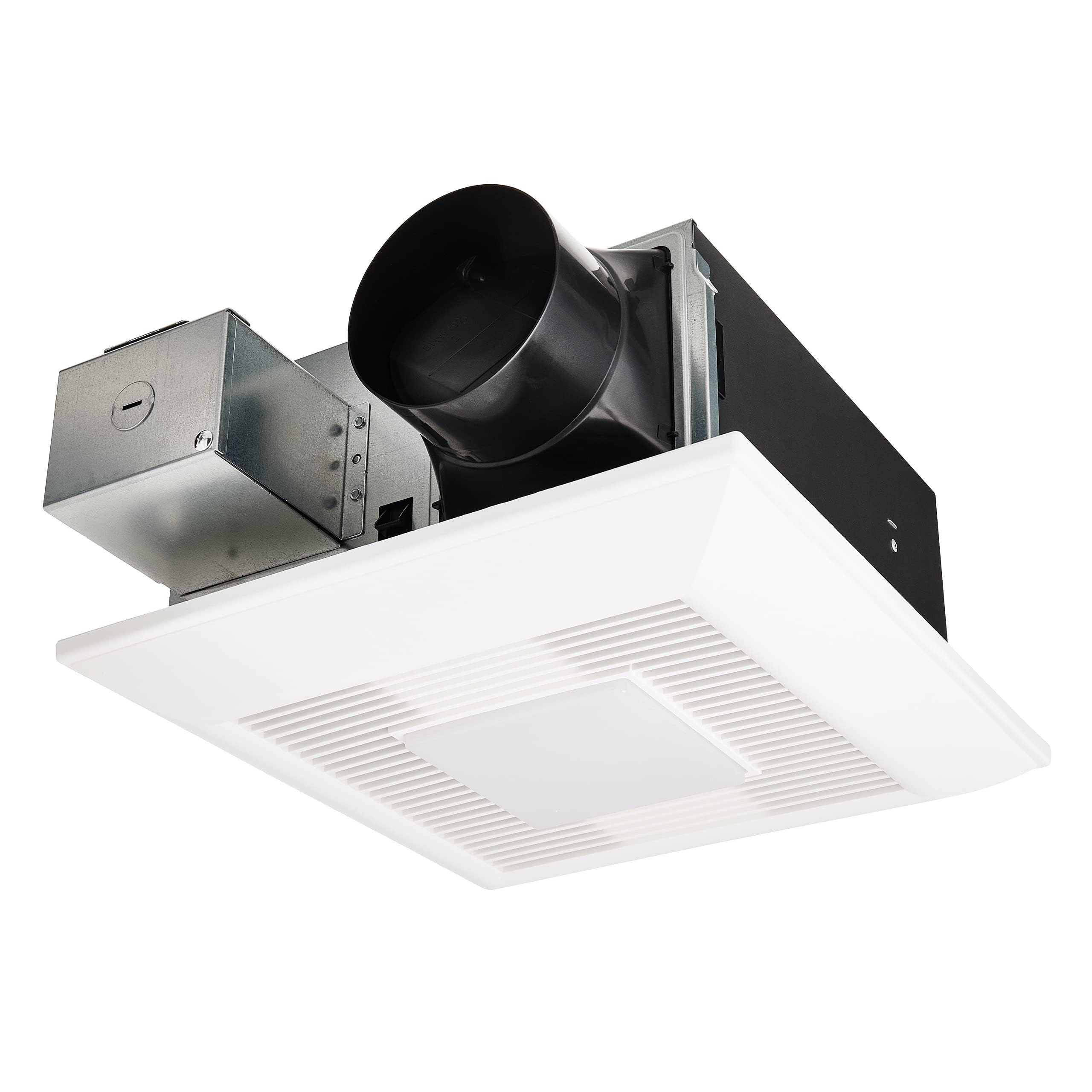
Panasonic WhisperFit FV-0511VFL1

92 /100
Kirk Score Outstanding
Light
Dimmable LED, night light
Noise
0.8 sone
Airflow
50, 80, or 110 CFM
Housing
10.25 x 10.25 x 5.6 in.
Check Details on Amazon

Pros

  • 50, 80, or 110 CFM from one fan
  • 0.8 sone, the quietest in this group
  • Dimmable LED plus a night light
  • Roomside install with the Flex-Z bracket

Cons

  • Premium price next to the budget picks
  • Tops out at 110 CFM; big baths want more

A switch on the side of the housing sets this Panasonic at 50, 80, or 110 CFM, and that is why we put it at the top of this list. Most fans make you commit to a room size at the register. This one lets you set a powder room at 50 and a full bath at 110, and if you finish the basement or rework the bathroom later, you flip the switch instead of buying another fan.

It is also the quietest fan in this group at 0.8 sones, against 1.0 for the Broan and Fitop picks and 2.5 for the Yorkshire — a gap you notice the moment the door is shut. The brushless DC motor is what buys that, and the ENERGY STAR rating matters for a fan that ought to run most days. The light is a 10-watt dimmable LED with a separate night light that draws under a watt, so in a small bathroom this can be the only ceiling fixture and still be usable at 2 a.m.

Installation is the other half of the argument. The Flex-Z bracket is a single-hinged arm that lets you position the housing and drive the screws from below, so a retrofit does not require a trip into the attic. The housing measures 10.25 inches square and 5.6 inches deep, worth holding a tape against the hole your old fan left. One quirk: it comes up to speed slowly, roughly half a minute from a cold start. That is the soft-start motor rather than a fault, and once you know it is coming it stops being a surprise.

Bottom line: Our default for any bathroom we actually use: 50, 80, or 110 CFM from one housing, the quietest motor in this group, and a dimmable light with a night light.

Check Latest Price
#02

Best for a Standard Hall Bath

Broan-NuTone AE110LK

89 /100
Kirk Score Excellent
Light
Integrated LED
Noise
1.0 sone
Grille
12.25 x 12.25 in.
Airflow
110 CFM
Check Details on Amazon

Pros

  • 110 CFM at just 1.0 sone
  • Installs entirely from the room side
  • Bright integrated LED module
  • TrueSeal damper closes off backdrafts

Cons

  • Grille can sit slightly proud of the ceiling
  • One speed, no night light, no color choice

A 1.0-sone rating at 110 CFM is a genuinely quiet fan for a full bathroom, and the AE110LK gets you there with the least fuss of anything here. No airflow selector, no color-temperature switch, no app. You wire it, seat the grille, and it moves air.

That simplicity is the appeal in a standard hall bath, where the fan should be forgettable. The integrated LED leans cool rather than warm, closer to daylight than to the amber night light on the Panasonic, which suits a room where a vanity fixture is doing the ambient work. Broan's TrueSeal damper is a real bonus in a cold climate: it closes against backdrafts when the fan is off, so the vent is not an open hole in your ceiling's air barrier all winter.

Roomside installation means the whole job happens from the ceiling opening, with no crawl through insulation, and the unit is backed for three years. Where it gives ground to the top pick is scope — one speed, one light color, no night light. For a 100-square-foot bath where you want the fan to be invisible and the job finished in an afternoon, we do not think any of that costs you anything.

Bottom line: A hall bath does not need much more than this: 110 quiet CFM, a bright integrated LED, and a roomside install that skips the attic entirely.

Check Latest Price
#03

Best for Large, Steamy Bathrooms

OREiN OL17003 160 CFM

85 /100
Kirk Score Excellent
Light
1500 lm, 3 color temps
Noise
1.0 sone
Cutout
11.81 x 11.02 in.
Airflow
160 CFM
Check Details on Amazon

Pros

  • Auto-starts at 60% humidity
  • 160 CFM at 1.0 sone
  • 1500 lumens with three color temperatures
  • Soft 2200K night light

Cons

  • 17.6 pounds

The humidity sensor in this OREiN changes how the bathroom gets used. It watches the air and starts the fan once humidity passes 60%, about the point where a hot shower begins fogging the mirror, then runs until the room dries out. Nobody has to remember anything, which is the failure mode of nearly every bathroom fan ever installed.

It is also the most powerful fan here that stays quiet while it works: 160 CFM at 1.0 sone, enough for a large primary bath or one with a jetted tub. The light is the brightest in this group at 1500 lumens, and it switches between 3000K, 4000K, and 5000K on the unit. A 2200K night light mode comes on with a double flip of the wall switch, which sounds gimmicky until you are the one walking in at night.

The catch is the hole. This one wants an 11.81-by-11.02-inch cutout and hangs 8 inches deep, well beyond the 7.5-inch openings the Fitop and the black Akicon use, so measure the ceiling before you order. That measurement is the one we make first, every time. At 17.6 pounds it is also the heaviest unit here, and the lift is easier with a second person. If you are cutting new drywall for a remodel, neither point slows you down.

Bottom line: For a big, steamy bathroom the humidity sensor does the thinking — 160 CFM and 1.0 sone, with the brightest light on this list.

Check Latest Price
#04

Best for Small Bathrooms

Broan-NuTone 744

90 /100
Kirk Score Outstanding
Duct
4 in. round
Light
75W R30/BR30 bulb
Noise
1.5 sones
Airflow
70 CFM
Check Details on Amazon

Pros

  • Looks like a recessed ceiling light
  • Quiet 1.5 sones at 70 CFM
  • Standard R30/BR30 socket you can re-lamp
  • Budget price for a discreet fan

Cons

  • 70 CFM suits small bathrooms only

No LED module, no color-temperature switch, no dimming. The Broan 744 is a recessed light can with a fan behind it, and it takes a standard 75-watt R30 or BR30 bulb you screw in yourself — a design that reads like a step backward until you see it in a ceiling alongside actual recessed lights.

That is the trick of it. The trim is matched to the major recessed-light brands, so the fan sits in a row of cans without announcing itself, which is more than a white grille can claim. The housing is 6.87 inches high and shaped for 2-by-8 joists, making this a new-construction or open-ceiling installation rather than a roomside swap. Know that going in and the job goes smoothly.

We like it for exactly that disappearing act, and for the socket. Choosing your own bulb means choosing the color temperature, and replacing it later is a hardware-store errand rather than a new fixture. At 1.5 sones it is quiet for its size, and the 4-inch round duct connector matches what is already in most ceilings.

Bottom line: When the fan has to vanish into a row of recessed lights, this is it: 70 CFM, 1.5 sones, and a bulb you choose yourself.

Check Latest Price
#05

Best Budget

Fitop BPT13B-110L13

84 /100
Kirk Score Excellent
Light
1200 lm, 3 color temps
Noise
1.0 sone
Cutout
7.75 x 7.5 in.
Airflow
110 CFM
Check Details on Amazon

Pros

  • 110 CFM and 1.0 sone at the lowest price here
  • 1200 lumens with three color temperatures
  • Drops into a 7.75 x 7.5 in. opening
  • Galvanized steel housing

Cons

  • Light color resets each time the switch is flipped

Least expensive here, and it still lists 110 CFM, 1.0 sone, and a 1200-lumen LED — the kind of arithmetic that usually means something got left out. We went looking for the missing piece and did not find much.

The housing is galvanized steel rather than the plastic a fan at this end of the range usually gets, and the 1.0-sone motor is quiet enough that you will leave it running. Installation happens from below through a 7.75-by-7.5-inch opening, small enough to slip into holes left by plenty of older fans, and ETL listing covers the electrical side. The light is brighter than the Broan AE110LK's and offers three color temperatures.

Where it trails the pricier picks is refinement, not function. The trim does not sit quite as flush against the ceiling, and the switch gear feels a step less finished in the hand. For a hall bath, a basement bath, or a rental where you are replacing a screaming builder-grade fan without spending much, neither will bother you.

Bottom line: Buy this one when the budget is the deciding factor: 110 CFM and 1.0 sone, plus a genuinely bright light, for the least money here.

Check Latest Price
#06

Black fixtures

Akicon BPT13-14NK2-B

86 /100
Kirk Score Excellent
Light
Dimmable LED, night light
Noise
2.0 sones
Cutout
7.6 x 7.3 in.
Airflow
80 CFM
Check Details on Amazon

Pros

  • Matte black finish for dark bathrooms
  • Dimmable LED with three color temperatures
  • Separate 3.5W night light
  • Compact 7.6 x 7.3 in. cutout

Cons

  • 2.0 sones is audible next to the quiet picks

Almost every fan here is white, because almost every ceiling is white. This Akicon comes in matte black, which is the whole reason to look at it if your bathroom has matte black fixtures, dark tile, or a black shower frame — a white grille in that room looks like a mistake someone made.

The light package is better than a finish-first product usually gets: a 15-watt LED that dims, three color temperatures at 2700K, 4000K, and 5500K, and a separate 3.5-watt night light. The square trim is 11 inches across, so it reads as a fixture rather than a vent, and the whole unit weighs 6.6 pounds.

Airflow is 80 CFM at 2.0 sones — fine for a small or mid-size bathroom, noticeably more audible than the 1.0-sone fans here. In a powder room nobody will care. In a bathroom that shares a wall with a bedroom, you will.

The cutout is 7.6 by 7.3 inches, so it drops into a compact opening, and it is UL and HVI listed with a three-year guarantee. We were struck by how few black bathroom fans exist that also light a room properly; if the ceiling has to match the plumbing, the field narrows fast.

Bottom line: The rare black bathroom fan that also lights the room well: dimmable three-color LED, a night light, and 80 CFM in a compact cutout.

Check Latest Price
#07

Decorative baths

Good Housekeeping Yorkshire 90053

87 /100
Kirk Score Excellent
Duct
4 in. round
Light
Glass shade
Noise
2.5 sones
Airflow
80 CFM
Check Details on Amazon

Pros

  • Decorative glass shade looks like a light fixture
  • Tool-free re-lamping and cleaning
  • Listed for installation over a shower or tub
  • 80 CFM at a modest price

Cons

A brushed nickel rim around white swirled glass: this is the one fan here that reads as a light fixture rather than a vent, and in a traditional bathroom with nickel faucets it is the only one that will not look like an afterthought.

Underneath is an 80 CFM fan at 2.5 sones, the loud end of this group — you will hear it from the next room, and the ventilation is adequate rather than impressive. The glass and the trim are what you are paying for. The screwless design lets you drop the shade to clean or re-lamp without hunting for a screwdriver, a nicer detail than it sounds in a room that steams up daily.

What we keep coming back to is the ETL rating for installation over shower enclosures and tubs on a GFCI circuit, since the shower ceiling is exactly where people want the fan and exactly where a lot of fixtures are not rated to go. Five years on the motor, one on the parts. Buy it for the look and that rating.

Bottom line: A style-first fan that earns its keep: glass shade, brushed nickel trim, a listing for installation over the tub, and 80 CFM at 2.5 sones.

Check Latest Price

How We Tested Bathroom Exhaust Fans with Lights

We started with roughly 40 fans sold by the major retailers and narrowed that to 12 by matching CFM ratings to the actual square footage of our test bathrooms, checking each unit's ceiling cutout against the holes already in our ceilings, and favoring models that didn't demand attic access or a second pair of hands. We kept notes on what each step up in price bought you, since a fan with a nicer grille and a dimmable light costs real money. Testing ran about eight months across a main family bath, a kids' bath that sees three showers a night, and a basement bath with a long, undersized duct run.

Installation went first: I timed every swap from opening the box to flipping the switch, noted whether the housing dropped into the existing cutout or needed drywall patched, and wrote down each step that genuinely required two people. Performance got judged with a stopwatch and a fogged mirror — after a 15-minute shower, how long until I could see myself again, and whether condensation still beaded on the ceiling paint above the tub.

For noise, I took decibel readings at ear height from the doorway, then stood in the hallway and in the bedroom with the door shut to hear what actually carried, and paid attention to hums and rattles rather than the overall volume alone. Light got checked at the vanity: brightness on the counter, how low each fixture dimmed, whether the night light was a soft glow or a glare, and how skin looked under each color temperature setting while shaving or putting on makeup. Every month I wiped the grilles, listened for new rattles, and watched for yellowing plastic, finish wear, or a motor that had gotten louder with use.

How to Choose a Bathroom Exhaust Fan with Light

Size the Fan to the Room

The working rule is about 1 CFM for every square foot of floor with an 8-foot ceiling, so a 5-by-8 bath needs roughly 40 CFM and a 10-by-10 needs 100. That puts 50 and 80 CFM fans in most small bathrooms and 110 in a full one; Broan rates its 110 CFM unit for rooms up to 105 square feet, and OREiN rates its 160 CFM unit to 160. Step up for ceilings over 8 feet, a jetted tub, or two shower heads.

Resist the urge to simply buy the biggest number. An oversized fan on a long, narrow, or flexible duct cannot deliver its rated airflow, and the cure is smoother ductwork, not a larger motor.

Sones Decide Whether You Actually Use It

The fans here run from 0.8 to 2.5 sones, and the gap is wider than the numbers suggest, because sones are a linear loudness scale: 2.5 sones sounds roughly three times as loud as 0.8. Below 1.5 is quiet enough to talk beside, 1.0 is quiet enough to forget, and 2.5 is a fan you hear from the hallway with the door shut.

If the bathroom shares a wall with a bedroom, put your money into sones before you put it into features. A fan nobody runs because it is annoying is worse than a cheap one that gets used.

Measure the Hole Before Anything Else

Retrofit fans are sold on their cutout, and the spread here is wide: 7.6 by 7.3 inches for the black Akicon, 7.75 by 7.5 for the Fitop, 11.81 by 11.02 for the 160 CFM OREiN, and a 10.25-inch square housing on the Panasonic. Measure the opening your old fan leaves and compare it with the housing, not the grille that covered it.

Roomside installation means you never climb into the attic to mount the fan, but you still have to reach the duct through that same hole. Confirm the existing duct is 4-inch round and long enough to reconnect before you buy, and remember that a 3-inch run will throttle even a 160 CFM unit.

The Light Is Half the Purchase

Lumen output matters as much as fan speed. If the fan is the room's only ceiling fixture, the 1500-lumen OREiN or the 1200-lumen Fitop will light a shower properly; if it supplements a vanity, something nearer 1000 lumens is plenty. Color temperature is the second decision: 2700 to 3000K reads warm and residential, 4000K is neutral, and 5000K looks clinical in a small tiled room.

Models with selectable color temperature let you change your mind after the drywall is up, which is worth a small premium. Dimming and a separate night light matter most in a bathroom someone uses at 3 a.m.

What the Extra Money Buys

Three things separate the budget fans from the expensive ones: the motor, the housing, and the light. A DC motor like the Panasonic's runs at 0.8 sones and ramps gently; a basic AC motor is louder and simpler. Steel housings hold up better than plastic in a damp ceiling, and a sealed damper keeps cold air from pouring down the vent in January.

Integrated LED panels are slimmer and brighter, but you do not re-lamp them the way you can the 744's screw-in socket. Warranties run three to five years, which is worth comparing for a fixture that lives in the wettest air in the house.

Frequently Asked Questions

Final Verdict

The Panasonic FV-0511VFL1 is what we recommend for most bathrooms. The 50/80/110 CFM selector means it fits the room you have now and the one you remodel later, the 0.8-sone motor is the quietest here by a wide margin, and the dimmable light with a night light lets it serve as the only fixture on the ceiling.

If the budget is the deciding factor, the Fitop gets you 110 CFM and 1.0 sone for far less. If the bathroom is large and steamy, the OREiN's humidity sensor and 160 CFM solve a problem nothing else on this list does.