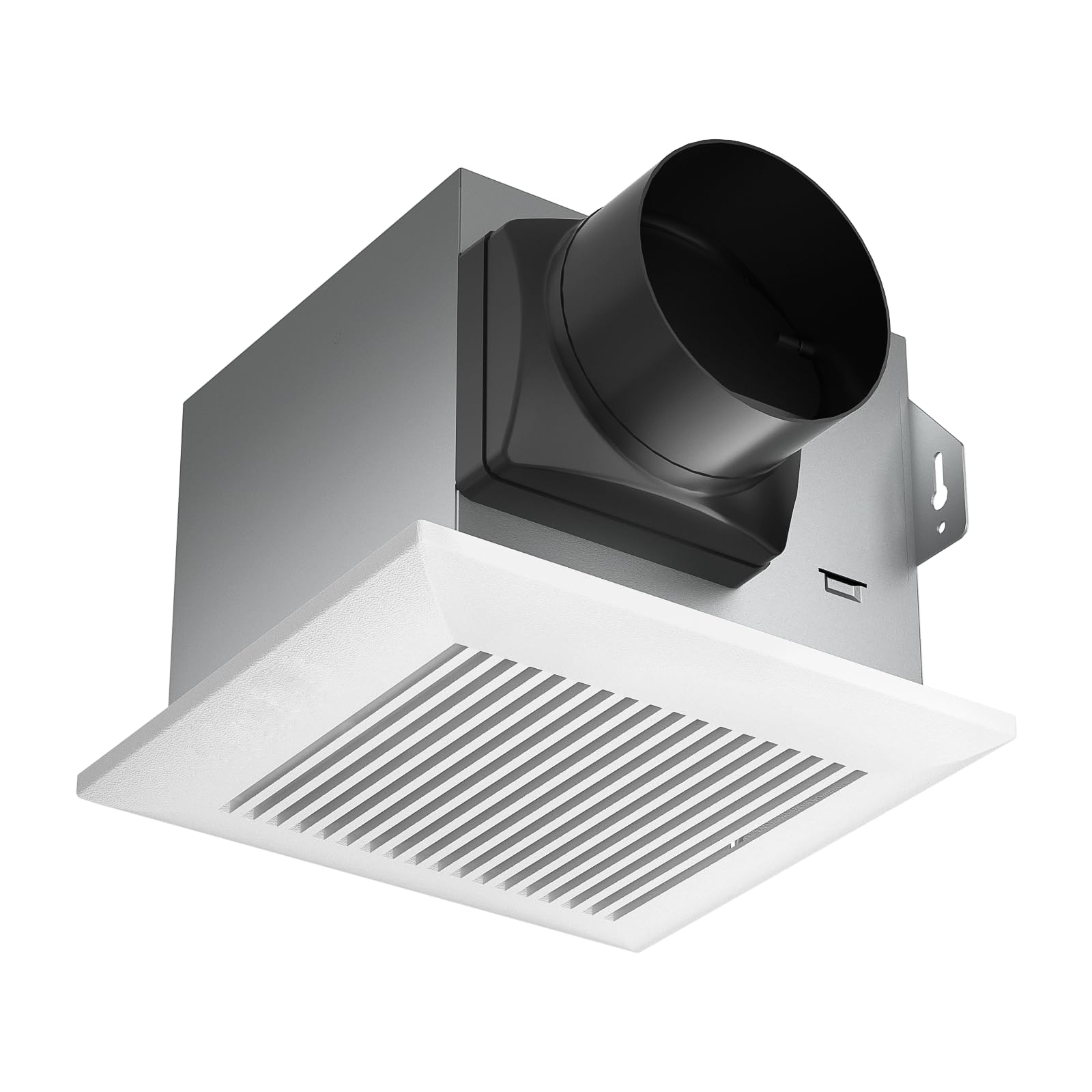
// data-verified

Best Bathroom Exhaust Fans of 2026

A bathroom exhaust fan is the rare home appliance you notice only when it quits: the mirror stays fogged, the towels smell like a damp basement, the paint above the tub blisters. What you want is a fan that clears the room and stays quiet enough that you actually switch it on — a smaller club than the packaging suggests. We installed and lived with 10 fans over six months, from 50 CFM units for a powder room to a 290 CFM model for a full bath.

CFM and sones decide everything, and they pull against each other: the quietest fan is useless if it can't clear the mirror, and the strongest one gets flicked off in ten seconds if it sounds like a jet taxiing. Installation is the part nobody mentions — whether the housing drops into your existing ceiling opening, and whether you can work from below or crawl through the attic, shapes your choice more than a tenth of a sone does. The picks below run from small-room units that barely whisper to high-CFM workhorses you can mount without going near the attic.

#01

Best Overall

Panasonic FV-0510VS1 WhisperValue

91 /100
Kirk Score Outstanding
Mounting
Ceiling or wall
Noise Level
0.9 sone
Housing Depth
3-3/8 in.
Airflow Options
50 / 80 / 100 CFM
Check Details on Amazon

Pros

  • Fits 3-3/8-inch ceiling cavities
  • Selectable 50, 80, or 100 CFM
  • 0.9 sone at full speed
  • Ceiling or wall mount, six-year motor warranty

Cons

  • 100 CFM ceiling rules out large baths

Three and three-eighths inches of housing depth decides more of these installs than any airflow figure on the box. In a hall bath with a shallow ceiling cavity, most fans mean cutting joists or dropping the ceiling; this Panasonic slips into the space that is already there, and it is the shallowest fan in this group. That, plus three selectable airflows and a 0.9-sone rating, is why it is the one we recommend first.

Pick-A-Flow is the part we appreciate most. A switch on the unit sets the fan to 50, 80, or 100 CFM, so one model covers a powder room or a full family bath, and you can turn it up later if the room turns out bigger than you judged. Since a fan can only move what the duct allows, going straight to 100 CFM on a long, sagging flex run buys less than the label suggests — keep the run short and the duct rigid where you can.

The duct collar is the one thing to sort out before the ceiling is open. It is not shaped like a plain 4-inch round fitting, so a standard round duct may need an adapter to seat properly. That is a small part and a second trip to the hardware store, not a reason to pass, but it is the sort of detail that turns a forty-minute swap into an afternoon if you find out halfway through.

Panasonic also covers the motor for six years, matched here only by the big WhisperCeiling, and the ceiling-or-wall mounting matters more than it sounds in a basement bath where the ceiling is concrete or already crowded with ductwork. What keeps this at the top for us is the combination rather than any single figure: shallow enough for the ceilings that force compromises, quiet enough that nobody reaches to turn it off, and adjustable enough that you are not guessing airflow before you know the room.

Bottom line: Our default pick: three selectable airflows, a 3-3/8-inch housing that fits shallow ceilings, and 0.9-sone running you won't switch off.

Check Latest Price
#02

Best for Large Bathrooms

Panasonic FV-30VQ3 WhisperCeiling

88 /100
Kirk Score Excellent
Airflow
290 CFM
Noise Level
2.0 sones
Bracket Span
Up to 24 in.
Motor Warranty
6 years
Check Details on Amazon

Pros

  • 290 CFM for genuinely large bathrooms
  • Quiet for its capacity at 2.0 sones
  • Rated for continuous operation
  • Six-year motor warranty

Cons

  • Installation is a real project
  • Premium price for the airflow

Two hundred and ninety cubic feet per minute is more fan than most bathrooms can use, and that is exactly the point. This is the answer for the room where a 110 CFM unit runs through a whole shower and the mirror still fogs: a big primary bath, a bathroom with two shower heads, or a space with a vaulted ceiling that traps steam up high where a small fan never reaches it. At roughly one CFM per square foot, it is built for a room in the 250 to 300 square foot range.

What surprises us is how little noise comes with that much air. Two sones puts it quieter than most of the fans here, despite moving close to three times the airflow of our top pick, and the wide double-tapered blower wheel moves the volume without the roar the number would suggest on a lesser fan. The galvanized housing is heavy-gauge and rust-resistant, the bracket adjusts up to 24 inches to span joists, and it is rated for continuous operation — so a timer or humidity control can leave it running without worry. Panasonic covers the motor for six years.

The catch is everything around the fan. A 290 CFM unit needs a larger ceiling opening, a bracket span across the joists, and ductwork that can actually carry the air; on a long run of 4-inch flex duct you spend the money and collect a fraction of the benefit. We treat this as a planned project rather than a Saturday swap, and it only makes sense when the room and the duct behind it are both big. In a standard hall bath it is simply more fan than the space can use.

Bottom line: We recommend it when the room is the problem, not the fan: 290 CFM clears a big, steamy bathroom at 2.0 sones, though we treat the install as a project.

Check Latest Price
#03

Best Without Attic Access

Broan-NuTone AE80B

89 /100
Kirk Score Excellent
Airflow
80 CFM
Room Size
Up to 75 sq. ft.
Noise Level
0.7 sone
Installation
Roomside, no attic access
Check Details on Amazon

Pros

  • Installs entirely from below the ceiling
  • 0.7 sone, the quietest here
  • TrueSeal damper cuts backdraft
  • Listed for use over tub or shower

Cons

  • One fixed speed, no airflow adjustment

If your attic is a foot of blown insulation and a maze of flex duct, this spec matters more than any other: the AE80B installs entirely from below. The housing mounts to the joists through the existing opening, the wiring and duct connect at the fan, and nobody climbs into the fiberglass. For a lot of houses that is the difference between replacing a noisy fan this weekend and living with it for another five years.

At 0.7 sones it is the quietest fan in this group, and 80 CFM covers a bathroom up to about 75 square feet, which is most of them. Broan's TrueSeal damper closes the duct when the fan is off, stopping the backdraft of attic air and the heat loss that rides with it — a small thing on a cold morning and a real one over a winter. The non-metallic duct connector is in the box, and the fan is listed for use over a tub or shower on a GFCI-protected circuit, so you can put it where the steam actually is.

One speed is the compromise we accept. There is no switch to dial the airflow down for a quick shower or up for a steamy one, so the room has to be right for 80 CFM going in — measure it rather than guess. The AC motor draws around 25 watts, more than the DC fans here, which matters mainly if you leave it running for hours at a stretch rather than the twenty minutes after a shower.

Where it earns its place is the ordinary case: a builder-grade fan that has rattled for a decade, a ceiling you would rather not open, and a homeowner who wants the job done in an afternoon. It is not the most capable fan here and it is not the cheapest, and neither of those is why we keep recommending it.

Bottom line: For a swap you can do without opening the attic, this is the one we reach for — 0.7 sones is the quietest rating in the group.

Check Latest Price
#04

Best Fan and Light Combo

Broan-NuTone 744

90 /100
Kirk Score Outstanding
Airflow
70 CFM
Noise Level
1.5 sones
Light Source
R30 or BR30 bulb, not included
Housing Height
6-7/8 in.
Check Details on Amazon

Pros

  • Looks like a recessed light, not a fan
  • 70 CFM at a quiet 1.5 sones
  • Standard screw-in bulb you choose

Cons

  • Bulb sold separately
  • 70 CFM limits it to smaller baths

Every other fan on this page announces itself with a square white grille. This one reads as a recessed can light, and in a bathroom that already has a row of cans in the ceiling it disappears into the pattern instead of interrupting it. Broan matched the trim to the major recessed-light lines, so the match is close rather than approximate, and that is the whole reason to pay attention to this model.

Behind the trim it is a 70 CFM centrifugal fan at 1.5 sones with a 4-inch round duct connector and a 75-watt bulb socket in the middle. Mid-pack airflow for this group, quiet enough that you notice the light more than the motor. It is also the pick here for a shower stall that wants its own light directly overhead rather than a glow from across the room.

The bulb is not in the box, and the fixture takes a standard R30 or BR30 rather than an integrated LED. We count that as a plus: you choose the color temperature, a warm bulb over a shower beats a cool panel, and replacing one costs pocket change. Budget for the bulb and you will not be making a second trip with the ceiling already open.

Our reservation is the physical size and the airflow together. The housing stands 6-7/8 inches tall, so it wants a 2x8 joist bay and simply will not go into a shallow soffit, and 70 CFM is a small-to-medium bathroom number — with the light on you are also adding a little heat to the room the fan is trying to dry out. Treat it as the right answer for a hall bath or a shower stall, not for a big primary bath with a soaking tub.

Bottom line: We like it where one ceiling hole has to do two jobs: it reads as a recessed light, runs at 1.5 sones, and 70 CFM suits a small or medium bath.

Check Latest Price
#05

Best Budget 80 CFM

Tech Drive TD-BF-04

89 /100
Kirk Score Excellent
Airflow
80 CFM
Room Size
Up to 85 sq. ft.
Noise Level
1.5 sones
Installation
Roomside, no attic access
Check Details on Amazon

Pros

  • 80 CFM at 1.5 sones on a budget
  • Installs from the room, no attic
  • Galvanized steel housing
  • Covers rooms up to 85 sq. ft.

Cons

  • Single speed, one airflow setting

Eighty CFM at 1.5 sones for the least money of any 80 CFM fan here is the entire argument, and it holds up. The housing is galvanized steel rather than the thin plastic you brace for at this end of the market, the grille is plain white and low-profile, and the whole thing installs from below with no attic access. It is HVI and UL certified and Energy Star qualified, and it is listed for use over a tub or shower on a GFCI-protected circuit.

The roomside install is why it keeps turning up in rentals and flips. The no-cut housing fits most standard openings, the 4-inch duct connector usually matches what is already in the ceiling, and the swap happens without anyone going into the attic. At 80 CFM it covers a bathroom up to about 85 square feet, which puts a normal hall bath comfortably inside its range with something to spare for a long duct run.

The detail worth flagging is the plastic collar where the duct attaches. Support the duct so its weight hangs on a strap rather than on the collar, and do not force a stiff length of flex over the tabs. Done that way this is a lot of fan for the money; forced, the collar is the first thing to give, and then you are improvising with tape and glue above a ceiling you just closed.

Bottom line: We keep this one on the list for budget jobs: 80 CFM at 1.5 sones, no attic access needed, and steel where cheaper fans use plastic.

Check Latest Price
#06

Best for Mobile Homes

Holdly V2262-50

88 /100
Kirk Score Excellent
Airflow
50 CFM
Fan Size
7 in.
Noise Level
1.0 sone
Rough-in Opening
8 in.
Check Details on Amazon

Pros

  • Fits 8-inch rough-in openings
  • 50 CFM at 1.0 sone
  • Direct mobile home replacement

Cons

  • Needs 6-1/2 inches of ceiling depth
  • Only fits 8-inch rough-in openings

A seven-inch fan sitting in an eight-inch opening is not a standard size, and if that is what your ceiling has — common in manufactured and mobile homes — the measurement is the whole purchase. A regular 10-inch-square bath fan means cutting the ceiling wider and patching drywall around it. This one drops into the hole that is already there and covers it with a round white grille, and that is a much shorter afternoon.

For that job we think it is the right answer. Fifty CFM and a 1.0-sone rating suit a small bathroom, the grille sits flush and unobtrusive, and it runs off an ordinary wall switch, which is what you want when you are matching an existing setup rather than adding controls. It is also the least expensive way to stop a rattling original fan without opening a remodeling project.

Two things to check before ordering. The motor and duct assembly add about 6-1/2 inches above the grille, so measure the ceiling depth — in a manufactured home with a shallow roof cavity that is the difference between fitting and returning it. And noise depends less on the fan than on the duct behind it: a short, rigid, well-supported run lets a 1.0-sone fan actually run near 1.0 sones, while a loose flex duct on a thin ceiling panel makes any fan sound worse than its rating.

Bottom line: We recommend it to match the hole rather than the spec sheet: a 7-inch fan for 8-inch rough-ins, exactly what mobile home replacements call for.

Check Latest Price
#07

Small bathrooms

Homewerks 7140-50

90 /100
Kirk Score Outstanding
Airflow
50 CFM
Noise Level
1.0 sone
Ceiling Opening
7.75 x 7.5 in.
Housing Material
Galvanized steel
Check Details on Amazon

Pros

  • 1.0 sone at 50 CFM
  • Galvanized steel housing resists rust
  • No-cut roomside installation

Cons

  • 50 CFM suits only small rooms

Fifty CFM is a small-bathroom number and it is worth being blunt about that: in a family bath with a hot shower running for ten minutes, this fan is doing roughly half the work an 80 CFM unit would. Where it belongs is a powder room, a half bath, a small hall bath, or a laundry room that needs air moving and nothing more dramatic than that.

In that role it is a quietly good buy. A full sone rating of 1.0 puts it among the quietest fans here, at about the money the budget 80 CFM fan costs, and the galvanized steel housing resists the rust that eventually finishes off cheap bathroom fans. The grille is minimal enough to read as a vent rather than an appliance, which is more than several fans in this group manage.

Installation is the no-cut, roomside kind, with the ceiling opening listed at about 7-3/4 by 7-1/2 inches, and the grille comes off on spring clips for cleaning. Handle those clips gently — they are the part that snaps if the cover is pulled off at an angle, and a replacement grille is an irritating purchase. The rest of the fan is ordinary in the best way: a wall switch, a 4-inch duct, and nothing to program.

Bottom line: For a powder room or half bath, we think 50 CFM at 1.0 sone is a lot of quiet for the money — just not in the family bathroom.

Check Latest Price
#08

Utility rooms

Air King BFQ90

87 /100
Kirk Score Excellent
Airflow
90 CFM
Grille Size
10 x 10 in.
Noise Level
3.0 sones
Installation
Snap-in ceiling mount
Check Details on Amazon

Pros

  • 90 CFM at a budget price
  • Backdraft damper on the duct collar
  • Rated for continuous operation
  • Snap-in mount speeds replacement

Cons

  • Plastic grille and housing feel flimsy
  • Single speed, no airflow options

Three sones is loud, and there is no useful way to write around it. This is the fan you hear from the next room, and that is the trade Air King made to sell 90 CFM cheaply: a straightforward AC fan in a plastic housing with a snap-in mount and a 4-inch duct collar. Compared with the 0.7-sone Broan here it is a different category of object, and you should buy it knowing that.

What the noise buys is real airflow for modest money, a backdraft damper on the duct collar, and a housing rated for continuous operation and for ceilings insulated to R-40. The grille is a plain 10-inch square that wipes clean in a second, and the snap-in system makes short work of a replacement in an existing opening — a job that goes faster than on any other fan here.

It is also the one fan in this group where the build feels basic. The plastic grille is open enough that you can see the fan turning behind it, and the housing flexes more than the steel ones. None of that changes how it moves air, but it is why we keep it out of a bathroom you have just finished tiling and put it in the ones you have not.

Where it earns its place is everywhere quiet is not the point: a laundry room with a litter box, a basement bath, a workshop bathroom, or a rental where a fan running is a feature because it covers other noise. In those spots 90 CFM at a budget price is the sensible answer, and three sones is a fair trade for getting it.

Bottom line: We recommend it where quiet isn't the point — a laundry room, basement bath, or rental — because 90 CFM on a budget is worth hearing.

Check Latest Price

How We Chose and Tested the Best Bathroom Exhaust Fans

We started with spec sheets rather than reviews, pulling published CFM and sone ratings, HVI certification, duct diameter, and the rough-in opening each housing requires — a fan that doesn't fit your existing hole turns a swap into drywall work. Anything without a published sone rating got cut, as did housings that wouldn't fit a standard opening. That left 10 fans, which we installed and ran for six months.

Airflow and noise we measured rather than eyeballed. With each fan on its highest setting we read airflow at the grille with a handheld anemometer and sound with a decibel meter, first at ear height over the vanity and again from the bedroom next door with the door shut. We also listened for grille rattle and drywall vibration, and noted which ones were quiet enough to leave running while someone slept.

Installation got timed, solo, with a stopwatch and a running count of trips to the attic. We handled each housing to feel how much it flexed, then noted whether it dropped into the existing ceiling opening or had to be enlarged, whether the mounting bracket held it flush, and which models could be done entirely from below — the deciding factor in the first-floor bath with no attic above it.

Power and value we tracked over months rather than minutes: each fan ran through daily showers, we metered wattage to see what an hour a day actually costs over a few years, and we timed how long the mirror took to clear afterward. Along the way we watched for the things that show up late — rust on the housing, a damper that stops sealing, a motor that develops a rattle, grille clips that loosen after repeated cleaning. The ones still running as quietly in month six as in week one earned their spot.

How to Choose a Bathroom Exhaust Fan

Size the Fan to the Room, Then Check the Duct

The working rule is roughly one CFM per square foot of floor area, and the picks here follow it: 50 CFM for a powder room or a bath up to about 45 square feet, 80 CFM for 75 to 85 square feet, 110 or more for a big primary bath. Add headroom for a soaking tub, two shower heads, or a vaulted ceiling that holds steam up high. If you are between sizes, go up — a fan running at a lower setting is quieter than a small fan working flat out.

The trap is that the CFM number is measured at the fan, not at the roof cap. A long run of flex duct with a couple of elbows and a sagging loop can leave you with a fraction of the rated airflow, which is why a bigger fan sometimes fixes a problem a like-for-like swap never will. Before ordering, look at the run: short and rigid beats long and flexible every time, and a 3-inch duct caps what any fan can do. If the run is long, buy the next size up or fix the duct first.

Sones Are the Number You Actually Live With

Sones are close to linear in perceived loudness, so 2.0 sones sounds about twice as loud as 1.0, and the differences in this group are real: 0.7 sones on the Broan AE80B is a fan you forget is on, while 3.0 sones on the Air King follows you down the hall. If the bathroom shares a wall with a bedroom or opens onto the living room, stay at 1.5 sones or below. If it is a basement or utility bath, noise costs less.

Two practical notes. Quieter fans usually mean DC or ECM motors, which also draw less power — 12 watts rather than 50 — so the quiet choice and the efficient choice tend to be the same one. And many quiet models ramp up over 20 to 30 seconds rather than starting at full tilt, so judge one after it has settled, not in the first five seconds. A fan you think is broken is usually just spooling up.

Roomside, Attic, or New Construction

There are three ways in. Roomside or no-cut fans install entirely from below the ceiling — housing, wiring, and duct — with no attic visit; that is the whole reason the Broan AE80B, the Tech Drive, and the Homewerks exist. New-construction fans with brackets that span joists suit a remodel where the ceiling is already open. Retrofit brackets sit somewhere between. Decide which one you are doing before you shop, because it removes half the field.

The trap hiding in 'no-cut' is that it means no cutting, not that it fits your hole. Measure the existing opening and, more importantly, the depth of the ceiling cavity. The Panasonic WhisperValue needs 3-3/8 inches of housing and the Broan 744 needs 6-7/8 inches for a 2x8 joist bay; in a shallow soffit or a mobile home roof cavity, that measurement decides the purchase. Then look up: a joist, an offset duct, or a truss near the eaves can undo a fan that looked straightforward on paper.

Lights, Controls, and What Is Worth Paying For

Selectable airflow is the upgrade we rate highest for most people, because it removes the guesswork: the Panasonic Pick-A-Flow switch sets the same unit to 50, 80, or 100 CFM, so a room that turns out bigger than expected does not mean a second fan. A timer or humidity switch is the other one worth the money — most fans are run too briefly, and a 20-minute timer solves it more reliably than anyone's memory.

On lights, you have a real choice. An integrated LED gives you dimming, a nightlight, and low running cost; a screw-in bulb fixture like the Broan 744 lets you pick the color temperature yourself and replace a failed bulb for pocket change. What matters more is placement: any fan mounted over a tub or shower must be listed for that location and on a GFCI-protected circuit, which most of the picks here are. Placing it over the shower catches steam at the source instead of across the room.

Frequently Asked Questions

Final Verdict

For most bathrooms, we point you to the Panasonic WhisperValue FV-0510VS1. The 3-3/8-inch housing goes into ceilings that force other fans to be rethought, the three airflow settings mean you are not gambling on room size before you order, and 0.9 sone is quiet enough that you will actually leave it running.

Change the requirement and the pick changes with it. If the attic is off-limits, the Broan AE80B installs entirely from below and is the quietest fan here at 0.7 sones. If the room is genuinely large — double shower, vaulted ceiling, a tub nobody uses quickly — the 290 CFM Panasonic is the one that clears it.