// data-verified

Best Bathroom Tile Cleaners of 2026

The moment bathroom cleaners earned real scrutiny from me was around midnight, on my knees in a tub, scrubbing a grout line with a toothbrush while a spray bottle misted my forearm. Soap scum doesn't announce itself. It builds up quietly until the shower glass looks frosted and the tile feels like sandpaper. A good tile cleaner breaks that film down without you putting your back into it, and rinses away without leaving a cloudy haze across the glass. Over the past three months, my team and I worked through 14 bathroom cleaners — aerosols, trigger sprays, disinfecting formulas, gentle daily mists — on the same scummy shower, tub, and tile.

Format matters more than people expect. A thick foam clings to a vertical wall and gets time to work; a thin spray runs straight down the tile and pools in the caulk line, so we timed how long each formula stayed put. Scent got its own column too — a bathroom is small and poorly ventilated, and something you can't stand breathing in is something you'll stop reaching for. The ones worth keeping under the sink are below.

#01

Best Overall

Scrubbing Bubbles Mega Foamer

95 /100
Kirk Score Outstanding
Size
Two 20-oz cans
Scent
Rainshower
Formula
Aerosol foaming spray
Removes
Soap scum, limescale
Check Details on Amazon

Pros

  • Wide aerosol spray covers tile quickly
  • Removes soap scum and limescale
  • Disinfects when used as directed
  • Two cans suit a main and second bath

Cons

  • Foam and spray can be inconsistent

The wide-range nozzle is the detail that makes the Scrubbing Bubbles Mega Foamer useful on tile: it throws foam across a shower wall in fewer passes than a standard trigger spray, and the aerosol can saves your hand from pumping. The Rainshower scent is fresh without smelling medicinal, which matters in a steamy room.

This is a dedicated bathroom formula, and the label is specific about the job: 100% limescale and soap scum removal, 99.9% of bathroom bacteria when used as directed, and a surface list that includes glazed ceramic tile, tubs, shower walls, chrome, and fiberglass. We like that breadth because a tile cleaner usually ends up on the fixtures and tub surround too.

A two-can pack is more useful than it sounds. One can stays in the shower for the weekly clean, and the second goes under the sink for the tub and sink. The aerosol is also easier to aim upward at a tiled wall than a trigger bottle, which matters when the soap scum is above shoulder height.

We still keep a separate daily spray for quick after-shower upkeep; this is the can we use when the tile needs an actual clean. The foam gives the cleaner time to work on vertical tile, and the two-can pack means we are not saving the last ounce for a special occasion. The second can lives under the sink, out of the shower spray but within reach when the tub needs a pass.

Bottom line: Our top pick for most bathrooms: the wide foaming spray clings to tiled walls, cuts soap scum and limescale, and comes as a two-can pack that covers a main and second bath.

Check Latest Price
#02

Best Disinfecting

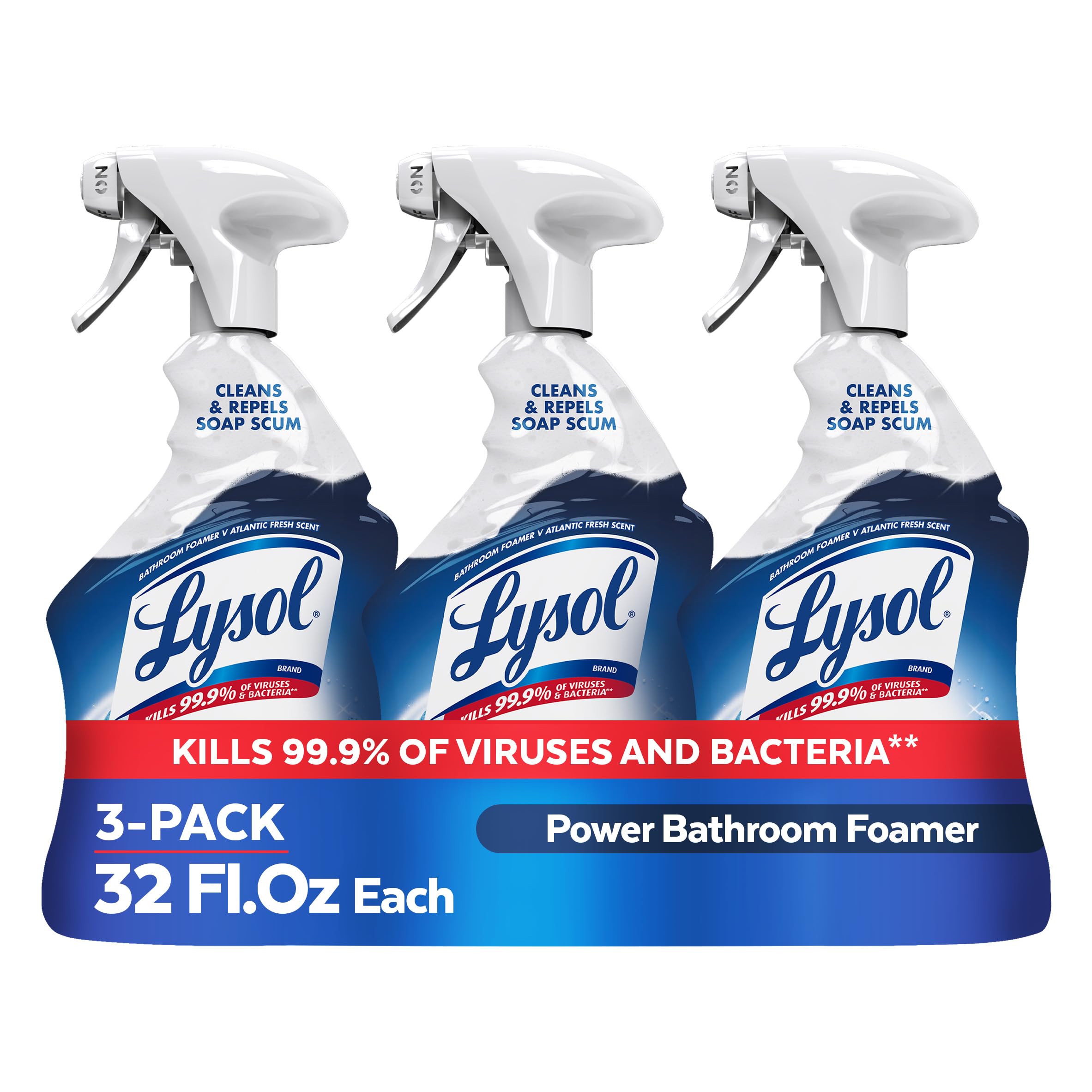
Lysol Power Foaming Bathroom Cleaner

95 /100
Kirk Score Outstanding
Size
Three 32-oz bottles
Formula
Foaming spray
Targets
Soap scum, limescale, mold
Disinfects
99.9% bacteria and viruses
Check Details on Amazon

Pros

  • Disinfects while it cleans
  • Foam shows coverage on tile
  • Three-pack covers a whole bathroom
  • Handles soap scum and limescale

Cons

  • Trigger can stream instead of mist

A three-pack of 32-ounce foaming cleaner is a lot of bathroom cleaner, but Lysol makes the size make sense: this is the bottle you can use on the tub, sink, toilet exterior, and tiled walls without feeling like you are wasting a specialty product. The label claims it eliminates soap scum, limescale, mold, mildew, and everyday grime, and it kills 99.9% of bathroom bacteria and viruses when used as directed.

That disinfecting claim is the reason to choose it over the other foaming cleaners here. We like having one product that can handle the soap scum on the shower tile and the germ-prone surfaces around the toilet and sink; it simplifies the caddy. The foam is also thick enough to see where you have sprayed, which helps on a large tiled wall.

The sanitizing step is where we slow down. Lysol lists 30 seconds for sanitizing, and that is a real dwell time, not a quick wipe; set a timer when you use it around the toilet and sink. The foam gives you something to see while the clock runs, and the trigger is easy to hold for that short window.

For a whole-bathroom routine, the three-pack earns its storage space. For a single shower stall, a smaller can is less clutter, and the Scrubbing Bubbles Mega is easier to aim at a tall tiled wall.

Bottom line: Choose this when you want one cleaner to disinfect the sink, tub, and toilet area as well as the tile; the foaming three-pack handles soap scum and limescale with a label-backed germ kill.

Check Latest Price
#03

Best Bleach-Free

Method Bathroom Cleaner

93 /100
Kirk Score Outstanding
Size
Four 28-oz bottles
Scent
Eucalyptus mint
Formula
Bleach-free spray
Targets
Mold, mildew, soap scum
Check Details on Amazon

Pros

  • Bleach-free formula
  • Pleasant eucalyptus-mint scent
  • Works on mold and mildew stains
  • Four bottles for multiple bathrooms

Cons

  • Soap-scum action is gentler than aerosols

The eucalyptus-mint scent is the first thing we noticed, and for a bathroom cleaner that is not a small thing: it makes a small, steamy room feel less like a chemical event. The formula is bleach-free and listed for mold and mildew stains, soap scum, grime on showers, tile, tubs, chrome, and fixtures. We like it for the bathroom where someone is sensitive to bleach fumes.

The four-pack makes it easy to keep one bottle in each bathroom, and the trigger spray is simple to aim at tile and fixtures. It is bleach-free, so you can use it around a tub without the whole room smelling like a pool. The 28-ounce bottle is a comfortable size to hold while you work around a shower, and the spray pattern is wide enough for a tub surround.

For mold and mildew stains, this is the bottle we reach for before the bleach spray, especially on colored grout or a ceiling corner where fumes linger. It handles everyday film well, and the eucalyptus scent lingers lightly instead of announcing itself from the next room.

Bottom line: Pick this bleach-free spray if fumes and scent matter more than the most aggressive foam; it handles mold and mildew stains and everyday soap film with a eucalyptus-mint finish.

Check Latest Price
#04

Best Low-Fume

ATTITUDE Shower & Tile Cleaner

91 /100
Kirk Score Outstanding
Size
27 fl oz
Formula
Plant-based spray
Targets
Soap scum, hard-water film
Certification
EWG Verified
Check Details on Amazon

Pros

  • EWG Verified low-fume formula
  • Works on soap scum and hard-water film
  • Bright citrus-zest scent
  • Useful for daily or weekly cleaning

Cons

  • Pricier per ounce than foaming picks

The EWG Verified mark is the reason this bottle stands out in a category full of harsh fumes. ATTITUDE lists 98% naturally derived ingredients, a citrus-zest scent, and a formula for soap scum, hard-water film, and body-oil buildup on shower walls, doors, tile, tubs, and fixtures. We like that it gives a small bathroom a credible low-fume option without asking you to scrub with a paste.

The spray is a daily-use product that can also do a weekly clean. It is not a thick foam, so it does not cling to vertical tile the way an aerosol does; you spray, let it sit, and wipe. For a shower that is already mostly clean, that is a pleasant routine, and the citrus scent is bright rather than heavy. The bottle is 27 ounces, so it fits in a caddy without much trouble.

On a large tiled shower with heavy buildup, it takes more passes than a foaming aerosol because the spray does not cling. The spray pattern is wide enough that a quick pass covers the tub surround, and the citrus scent is the detail that keeps us reaching for it. The EWG verification is the reason it stays in the rotation.

Bottom line: The low-fume choice for a small or shared bathroom: EWG-verified, easy to spray, and effective on daily soap film and hard-water film, though it costs more per ounce.

Check Latest Price
#05

Best Single-Bottle

Scrubbing Bubbles Grime Fighter

95 /100
Kirk Score Outstanding
Size
20 oz
Scent
Rainshower
Formula
Aerosol foaming spray
Disinfects
99.9% bacteria, as directed
Check Details on Amazon

Pros

  • Single can suits one bathroom
  • Disinfects and removes soap scum
  • Foam clings to shower walls
  • Works on tile, tubs, and fixtures

Cons

  • Spray nozzle can be finicky

One 20-ounce aerosol can is the right size if you have one bathroom and do not want a cupboard full of backup bottles. The Scrubbing Bubbles Grime Fighter is a disinfecting bathroom spray that claims 100% soap scum removal and 99.9% bacteria kill when used as directed, and it lists tile, tubs, shower walls, curtains, sinks, chrome, and fiberglass among its surfaces.

The foam is the useful part on vertical tile: it gives the cleaner somewhere to sit while you work down the wall, and the aerosol can reaches the top of a shower without a step stool. We like the plain Rainshower scent, which is noticeable but not as heavy as a bleach cleaner. The single can also makes it an easy first purchase if you are unsure which formula you like.

It is not a whole-house value pack, and one can is the point. A 20-ounce can is not huge if you clean a large shower twice a week, but it is enough to decide whether you like the formula. The aerosol reaches high tile without a pump bottle, and the can is small enough to tuck beside the toilet brush.

Bottom line: A strong first can for a single bathroom: it foams, disinfects, and goes after soap scum without committing you to a multipack.

Check Latest Price
#06

Daily upkeep

Method Daily Shower Cleaner

93 /100
Kirk Score Outstanding
Use
Daily shower upkeep
Size
Four 28-oz bottles
Scent
Eucalyptus mint
Formula
No-rinse daily spray
Check Details on Amazon

Pros

  • No-rinse daily maintenance
  • Wide spray covers shower walls
  • Fresh eucalyptus-mint scent
  • Helps prevent soap scum

Cons

  • Can streak on glass if left unbuffed

This is not the bottle to grab when the shower tile is already coated in soap scum. Method Daily Shower Cleaner is a maintenance spray: it is meant to be used after a shower to dissolve and prevent soap scum before it sets, and the label says it cleans without rinsing. That makes it a different product from the deeper bathroom cleaners here, not a weaker version of them.

Used that way, it is easy to live with. The eucalyptus-mint scent is fresh, the trigger sprays a wide area, and you can spritz the walls and glass and walk away. We like it for a household that already has a weekly deep-clean habit; it keeps the shower looking better between those sessions and cuts down on how often you need the heavy foam.

It also is not a disinfecting cleaner, so it does not replace a product for mold, mildew, or germs. Keep it as the daily step, not the only cleaner under the sink. The bottle belongs in the shower caddy, where it is easy to reach for the thirty seconds after you turn off the water.

Bottom line: Keep this by the shower if you already deep clean regularly and want to stop soap scum before it sets; it is not a rescue cleaner for neglected tile.

Check Latest Price
#07

Hard-water stains

OxiClean Bathroom Cleaner

92 /100
Kirk Score Outstanding
Size
32 oz
Bleach
Chlorine-free
Formula
Oxygen-powered spray
Disinfects
99.9% bacteria and viruses
Check Details on Amazon

Pros

  • Chlorine-bleach-free formula
  • Fights hard-water buildup and stains
  • Kills 99.9% when used as directed
  • Large 32-ounce bottle

Cons

  • Scent can be strong

OxiClean built its name on oxygen cleaning, and this bathroom spray puts that idea to work on soap scum, hard-water buildup, and everyday stains. The label is clear that it is chlorine-bleach-free, which is the main reason we reach for it over a bleach cleaner on a tub or tile that does not need disinfecting.

It also claims 99.9% bacteria and virus kill when used as directed on hard, non-porous surfaces, so it is not just a stain fighter. For a bathroom that needs both a deep clean and a sanitizing step, that combination is useful. The 32-ounce bottle is a practical size for a single bathroom, and the spray is easy to direct at grout lines and the tub surround.

The oxygen formula benefits from dwell time, so spray it on and give it a few minutes rather than wiping immediately. That is also why it works better on a tub floor or a sink than on a vertical tile wall, where the spray can run down before it has time to act. We keep it for the flat surfaces and use a foaming aerosol when the shower wall is the main job.

For hard-water film and dull tub stains, it is a good value in this group, and the no-chlorine formula is a real plus. It is not the first pick for a shower wall that needs a thick clinging foam; that is where the aerosols still win.

Bottom line: A solid value for hard-water film and bathroom stains, especially if you want oxygen cleaning without chlorine bleach; just expect a stronger scent.

Check Latest Price

How We Tested the Bathroom Cleaners

We started with the shelves, not the reviews: I pulled every bathroom-specific cleaner from two big-box stores and one online order — aerosols, trigger sprays, multi-packs, and a few fragrance-free, eco-labeled options — and cut anything that was really a toilet-bowl product or a kitchen spray in disguise. That left 14 formulas, which my team and I used for three months across two bathrooms: one with a glass shower door that films over fast, and one with white tile and gray grout that hides nothing.

Each cleaner got the same first job — a Saturday-morning deep clean of the shower door and the bottom third of the tile, where soap scum actually lives. I sprayed a fixed square, waited the labeled dwell time, wiped once with a dry microfiber, then held the glass against the window light to check for streaks and haze; one pass clean was the bar. I noted whether the foam clung to the wall or slid down it, whether the sprayer put out a fan or a hot stream, how many pumps it took to prime a new bottle, and whether the trigger dribbled onto my hand. Grout got a stiff brush and no mercy.

Between deep cleans, I used each one as a daily mist after showers and counted how many days it kept the film from returning, and how fast the bottle level dropped — a cheap bottle that empties in two weeks isn't cheap. Scent was rated on strength while cleaning and how long it lingered with the exhaust fan running; anything that made a small, steamy room hard to breathe in lost points. Value came down to cost per week of clean shower rather than sticker price. Three months in, a handful are still on the shelf and the rest got demoted to backup.

How to Choose a Bathroom Tile Cleaner

Start with the soil, not the label

A daily shower spray is built to prevent and dissolve fresh soap scum; a foaming bathroom cleaner is built for the film that has already set. If your tile feels slick or looks cloudy, a maintenance spray will help over time, but a deeper foamer or disinfecting spray gets there faster. For pink or black growth in grout lines, choose a product labeled for mold and mildew stains; a daily spray is not that product.

We keep two products in a shower for this reason: a no-rinse spray for after most showers and a foaming cleaner for the weekly clean. That is not upselling. It is the difference between maintaining a clean surface and trying to rescue a neglected one.

Foam, spray, or paste?

Foam is the most useful format on vertical tile because it stays where you put it long enough to work. Aerosols give you a fine, wide spray and no trigger fatigue; trigger foams are easier to direct but can stream or sputter. A plain spray is best for quick maintenance and glass, while a paste is for spot scrubbing and needs more rinsing.

Check the nozzle before you commit to a large pack. A trigger that streams rather than mists makes a big tile wall take longer, and an aerosol that foams only around the rim is frustrating. If you are unsure, start with one can and see how the foam behaves on your shower.

Disinfecting is a separate job

Cleaning removes soil; disinfecting kills germs on the label's listed surfaces after a stated dwell time. If you want one product for the tub, sink, and toilet exterior, choose a bathroom cleaner with a disinfecting claim and follow the time on the bottle. A 30-second sanitize step is not the same as a quick wipe-and-rinse.

For a household with young children or a lot of shared bathroom traffic, that extra step can be worth it. For a guest bath that mostly needs soap scum removed, a non-disinfecting cleaner is simpler and often gentler.

Match the formula to the surface and the room

Most bathroom tile cleaners are labeled for glazed ceramic, porcelain, fiberglass, chrome, and glass, but not every formula is safe on natural stone or unsealed grout. Test a hidden spot first, and do not use a bleach cleaner on a surface where the label warns against it. Ventilation matters as much as the formula: run the fan, open a window, and keep the door open while you work.

If fumes bother you, a bleach-free or EWG-verified spray is the easier choice for a small bathroom. If you need to remove mold stains, a bleach formula may be the right tool, but ventilation and label directions matter more than a stronger scent.

Frequently Asked Questions

Final Verdict

Start with the Scrubbing Bubbles Mega Bathroom and Shower Foamer for the main bathroom. Its wide aerosol spray and clinging foam make short work of soap scum on vertical tile, and the two-can pack covers a second bath without turning your cupboard into a cleaner aisle.

If you want one product that also disinfects the sink, tub, and toilet area, the Lysol Power Foaming Bathroom Cleaner is the more practical buy. If fumes are the deciding factor, the ATTITUDE Shower & Tile Cleaner is the gentler daily option.