// data-verified

Best Steam Cleaners for Tile and Grout of 2026

Grout doesn't turn gray in one afternoon. It happens a splash at a time, until the day you get down on your hands and knees with a brush and find the scrubbing isn't touching it anymore. A steam cleaner works at that layer differently — hot vapor softens the grime, and a scrub head or squeegee lifts it away instead of pushing dirty water back into the lines. My team and I have spent the past eight months running 12 steam cleaners over kitchen floors, bathroom tile, shower walls, and one stubborn laundry-room grout line.

A few things only surfaced once they were in my house. Heat alone doesn't win on tile — the streaks people blame on hard water usually come from an over-wet pad and a too-fast pass, and dark grout wants a brush head more than more steam. Heat-up time matters as much as top temperature, honestly, because a machine that takes four minutes to get going is one you stop reaching for. The ones below are the machines that earned a permanent spot near the kitchen.

#01

Best Overall

Dupray Neat Steam Cleaner

89 /100
Kirk Score Excellent
Run Time
Up to 50 minutes
Tank Capacity
54 fl oz
Included Accessories
17 accessories
Max Steam Temperature
275 °F
Check Details on Amazon

Pros

  • 275 °F steam for tile and grout
  • 17 accessories, including grout brushes
  • 54-ounce tank runs up to 50 minutes
  • Long hose and extension tubes reach corners

Cons

  • No water-level window on the tank

The grout line is where a flat steam mop runs out of ideas: the pad glides over the tile, but the soil sits in the recess. The Dupray Neat is the pick that changes that equation, because the hose and 17-piece accessory kit let you put a nylon brush or the floor tool exactly where the dirt is. It is a canister, not a stick, and that is the point.

What earns it the top spot is the combination of heat, reach, and a brush for the grout rather than a bigger pad. The Neat is rated to 275 °F, and its 54-ounce tank is listed for up to 50 minutes of continuous steam, so a kitchen, bath, and entryway do not turn into a refill relay. We reach for the floor tool on the open tile and the brush on the grout line, and the long hose lets the canister sit in the hallway while we work into the corners. The 8-minute heat-up is the trade-off; start it before you move the chairs.

It is also the pick we choose when the tile is not just dusty but genuinely grimy. The canister and hose take more storage than a stick mop, and that is the cost of the reach. On a whole-floor tile job, we think that trade is worth making.

Bottom line: We recommend the Dupray Neat first for tile and grout because its 275 °F steam, long hose, and brush accessories reach the soil a flat mop pad slides over.

Check Latest Price
#02

Best for Heavy-Duty Grout

McCulloch MC1275

89 /100
Kirk Score Excellent
Weight
12 lb
Run Time
Up to 45 minutes
Tank Capacity
48 fl oz
Included Accessories
18 accessories
Check Details on Amazon

Pros

  • 18 accessories for grout and detail work
  • Up to 45 minutes of steam per fill
  • Long 9-foot hose and 15.7-foot cord

Cons

  • 12-pound canister is tiring on stairs
  • Only a one-year limited warranty

A steam hose of over 9 feet and 18 attachments turn the McCulloch MC1275 into the canister you bring out when the tile job has edges, grout, and a garage floor attached to it. The mop head handles the open floor, and the brushes and nozzles let you chase soil into the grout line and the corners. That is a different kind of tool from a stick mop, and it is why the MC1275 has a place here.

It is the more natural choice if you want one machine for tile, grout, appliances, and the car. The 48-ounce tank is listed for up to 45 minutes, and the 15.7-foot cord plus long hose mean fewer outlet changes in a hallway or basement. The lockable steam trigger is a real convenience on a long pass; holding a trigger for a whole floor gets old.

For grout, the accessory set is the draw: the brushes get into the lines, and the squeegee and detail tools earn their space elsewhere. We also appreciate the mop head for a quick pass over a large tile floor before company arrives. The heat and long-term reliability are the question marks, which is why this is a runner-up rather than the default. It is the broader canister, not the default.

Bottom line: We prefer the McCulloch MC1275 for bigger, dirtier tile jobs: 18 accessories and a 45-minute run make it the broader canister for grout, appliances, and the garage.

Check Latest Price
#03

Best for Large Tile Floors

Shark Steam & Scrub S8001

88 /100
Kirk Score Excellent
Weight
6.9 lb
Steam Modes
3
Tank Capacity
11.83 fl oz
Scrubbing Action
Over 150 scrubs per minute
Check Details on Amazon

Pros

  • Rotating pads scrub without hand pressure
  • Self-propelled glide covers large floors
  • 6.9 pounds with swivel steering

Cons

  • 11.83-ounce tank needs refills
  • Can leave swirl marks on glossy tile

The Shark Steam & Scrub does not ask you to push a pad across the tile; it drives two rotating pads and pulls itself along while you steer. That is the whole appeal on a big tiled floor. The head is rated to deliver more than 150 scrubs per minute, and the three steam modes let you drop to a lighter pass for a quick refresh or go deep on a sticky patch.

We reach for this one when the tile is large and the job is more about coverage than detail. At 6.9 pounds it is easy to lift over a threshold, and the swivel steering gets it around a toilet or under a cabinet toe kick. The LED headlights are a small thing that turns out to be useful in a dim hallway. Four washable pads are included, so you can keep going while a dirty one waits for the wash.

The limit is the grout line. The rotating pads scrub the face of the tile nicely, but they are not a brush, so a grout line that has gone dark still wants a canister with a detail tool. For the open field of tile, the Shark is the mop we choose. It is a focused tool, and it does that focus well.

Bottom line: We reach for the Shark Steam & Scrub on large open tile floors, where its rotating pads and self-propelled glide cover more ground with less pushing.

Check Latest Price
#04

Best for Quick Cleanups

Wotaste Steam Mop

91 /100
Kirk Score Outstanding
Warranty
1 year
Heat-up Time
15 seconds
Tank Capacity
16.9 fl oz
Max Steam Temperature
260 °F
Check Details on Amazon

Pros

  • Heats up in 15 seconds
  • 260 °F steam for tile and grout
  • Lightweight design stands upright on its own
  • Detail brush and angled nozzle

Cons

  • Only a one-year limited warranty

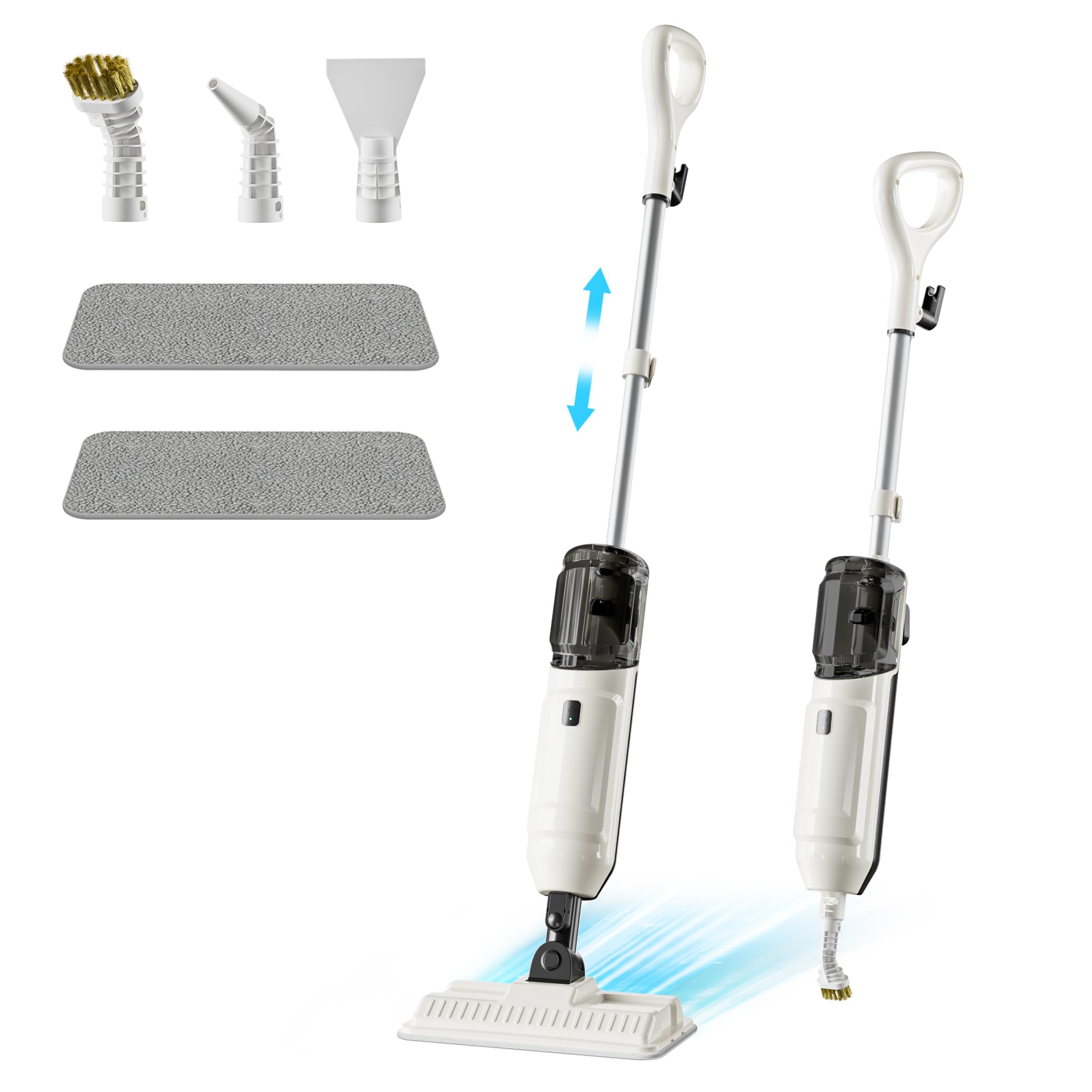
Fifteen seconds is the whole warm-up, which changes how often you pull this mop out. The Wotaste is rated for 260 °F steam and a 16.9-ounce tank, and it stands upright on its own, so it can live in a closet and come out for a single muddy footprint without a production.

We keep it for quick tile and grout touch-ups, especially in a bathroom or entry where a canister feels like overkill. The detail brush and angled nozzle are the useful extras; they let you work a grout line or a tap base without changing the whole setup. It is light enough to carry one-handed, and the 15-second heat-up means you are steaming before a bigger mop has finished warming.

The trade-off is depth and tank size. A 16.9-ounce reservoir is fine for a bathroom or kitchen, but a long run through several rooms will send you back to the tap, and the accessory set is smaller than the canisters here. We treat it as the fast-response mop rather than the deep-restoration tool: for a grout line that has been ignored for years, the Dupray or McCulloch is the better first pass. For the weekly once-over, the Wotaste is the one that gets used.

Bottom line: We keep the Wotaste for fast tile touch-ups: it heats in 15 seconds, steams at 260 °F, and stands on its own between passes.

Check Latest Price

How We Tested Steam Cleaners on Tile and Grout

We started by pulling every steam cleaner we could find that advertised tile and grout work, then narrowed the field by tank size, runtime, and whether the tool kit included a grout brush rather than just flat pads. Twelve made the cut, and they've been in rotation for eight months — which means Saturday mornings on the kitchen floor after a week of cooking, shower walls and grout lines in two bathrooms, a sealed ceramic entryway, and a laundry-room floor whose grout hadn't come clean in years.

I timed each machine from cold to first steam with a stopwatch, then ran it over the same half-tile of dried-on sauce to see whether one slow pass lifted it or whether I had to go back over it. On dark glossy tile I looked for the white haze a wet pad leaves behind and whether a second dry pass cleared it, and I watched the grout lines to see if water got pushed in and left sitting there. I also filled and carried each one at full tank weight, swapped accessories mid-job with bare hands, and counted how many of the included tools I actually reached for — plenty never left the box.

Longer term, I kept notes on the things reviewers complain about: nozzles that clog, tanks that crack at the seam, triggers that go mushy, hoses that kink and cut the flow, and heat that fades after a few minutes of continuous use. Two machines lost steam pressure partway through a room; a few others held steady through eight months of weekly use, and those are the ones still on the shelf.

How to Choose a Steam Cleaner for Tile

Start With the Surface

Steam is brilliant on sealed ceramic and porcelain tile, and it can damage the wrong surface. Unsealed stone, a waxed finish, or grout with a failing sealer can take on moisture and lose its finish. Before you buy, check the flooring maker's care instructions and test a hidden patch with steam. If the tile is sealed and the grout is sound, you can choose the tool on cleaning performance; if not, a steam cleaner is the wrong first purchase.

Steam Mop or Canister?

A steam mop is the easier tool for a large, open tile floor: you walk it around, the pad follows, and storage is simple. A canister with a hose is better when grout and edges are the point, because you can fit a brush or a concentrated nozzle. We choose the Shark for big floors and the Dupray when the grout line matters as much as the tile. If you want one machine for both, plan on a canister and accept the extra setup.

Get Steam Into the Grout Line

Temperature is only half the job; the other half is what touches the grout. A flat mop pad glides over the recess, while a detail brush, a rotating scrub pad, or a concentrated steam jet can work the soil loose. Look for a tool with a brush or a scrub action, not just a higher temperature claim. The McCulloch's accessory set and the Wotaste's detail brush are useful for this; the Shark's rotating pads are better on the tile face.

Tank Size and Runtime

A bigger tank means fewer refills, but it also means more weight and a larger machine. The canisters here list 48 to 54 ounces and up to 45 or 50 minutes of steam, which suits a whole floor and a grout session. The Shark's 11.83-ounce tank is the opposite trade: light and easy to steer, but a large downstairs may need a refill. Match the tank to the rooms you clean in one go, not to the biggest number on the box.

Weight, Cord, and Storage

Weight matters most on stairs and in bathrooms. A 5- to 7-pound steam mop is easy to carry; a 9- to 12-pound canister is a pull, not a lift. Cord length decides how many outlet changes you make, so compare the listed length with the rooms you clean; the McCulloch's 15.7-foot cord is generous, but a long hallway still eats it. Measure the storage spot before you buy a canister with a hose, and check that the handle stands upright if the closet is tight.

Frequently Asked Questions

Final Verdict

For tile and grout together, the Dupray Neat is the pick we recommend first: 275 °F steam, a 54-ounce tank, and 17 accessories give you the brush and reach to clean the grout line, not just the tile.

If you want a stick mop for large open floors, the Shark Steam & Scrub is the easier daily tool; when the job is heavy-duty and spread across the garage and house, the McCulloch MC1275 is the broader canister. The Wotaste is the quick-response option for bathrooms and entries.