// data-verified

Best Degreasers of 2026

Grease is the one kitchen mess that doesn't care how nice the bottle looks. The sprays that genuinely cut baked-on fat tend to announce themselves with fumes that send you reaching for a window, and the pleasant-smelling, gentle ones usually need three passes and a lot of patience. A good degreaser is supposed to buy back the scrubbing — the elbow grease, the second and third wipe, the soaking — not just move the grease around while you cough.

I've kept a rotating cast of degreasers under my sink for years, and the heavy-duty claims on the label are only worth what happens on a cold sheet pan. Over the past four months, my team and I worked through 16 bottles and jugs, from ready-to-use sprays to gallon concentrates you dilute yourself (a couple of which double as disinfectants, which changes how you use them). One thing first-time buyers miss: a concentrate is almost always the better value, since a gallon makes many bottles' worth — but only if you actually measure the dilution. Too strong and you're back to fumes, too weak and you're scrubbing twice.

Below are the ones that earned their shelf space, whether you're degreasing a hood filter once a month or chasing oil stains across a garage floor.

#01

Best Overall

Spray Nine Heavy Duty Degreaser

95 /100
Kirk Score Outstanding
Form
Ready-to-use refill
Volume
1 gallon
Surfaces
Engines, tools, vinyl, stainless, tile
Disinfects
Yes — sanitizes in 10 seconds
Check Details on Amazon

Pros

  • Cleans, degreases, and disinfects in one pass
  • Gallon refills a trigger bottle you already own
  • Handles garage grime and bathroom scum alike
  • Cheapest per ounce of the ready-to-use picks here

Cons

  • Sharp chemical scent in small rooms
  • Ready-to-use only

Engine bay, shower wall, garden tools: we handed this gallon the three greases that usually need three different bottles, and it took all of them. That range is why it's our top pick. Spray Nine is a cleaner, a degreaser, and a disinfectant in one ready-to-use liquid, so there's nothing to measure and no second jug to buy — you pour it into a trigger bottle and work. When we don't yet know what a mess is made of, this is the bottle that comes off the shelf first.

The disinfecting half is more useful than it sounds. The label gives wet-contact times — ten seconds to sanitize, thirty for viruses, forty-five for bacteria — which tells you it's meant to sit, not be sprayed and wiped in one motion. In a bathroom or around a sink, that one pass does both jobs. And at a gallon, the per-ounce math beats every trigger spray here, which is the quiet reason it ends up handling the ugly jobs the pretty bottles get saved for.

Where we're careful is strength. This is a professional-strength formula, and it can dull a soft plastic or lift a finish that isn't fully cured, so we test a hidden corner before taking it to anything rubbery or painted. That's the trade: real power on concrete, tile, and mildew-prone corners, and a bottle you don't hand to someone who scrubs without reading the label. For a garage-and-bathroom household, that trade is worth making.

Bottom line: The default purchase: one gallon that degreases garage grime and bathroom scum, disinfects in the same pass, and costs less per ounce than any spray here.

Check Latest Price
#02

Best Mild Concentrate

Simple Green Industrial Degreaser

95 /100
Kirk Score Outstanding
Form
Concentrate
Volume
1 gallon
Dilution
Custom strength by task
Certification
EPA Safer Choice
Check Details on Amazon

Pros

  • EPA Safer Choice recognized formula
  • Dilutes to the strength the job needs
  • Low odor for indoor rooms
  • Listed for carpet, floors, and machines

Cons

  • Mild

The EPA's Safer Choice mark is the first thing to notice on this jug, and it's why the bottle lives in the house rather than the garage. The formula is phosphate-free and biodegradable, and it carries a low-odor claim that holds up — you can work in a small bathroom without propping the door open.

What earns it a place is control. It's a concentrate, so you set the strength: a weak mix for a spray bottle of everyday cleaner, something stronger for a greasy range hood, and a gallon that lasts months when you mix by the bottle. We used it on counters, a vinyl-sided wall, painted trim, and the housing of a shop machine, and it lifted the film without the sharp smell that comes with solvent formulas. It is a mild degreaser, though. Baked-on oven grease is not its job, and no amount of soaking turns it into a solvent.

Read the dilution as the value rather than the chore. It's listed for carpet and upholstery as well as hard surfaces, and for floor scrubbers, carpet extractors, foamers, and pressure washers, which is a wider brief than any trigger spray here can claim. If your grease is everyday cooking film, dust-bound oil, and soap scum, this handles it in one pass and leaves the room breathable.

Bottom line: Buy this one when fumes are the reason you avoid degreasers: a certified-safer concentrate that's mild enough for indoor surfaces and stretches through several refill bottles.

Check Latest Price
#03

Best for Garage and Grill Grease

Zep Heavy-Duty Citrus Degreaser

91 /100
Kirk Score Outstanding
Form
Concentrate
Scent
Citrus
Volume
1 gallon
Do Not Use On
Glass, plastics, auto paint, leather, stone
Check Details on Amazon

Pros

  • Cuts carbonized grease on grills and engines
  • Natural citrus solvent smell
  • Dissolves adhesive and sticker residue
  • Concentrated, so a gallon covers a lot

Cons

  • Not for plastics, auto paint, leather, or stone

Citrus solvent does two jobs soapy formulas can't: it cuts carbonized grease off a grill grate, and it dissolves the adhesive a sticker or a shelf liner leaves behind. This Zep concentrate is built around that solvent, and it's the one we keep for metal that has seen heat — grates, stovetops, tools, engine parts, fiberglass, aluminum, stainless, concrete.

A gallon goes a long way at concentrate strength, and the label is honest about dwell time: thick buildup around an oven or a cooking space needs longer before you wipe, and it works faster on a warm surface than a cold one. Our first pass on heavy carbon did less than our second, which is the pattern with any solvent — the first application softens, the second lifts. The orange smell is real citrus rather than chemical perfume, which matters when you're leaning over a hot engine.

Our verdict: buy it for greasy metal and grimy concrete, and read the back of the bottle before you take it anywhere else. It's the strongest solvent in this group and the one that handles char, road dirt, and adhesive in the same afternoon, and it costs less than the ready-to-use gallon we recommend as the default. A garage shelf with this and a mild concentrate on it covers almost everything.

Bottom line: For greasy metal — grills, engines, tools, concrete — this is the solvent we keep, with a real citrus smell and a do-not-use list worth reading first.

Check Latest Price
#04

Best Budget Kitchen Spray

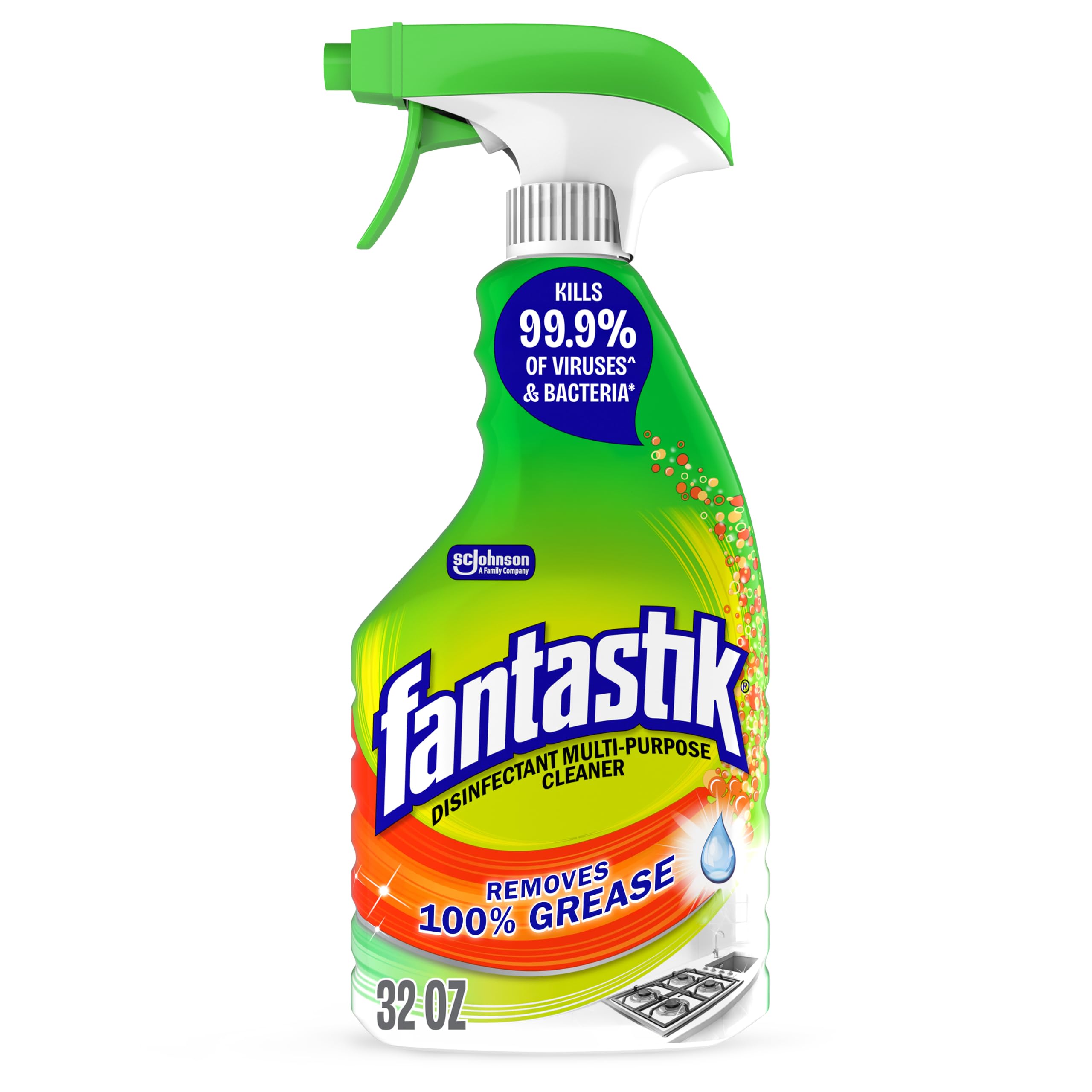
Fantastik Kitchen Degreaser

95 /100
Kirk Score Outstanding
Form
Trigger spray
Size
32 fluid ounces
Surfaces
Sealed granite, marble, stainless, brass
Disinfects
Yes, when used as directed
Check Details on Amazon

Pros

  • Safe on sealed stone, stainless, brass, and aluminum
  • Disinfects while it degreases
  • Lowest price of the sprays here
  • Fresh scent that doesn't turn harsh

Cons

  • Not strong enough for baked-on oven or grill carbon

It's the least expensive bottle in this roundup, and it's the one we keep on the kitchen counter because of what it won't do: no dulling on sealed granite or marble, no clouding on stainless, no trouble on glazed tile, acrylic, aluminum, brass, or bronze. Most degreasers make you check a list before you spray. This one names the good surfaces as approved.

It disinfects too, and the label claims 99.9% of bacteria and viruses when used as directed — which means leaving it visibly wet for the stated time instead of wiping it straight off. On a daily countertop pass that's the difference between cleaning and actually sanitizing, and it's rare in a bottle this cheap.

The limit is muscle. This is for the film that builds on a cooktop and the splatter beside it, not for carbon baked onto a grate for a year; for that, the citrus concentrate and a few minutes of patience do the work. For the everyday grease a kitchen throws at a counter in a week, this is the bottle we buy again, and the surface list is why we don't have to think about it.

Bottom line: For everyday kitchen film, this is the bottle we reach for: cheap, safe on sealed stone and stainless, and it disinfects while it wipes.

Check Latest Price
#05

Best for Laundry and Whole-House Dilution

Stanley Home Products Original Degreaser

92 /100
Kirk Score Outstanding
Form
Concentrate
Size
32 fluid ounces
Yield
32 gallons of solution
Listed Uses
Dishes, cookware, grills, woodwork, laundry
Check Details on Amazon

Pros

  • 32 gallons of solution from one bottle
  • Works on dishes, floors, laundry, and grills
  • Performs in hard and soft water
  • No strong smell

Cons

  • Highest price here for the smallest bottle
  • Needs measuring and a bucket or spare bottle

One ounce per gallon — two tablespoons — is the mix, and the bottle holds 32 ounces, which works out to the 32 gallons the label promises. That arithmetic is the entire proposition: you're buying a bucket cleaner, not a spray bottle, and the measuring is the price of admission.

In a bucket it's a workhorse. The label covers cookware, grills, dishes, woodwork, countertops, broilers, equipment, and tools, and it says the formula works in hard water as well as soft, which matters if you're filling a bucket from a well. A capful in a sink of hot water cuts the grease off a roasting pan without a second soak.

The use that earns it space outside the kitchen is laundry. A drop at full strength worked into a grease stain before the wash is the reason one of these ends up in a utility room, and a weekly dose down a slow kitchen drain is another job it handles. Neither is on the front of the bottle, and both are the sort of thing you only learn by keeping a jug around.

Our take: the measuring is the only real labor in it, and the rest is a jug that quietly replaces most of the shelf — dishes, floors, laundry, and the grill all come out of the same bottle. What it won't do is live beside the sponge. There's no trigger, no foam, and none of the instant gratification a spray gives you.

Bottom line: A concentrate that makes 32 gallons and doubles as a laundry pretreatment — worth the measuring if you'd rather buy one jug than six bottles.

Check Latest Price
#06

Best Unscented for Shop Equipment

Simple Green Pro HD Concentrate

93 /100
Kirk Score Outstanding
Form
Concentrate
Scent
Unscented
Volume
1 gallon
Equipment
Pressure washers, parts washers, ultrasonic
Check Details on Amazon

Pros

  • Unscented
  • Built for pressure washers and parts washers
  • Non-corrosive on metal, plastic, and carpet
  • Concentrate stretches by the bucket

Cons

  • Weaker than a solvent on carbonized grease

If there's a pressure washer in the garage, this is the jug that belongs beside it. The label names pressure washing, parts washing, ultrasonic cleaning, floors, walls, appliances, commercial kitchens and baths, and automotive or RV work — a brief about equipment and buildings rather than countertops.

We rate it the heavy-duty concentrate here for anyone diluting by the bucket. It's non-corrosive, listed for metal, plastic, and carpet, and unscented, which in a closed garage is worth more than a nice fragrance. Engine bays, porch floors, and shop equipment are the work it's built for, and it rinses without leaving a film behind.

The name promises a little more than the formula delivers on carbonized grease. A citrus solvent will outrun it on a grill grate or a decades-old oven, and the heavy-duty label sets an expectation a general-purpose concentrate can't meet. What it offers instead is volume and neutrality: no scent, no corrosion, and a dilution you set for the job in front of you. That's the one we want on a shelf where the work is big and repeated.

Bottom line: Unscented, non-corrosive, and built for pressure washers and parts washers — the concentrate to buy when the grease is on equipment, not a countertop.

Check Latest Price
#07

Walls and trim

Zep All-Purpose Degreaser

95 /100
Kirk Score Outstanding
Form
Concentrate
Volume
1 gallon
Dilution
3 to 6 fl oz per 32 oz water
Surfaces
Tile, stainless, porcelain, painted trim
Check Details on Amazon

Pros

  • One of the lowest-priced gallons here
  • Printed dilution ratios remove the guesswork
  • Listed for painted doors, trim, and cabinets
  • Covers floors, walls, and stainless

Cons

  • Full strength only for cooked-on grease

Painted cabinet fronts and door trim are where an all-purpose cleaner can quietly cost you a sheen, and they're the reason we keep this Zep gallon. The back label prints three dilutions — 3 fluid ounces per 32 ounces of water for light soil, 6 for medium, full strength for tough — and that chart is the difference between a cleaner that's safe on paint and one that isn't.

Diluted, it's a household workhorse: tile, stainless, porcelain, fiberglass, walls, and floors. At full strength it takes the grease film off the cabinet run above a range and the hood beside it. The label lists painted doors and trim by name, which is more specific guidance than most bottles of this kind bother with.

Pouring from a gallon into a 32-ounce spray bottle is clumsy without a funnel, and that's the only friction in the system. Once it's in the bottle, the chart does the thinking: 3 ounces per quart makes a wall-and-floor cleaner, full strength makes a degreaser. It's one of the lowest-priced gallons here, and the one we trust on painted surfaces.

Bottom line: Our painted-cabinet pick: a chart on the back that takes the guesswork out of dilution, at one of the lowest prices in this roundup.

Check Latest Price
#08

Kitchens and facilities

CloroxPro Formula 409 Refill

95 /100
Kirk Score Outstanding
Form
Refill jug
Bleach
None
Volume
128 fluid ounces
Kills Germs
99.9% on hard surfaces
Check Details on Amazon

Pros

  • Degreases and disinfects in one pass
  • No bleach in the formula
  • Kills 99.9% of germs on hard surfaces
  • 128-ounce refill lasts through several bottles

Cons

  • Refill only
  • Not for food-contact surfaces

Two jobs in one jug: this 409 refill dissolves oil-based soil and kills 99.9% of germs on hard, nonporous surfaces, without bleach in the formula. That combination is the appeal — one pass around a kitchen that gets greasy and germy in the same afternoon.

The germ claim is specific — Salmonella, Staph, E. coli, and athlete's foot fungus — and the label expects the surface to stay visibly wet for the stated contact time, which is where most spray-and-wipe routines fall short. Countertops, stovetops, stainless appliances, and sinks are the intended targets.

It's sold for offices, day cares, schools, hotels, and restaurants, and that framing is accurate. This is a workhorse refill for someone cleaning a lot of hard surface, not a specialty solvent for a grill grate. A 128-ounce jug refills a trigger bottle four times over.

Our take: buy it for the combination, not for the muscle. It handles stovetop film, sink surrounds, and stainless without a bleach smell, and it does it at refill pricing. For carbonized grease a solvent concentrate is the right tool, and no amount of dwell time turns this into one.

Bottom line: A refill jug that degreases a stovetop and kills germs on the sink around it without bleach — sensible for a kitchen that gets wiped down daily.

Check Latest Price

How We Tested 16 Degreasers on Baked-On Grease

To build the shortlist, I started with roughly 40 degreasers sold at major retailers and read the labels before buying anything: active ingredients, concentrate versus ready-to-use, the dilution the manufacturer actually specifies, and whether it carries disinfecting claims. That last point matters more than people expect, because a product that disinfects usually needs a wet dwell time of several minutes, which is a different job than a quick wipe-and-go. I dropped anything that sold a concentrate with no dilution guidance, and anything priced so high per use that it only made sense in a commercial kitchen.

We then tested 16 of them over four months in home kitchens, on a gas grill, and on a garage floor with a decade of oil drips. The core scene was the sheet pan and the range hood filter after a roast chicken: I mixed each concentrate to its stated ratio, timed how long the grease took to soften, and counted how many passes it took to get a clean swipe rather than a smeared one. I also watched how each formula behaved on vertical surfaces — the thin, watery ones ran straight down the oven door, while the thicker ones clung and worked where I put them.

Scent got scored honestly: whether the smell faded within a few minutes or followed me around the house, and whether it made me open a window mid-clean. I also checked for residue after a wipe, since a degreaser that leaves a film just means the next sponge has more to do. Finally, I diluted each gallon per its label and tracked how long it lasted, so value reflected cost per cleaning instead of the sticker price.

How to Choose a Degreaser

Match the Strength to the Soil

Light kitchen film, soap scum, and dust-bound oil come off with a mild, dilutable formula and a minute of contact. Baked-on oven and grill grease, engine grime, and adhesive residue need a solvent — citrus- or alkaline-based — and much longer dwell.

Buying the strongest bottle for a daily countertop wipe costs more per job and forces more ventilation than the work requires. Our split is deliberate: a mild concentrate for the surfaces you touch every day, and a solvent concentrate for the metal that gets cooked on.

Concentrate or Ready-to-Use

A gallon of concentrate is cheaper per job than a trigger spray, but only if you actually dilute it. That means a measuring cup, a spare bottle, and a label on it, because a too-strong mix can dull a finish and a sloppy one wastes product.

Ready-to-use wins when you clean in short bursts and want one bottle under the sink. Concentrates win when there's a bucket, a pressure washer, or a whole house involved. Stanley's 32-ounce bottle making 32 gallons is the extreme case; Zep prints its ratios on the back so you don't have to guess.

Read the Do-Not-Use List

Degreasers are solvents, and solvents attack finishes. Plastics, acrylic, auto paint, leather, and natural stone mark quickly — clouding, etching, or a lifted clear coat — and the damage doesn't come back.

Manufacturers print the exclusions for a reason: Zep's citrus concentrate rules out glass, plastics, auto paint, leather, and natural stone in the same breath as it recommends engines and grills. Test a hidden spot, keep the surface wet rather than letting it flash dry, and rinse before the residue sets.

Dwell Time Beats Elbow Grease

The biggest technique difference is patience. Most formulas need a few minutes of wet contact to do their work, and a surface that dries stops working. Spray a section, let it sit, then agitate with a non-scratch pad. On vertical surfaces, work bottom-up so runoff doesn't streak through the part you've already cleaned.

Rinse food-contact surfaces with water afterwards, as the label directs. Leftover cleaner film is what makes a counter feel tacky the next morning.

Fumes and Small Rooms

Scent is the most common complaint about degreasers, and the stronger the formula, the more reliably it fills a small room. If you clean a windowless bathroom, choose a low-odor or unscented concentrate over raw power: Simple Green's industrial gallon is low-odor, and Pro HD is unscented.

Otherwise ventilate, keep the jug capped between passes, and work in sections rather than fogging the whole room.

Frequently Asked Questions

Final Verdict

Buy the Spray Nine gallon if you want one bottle for garage grime, kitchen film, and bathroom scum, and a sharp smell doesn't bother you. It disinfects on the same pass, needs no measuring, and costs less per ounce than the trigger sprays here.

If fumes decide it, the Simple Green industrial concentrate is the better buy and the one to keep for the surfaces a house touches daily. When the grease is on a grill or an engine, neither is the right tool — that's the citrus concentrate's job.