// data-verified

Best Exterior Wood Filler of 2026

A hole in a deck board takes ten minutes to fill and about six months to prove you chose well. The patch that looks seamless in October is the one that cups, cracks, or pops loose after its first freeze and thaw, and a good exterior filler is what stands between those two outcomes. It has to seal the joint against water, hold its shape through sun and temperature swings, and accept paint or stain, because a repair you can't hide is a repair you'll redo.

I've patched porch railings and window trim for years, so I had opinions going in. Over the past six months my team and I worked through 12 exterior fillers, from two-part epoxy pastes to squeeze-tube latex, and left every repair outdoors from late winter into summer. The surprise was that the hardest-curing product isn't automatically the best. Epoxy that sets harder than the wood around it is a pain to sand flush and can telegraph a ridge under paint, while some easy-spreading latex fillers shrank back into the hole after the first rain.

The picks below are the ones that held, sanded fair, and took a finish.

#01

Best Overall

PC-Woody Epoxy Paste

92 /100
Kirk Score Outstanding
Format
Two-part epoxy paste
Full Cure
24 hours
Application Temp
35 to 115 °F
Exterior Resistance
UV, fresh and salt water
Check Details on Amazon

Pros

  • Rated for UV, fresh and salt water
  • High tack holds on vertical trim
  • Workable from 35 to 115 °F
  • Sands and paints after a 24-hour cure

Cons

  • Two-part mixing and a 24-hour cure slow small jobs
  • Thick, sticky paste takes patience to place

Three words in the product description do more for an outdoor repair than anything else in this category: UV, salt water, dry rot. PC-Woody is a two-part epoxy paste mixed one to one by volume, and the cured repair is rated to shrug off sunlight, fresh water and salt water — the three things that actually finish off exterior wood. That combination of resistance and hardness is what makes it our top pick.

High tack is the part we appreciate most in use. Exterior damage sits on window sills, door frames and railing caps, and none of those faces are horizontal; a filler that sags out of the repair before it sets has wasted your afternoon. This one holds its shape while it hardens, and the listed application range of 35 to 115 degrees F means a cool fall day is still workable. Full cure takes 24 hours.

Mixing is the tax. Equal volumes of part A and part B, worked together on a flat surface with a stiff putty knife, and the label specifically says not to mix it with gloves on. The paste is thick, closer to peanut butter than to anything from a squeeze tube, and it needs thorough combining or you'll sand into soft spots tomorrow.

Against the rest of this set, it's the one product that handles a rotted sill and a hairline crack without a change of tools. The J-B Weld stick is quicker for a single hole and SculpWood is better when a whole corner is gone, but neither covers the middle ground as neatly. Mix only what you can place in one sitting.

Bottom line: PC-Woody is the exterior filler we reach for first: it resists sun, water and rot and stays put on a vertical sill.

Check Latest Price
#02

Best for Fast, Hard Repairs

Bondo Wood Filler

92 /100
Kirk Score Outstanding
Size
30 ounces with 0.5-ounce hardener
Format
Two-part filler and hardener
Sandable
15 minutes
Exterior Rating
Interior and exterior wood
Check Details on Amazon

Pros

  • Sandable in 15 minutes
  • Chemically bonds for non-shrinking repairs
  • Generous 30-ounce container with hardener

Cons

  • Takes stain unevenly; plan on paint

Fifteen minutes is the number that sells Bondo: mix the filler with the cream hardener, spread it, and you can be sanding while a latex filler is still wet. The two-part chemistry bonds to the wood instead of sitting on top of it, and the repairs are non-shrinking — which is what you want in a railing or a door frame that takes weather and knuckles.

We rate it the fastest hard repair here for large, paint-grade exterior damage. A 30-ounce container with a half-ounce tube of hardener goes a long way, and per ounce it's the cheapest of the two-part products in this group, which matters when you're rebuilding a run of shed trim rather than a single nail hole.

Speed cuts both ways. Once the hardener goes in, the clock is running, so mix small batches and keep your placement tidy. A trick worth knowing: run a sharp chisel over the excess a couple of minutes after application and you'll save most of the sanding.

Sanded to a feathered edge, the patch disappears under primer, and the cured filler stands up to an orbital sander without tearing out. That's the whole case for keeping a container on the shelf.

Bottom line: We rate it the fastest hard repair here for large, paint-grade exterior damage, provided you mix small batches and plan on paint.

Check Latest Price
#03

Best for Small Spot Repairs

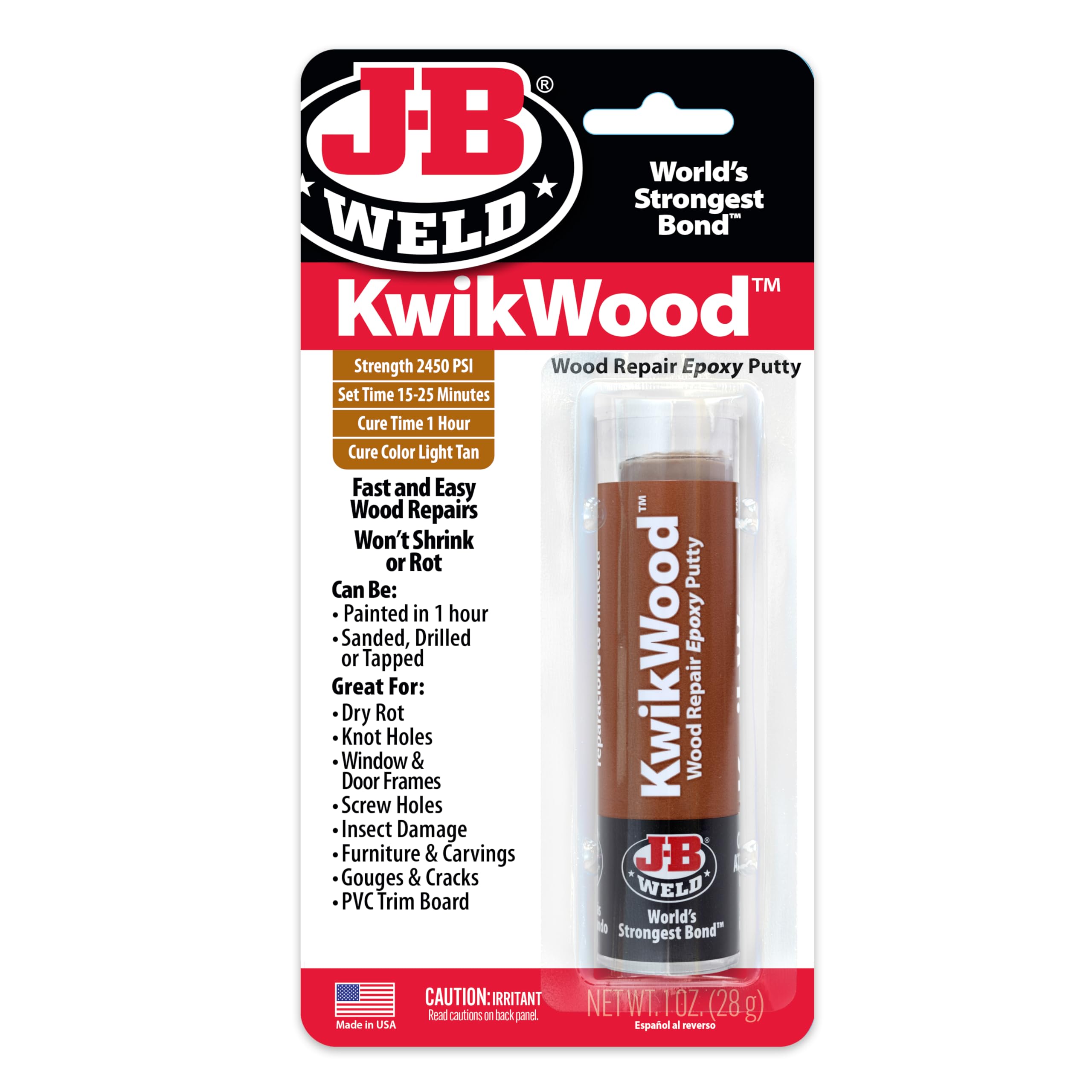
J-B Weld KwikWood

91 /100
Kirk Score Outstanding
Size
1-ounce stick
Format
Two-part epoxy putty stick
Set Time
15 to 25 minutes
Full Cure
1 hour
Check Details on Amazon

Pros

  • Hand-kneaded, nothing to measure
  • Sets in 15 to 25 minutes
  • Drills, sands and shapes like wood

Cons

  • One-ounce stick covers only a few holes
  • Costliest per ounce of anything here

Sometimes the entire job is one stripped hinge screw and a gouge the size of a thumbnail in a door frame. That's not a two-can, measure-and-mix situation, which is the gap the J-B Weld KwikWood stick fills.

Cut off a slice, knead it between your fingers until the two parts are one color, and press it into the hole. Set takes 15 to 25 minutes and full cure about an hour, after which the putty can be sanded, drilled, tapped, shaped and stained. It won't shrink or rot, which is the part that matters outdoors.

We keep coming back to it for small exterior spot repairs, because there's nothing to measure and nothing to clean up afterward. The same stickiness that holds it in a vertical hole makes it grab at your fingers while you knead, so work in small pieces and press it home with a putty knife rather than a thumb.

One ounce is the catch. It covers a few holes and no more, which makes the stick a supplement to a tub or a can rather than a replacement for one. Keep the unused portion sealed; kneaded leftovers are already curing.

Bottom line: Keep a KwikWood stick in the toolbox for one-hole exterior repairs; for anything bigger, buy a paste.

Check Latest Price
#04

Best for Large Rebuilds

SculpWood Epoxy Putty

92 /100
Kirk Score Outstanding
Format
Two-part epoxy putty
Kit Size
1 quart
Mix Ratio
1:1
Water Resistance
Waterproof
Check Details on Amazon

Pros

  • Moldable putty holds its shape on verticals
  • Waterproof and shrink-free after curing
  • Can be carved and machined after cure
  • Quart kit covers large rebuilds

Cons

  • A one-day cure slows the job down
  • Highest upfront price of the picks

A quart kit changes the economics of epoxy filler. SculpWood arrives as two parts you mix one to one by hand, and the result behaves like modeling clay — it holds the shape you press it into instead of slumping off a vertical face, which is what lets you rebuild a missing corner on a porch post rather than skim over one.

It's waterproof, it won't shrink or turn brittle as it cures, and once hard it can be sanded, carved or machined like wood. Full cure takes about a day, so this is a plan-ahead repair rather than a Saturday-morning one.

The sticker is the highest in this guide, and it's fair to flinch at it. By volume, though, a quart lands close to the smaller epoxy kits here, so a genuine rebuild — a sill with a chunk gone, a door bottom that's been soaking for years — is better value than the price suggests.

It cures brown, so plan on a topcoat to bring it back to the color of the surrounding trim. For sheer volume of damaged exterior wood, nothing else here covers as much ground.

Bottom line: For a genuine rebuild — a missing corner, a rotted sill end — SculpWood's quart kit is the one to buy, and the per-ounce math is kinder than the sticker suggests.

Check Latest Price
#05

Best for White Painted Trim

DAP Plastic Wood, White

91 /100
Kirk Score Outstanding
Color
White
Format
Latex paste in a tube
Dry Time
3 to 6 hours shallow, 36 hours deep
Exterior Rating
Interior and exterior
Check Details on Amazon

Pros

  • White blends into painted trim
  • Holds its shape on vertical faces
  • Sands easily and takes paint

Cons

  • Deep fills can take 36 hours
  • Not structural; cosmetic repairs only

White paste in a 6-ounce tube that applies like caulk is a narrow product. On white exterior trim, it's the right narrow product: DAP's Plastic Wood goes onto corners and vertical faces where a runny filler would end up on your shoes, and it dries to a white that can pass for fresh paint on a nail hole.

That's the whole appeal. On painted white trim, a color that matches means one less step, and the thick knife-grade body stays where it's put. We think it's the best choice here for finishing-nail holes, hairline cracks and small dings on exterior trim that's already white.

Limits are real. This is latex, not structural, and the schedule reflects it: 3 to 6 hours for fills up to 1/8 inch, roughly 36 hours at a quarter inch and deeper. Expect to layer deep holes. The white can also read light gray against a bright white paint, so test a patch on scrap before you commit.

While it's wet, a damp fingertip smooths the bead and water takes the residue off your hands, the trim and the tools. That ease is most of why it stays in the rotation.

Bottom line: For finishing-nail holes and small dings on white exterior trim, DAP's white Plastic Wood is the sensible buy — color and cleanup do the work.

Check Latest Price
#06

Best Budget Tub

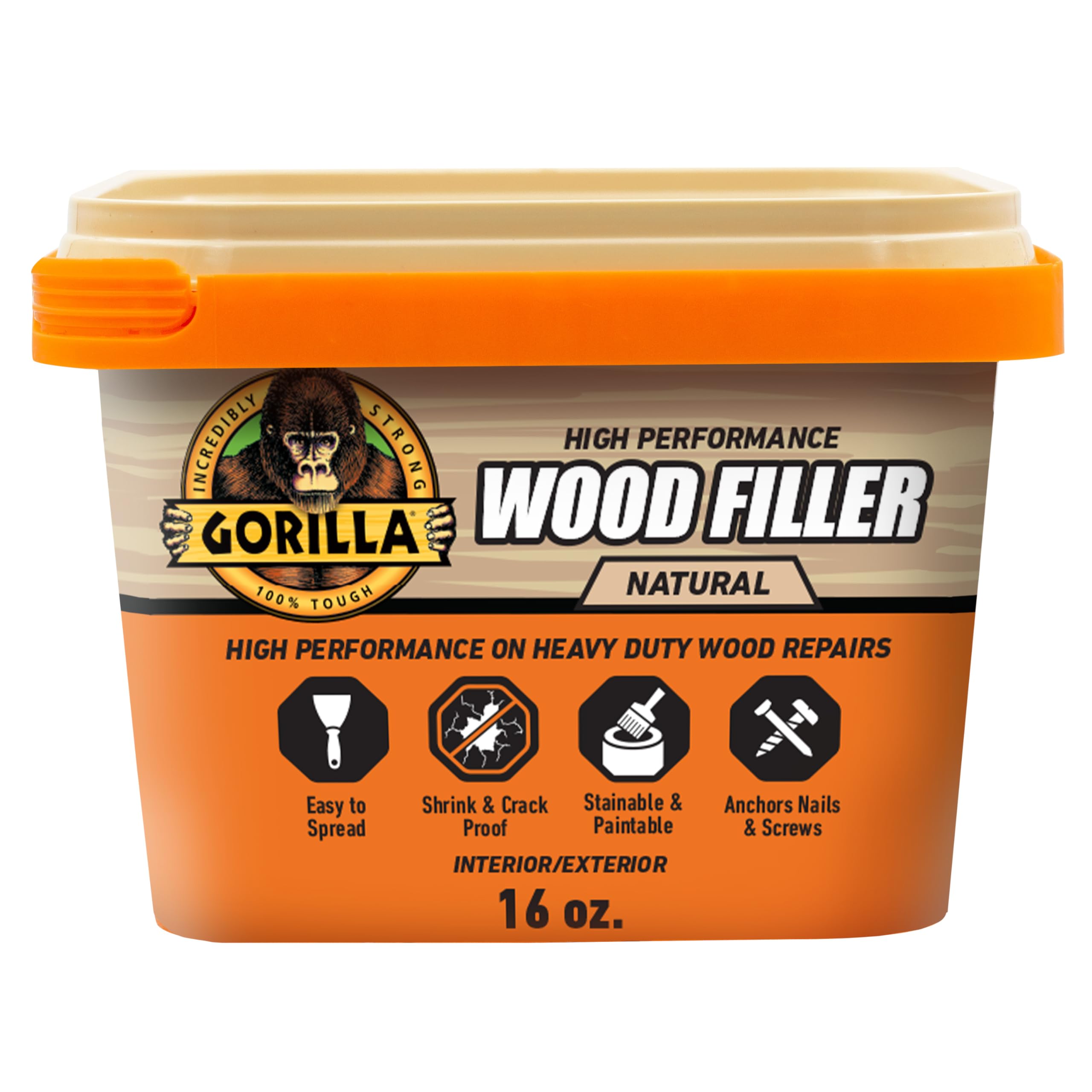
Gorilla Wood Filler

89 /100
Kirk Score Excellent
Size
16 oz
Finish
Paintable and stainable
Format
Acrylic paste in a tub
Exterior Rating
Water resistant, indoor and outdoor
Check Details on Amazon

Pros

  • Large tub at a low cost per ounce
  • Sands smooth and takes paint
  • Rated for indoor and outdoor use

Cons

  • Can crumble on exterior joints that flex

Open a tub of Gorilla wood filler and you find out fast which one you got. Some tubs are a smooth, spreadable paste; others arrive dry and gritty, closer to damp sand than to putty. That variation is the honest headline on an otherwise useful, inexpensive product.

When the tub is right, it's pleasant to use. It spreads into a crack, sands down as smooth as the wood around it, and takes paint without a fight. The formula is acrylic and water resistant, rated for indoor and outdoor work, and the label claims it won't shrink or crack while also anchoring nails and screws.

A dry tub isn't a lost cause. Work in a splash of water and mix until the paste spreads again — the container has usually lost moisture on a shelf rather than failed outright — then use it in thin lifts so whatever water is left has somewhere to go.

Movement is where it struggles. On exterior joints that flex with the weather, a latex filler can crack and crumble rather than hold, and deep fills show it first. Keep this one to shallow cosmetic work on stable trim.

Where it earns its shelf space is volume: a 16-ounce tub covers a lot of trim for very little money, and if the first tub arrives dry you now know what to do about it. Buy it for square footage, not for strength.

Bottom line: Our pick for broad, shallow, paint-covered filling is the Gorilla tub — as long as you're not repairing rot or a hinge.

Check Latest Price
#07

Carved restoration work

Abatron WoodEpox

89 /100
Kirk Score Excellent
VOC
GREENGUARD certified
Format
Two-part epoxy putty
Kit Size
12 oz
Working Time
20 to 30 minutes
Check Details on Amazon

Pros

  • Carves, planes and nails after curing
  • Low-odor, GREENGUARD certified formula
  • 20 to 30 minutes of working time

Cons

  • Expensive for a 12-ounce kit

Abatron's 12-ounce kit costs about what our top pick costs, and it buys something different: a putty you can saw, plane, carve and nail once it's hard, made without solvents and certified GREENGUARD for low emissions. On a window sash or a porch column where you'll be shaping the repair afterward, that distinction matters more than raw strength.

The working window is the friendliest of the epoxies here — 20 to 30 minutes of pot life, enough to mix, place and tidy a repair without sprinting. Full cure is listed at two hours, and the cured putty sands, paints and stains.

Our reservation is grip. It holds best on rougher, weathered or rotted surfaces; on smooth, freshly planed stock it can struggle to grab, so rough up the face first and don't expect it to bridge a slick surface on its own. It's also the priciest small kit here. For restoration work where the repair gets shaped after curing, neither point is disqualifying.

Bottom line: Mix WoodEpox when you'll be carving or machining the repair afterward and want no solvent smell; rough up smooth wood first.

Check Latest Price
#08

Stained exterior wood

Minwax Stainable Wood Filler

89 /100
Kirk Score Excellent
Format
Latex filler in a tub
Dry Time
About 2 hours, shallow fills
Exterior Rating
Indoor and outdoor
Stain Compatibility
Oil and water-based stains
Check Details on Amazon

Pros

  • Accepts oil- and water-based stains
  • Rated for indoor and outdoor use
  • Shallow fills dry in about two hours

Cons

  • Deep fills need many hours and layering

Most exterior fillers are paint-grade, and you find that out the moment stain hits the patch and goes flat while the wood around it warms up. Minwax's 16-ounce filler is formulated to accept oil- and water-based stains, which makes it the pick here for stained exterior wood — deck boards, cedar siding, a refinishing job where paint was never the plan.

Underneath the stain claim it's a conventional latex filler for cracks, small gouges, nail holes and knot holes, rated for indoor and outdoor use. Shallow repairs dry in about two hours, which keeps a staining project moving.

Stainable isn't the same as invisible. Filler and wood absorb stain differently even when the chemistry is right, so test on an offcut before you commit to a run of siding. Deep fills take far longer than two hours and want layering.

Sand it flush, wipe the dust, and finish it on the same schedule as the surrounding wood. On a stained surface, that timing is the whole game.

Bottom line: Choose Minwax when the wood around the repair will be stained rather than painted; its whole job is accepting a stain coat.

Check Latest Price
#09

Fast trim repairs

Famowood Latex Filler

92 /100
Kirk Score Outstanding
Finish
Stainable and paintable
Format
Water-based latex paste
Dry Time
15 minutes
Exterior Rating
Interior and exterior use
Check Details on Amazon

Pros

  • Dries in about 15 minutes
  • Sands smooth with no mixing
  • Water cleanup and low odor

Cons

  • Stained patch can read lighter or darker

A water-based latex that's ready to sand in about a quarter of an hour is a different tool from the epoxies on this list. Famowood goes on creamy, feathers out at the edges and sands to a smooth face — with 400 grit it polishes down to something a finish will sit on happily.

There's no mixing, next to no smell, and cleanup is water. For a run of trim repairs where you want to fill, sand and get on with priming, that pace is the point.

Two things to plan around. It isn't waterproof — it soaks up water — so outdoors it needs a topcoat, and that topcoat has to stay intact. On deep or wide fills it can crack and crumble as it dries, so build in layers rather than one thick application.

Stain is the other uneven spot: it takes stain, but the patch can read lighter or darker than the surrounding wood, so test on an offcut before you do a visible run. Fast, smooth and easy to sand, it's the filler for primed exterior trim — not for a wide repair on bare wood that faces the weather.

Bottom line: Famowood is for fast, smooth filling on primed exterior trim, where you'll sand it in minutes and topcoat it anyway.

Check Latest Price

How We Tested Exterior Wood Fillers

We started with spec sheets and product data, pulling every filler actually rated for exterior use, which ruled out a surprising number of popular interior products, then sorted what was left by cure type: two-part epoxy, epoxy putty, water-based latex, and acrylic. Twelve made the cut. From late winter into summer we used them for real repairs: soft spots in deck boards, gouges in a porch railing, a punky window sill, split door-frame trim, and a fence gate that takes full afternoon sun.

Each filler got the same jobs. We noted what came out of the container, whether the paste was smooth or crumbly, whether it held in a vertical hole or sagged, and how evenly a two-part kit mixed. We timed how long each stayed workable and how long before it could be sanded, and compared patches in shade against patches in direct sun. Then we sanded every repair flush with 80- and 120-grit paper, watching for clogged paper, filler that balled up instead of cutting, and edges where the surrounding wood got gouged, and pressed a screwdriver tip into each cured patch to see whether it dented, crumbled, or resisted like the board.

Half of every patch was left bare and half painted or stained, and we checked them after rain, after the last freeze, and at the end of the test, looking for shrinkage in the form of a dip or dish at the edge of the fill, plus cracking, chalkiness, and any spot where water had worked in behind the repair. Finally we tracked waste: how much of a container actually ended up in a hole, and whether it resealed well enough to use again next season.

How to Choose an Exterior Wood Filler

Epoxy or ready-mixed: decide by the damage

If the wood is sound and you're hiding nail holes, hairline cracks or dings, a ready-mixed acrylic or latex filler is faster, sands easily and cleans up with water. If the wood is missing, soft or rotted, you need a two-part epoxy that cures hard and stays put. We reach for epoxy the moment a fingernail sinks into the wood.

Don't let a waterproof claim on a tub fool you. That word describes the cured film, not structural strength; no ready-mixed filler will rebuild a rotted sill end the way PC-Woody or SculpWood does.

Match the filler to the finish, not just the wood

Paint hides almost anything, so most exterior fillers are paint-grade and only have to sand smooth and hold a primer. Stain is less forgiving: it colors the filler as it colors the wood, and a filler with no grain structure reads flat or patchy beside real wood. Minwax's stainable formula is the product here aimed squarely at that job.

Even then, test on an offcut. The same stain on face grain, end grain and filler gives three different results, and a test patch is far easier to adjust than siding that's already on the house.

Working time, temperature and the mixing trap

Two-part products start a clock the moment they're mixed: 15 to 25 minutes of set time for a putty stick, 20 to 30 for Abatron, and a much shorter window for fast-setting fillers. Mix small batches on a flat board, and check the label's temperature range — PC-Woody wants 35 to 115 degrees F at application, so a cold morning is worth waiting out.

Mixing a full container because it's easier is the most common way to throw half of it away.

Vertical faces and deep fills

A filler that sags out of a door frame is worse than useless. High-tack and no-sag formulas earn their price on sills, jambs and railing caps, and a stiff knife-grade paste beats a runny one every time.

Depth matters just as much. Latex fillers skin over while the middle stays soft, which is why DAP quotes 3 to 6 hours for a 1/8-inch fill and about 36 hours at a quarter inch and beyond. Build deep repairs in lifts, letting each one firm up before the next goes on.

Rot, structure, and what filler can't do

Filler replaces missing wood, not the reason it went missing. Dig out anything soft or dark until you hit sound fiber, and deal with the water that caused the rot — a sill that stays wet will rot again behind the neatest repair.

On a load-bearing post, a large repair is a carpentry job rather than a filling job. Epoxy suits trim, sills, frames and other semi-structural work; a filler that anchors a screw is holding a screw, not rebuilding a joint.

Frequently Asked Questions

Final Verdict

We point people to PC-Woody first for exterior work: it resists sun, fresh water and salt water, holds its shape on a vertical sill, and cures hard enough to sand and paint. Mix it, place it, and leave it alone for a day.

If your repair is cosmetic — nail holes on white-painted trim, a hairline crack in a door frame — DAP's white Plastic Wood gets you a color match and a water cleanup instead. And when half a porch post is missing, SculpWood's quart kit lets you build the piece back rather than fill a hole in it.