// data-verified

Best Sump Pump Battery Backups of 2026

A sump pump only works while the power does, and the storms that push the most water at your foundation are usually the ones that take the grid down. That's the whole case for a battery backup: when the primary pump goes quiet, a charged battery and a second pump keep the pit from spilling over. My team and I spent ten months running eight of these systems through simulated outages in real basements.

Here's what the box won't tell you: flow ratings are measured at zero head height, with the discharge roughly at floor level. Add the vertical lift of your own line and the real number drops, so we timed output against a standpipe. The other fork is a trickle-charged DC pump versus an inverter-and-charger system running off a battery you supply; the first is simpler, the second runs longer.

Which system suits your pit comes down to water table, discharge height, and how much you want it talking to your phone. The picks below run from a bare float switch to models that ping you when a battery sags.

#01

Best Overall

Basement Watchdog Special CONNECT

87 /100
Kirk Score Excellent
In The Box
Pump, controller, charger, dual float, battery box
Flow At 0 Ft
2,500 GPH
Flow At 10 Ft
1,730 GPH
Pump Dimensions
9"L x 5"W x 7.63"H
Check Details on Amazon

Pros

  • 1,730 GPH at 10 ft of lift
  • Panel names the fault and the fix
  • Fits narrow pits at 9 inches long
  • Monitors battery fluid for you

Cons

  • Battery and WiFi module both cost extra
  • Two-year warranty is on the short side

Most backup controllers speak in a red light and a beep and leave you to decode the rest. This one lights up with a message that names the problem and tells you what to do about it, which is a different experience entirely at six in the morning with water coming into the pit. The same panel watches fluid level in a wet-cell battery — the failure that stays invisible until the night it matters.

We recommend it first among these because of lift, not the headline figure. The Special CONNECT moves 1,730 gallons an hour at 10 feet of head, more than the Wayne ESP25n manages and well ahead of the older Watchdog emergency unit. At zero feet it's rated 2,500 gallons, which is the number most listings lead with and the one that says least about a basement whose discharge pipe climbs a wall before it exits.

The quieter advantage is size. At 9 inches long and 12 pounds it slides in beside a primary pump in a pit that would never accept a second full-size body, which widens the number of basements this can actually be installed in. Before the wet season, lift the float by hand and let the pump run — the float and the control board are the two parts worth proving while the pit is dry.

Bottom line: Our pick for most basements: more lift at 10 feet than anything else here and a controller that explains itself in plain English.

Check Latest Price
#02

Best Full Combo System

Basement Watchdog Big Combo CITS-50

85 /100
Kirk Score Excellent
Monitoring
24/7 controller, optional WiFi
Rated Flow
73.3 gpm
Maximum Lift
25 ft
Primary Motor
1/2 HP
Check Details on Amazon

Pros

  • One pipe connection to install
  • 1/2 HP cast iron primary, 25 ft lift
  • Charges two batteries in parallel
  • Quiet enough to stand beside

Cons

  • Pricier than adding a backup to a healthy pump
  • WiFi alerts need a sold-separately module

If the primary pump in your pit is older than your refrigerator, adding a backup is only half a fix. This is the pick for that moment: a 1/2 HP cast-iron primary and a battery backup, preassembled and preplumbed, so installation is one pipe connection rather than a Saturday with PVC cement. We like the preplumbed approach for anyone replacing both at once, and the copper-wound motor is the sort of primary that should outlast the controller bolted beside it.

The primary is rated 73.3 gpm with 25 feet of maximum lift, and it runs quietly enough that you notice the water leaving rather than the machine doing it. On the backup side, the controller watches pump, power, and battery conditions around the clock, and it can charge two batteries in parallel — the difference between an outage that ends when the first battery does and one that keeps going.

Practicalities first. The whole assembly weighs 27 pounds, so this is a two-hands installation with the lid off rather than a one-handed drop-in, and the backup body needs its own clearance beside the primary. The check valves and float switches arrive already fitted, which is why the job comes down to a single connection instead of a plumbing project.

Longevity is the open question. A combo ties the primary pump and the backup controller to each other, so a controller fault can look identical to a dead pump from the top of the stairs. Ours cycled cleanly and ran quiet, but keep the receipt and the manual in the same drawer.

Bottom line: If your primary pump is aging, we think replacing both at once beats bolting a backup onto a pump already on borrowed time.

Check Latest Price
#03

Best for an Existing Pump

OLTEANP 2500W Backup System

91 /100
Kirk Score Outstanding
Output
2,500 W continuous, 5,000 W peak
Charger
25 A
Waveform
Pure sine wave
Remote Monitoring
LCD controller
Check Details on Amazon

Pros

  • Keeps your pump and its full capacity
  • Pure sine wave, 2,500 W continuous
  • 25-amp charger refills quickly
  • Remote LCD shows battery and load

Cons

  • Short battery cables pin the battery close by
  • One-year warranty is on the short side

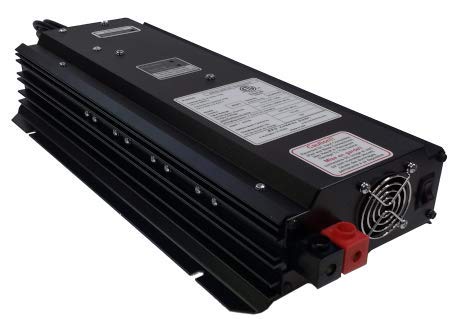
This one doesn't go in the pit. It mounts on a wall near an outlet, the wall feeds the unit, your existing sump pump plugs into the unit, and a 12-volt deep-cycle battery connects at the back. When utility power drops, the transfer switch moves the pump onto the battery without anyone touching it — no second pump, no second discharge line, no new hole in the foundation.

The output is 2,500 watts continuous and 5,000 peak of pure sine wave across three outlets, with a 25-amp charger that refills the battery once power returns. What we appreciate most is the remote controller: it shows battery voltage and load on an LCD you can mount at eye level, so checking the system stops being a flashlight-and-kneel job.

Our pick for a healthy pump in a crowded pit. The headroom is genuine — a 1/2 HP pump sits well inside what this delivers, with two outlets left for a freezer or a work light during an outage. Plan around two things: the battery is a separate purchase, and the supplied cables are short enough that the battery has to live close to the unit.

Bottom line: For a pump you trust, this is what we reach for: it keeps that pump running on pure sine wave power without adding plumbing.

Check Latest Price
#04

Best Premium Option

SEC America Pump Sentry 822PS

89 /100
Kirk Score Excellent
Output
1,200 W
Pump Limit
9 amps
Certification
UL and CSA
Battery Required
12V, 90-200 Ah
Check Details on Amazon

Pros

  • No plumbing; runs the pump in the pit
  • UL and CSA listed, aluminum housing
  • Handles pumps drawing up to 9 amps
  • Two-year factory warranty

Cons

  • Highest price in this group

The price is the first thing to get out of the way. This is the priciest unit on the page, and it doesn't include a pump — it exists to keep the one already in your pit running when the grid goes down.

What the money buys: a 1,200-watt inverter with an automatic transfer switch, UL and CSA listings, and an aluminum housing that looks built for a mechanical room rather than a shelf. It mounts on a wall, weighs 18 pounds, and carries a two-year factory warranty. Nothing about it is fussy, and the installation is a wiring job rather than a plumbing one, which is why it suits a basement that's already finished.

It's rated for pumps drawing up to 9 amps and wants a deep-cycle marine battery between 90 and 200 amp-hours — a big battery, and where most of the runtime actually comes from. The onboard charger maintains it between outages, which is the part people forget: a battery left flat for a season is a battery you replace.

For a finished basement, a cabin, or weeks away from home, this is the unit we point at, and the reliability side of the ledger is the strongest thing about it. The 9-amp ceiling is the boundary, though — read the nameplate on your pump before ordering, and step to the OLTEANP if it draws more.

Bottom line: We see the price as insurance: no new plumbing, and the pump you already own does the work when the grid drops.

Check Latest Price
#05

Best for Debris-Prone Pits

Wayne ESP25n 12V Backup Pump

89 /100
Kirk Score Excellent
Flow At 0 Ft
2,700 GPH
Maximum Lift
15 ft
Flow At 10 Ft
1,680 GPH
Pump Material
Coated steel and cast iron
Check Details on Amazon

Pros

  • Top suction resists silt and air lock
  • Cast iron and coated steel body
  • 2,700 GPH at 0 ft, 1,680 at 10 ft
  • Mechanical reed float, few electronics

Cons

  • Control box and charger are the weak point

Cast iron and coated steel, with the intake at the top of the housing rather than the bottom. That's the detail that earns this one a place: it draws clear water from above the sludge instead of chewing on what settles, and the top suction design also avoids the air lock that bottom-intake pumps develop in a shallow pit. In a pit that collects grit, this is the backup we want.

Capacity is 2,700 GPH at zero feet and 1,680 at 10 feet, against a 15-foot maximum lift, which covers a normal basement discharge with a little to spare. The reed float switch is a mechanical part rather than a pressure sensor, and we like that kind of simplicity in something that sits idle for months and then has to work on the first try.

The pump isn't the part to worry about; the control box and charger are. A charger fault takes down a system whose cast-iron half is perfectly healthy, and it looks like a charged battery right up until the power goes out — so test monthly rather than trusting the panel. The recommended WSB1275 battery is a separate purchase, and the 10,000 gallons Wayne rates per charge assumes you bought one.

Bottom line: Our choice for a gritty pit: a top intake and a cast-iron body do more for longevity than clever electronics.

Check Latest Price
#06

Best for Zoeller Primary Pumps

Zoeller Aquanot 508

85 /100
Kirk Score Excellent
Voltage
12V DC
Warranty
12 months, 36 with Aquanot battery
Discharge
Integrated check valve, quick disconnect
Flow Rate
40 gpm
Check Details on Amazon

Pros

  • Integrates cleanly with an M53 primary
  • Wall-mounted control, no kneeling
  • Integrated check valve, quick disconnect
  • Takes AGM or wet-cell batteries

Cons

  • Warranty extension hinges on a Zoeller battery
  • Control needs power at the mounting spot

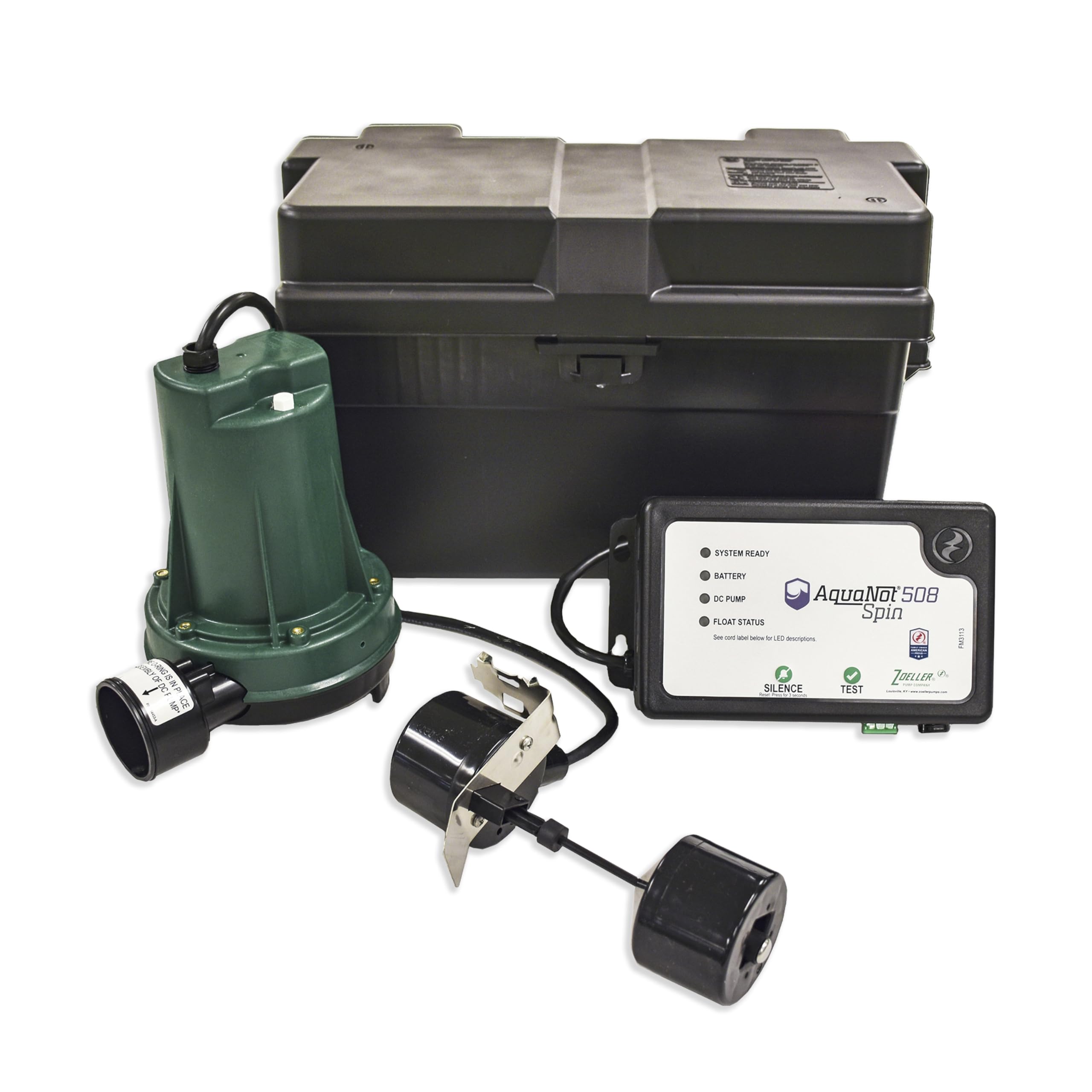
The three-year warranty comes with a condition: it applies when you buy a Zoeller Aquanot battery with the system. Without one, coverage is 12 months from installation or 18 from manufacture, which is a meaningful difference on a part that spends its life in water.

It makes most sense where a Zoeller primary is already in the pit — the kit integrates cleanly with an M53, and the wall-mounted control unit is the part we appreciate, because you check the system standing up rather than kneeling on a wet floor. The integrated check valve and quick-disconnect discharge simplify the plumbing, flow is 40 gpm, and it accepts both wet-cell and maintenance-free batteries. Mount the control where you'll actually see it, at the top of the stairs rather than behind the furnace, because its alarm is the only thing that tells you the backup has stopped being a backup.

Bottom line: We like it for Zoeller owners, provided the Aquanot battery comes with it; without one, the long warranty doesn't apply.

Check Latest Price
#07

Simple UPS installs

PumpSpy 2000W Backup System

80 /100
Kirk Score Excellent
Output
2,000 W
Housing
Aluminum
Output Current
16.6 A
Battery Required
12V deep-cycle
Check Details on Amazon

Pros

  • Simple UPS wiring, no plumbing
  • Aluminum housing, 10.5 pounds
  • Trickle charging maintains the battery

Cons

  • Battery is a separate purchase
  • Less headroom than the other inverter here

The 16.6-amp output ceiling is the number that defines this one: 2,000 watts at 120 volts across two outlets, which is plenty for a single sump pump and not much beyond it.

It's a wall-mounted aluminum box at 10.5 pounds, and the wiring is as simple as this category gets — wall to unit, pump to unit, battery to unit. A trickle charge holds the battery at full once it's there, which is the difference between a battery that's ready in year three and one that's been cooked dry by a charger that never stopped.

Simpler and less capable than the OLTEANP: two outlets instead of three, no remote display, and a small monitor on the side of the box that shows battery health when you walk over to it. We recommend it where the load is one pump and nothing else, and where you'd rather put the difference into the battery.

Bottom line: We treat it as the plain, capable fallback: easy to wire and honest about battery health, though it trails the OLTEANP on output.

Check Latest Price

How We Tested (and Installed) Sump Pump Battery Backups

We started by pulling every backup we could find that was actually built to live in a sump pit: DC pumps with an integral float, inverter-and-charger kits, and preassembled combos with a primary pump already mated to a backup. We ruled out anything that wouldn't drop into a standard 18-inch pit, anything with a warranty under a year, and anything that needed a battery the manufacturer wouldn't specify. Eight systems ended up in basements, including mine and two belonging to colleagues who volunteered their pits.

Each got the same treatment. We installed it solo with hand tools and timed the job, noting whether the float switch and check valve cleared the rim and whether the backup pump sat next to an existing primary without moving the plumbing. Then we cut the breaker at the panel to kill the primary, ran a hose into the pit, and watched. We timed how long each unit ran on a full charge, how much water it moved against the vertical lift of a real discharge line, and how long it took to recharge after.

Because a backup that shrieks is one you'll unplug, we stood on the floor above while each unit cycled and logged what carried through the joists. On the connected models we set up the app, pulled a battery lead to fake a failure, and checked whether the alert hit a phone before the pit filled. Ten months in, we've also looked at what the terminals and check valve look like after a season of cycling, and whether the battery was included in the price or a separate purchase.

How to Choose a Sump Pump Battery Backup

Start With the Architecture

Three designs solve the same problem, and the right one depends on the pump you already have. A dedicated 12-volt backup puts a second pump in the pit with its own controller, so it covers a dead primary as well as a dead grid. A combo replaces both at once, preassembled and preplumbed, which suits a primary near the end of its life. An inverter feeds your existing pump from a battery, keeping its full capacity and skipping the plumbing. If that pump is healthy and the pit is tight, the inverter is the tidier answer.

Compare Flow at 10 Feet, Not Zero

Flow at zero feet of lift is the biggest number a manufacturer can print and the least useful one you'll read. Your discharge climbs a wall and exits above the foundation, which is closer to 8 or 10 feet of head. Across this group the 10-foot figures run from about 1,500 to 2,500 gallons an hour, and that spread decides whether the pit refills faster than the backup can empty it. Measure the vertical rise from the bottom of the pit to where the pipe leaves the house before comparing anything.

Budget for the Battery

Almost every system here ships without a battery, and a deep-cycle battery is a real part of the total. A maintenance-free AGM asks nothing of you; a wet-cell costs less and needs its fluid checked, which is exactly why a controller with a built-in fluid sensor earns its place. Buy the battery the same week you buy the system. A backup with an empty battery tray is a bucket with a float switch on it.

Make Sure the Pit Has Room

A second pump has to sit beside the primary without touching it, and its float needs room to rise. A compact unit such as the Special CONNECT, at 9 inches long, is the difference between fitting a backup and digging a new pit. Depth matters as much as width: the backup's intake has to stay underwater while the primary's float still triggers. Measure the inside diameter of the basin and the water depth at the point the primary kicks on.

Know What Will Tell You It Failed

A backup that dies quietly is worse than none, because you stop checking it. The better controllers here name the fault in words rather than blinking a code, and some watch battery fluid or run a self-test. Remote alerts usually cost extra — both Watchdog CONNECT units need a sold-separately module — so price that in if you travel. Whatever you buy, put a monthly reminder in your phone to lift the float and let the pump run.

Frequently Asked Questions

Final Verdict

Most basements are best served by the Basement Watchdog Special CONNECT. It moves 1,730 gallons an hour at 10 feet of lift, fits a pit that won't take a second full-size pump, and tells you in plain words when something is wrong — we recommend it without qualification alongside an existing primary.

If that primary is near the end of its life, the Big Combo does both jobs in one preplumbed unit. If the pump is sound and you want to keep its capacity, the OLTEANP inverter is the better answer.