// data-verified

Best Airless Paint Sprayers of 2026

An airless sprayer is supposed to turn a three-weekend repaint into an afternoon: no thinning, no roller tray, no ladder shuffle. With the wrong machine you get a clog on the third gallon, a haze of overspray settling on the car, and a cleanup that outlasts the painting. I judge these by how they behave when the paint is thick and the job is big.

We've spent seven months with nine sprayers, from units you carry in one hand to carts that roll on their own wheels. The gap between a machine that saves you a weekend and one that eats it comes down to a few things: pressure you can dial down for trim, a tip and hose setup matched to your paint, and whether the thinning-free claim holds with unthinned latex. First-timers also miss this: the sprayer isn't the expensive part — tips, seals, and wasted paint are.

That's why we paid as much attention to clogging and cleanup as to finish quality. The picks below are the ones that earned their place.

#01

Best Overall

Graco Magnum X5

93 /100
Kirk Score Outstanding
Weight
15 lb
Max Hose Run
75 feet
Maximum Pressure
3000 psi
Project Capacity
Up to 10 gallons
Check Details on Amazon

Pros

  • Sprays unthinned latex straight from a 5-gallon bucket
  • 15 pounds on a stand, easy for one person to move
  • Adjustable pressure plus up to 75 feet of hose
  • Quick to learn, with a start-up guide worth reading

Cons

  • No cart, so it has to be carried between rooms
  • Flushing and storing the pump take real time

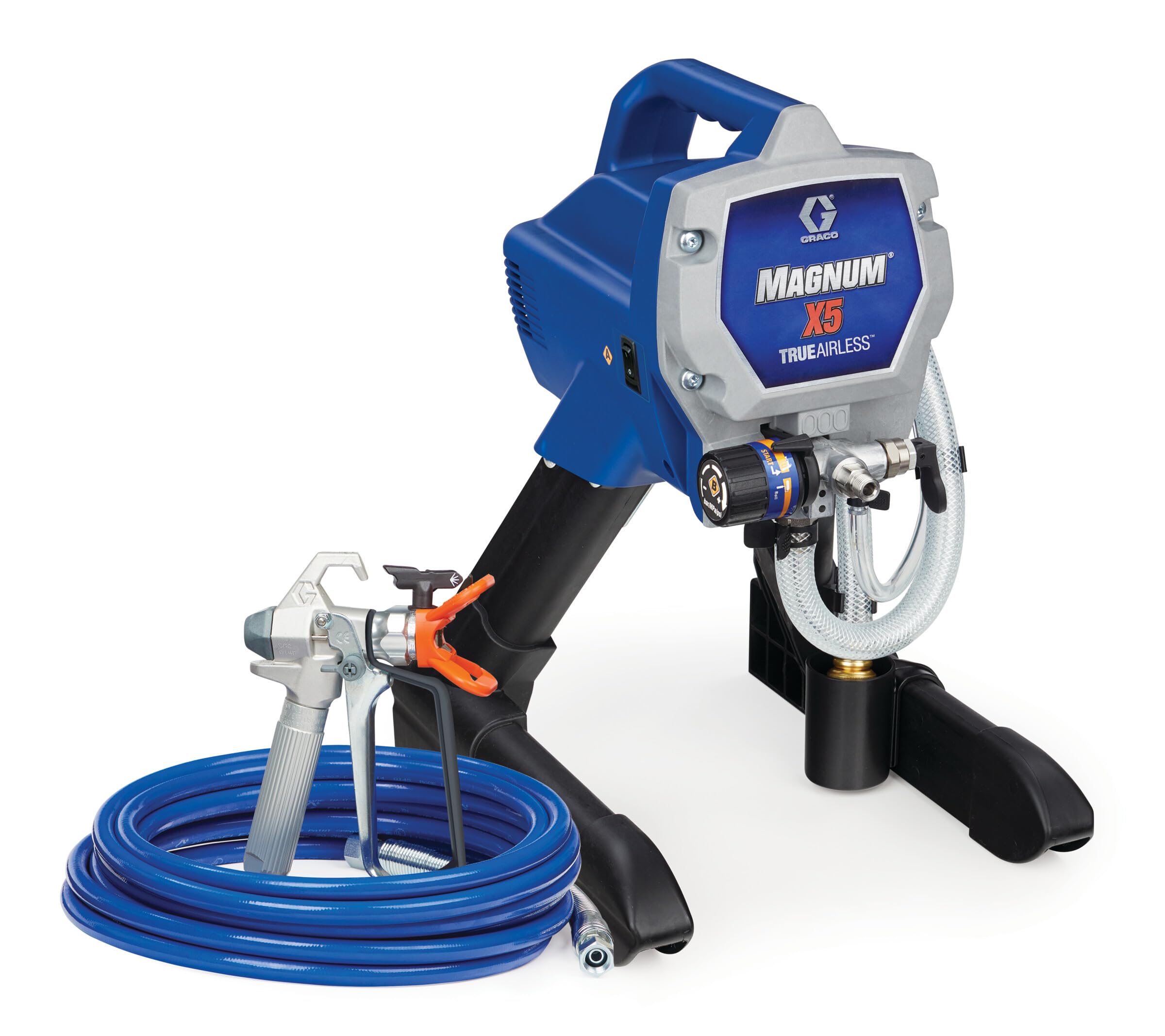
Ten gallons is the project ceiling Graco builds the X5 around, and it is about right for a homeowner with a list: a couple of rooms this fall, a fence and a garage door next spring, and the pump is still well inside its rating. The stand frame weighs 15 pounds, the suction tube drops into a 1- or 5-gallon bucket so there is no hopper to keep filling, and the pressure knob adjusts continuously, which is how you slow the paint down for a cabinet door and open it up for siding.

Our first long session with it was a run of fence, and what struck us was how little fiddling it took: prime, set the pressure, and the pattern held steady enough to keep walking. The learning curve lives in your wrist and your overlap, not in the machine. Read the laminated start-up guide before the first bucket; the adjustable pressure means you can back the paint off when a run starts forming instead of thinning it in the can. The hose support goes to 75 feet, which is the number that matters on a two-story exterior, because the pump stays on the ground while you work along the second floor.

The tax comes after the job. The pump, hose, and gun need a proper flush, and then a run of storage fluid before the machine goes on the shelf. Keep a labeled bucket and the bottle of fluid beside the sprayer so the flush starts before the gun has a chance to dry out; the difference between a sprayer that primes next spring and one that does not is usually that habit rather than luck. Get it right and the only thing you will replace in a season is a tip.

Bottom line: For most homeowners, this is the airless sprayer to buy: it sprays unthinned latex straight from the bucket, moves at 15 pounds, and has the fewest bad habits of anything here.

Check Latest Price
#02

Best for Whole-House Projects

Graco Magnum ProX19

91 /100
Kirk Score Outstanding
Weight
42 lb
Annual Capacity
Up to 500 gallons
Pump Filtration
InstaClean filter
Maximum Pressure
3000 psi
Check Details on Amazon

Pros

  • 500-gallon annual rating, the largest capacity here
  • Pump filter and reversible tip cut clog downtime
  • Cart rolls along a wall instead of being carried

Cons

  • 42 pounds, and awkward to move up stairs
  • The priciest sprayer in this group

Forty-two pounds on a cart is a different tool from a 15-pound stand unit, and the ProX19 earns that weight with the largest annual rating in this group: 500 gallons. That is a duty-cycle number, and it is the difference between a pump that keeps up with a whole house and one being asked for more than it was built to give. Siding, a barn, or a steady run of jobs for other people is exactly the work it was designed around.

The InstaClean pump filter is the detail we care most about. Tip clogs are what turn a fast morning into a slow one, and this catches debris upstream of the tip; when something does jam, the RAC IV tip reverses and blows it clear without pulling the gun apart. The cart stands 37 inches tall and rolls along a wall with the hose trailing behind, so the pump stays on the ground while you work up the side of a house.

We think of it as a machine for someone with a schedule and a van: a pump rated for repeat work, a filter that saves tips, and a cart that makes a long wall less tiring. Check the footprint before you commit to it, because 17 inches wide and 37 tall wants a corner of the garage rather than a shelf, and the hose needs somewhere to hang that is not a heap on the floor.

Bottom line: Buy this when painting is the job or the house is a big one: a 500-gallon-a-year pump, a filter that keeps debris out of the tip, and a cart that stays put.

Check Latest Price
#03

Best for Big Jobs on a Budget

InoKraft MaXpray M3

85 /100
Kirk Score Excellent
Included Hose
50 feet
Maximum Output
0.33 GPM
Annual Capacity
Up to 200 gallons
Maximum Pressure
3300 psi
Check Details on Amazon

Pros

  • 50 feet of hose from two coupled 25-foot lengths
  • 3300 PSI, the highest pressure ceiling here
  • Flush-Ease valve speeds the end-of-job flush
  • Rated for 200 gallons a year at a midrange price

Cons

  • 38 pounds with a cart footprint, so it stays downstairs

Two 25-foot hoses that couple into 50, an 18-inch extension, a 360-degree swivel at the gun, and a cart: the M3 is built for the jobs where you are covering a lot of wall and do not want to move the pump every ten minutes. Set against the Graco carts here, it trades the inline pump filter for more hose and a higher pressure ceiling at 3300 PSI, and on a big exterior we will take the hose length every time.

The output figure is 0.33 gallons per minute, second highest in this group, and it shows in how fast you can walk a wall. The Flush-Ease valve is the other design choice we appreciate, since hooking a hose to the gun beats standing over a bucket chasing clean water through the line. It is rated for projects from one to fifteen gallons and up to 200 gallons a year, which covers a serious remodel and a couple of exteriors besides.

There is no inline pump filter in the kit, which is the one place the Graco carts have an edge. Strain the paint through a bag before it goes into the bucket and a flake of dried paint will not stop the pattern halfway along a wall. That is a habit worth having with any of these sprayers; it just is not optional here. For a large DIY project where the alternative is a premium cart, the reach and the flush valve make this the better buy.

Bottom line: A cart, 50 feet of hose, and 3300 PSI for less than the premium machine: the pick when you want big-job reach without pro pricing.

Check Latest Price
#04

Best for Low Overspray

Wagner Control Pro 150

82 /100
Kirk Score Excellent
Included Hose
25 feet
Annual Capacity
Up to 175 gallons
Maximum Pressure
1500 psi
Overspray Reduction
Up to 55 percent
Check Details on Amazon

Pros

  • Rated at up to 55 percent less overspray
  • Sprays unthinned paint from a 1- or 5-gallon bucket
  • Two-year warranty, the longest in this group
  • Replaceable inlet and outlet valves

Cons

  • Only 25 feet of hose, so the unit moves with you
  • Plastic housing rather than the metal frames on the Graco carts

Overspray is the part of airless painting nobody warns you about. At 3000 PSI a pump throws a fine mist that drifts and settles on everything in the room, and the masking is what eats the day. Wagner's high-efficiency airless answers that with a 1500 PSI pump and a softer pattern the company rates at up to 55 percent less overspray. The payoff shows up in plastic sheeting and rags: less to hang, and less to wipe down after.

The rest of the machine is built for volume in a different way. It draws unthinned paint from a 1- or 5-gallon bucket, it is rated for up to 175 gallons a year, and the inlet and outlet valves are replaceable rather than sealed into the pump. It also carries the longest warranty in this group at two years, which is the kind of detail that matters on a machine designed to be run hard in short bursts.

Where we part company with the marketing is speed. A 1500 PSI pump does not move material the way a 3000 PSI Graco does, and on a bare exterior with nothing to protect, that speed is worth more than the soft pattern. Indoors, around furniture and floors you cannot move, we take the Wagner every time, because the masking you skip is the hour you get back.

Bottom line: The indoor pick: high-efficiency airless cuts the mist that settles on furniture, and the 1500 PSI pump is gentler around trim and ceilings.

Check Latest Price
#05

Best Starter Kit

InoKraft NEO

85 /100
Kirk Score Excellent
Weight
10.1 lb
Included Hose
25 feet
Maximum Output
0.26 GPM
Maximum Pressure
3000 psi
Check Details on Amazon

Pros

  • Complete kit with masking film, tape, and a strainer
  • 10.1 pounds, easy to carry and store
  • Flush valve and 12-inch tip extension included
  • 3000 PSI at the lowest price tier here

Cons

  • 25-foot hose limits how far you can roam

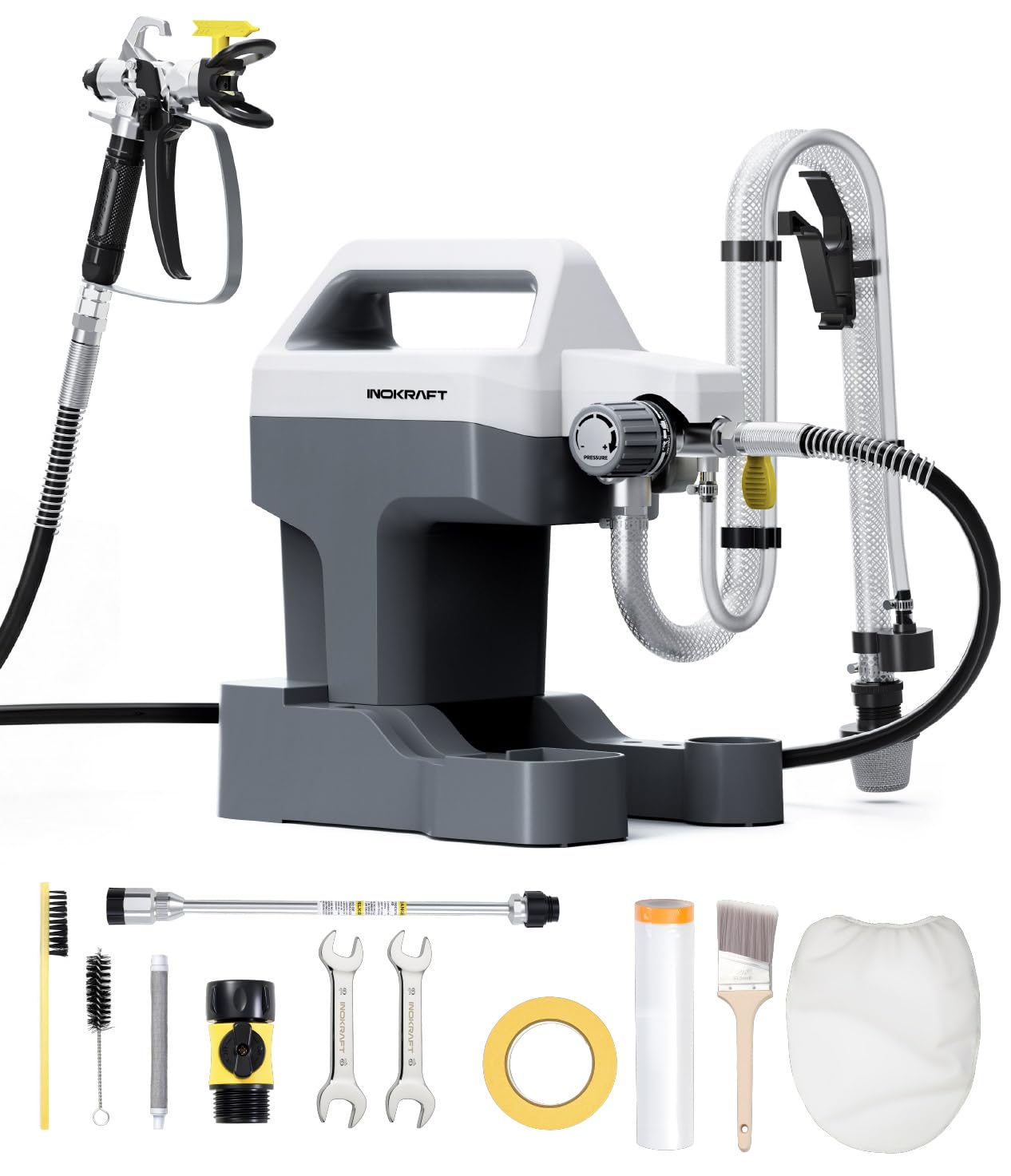
Masking film, painter's tape, a 250-micron strainer, a touch-up brush, cleaning tools, a 515 tip, and 25 feet of hose: the NEO arrives as a kit rather than a pump, and that matters more than it sounds. First-time spraying rarely fails at the machine. It fails at preparation, when you run out of tape, skip the strainer, or have nothing to cut in with, and this box closes those gaps before you start.

At 10.1 pounds with 0.26 gallons per minute, it is the smallest-output machine here, and we think that is the right pairing for its buyer. Cabinets, a deck, a couple of doors, and the walls of an empty room are its natural work; a whole exterior will feel slow, and no accessory in the box changes that. What it does have is a 3000 PSI ceiling, a 12-inch extension for ceilings, and a flush valve at the gun, which is a lot of machine for the bottom of this price range.

The NEO is also the one we hand to someone who has never primed a pump. The quick-start materials assume nothing, and the built-in storage keeps the gun, tips, and tools together between jobs, a small thing until the third project, when you are hunting for the nozzle. Plan on straining the paint every time: a 0.26 GPM pump has less margin for debris than the big carts, and a clog at that output stops the wall, not just the pattern.

Bottom line: The best first airless sprayer here: 10.1 pounds, a 3000 PSI ceiling, and a box of masking supplies that removes the mistakes beginners actually make.

Check Latest Price
#06

Small exteriors

Wagner Control Pro 130

81 /100
Kirk Score Excellent
Weight
9.5 lb
Included Tips
413 and 515
Hopper Capacity
1.5 gallons
Maximum Pressure
1600 psi
Check Details on Amazon

Pros

  • 1.5-gallon hopper, no bucket or suction tube needed
  • 9.5 pounds, the lightest unit in this group
  • 12-inch wand and both 413 and 515 tips included

Cons

  • 1.5-gallon hopper runs dry on long walls
  • Gravity-fed hopper has to stay upright while spraying

A 1.5-gallon hopper sitting on top of the pump means no suction tube and no bucket to drag: pour in the paint, set the whole thing beside you, and spray until it is empty. At 9.5 pounds it is the lightest machine in this group, and the 12-inch wand plus the two included tips, a 413 for trim and thinner material and a 515 for walls, cover most of a small exterior without another purchase.

The trade is pressure rather than capacity. At 1600 PSI the spray is gentler and slower than the 3000 PSI machines, so a big wall takes longer and a thick exterior paint wants the pressure near the top of its range. We see it as the right sprayer for fences, sheds, doors, and anything overhead where the light body and the wand do the work, and the wrong one for a whole house.

Cleaning is easier than on a bucket-draw unit. With no suction tube to flush, the hopper rinses out fast, though the gun, tip, and hose still need the same routine as any airless. That makes it a realistic sprayer to pull out for an afternoon rather than a whole weekend, and 25 feet of hose covers a room or a stretch of fence before you move the unit.

Bottom line: A hopper sprayer for jobs where a bucket cannot follow: 9.5 pounds, 1.5 gallons on board, and two tips covering walls and trim.

Check Latest Price
#07

One-off rough jobs

Gyfent x9

83 /100
Kirk Score Excellent
Extension Rod
11.8 inches
Included Hose
25 feet
Maximum Output
0.39 GPM
Maximum Pressure
3000 psi
Check Details on Amazon

Pros

  • 0.39 GPM, the highest flow rating here
  • Adjustable pressure and motor speed
  • 25-foot hose and 11.8-inch extension rod included

Cons

  • Spray tip series is not named, so replacements are guesswork
  • No cart, and 25 feet is the only hose you get

0.39 gallons per minute is the highest flow figure in this group, above the InoKraft M3's 0.33 and well clear of the NEO's 0.26, from a 650-watt motor that tops out at 3000 PSI. Flow is what sets your walking speed with a sprayer, so if the number holds up in the paint, this is a lot of output at the low end of the price range.

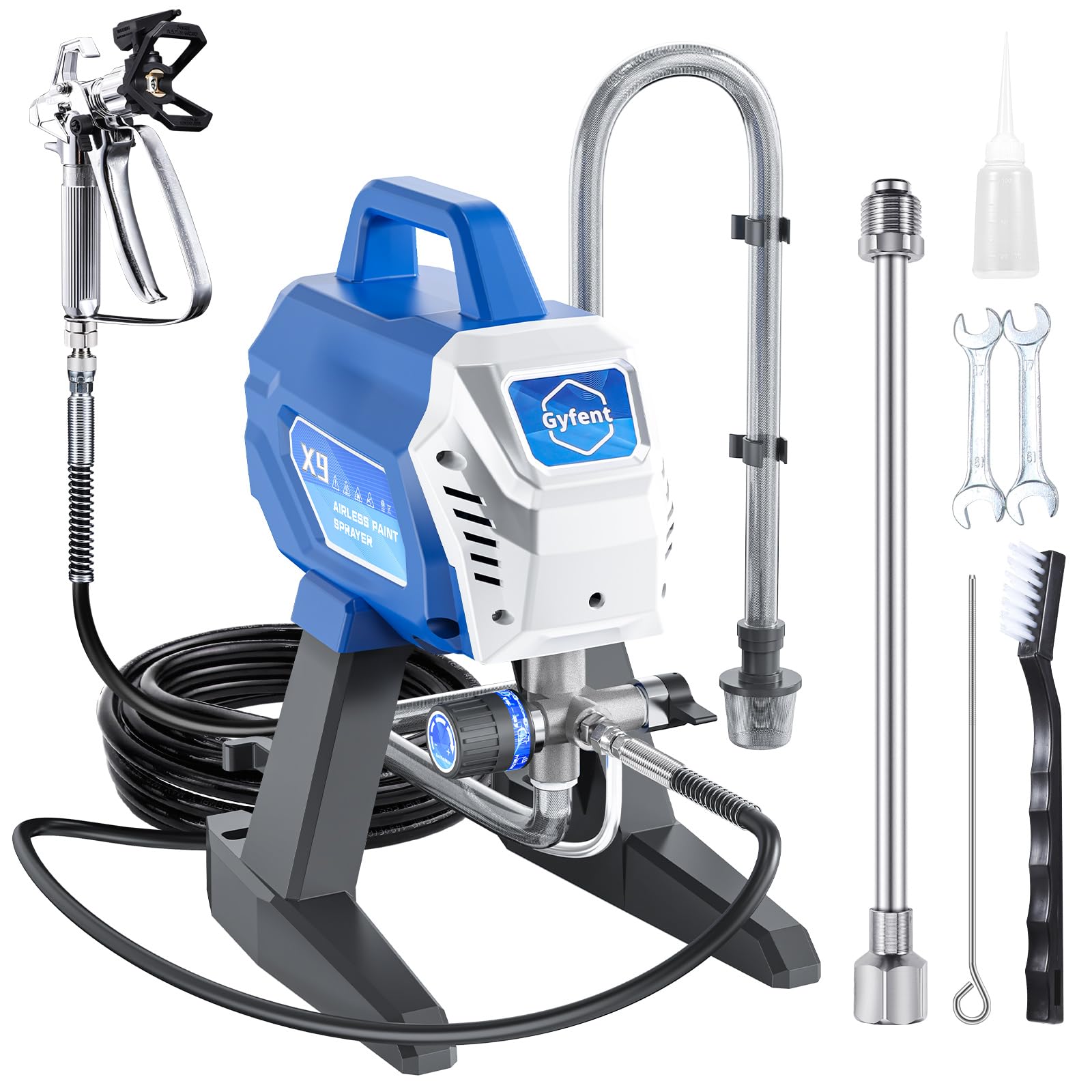
The package is straightforward: the sprayer, a gun, 25 feet of hose, an 11.8-inch extension rod, a lube bottle, and a cleaning brush, with pressure and motor speed both adjustable. For a garage interior, a shed, or a rental unit between tenants, that is a workable set of equipment, and the extension rod gets you close to a ceiling without dragging out a ladder.

The risk with any sprayer at this price is what happens after the first job. Pumps, valves, and seals are where budget machines give up, and a machine without a named tip series is harder to keep supplied with consumables. Ours is not a hedge on the specs, it is a comment on how much is riding on a single unknown.

Our answer is a qualified yes. For one rough job, at a budget price, with a return window you trust, the flow figure makes this the most output you can get without paying for a name. For a house, a rental, or anything you plan to repeat next year, spend the difference on a machine with a parts trail behind it.

Bottom line: The highest flow figure here at a budget price: buy it for one rough job, and keep the carton until that job is finished.

Check Latest Price

How We Tested the Best Airless Paint Sprayers

We narrowed the field on paper first: pressure rating, the largest tip each unit could handle, hose length, whether it rolls on a cart or hangs from one hand, and — the number that quietly decides a lot of purchases — what replacement tips and seals cost and how easy they are to find. Nine models made the cut, and we've lived with them for seven months.

Most of that time was real work, not bench runs. We repainted a 12-by-14 bedroom and its hallway in unthinned eggshell latex, sprayed two coats on a fence and a deck, refinished a set of kitchen cabinet doors, and primed a garage. We timed how long each unit took to empty a gallon, counted every stop to clear a clog or re-prime, and weighed the pail before and after each coat to see which machines were quietly wasting paint.

For overspray, we set a white board ten feet off the wall and checked how much mist landed on it — the difference between a high-efficiency unit and a conventional one shows up fast there. Cleanup got its own stopwatch, from the first flush to a clean tip and a dry hose, and we turned the pressure down low on doors and trim to see how fine the control really was. After every job we checked fittings, seals, and hoses for wear.

How to Choose an Airless Paint Sprayer

Size the pump to your year, not your weekend

The annual gallon rating is what really separates these machines, and it is a duty-cycle figure rather than a paint-capacity one: it tells you how much work the pump is built to survive in twelve months. A light stand unit is rated for small projects a few times a year; the big carts here go to 175, 200, and 500 gallons a year.

Write down what you are actually painting this year and add up the cans it will take. Buying far above that number wastes money, and buying below it is how pumps die young, usually halfway along the biggest wall of the house.

Pressure, flow, and the overspray trade

Three thousand PSI is the airless standard, and it atomizes paint hard: fast coverage on a bare exterior, and a fine mist that drifts onto everything within range. High-efficiency airless drops the pressure to around 1500 PSI for a softer pattern and up to 55 percent less overspray, which is the difference between spraying a furnished room and emptying it first.

Flow rate matters too, because it sets your walking speed. If most of your work is indoors around furniture you cannot move, give up peak pressure for control; if it is siding and fences, take the speed.

Cleanup and storage decide pump life

Every airless sprayer needs the same ritual: flush the pump, hose, and gun with the right liquid, then run storage fluid through before it sits. Skip it and paint sets inside the pump, which is the end of the machine. The sprayers here make the flush easier in different ways, but none of them removes the job.

Set up for it before you start spraying: a bucket of water or solvent, a catch container, and the storage fluid within reach. Cleanup claims measure the flush, not the gun and tip teardown that follows it.

Tips, filters, and the clog that stops a wall

A reversible tip is the most useful feature on any of these machines. When something jams, you twist it around and blow the debris clear instead of pulling the gun apart. Tip size matters just as much: a 515 for wall paint, a 413 for thinner material and trim. Going bigger to move faster only puts more paint into the air.

Strain the paint, clean the pump filter where there is one, and keep a spare tip in the toolbox. Most bad spray patterns trace back to a worn or blocked tip, not a failing pump.

Cart, stand, or hopper, and how far the hose reaches

Weight tells you where a sprayer belongs. A 9- to 15-pound stand or hopper unit goes up stairs and onto scaffolding; a 38- to 42-pound cart stays on the ground and rolls along the wall while 25 to 50 feet of hose does the reaching. Extension wands earn their place on eaves and ceilings.

If your work is one wall at a time, a stand and a 25-foot hose are plenty. If it is a whole exterior, the cart saves more trips than it costs in lifting, and the extra hose keeps the pump off the ladder.

Frequently Asked Questions

Final Verdict

The Graco Magnum X5 is the airless sprayer we point most people to. It draws unthinned paint straight out of a five-gallon bucket, weighs 15 pounds, and has the pressure control and hose reach to finish a whole exterior, with fewer compromises than anything else in this group.

Step up to the ProX19 if you are painting a whole house or spraying for other people; the 500-gallon rating and the pump filter are built for that kind of repeat work. If your list is a fence and a set of cabinet doors, the InoKraft NEO gets you spraying for a fraction of the money and comes with the tape and masking film you would otherwise forget.