// data-verified

Best HVLP Paint Sprayers of 2026

A paint sprayer isn't just a roller that moves faster. HVLP stands for high volume, low pressure, and the low pressure is the point: instead of fogging your garage with overspray, the gun lays paint down where you aimed it, so the finish dries smooth rather than stippled. The spec that matters most usually isn't the wattage on the box. It's the tip size, how far you can dial in the fan pattern and fluid flow, and how many pieces you have to take apart when you're finished.

I've sprayed cabinet doors in a one-car garage and fence boards in a windy backyard, and cleanup outlasted the painting both times. Over the past six months, my team and I have put 12 sprayers through furniture, trim, doors, fences, and a few garden chairs. The ones worth keeping let us change the pattern without changing our grip and came apart for cleaning without a manual. Below, they're sorted by the job you're actually doing — a quick fence refresh and a cabinet refinish don't want the same gun.

#01

Best Overall

Fuji Spray Semi-PRO 2

93 /100
Kirk Score Outstanding
Cup
400 cc gravity
Nozzle
1.3 mm air cap
System
1400W turbine, 25 ft hose
Warranty
24 months, parts and labor
Check Details on Amazon

Pros

  • Fine atomization that levels into a smooth coat
  • Air control valve at the gun cuts overspray
  • Cleaning is confined to the gun and cup
  • 24-month parts and labor warranty

Cons

  • 400 cc cup needs frequent refills

Cabinet doors are unforgiving. A bad spray job shows as clearly as a bad brush job, just in a different texture. The Semi-PRO 2 is the sprayer here that gets closest to the flat, even coat you are picturing: a 1400W turbine feeds a non-bleed gravity gun with a 1.3mm air cap, and the material goes on fine enough to level out instead of sitting on the surface.

We underestimated the 25-foot hose until we were spraying inside a garage. The air control valve sits at the gun, so you can pull the pressure back at the nozzle, and that is how you keep overspray and bounce-back out of your face. The turbine stays on the floor where it belongs.

Capacity is what you trade for that. The cup holds 400 cc, so a run of doors means refilling every few passes; work from a mixing bucket with a strainer and that rhythm becomes normal. Cleaning is the gun and cup only — the turbine and hose stay out of it — which is a rinse and a brush rather than a lost evening.

The metal case has a holder for the gun, so the system packs away as one unit, and the 24-month parts-and-labor warranty covers a machine that costs real money. For trim, doors, and furniture, the results justify all of it.

Bottom line: We think it has the best atomization here, and it is the pick for anyone whose project is judged by its finish — cabinets, doors, and furniture rather than fences.

Check Latest Price
#02

Best Handheld for Big Jobs

HomeRight Super Finish Max

86 /100
Kirk Score Excellent
Cup
40 fl oz
Tips
1.5, 2.0 and 4.0 mm brass
System
Corded handheld
Weight
3.3 lb
Check Details on Amazon

Pros

  • Three brass tips from 1.5 to 4.0 mm
  • Light 3.3-pound body for overhead work
  • 40-ounce cup cuts refill stops
  • Needs less thinning than most handhelds

Cons

  • Latex still needs thinning
  • Full cup gets heavy over a long session

Three brass tips is the right number for a handheld: 1.5mm for stain and polyurethane, 2.0mm for most thinned latex, and 4.0mm for the thick material that stops a finer nozzle dead. HomeRight's claim is that the Super Finish Max needs less thinning than the handhelds around it, and the 4.0mm tip is where that claim gets tested.

At 3.3 pounds the body is light enough for overhead work along a fence line or a soffit, and the 40-ounce cup cuts the number of trips back to the paint can. We noticed the trade the moment we filled it: a full cup is a lot of material to hold at arm's length, and an hour into a session your wrist knows it.

It is still a corded handheld, so latex needs thinning and the finish is good rather than glassy — a big flat surface rewards a steady, overlapping pass and punishes a hesitant one. The job it owns is the one too big for a brush and too small for a turbine: a fence, a set of shutters, a shed, a pair of Adirondack chairs.

Bottom line: The handheld we point beginners to: three brass tips cover stain through thick latex, and the light body keeps a long session comfortable.

Check Latest Price
#03

Best Budget

LESONJOY 1000W HVLP Sprayer

96 /100
Kirk Score Outstanding
Cup
1400 ml
Motor
1000W
System
Corded handheld
Nozzles
4 copper
Check Details on Amazon

Pros

  • Complete kit includes viscosity cup and filters
  • Four copper nozzles and three spray patterns
  • 1400 ml cup holds more than a quart
  • Adjustable flow knob for thin or thick material

Cons

  • Cleanup takes real time after each color
  • Plastic housing feels its price

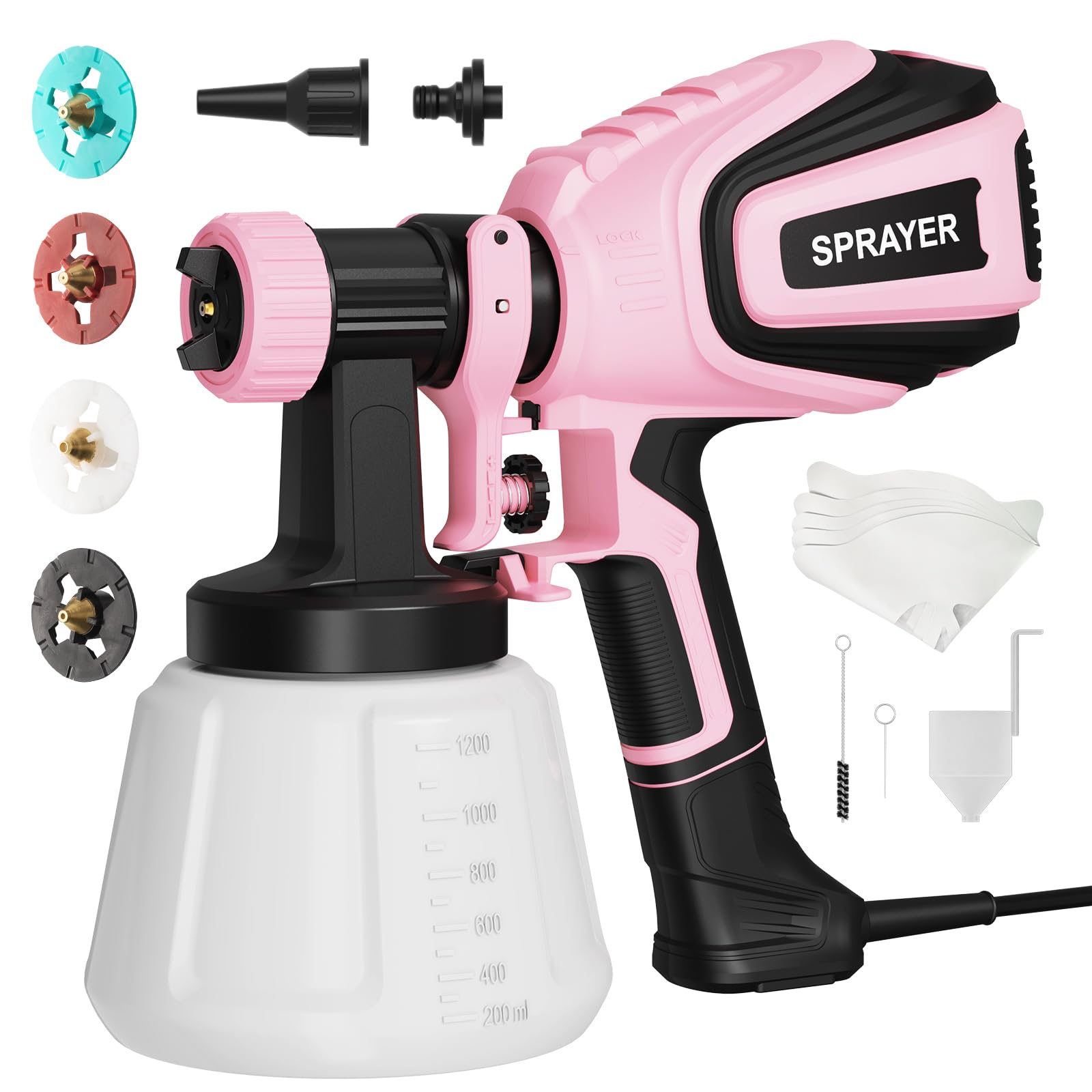
Open the box and you have a sprayer, four copper nozzles, a viscosity cup, filter funnels, a cleaning brush, an unclogging needle, and gloves. None of that is padding: the viscosity cup is the tool that tells you whether your paint needs thinning, and plenty of budget sprayers make you buy one separately.

The 1000W motor and the flow knob do the work you actually notice — down for trim and cabinet faces, up for a fence panel — and the three patterns cover the shapes in front of you. We found the circular pattern genuinely useful on spindles and chair legs, where a fan wastes material on either side of the workpiece.

The 1400 ml cup is the largest on any handheld here, which means fewer refills and a heavier tool once it is full. Cleanup is where the money shows: the parts come apart easily, but a full teardown and rinse after each color takes real time. On a first project — a dresser, a set of cabinet boxes, a fence — that is a fair trade.

Bottom line: Our budget pick: the kit covers everything a first spray job needs, and it lays an even coat on fences and furniture with minimal fuss.

Check Latest Price
#04

Best Premium

Fuji Spray Mini-Mite 4 Platinum

93 /100
Kirk Score Outstanding
Cup
0.25 gal gravity
Gun
T75G with side fan control
System
Turbine with HDC, 25 ft hose
Warranty
24 months, parts and labor
Check Details on Amazon

Pros

  • Side-mounted pattern knob adjusts the fan one-handed
  • Consistently smooth, even coats on doors
  • Stay-cool handle for long sessions
  • 24-month parts and labor warranty

Cons

  • Quarter-gallon cup runs dry on long runs

There are two Fuji systems in this guide, and the distance between them is air and money. The Mini-Mite 4 Platinum is the bigger turbine paired with the T75G gravity gun, and if you spray often enough that a bad coat costs you a weekend, that distance is the whole decision.

We think the T75G is the reason to step up. The pattern control knob sits on the side of the gun, so you shrink the fan for a cabinet stile and open it for a door face without re-dialing the air or taking your hand off the trigger. The stay-cool handle keeps that comfortable through a long session, and the coats that come out of it are smooth and even in a way that makes people ask who sprayed the doors.

The quarter-gallon cup is an improvement on the Semi-PRO 2's without being generous, so plan on a refill or two during a full set of doors. The metal case holds the gun between jobs, which matters more than it sounds once a 25-foot hose is in the picture.

Bottom line: For weekly spraying, the extra air and the better gun are worth the step up — we think this is the system that turns a good finish into a repeatable one.

Check Latest Price
#05

Best for Compressor Owners

3M Performance Spray Gun Kit

91 /100
Kirk Score Outstanding
Cup
650 ml PPS 2.0
Heads
15, in 1.2 to 1.4 mm
System
Compressed-air gun
Air Control
Valve included
Check Details on Amazon

Pros

  • Liner-and-head system makes cleanup a wipe
  • 15 replaceable heads in three sizes
  • Light gun for awkward angles
  • Air control valve included

Cons

  • Needs a compressor with real air output
  • Heads and liners are an ongoing cost

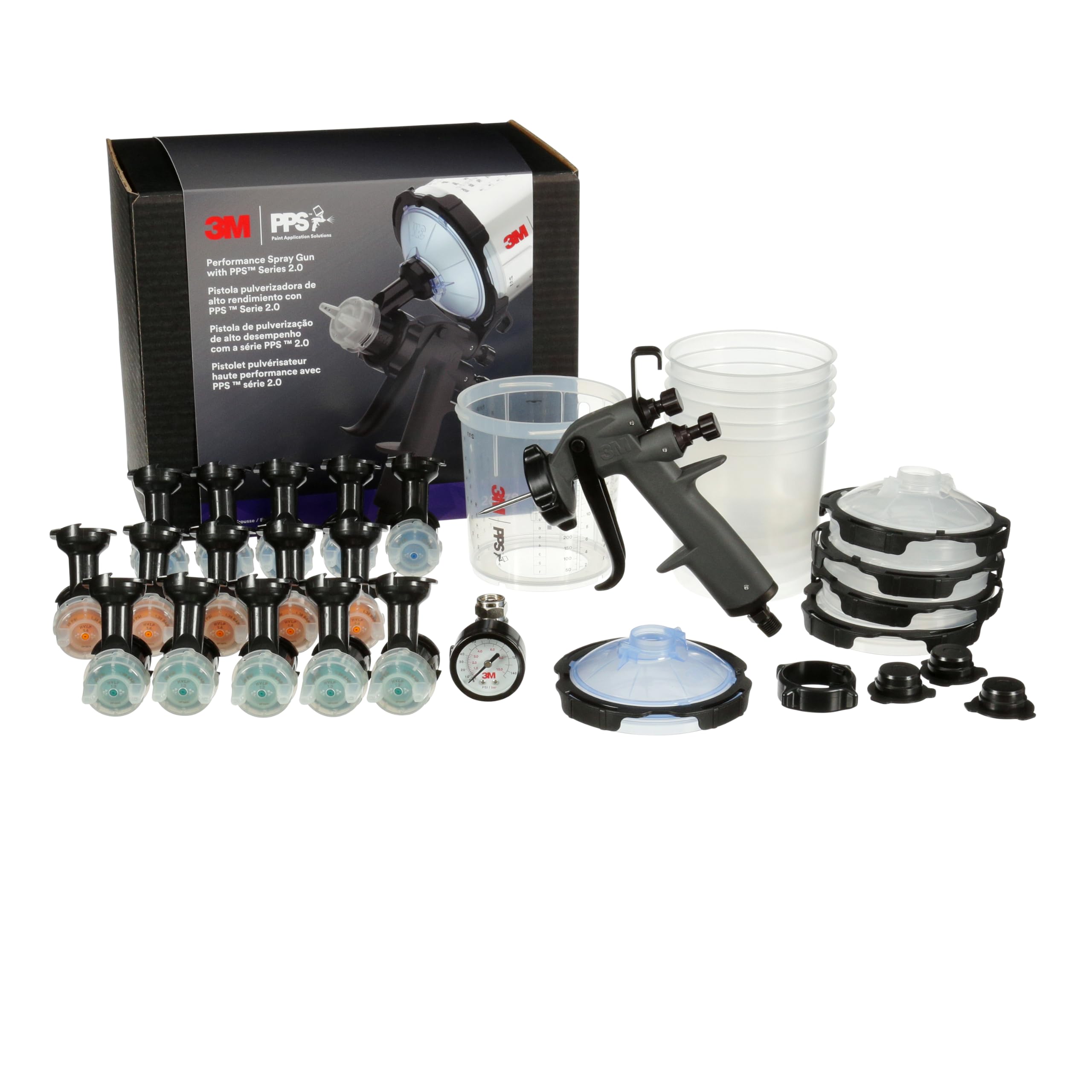
The PPS 2.0 cup is a flexible liner inside a rigid shell, and the atomizing head is a replaceable nozzle rather than a machined one you scrub. Cleanup shrinks to the needle and a wipe, and a color change stops being an event. The spraying is good; what you are paying for is the not-cleaning.

Fifteen heads come in the kit, five each in 1.2, 1.3, and 1.4mm, which covers primers through clearcoats and gives you a fresh nozzle instead of a worn one partway through a multi-coat job. The gun is light — lighter than the machined guns we have handled — which matters when you are working under a panel or around a wheel arch.

The catch is air. This is a compressed-air gun, and HVLP heads want a steady volume, so a small pancake compressor is the wrong partner. The heads and liners are consumables as well, and that running cost is the trade for the cleanup time and the paint you save.

Bottom line: If you already own a serious compressor and hate cleaning, this is the gun we hand you: swap the head, toss the liner, spray the next color.

Check Latest Price
#06

Decks and fences

Wagner Control Spray Max

87 /100
Kirk Score Excellent
Cup
1.5 qt, metal and plastic
Power
510W
System
Two-stage turbine, 20 ft hose
Weight
10 lb
Check Details on Amazon

Pros

  • 20-foot hose keeps the motor out of your hand
  • 1.5-quart cup in metal and plastic
  • Pressure dial plus flow adjuster
  • Motor sits in the base, not the gun

Cons

  • Pattern goes uneven with thicker latex
  • Ships with a single nozzle

Twenty feet of hose changes how a sprayer feels. The turbine sits on the ground, the gun weighs almost nothing in your hand because the motor is not in it, and you can walk a fence line without dragging a cord or a cup of paint along with you. That is the difference between finishing a deck and abandoning it halfway.

We found the pressure dial gives enough control for stain, sealer, and thinned latex, and the flow adjuster lets you lay a wet coat on a deck board without flooding it. Push toward thicker material and the pattern gets less even — this is a sprayer that rewards thin material and punishes shortcuts.

The 1.5-quart cup is generous for a turbine at this price, and you get both a metal and a plastic cup, so one can stay on stain duty and the other on finishes. It ships with a single nozzle, though, and that sets the ceiling on what it can spray.

Bottom line: The hose-fed turbine we like for decks, fences, and big flat surfaces, where reach and a big cup matter more than a showroom finish.

Check Latest Price
#07

Thick material

VONFORN 700W HVLP Sprayer

88 /100
Kirk Score Excellent
Power
700W
System
Corded handheld
Nozzles
1.0, 1.5, 2.0 and 3.0 mm
Included
Dust-blowing joint and cleaning kit
Check Details on Amazon

Pros

  • 3.0 mm nozzle handles thick material
  • Dust-blowing joint clears surfaces first
  • Tool-free assembly and full starter kit
  • Light enough to work overhead

Cons

  • Durability is the weakest of the sprayers here

Most handhelds in this guide top out at 2.0mm. This one goes to 3.0, the size that lets thick latex and primer move without being thinned to the consistency of milk. If a can of old exterior paint is the reason you are shopping, that nozzle is the argument.

Setup is tool-free, and the dust-blowing joint is an odd-looking accessory that earns its place: clear the dust off a fence or a cabinet box before you spray instead of watching it settle into the wet coat. Five filters, a viscosity cup, and a cleaning needle round out a kit that leaves you nothing to buy before you start.

Spray consistency is where it slips: we got passes that laid out even and passes that landed textured, and the difference tracked how well the material was thinned and how clean the air cap was. That makes it a sprayer that rewards fiddling. For a shed, a fence, or a rental you are turning over, that is a fair trade.

Bottom line: We keep this one for rough projects and thick material — the widest nozzle range here, light in the hand, and cheap enough to treat as a tool rather than an investment.

Check Latest Price
#08

Primer and clear

ENDOZER HVLP Spray Gun Set

87 /100
Kirk Score Excellent
Cup
600 cc gravity
Gauge
Included
System
Compressed-air gun
Nozzles
1.4, 1.7 and 2.0 mm stainless
Check Details on Amazon

Pros

  • Three stainless nozzles from 1.4 to 2.0 mm
  • Air pressure gauge mounted at the gun
  • Even atomization from the 15-hole brass hood
  • Low cost for a compressor gun kit

Cons

  • Internal passages are fussier to clean
  • Fluid and pattern knobs drift mid-job

This one will not spray latex, and the listing says so. That is less a flaw than a job description: the ENDOZER is a compressed-air gun with 1.4, 1.7, and 2.0mm stainless tips, built for base coats, clear, primer, and the coatings that would clog a handheld's plastic passages.

The brass hood with its 15 holes atomizes evenly for a gun at this price, and the gauge at the inlet is the detail we appreciate most. HVLP work lives and dies on inlet pressure, and having the gauge on the gun saves you walking back to the regulator every time the pattern looks wrong.

Where it feels its price: the internal design makes a full clean fussier than the 3M's liner-and-head system, and the fluid and pattern knobs do not hold a setting as firmly as a gun costing many times more. For primer and clear on a weekend project, both are manageable.

Bottom line: The gun we reach for on primer, clear, and car panels: three stainless tips and a gauge for very little money, provided you already own a compressor.

Check Latest Price

How We Tested 12 HVLP Paint Sprayers

We started the shortlist with the specs that change the outcome: nozzle and tip sizes, cup capacity, whether the gun feeds by gravity or suction, how many spray patterns it offers, and whether fan width and fluid flow adjust separately. Anything with a single fixed tip got cut. What was left we grouped by power source — turbine systems, corded handhelds, and guns that run off a compressor — so a cabinet-finishing tool wasn't being judged against a fence refresher. That left 12 sprayers, tested over six months.

Most of that time was spent in a garage with cabinet doors and drawer fronts laid across sawhorses, plus a fence, a set of bifold doors, trim, and four garden chairs. We sprayed thinned latex, stain, sealer, and a water-based topcoat, then examined each pass under a raking work light for orange peel, runs, and dry spray. We switched from a wide fan to a narrow one mid-project to count how many controls — fluid, air, pattern — we had to touch and whether we could do it wearing gloves. We also noted how each gun balanced after an hour of steady spraying; a full cup at the wrong angle is what ends a session early.

Cleanup got its own test, since that's where these tools get abandoned. We broke down and flushed each gun after every session, timed it, and counted the parts. Then we were deliberately unfair: we let latex dry overnight in the nozzle and fluid passage and tried to clear it with the supplied brush and pick, noting what had to be soaked or scraped. We watched cup gaskets and threads for weeping after each cleaning, checked how much overspray landed on a masked wall behind the fence, and noted which units still felt tight after a dozen teardowns. Price came last — a sprayer that finishes beautifully but eats gaskets isn't a value.

How to Choose an Hvlp Paint Sprayer

Start With the Air Source

The three designs in this guide are not interchangeable. A corded handheld puts the motor and the cup in your hand: cheapest, lightest, and limited to material thin enough for a small fan to atomize. A turbine system sits on the floor and feeds the gun through a hose, so the gun stays light while the air volume goes up — and it is roughly as loud as a shop vacuum. A compressed-air gun needs a compressor you probably already own.

Buy the handheld for a fence and one dresser, the turbine when the finish is the point, and the air gun when a compressor already anchors your shop. If you are honest with yourself that this is a two-project purchase, the handheld is the sensible answer; if you have a house full of trim ahead, the hose is worth the money.

Match the Tip to the Material

Tip size, not wattage, decides what sprays. Roughly: 1.2 to 1.4mm for clear, lacquer, and thin finishes; 1.7 to 2.0mm for primer and thinned latex; 2.5 to 3.0mm for thick latex and high-build primer. The trap is assuming a bigger motor moves thicker paint — a 1000W handheld with a 1.5mm tip still cannot push unthinned latex.

Check the tip range against the material you will actually buy, then use the viscosity cup: if the material does not drain in the stated time, thin it and test on scrap before you touch the workpiece. A five-dollar cup and ten minutes of testing save more finishes than an extra nozzle does.

Cup Size, Feed Style, and Reach

A gravity cup sits on top and feeds by weight; a bottom-feed cup hangs below and draws material up. Gravity is more forgiving for small batches and fine work, bottom-feed for volume. Cup size is a straight trade — a 40-ounce or 1400 ml cup means fewer refills and a heavier tool, while a 400 cc cup keeps the gun light and sends you back to the bucket.

Reach matters more than most shoppers expect: 20 to 25 feet of hose lets you walk a wall without moving the base, which is exactly the freedom a handheld cannot give you once the cup gets heavy.

Cleanup and Running Costs

Every sprayer needs cleaning the moment you stop, and the design decides how long it takes: a gun-and-cup rinse on a turbine system, a full teardown on an inexpensive handheld, or a liner swap on the 3M. Consumables change the math as well — replaceable heads and disposable liners cost money per project and buy back the cleaning time.

If you plan to spray two colors in a day, add a second cup or a liner system. That choice saves more frustration than any nozzle upgrade.

Frequently Asked Questions

Final Verdict

We recommend the Fuji Spray Semi-PRO 2 for the projects that get looked at up close. It lays the finest, most even coat in this guide, it cleans up at the gun, and the 400 cc cup is the price of a light, maneuverable tool.

If the job is a fence, a deck, or a set of shutters, the HomeRight Super Finish Max handles it for far less money, and a merely good finish is not a problem there. If a compressor already lives in your shop, start with the 3M.