// data-verified

Best Paint Sprayers of 2026

A paint sprayer can save a weekend—or turn your garage into a fog of overspray and a cleanup project that outlasts the painting. I've learned to care less about the biggest pressure number on the box and more about whether the sprayer lets me adjust pressure without fuss, handles the coating I'm actually using, and comes apart before paint sets in the nozzle. The right one fixes all three; the wrong one adds clogging and splotchy coverage to a job you were trying to make easier.

Over the past six months, my team and I ran eight sprayers through kitchen cabinet doors, interior walls, a fence, and a few furniture refreshes. We paid attention to how quickly each got us spraying, how evenly it laid down latex and stain, how often we stopped to clear a clog, and what cleanup really involved. Price and specs matter, but the better value often comes from useful tips and pattern changes rather than a higher pressure rating alone. Below are the picks we'd hand to someone painting walls, cabinets, fences, or furniture.

#01

Best Overall

Graco Magnum X5

93 /100
Kirk Score Outstanding
Weight
15 lb
Max Pressure
3000 PSI
Project Size
Up to 10 gallons
Max Hose Length
75 ft
Check Details on Amazon

Pros

  • Draws straight from a 1- or 5-gallon bucket
  • Sprays unthinned latex at up to 3000 PSI
  • Rated for projects up to 10 gallons
  • Supports 75 feet of hose for second stories

Cons

  • Bulkier and heavier than any handheld here

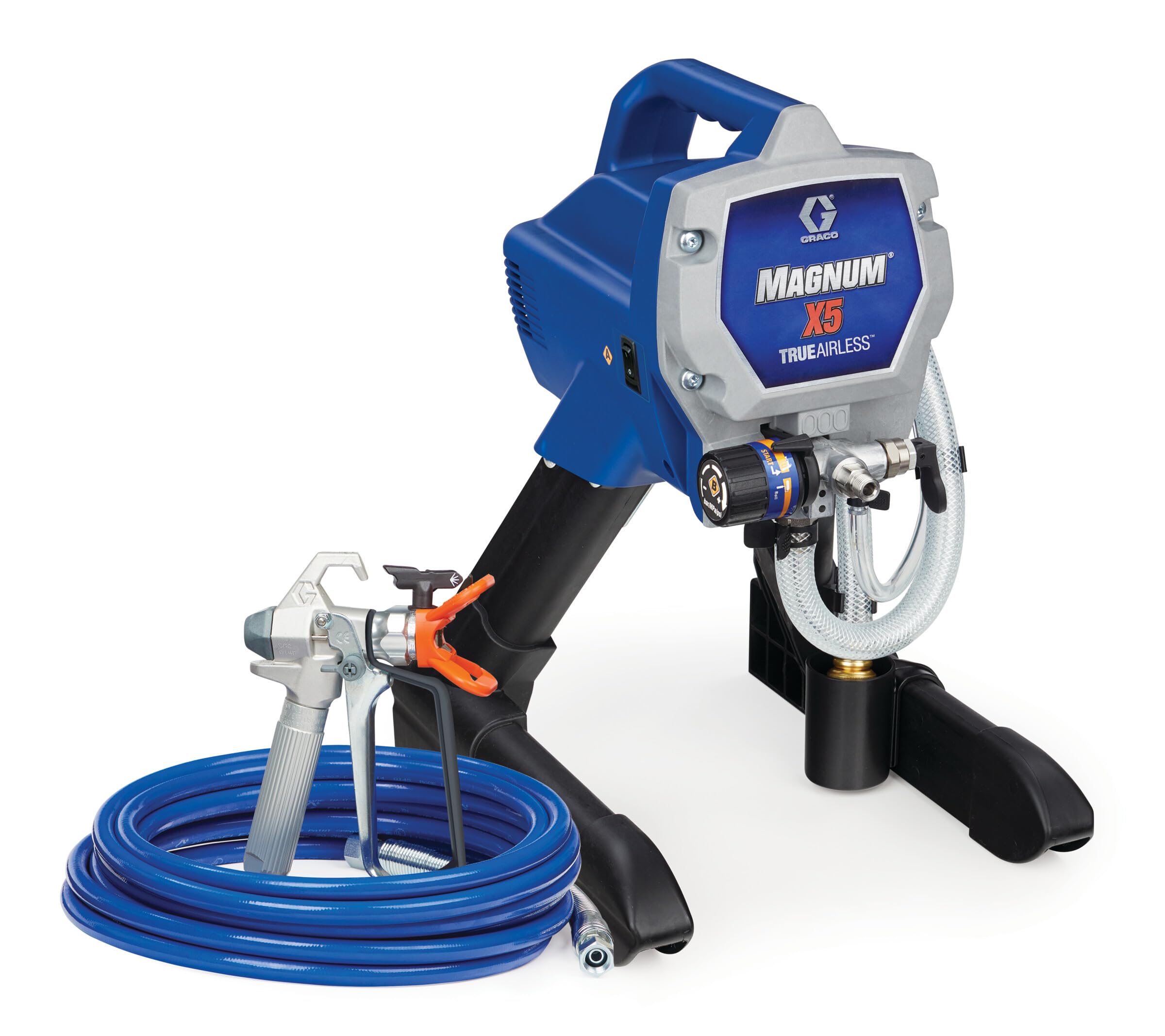
The flexible suction tube is the small piece of design that decides what the Magnum X5 is for. Drop it into a 1-gallon can or a 5-gallon bucket and the pump pulls paint straight from the container, so there is no pouring and no stopping to refill a cup. Set the pressure dial and it sprays latex unthinned at up to 3000 PSI, which is the difference between a sprayer you fight and one you simply point.

That is why this is the airless we recommend to most people with a real project ahead of them. Graco rates it for jobs up to 10 gallons, it supports up to 75 feet of hose for a second story, and at 15 pounds it follows you along a wall without a second person dragging the pump. If your list is a house exterior, a deck and a run of fence, the X5 handles all three on one machine, and the reversible pressure control means you can turn it down for trim instead of buying a second tool.

The prep is the part nobody warns you about. An airless lays material down fast, so masking, drop cloths and moving furniture take longer than the spraying does. Pumps in this class can also quit early — Graco covers the X5 with a one-year warranty against defects, so register it, keep the receipt, and flush the fluid path at the end of every session instead of leaving paint to skin inside. Where it earns its keep is repeat work: with siding, a deck and a few rooms of trim ahead over the next few seasons, it stops being an expensive one-off.

Bottom line: For a whole exterior or several rooms, the Magnum X5 is the one we tell people to buy: it draws unthinned latex from a bucket and keeps up.

Check Latest Price
#02

Best Handheld for Furniture

HomeRight Super Finish Max

86 /100
Kirk Score Excellent
Weight
3.3 lb
Tip Sizes
1.5, 2.0, 4.0 mm
Cup Capacity
40 fl oz
Spray Patterns
3
Check Details on Amazon

Pros

  • Three brass tips cover stain through latex
  • 3.3 pounds, light enough to hold at height
  • Less thinning than earlier handhelds

Cons

  • 40-ounce cup needs refills on longer jobs

Three brass tips — 1.5mm, 2.0mm and 4.0mm — are the reason the Super Finish Max is the handheld we point most people to first. The small one puts a thin, even coat on a cabinet door without the sags a wide nozzle leaves, and the 4.0mm handles latex on a fence or a deck rail. If you want to spray a dresser, a set of doors and a fence without spending airless money, this is where to start.

At 3.3 pounds it is light enough to hold at chest height through a whole set of cabinet doors, and the three spray patterns let you turn the fan to suit a vertical stile or a horizontal rail. HomeRight's claim for this model is less thinning than its earlier handhelds, and the tip sizes back that up — but thick latex still gets checked against the included viscosity cup before it goes in, and half a minute of stirring beats a clogged nozzle halfway through a door.

Where it stops is walls. A 40-ounce cup and handheld pace turn a whole room into a refilling exercise, and that is the point at which the Graco X5 earns its keep instead. Everything smaller is fair game, and the whole unit, cup and all, fits on a shelf above a workbench, which is more than the cart machines can say.

Bottom line: Our pick for furniture, doors and fences: three brass tips, 3.3 pounds in the hand and no airless price tag.

Check Latest Price
#03

Best Airless for Beginners

InoKraft NEO Airless

85 /100
Kirk Score Excellent
Weight
10.1 lb
Max Output
0.26 GPM
Included Tip
515
Max Pressure
3000 PSI
Check Details on Amazon

Pros

  • 3000 PSI airless at 10.1 pounds
  • Masking film, tape and strainer in the box
  • Flush-Ease valve simplifies cleanup
  • Draws from a 1- or 5-gallon container

Cons

  • Lowest published output of the airless picks here

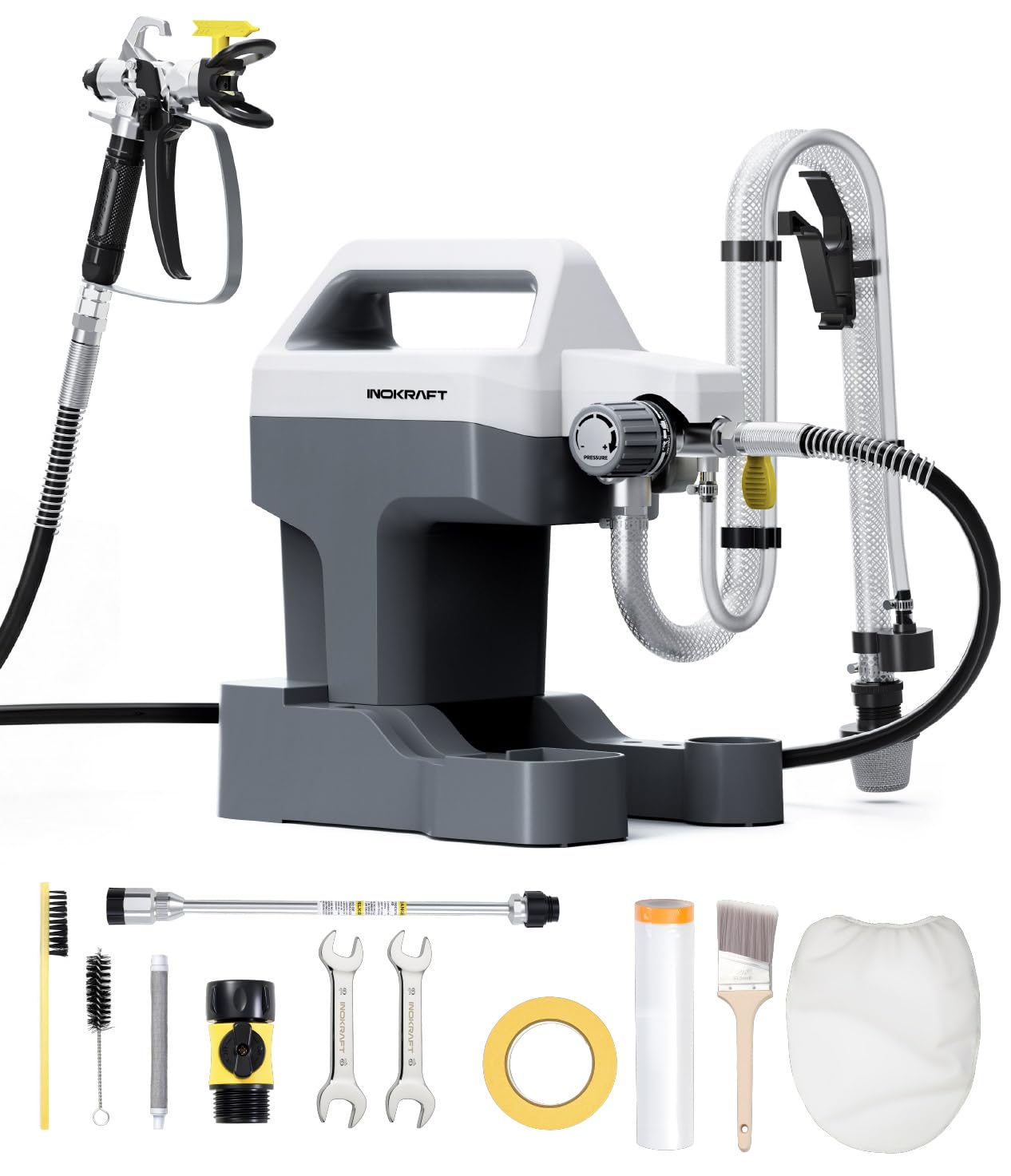
At 10.1 pounds, the NEO is an airless sprayer you can carry to the wall in one hand while the other hand holds the bucket. It runs up to 3000 PSI with 0.26 GPM of output, draws compatible latex, acrylic, stain and primer from a 1- or 5-gallon container without thinning when the coating allows, and ships with a 515 tip and a 12-inch extension for ceilings and eaves.

For a first airless, this is the one to buy. What we did not expect at this price is the masking film, the painter's tape, a 250-micron strainer and a touch-up brush in the box — the unglamorous half of a first job, so the project does not begin with a second trip to the store. The flip side of the low weight is a modest output: on a whole exterior it is slower going than the bigger InoKraft or the Graco machines, and a big job will feel like it.

One 515 tip is a starting point rather than a set. Deck railings and cabinet frames want a narrower fan, so plan on buying a second tip before those projects rather than fighting the pattern. Clogs mostly come down to strained paint and thinning to the cup, and the reversible tip clears the rest without a teardown. Cleanup is the Flush-Ease routine: a bucket of water, the valve open, and the gun off the hose before anything sets.

Bottom line: If you want airless performance without a cart, we think the NEO is the smartest first purchase here — light, complete and quick to flush.

Check Latest Price
#04

Best Finish Quality

Fuji Spray Semi-PRO 2

93 /100
Kirk Score Outstanding
Motor
1400W
Air Cap
1.3 mm
Hose Length
25 ft
Cup Capacity
1 qt
Check Details on Amazon

Pros

  • Turbine HVLP lays a fine, even coat
  • Metal gun and heavy-duty hose
  • Adjustable fan and air control at the gun
  • 24-month parts and labor warranty

Cons

  • One-quart cup means frequent refills
  • 25-foot hose ties you to the turbine's radius

If the job is a room of drywall, this is the wrong machine. The Semi-PRO 2 is a turbine HVLP system built for finishes: a 1400W turbine, a non-bleed gun with a 1.3mm air cap, and a fan you can dial from wide for a door panel down to narrow for a cabinet stile. It lays paint on rather than throwing it at the wall.

What that buys you is atomization — paint arrives as a fine, even mist instead of droplets you have to tip off with a brush. The gun is metal, the 1-quart cup is bottom-feed, and the turbine case has a holder so the gun is not lying on the floor between passes. Fuji covers the system with a 24-month parts and labor warranty, the longest coverage of anything here.

For furniture, cabinet doors, trim, shellac and water-based poly, this is the pick: when the finish is the point and the footage is small, nothing here beats it for the coat it leaves. We like that the air control valve sits at the gun rather than back on the turbine, so you can pull the material back mid-panel without a walk to the machine — a small thing that matters three doors into a set.

Bottom line: Buy the Semi-PRO 2 when the finish matters more than the square footage; it has the strongest atomization in this group.

Check Latest Price
#05

Best for Whole-House Jobs

Graco Magnum ProX19

91 /100
Kirk Score Outstanding
Weight
42 lb
Annual Use
Up to 500 gal
Hose Length
150 ft
Max Pressure
3000 PSI
Check Details on Amazon

Pros

  • 150 feet of hose and a reversible tip
  • Rated for up to 500 gallons a year
  • InstaClean pump filter cuts tip clogs
  • Rolls on a cart instead of being carried

Cons

  • 42 pounds and a 37-inch cart need floor space

Take the X5 and give it a cart, a much longer hose and a pump built for repeat seasons, and you have the ProX19 — for a whole-house exterior it is the one that makes sense. The numbers behind that: 150 feet of hose, a stainless steel piston pump with an annual use recommendation of up to 500 gallons, an InstaClean filter that catches debris before it reaches the tip, and a RAC IV tip you reverse with a flick when it clogs.

The reach is the part you feel. Far more hose than the X5 means you move the cart once per side of the house rather than once per wall, and the reversible tip turns a clog into five seconds instead of a teardown. The 17-inch-wide cart rolls through a standard doorway without being lifted, which is not something you can say about most machines in this class.

It is the priciest pick here, and the honest justification is repeat work. A 500-gallon annual rating belongs to someone with siding, a fence, a deck and maybe a rental on the list — not to one bedroom. If your projects run a few gallons a year, the X5 sprays the same unthinned latex from the same bucket for a lot less money.

Bottom line: The ProX19 is what we point to when a house, not a room, is the job: 150 feet of hose and a pump rated for 500 gallons a year.

Check Latest Price
#06

Best Cordless

Tilswall Shark700

88 /100
Kirk Score Excellent
Weight
2.5 lb
Battery
DeWalt 20V, bare tool
Cup Capacity
1300 ml
Check Details on Amazon

Pros

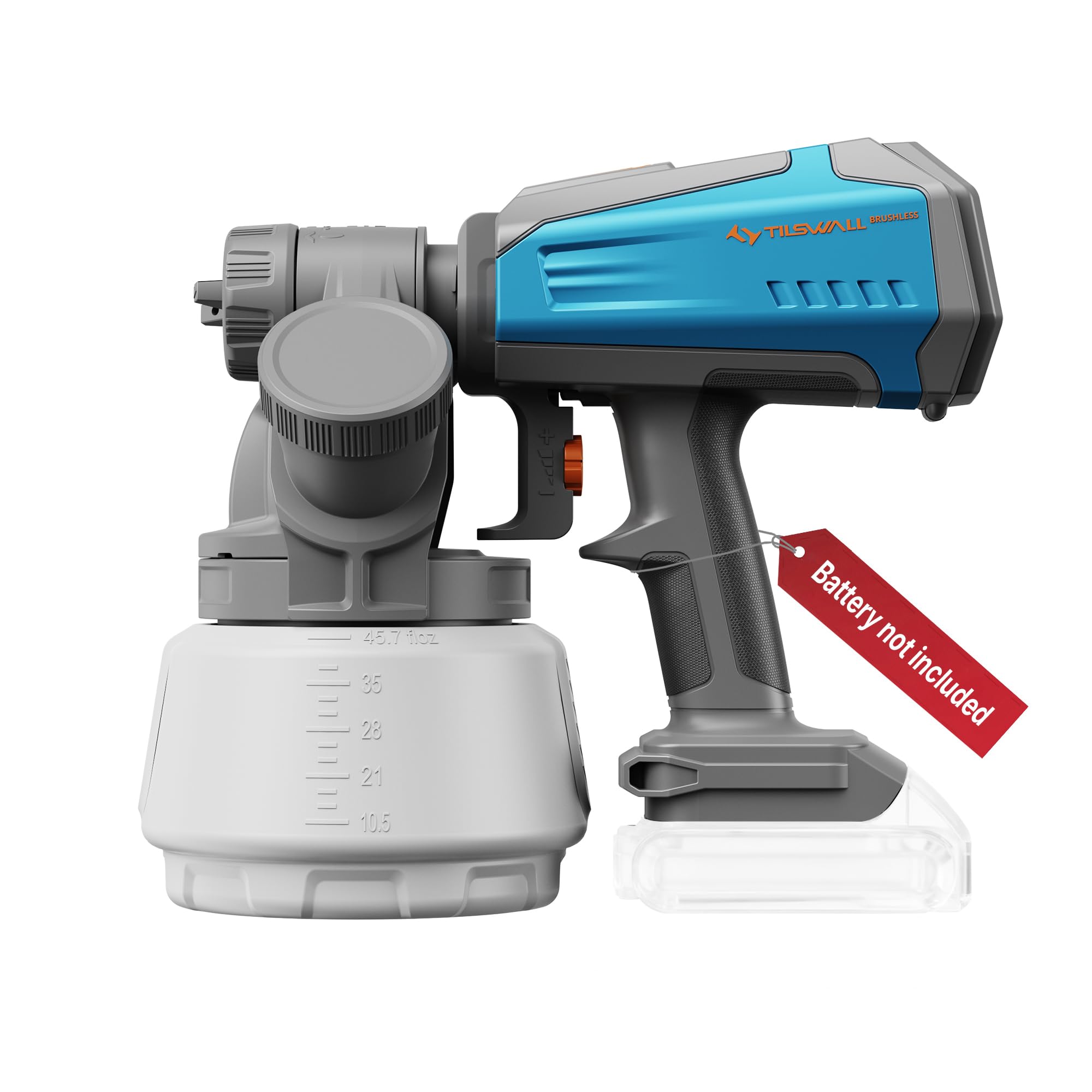
  • Runs on DeWalt 20V packs
  • 2.5 pounds with no cord to drag
  • Side-fill cap for quick refills
  • Three patterns and a viscosity cup included

Cons

  • Battery and charger sold separately
  • Paint must be thinned to the viscosity cup

A fence line, a shed, a bench in the driveway: these are the jobs where the extension cord is the annoying part, and they are what the Shark700 is built for. It runs on the DeWalt 20V packs you already own, weighs 2.5 pounds, and fills through a cap on the side of the cup, so you are not unscrewing the whole reservoir off the gun every time it runs low.

The brushless motor spins fast enough that the gun atomizes thinned paint well for a battery tool, and the three patterns plus two nozzles cover rails, panels and furniture. The viscosity cup in the box is not decoration: this is an HVLP gun, so paint goes in thinned to the cup or it goes in badly and spatters.

Where it earns a place is exactly where a cord is a nuisance, and we were surprised how much the side-fill cap changes a refill when you are halfway along a fence with a wet brush in the other hand. It is the pick for someone on the DeWalt platform who wants to spray a small project without stringing cable across a yard. It will not keep pace with an airless on a wall, and it is not trying to — with a 1300ml cup you are not mixing a gallon to spray a drawer front.

Bottom line: We like it for anyone already on DeWalt 20V who wants to spray a fence or a bench without a cord.

Check Latest Price
#07

Large DIY projects

InoKraft MaXpray M1

85 /100
Kirk Score Excellent
Max Output
0.31 GPM
Hose Length
25 ft
Max Pressure
3000 PSI
Tip Extension
12 in
Check Details on Amazon

Pros

  • 0.31 GPM output with a 3000 PSI ceiling
  • 25-foot hose plus a 12-inch extension
  • Carbide reversible 515 tip
  • Quick-start guide and video walkthroughs

Cons

  • No masking film, tape or strainer in the kit

0.31 gallons per minute is the number to hold on to. It is the M1's maximum output, and it is the difference between a starter airless and one that keeps up on siding: more material through the tip per minute means fewer passes and a wetter edge to follow. The step up from the NEO's 0.26 GPM is modest, but it comes with 3000 PSI of headroom and a carbide reversible 515 tip that clears a clog by hand.

The kit is built around reach: 25 feet of hose, a 12-inch tip extension for eaves and ceilings, a 360-degree swivel at the gun, and support for up to 75 feet of hose if you add more. Goggles, two wrenches and a laminated quick-start guide come with it, and the guide plus the video walkthroughs cover priming and pressure setting — the two things that decide whether a first airless job goes well.

What is missing is the small stuff. There is no masking film, no painter's tape and no strainer in this box, all of which the cheaper NEO includes, so add them to the order or plan a store run before the first fill. On a job where the masking is already the slow part, that is an hour you notice.

For a homeowner with a whole interior, a garage and a fence on the list, we think this is the sensible middle: more output and more reach than the starter kits, noticeably less weight than the cart machines. We found the 12-inch extension earns its place on ceilings. It still wants strained paint and a steady hand — an airless at 3000 PSI puts a run on a wall faster than you can catch it.

Bottom line: Our middle pick: more output and reach than the starter airless kits, without the weight of a cart machine.

Check Latest Price
#08

Small budget jobs

LESONJOY 1000W HVLP

96 /100
Kirk Score Outstanding
Motor
1000W
Cup Capacity
1400 ml
Copper Nozzles
4
Spray Patterns
3
Check Details on Amazon

Pros

  • Four copper nozzles plus a viscosity cup
  • Adjustable flow knob for light coats
  • Quick-disassembly parts for cleaning
  • The cheapest way into spraying here

Cons

  • Short 1.8 m hose limits where you can work

A 1000W handheld with a 1400ml cup will not paint the outside of a house, and it does not pretend to. What it does, for the least money of the picks here, is put an even coat on a fence panel, a set of cabinet doors, a garden bench or a radiator cover — the short list of small jobs that a brush turns into an afternoon.

The kit is fuller than the price suggests: four copper nozzles, three spray patterns, a flow knob for trimming output, a viscosity cup, filter funnels, a cleaning brush, an unclogging needle and a pair of gloves. The spray components come apart without tools, which matters more than any specification when you are standing over a sink at the end of the day.

The limits are the usual handheld ones. HVLP needs the paint thinned to the cup before it will atomize properly, and thick latex straight from the can spatters instead of settling. The motor is also running in your hand rather than on the ground, so long sessions are tiring in a way that a bucket-fed airless never is.

For a first sprayer and a short project list, this is a sensible place to start: cheap enough that one fence does not have to justify it, and complete enough that you are not buying nozzles separately a week later. We appreciated the flow knob's travel — there is enough adjustment to go from a mist coat on trim to a wet coat on a fence without swapping anything.

Bottom line: We recommend it as a first sprayer for small projects: four nozzles, an adjustable flow knob and a kit that covers cleanup.

Check Latest Price

How We Picked and Tested the Best Paint Sprayers

I started by narrowing the field to airless and HVLP sprayers meant for real household jobs—walls, cabinets, trim, fences, and furniture—and filtered out models with vague tip options or parts that seemed hard to replace. That left eight units, which we used for six months. Each sprayer went through several projects rather than a single test panel, because a sprayer that behaves on a smooth door can fall apart on a fence.

We set up in a garage and a basement workshop, sprayed latex on primed cabinet doors and wall patches, ran stain over a fence and a small side table, and tried each unit's included tips and pattern settings. I timed how long it took to go from unboxing to first spray, counted passes needed for even coverage, and adjusted pressure or flow while watching for spitting, dry patches, and clogging. When a unit stopped spraying cleanly, I noted how long it took to clear and whether the fix held.

Cleanup was part of the test, not an afterthought: we flushed and wiped the gun, nozzle, and cup or hose by the manual, then checked tight corners for leftover paint. We also compared what came in the box—tips, cups, hoses—because extras that expand the jobs a sprayer can handle count toward value. Between sessions, each unit was stored and rechecked for trigger feel, hose and fitting wear, and whether it started as cleanly as it did on day one.

How to Choose a Paint Sprayer

Airless or Handheld First

Two machines do most of this work, and they are not interchangeable. An airless sprayer pressurizes paint and forces it through a tip, so it handles unthinned latex straight from a 1- or 5-gallon bucket — that is what makes the Graco X5 and the InoKraft NEO quick across walls, siding and fencing. A handheld HVLP gun breaks paint up with a fan of air; it is lighter, cheaper and better suited to furniture, cabinet doors and trim, as long as you thin the paint first.

Our rule of thumb: two rooms or an exterior means airless; a dresser, some doors and a fence panel means handheld. A turbine system like the Fuji Semi-PRO 2 sits between them, with a separate air supply and a gun on a hose, and it exists for finish quality rather than coverage.

Match the Tip to What You Are Spraying

Tip size changes your finish more than any pressure dial. On a handheld, roughly 1.5mm suits stain and sealer, 2mm thinned latex on trim, and 4mm latex on a fence or deck rail. Airless machines use numbered tips — most kits here ship a 515 — where the last two digits give the orifice in thousandths of an inch and the first digit relates to fan width.

The trap is buying a bigger nozzle so you can skip thinning. Thick paint through too small an orifice spatters; through an oversized one it runs. Strain the paint and check it against the viscosity cup before it goes in the gun.

Overspray and Masking

Airless spraying throws a fine fog well past the wall you are aiming at, so masking, drop cloths and moving everything you can lift are part of the job rather than an optional extra. Outdoors, wind carries overspray onto cars, windows and plants. Indoors, seal the room and ventilate it. HVLP moves less material but bounces more off the surface.

Budget the time honestly. On a single room the masking outlasts the spraying, which is exactly why an airless only pays off on bigger projects.

Cleanup Is the Real Cost

Paint left sitting in a fluid path is how pumps die. Water-based coatings flush with warm water until it runs clear, then once more; oil-based coatings need the matching solvent and a gun that tolerates it. Machines with a dedicated flush valve make this a two-step routine instead of a disassembly, and the handhelds come apart without tools.

Do it the same day, every time. A sprayer that gets cleaned properly is the one that still works on the next project, two seasons later.

Weight, Reach and Storage

Airless units run from a 10-pound carry-anywhere body to a 42-pound cart, and that difference decides where the machine lives between jobs. Hose length decides how often you reposition: 25 feet is a room, 75 feet of supported hose is a second story, 150 feet is a whole side of a house.

Measure the longest run you will spray before you choose, and check you have a shelf or a floor corner for it. A cart sprayer stored at the back of a basement is a sprayer you stop using.

Frequently Asked Questions

Final Verdict

For anyone with a house, a deck or a run of fence on the list, the Graco Magnum X5 is the sprayer to buy. It pulls unthinned latex straight from a bucket, takes 75 feet of hose, and covers a whole exterior without a refill — the combination that makes an airless worth owning rather than renting.

If your projects are smaller, the HomeRight Super Finish Max does the furniture, the doors and the fence panel for a fraction of the money and stores on a shelf. Buy the X5 for the house; buy the handheld for the furniture.