// data-verified

Best Aviation Snips of 2026

Sheet metal punishes the wrong tool. Force a long straight cut with the wrong pair and the panel curls into a corkscrew; try a tight radius with a straight-cut snip and you get a ragged seam no file will rescue. Aviation snips exist to fix exactly that — compound-leverage shears that turn a white-knuckle squeeze into an easy one — provided you match the tool to the cut in front of you.

Here's the part first-time buyers miss: the color on the handle isn't decoration. Yellow cuts straight, red curves left, green curves right, and left and right snips are mirror images, not beginner and advanced versions. Over four months my team cut with 16 of them — straight, offset, left, right, plus a couple of sets — through galvanized duct, aluminum flashing, and stainless trim, and the gaps in sharpness, grip comfort, and edge life were obvious within a few cuts.

The picks below are the ones that held an edge, didn't shred my palm by the end of an afternoon, and felt worth the money.

#01

Best Overall

Midwest Bulldog MWT-6716B

95 /100
Kirk Score Outstanding
Blades
Forged molybdenum alloy, heat-treated
Weight
13.6 oz
Capacity
18-gauge cold-rolled steel
Cut Type
Straight and wide curves
Check Details on Amazon

Pros

  • Short jaws put more of your force into the cut
  • Pinch-thru-point blades keep cutting to the tip
  • Forged, heat-treated molybdenum blades
  • Chemical-resistant grips stay secure with gloves

Cons

  • Wide curves only; tight radii need an offset pair

Short jaws are the whole idea behind the Bulldog, and they are why this is the first snip we reach for on straight work. Less blade between the pivot and the cut multiplies the force your hand delivers, and Midwest rates the tool for 18-gauge cold-rolled steel with pinch-thru-point cutting, which keeps the blades biting all the way to the tip instead of going soft near the end. Starting a notch at a corner becomes a one-snip job as a result: set the point on the mark, squeeze, and the cut runs from there without wandering.

The blades are hot drop-forged molybdenum alloy, austemper heat-treated, and they arrive with a serrated edge that grips the sheet rather than skating over it. Grips are the other place the money went. The Kush'N-Power handles are chemical resistant and shaped so you are not white-knuckling your way through a long run, and they stay put with a glove on.

Add a limited lifetime warranty that covers the blades and the spring, and this is the snip in the group with the fewest reasons to hesitate. Nothing about it feels built to a price, which is not something we can say about every pair on this page.

Bottom line: Short jaws, forged blades, and a tip that keeps cutting make this the straight-cut snip we hand people first.

Check Latest Price
#02

Best Set for Curves

Midwest MWT-6510C Set

95 /100
Kirk Score Outstanding
Weight
1.9 lb
Capacity
18-gauge cold-rolled steel
Cut Type
Straight cuts and tight curves
Set Contents
Left and right offset snips
Check Details on Amazon

Pros

  • Offset handles keep your knuckles clear of the sheet
  • Left and right models cover curves both ways
  • Forged blades cut 18-gauge from heel to tip
  • Grips stay secure with gloves on

Cons

  • Two snips to carry and keep track of

Long cuts and tight curves are two different jobs, and this pair exists because one snip rarely does both well. The offset handles are the reason: the grips sit above the blade line, so the sheet passes under your knuckles instead of dragging across them, and you can push a long cut down a duct or across a roof panel without holding the metal up with your other hand.

Midwest builds the set as a left and a right, which covers a curve in either direction; you pick by which side of the line the waste is on, not by which hand you write with. The blades are hot drop-forged molybdenum alloy, heat-treated, and they cut 18-gauge cold-rolled steel from heel to tip. This is the smoothest cutting action in the group — on a run of flashing the jaws tracked the line without the judder a stamped blade gives you. The grips are more convincing than they look, too: chemical resistant, and secure with a glove on.

What you give up is simplicity. This is the most expensive way to buy snips here, and the pair only earns that back if you actually cut in both directions. For a single gutter repair, a straight snip will do the job; for anyone cutting duct, flashing, or trim on a regular basis, the offset geometry is worth the outlay.

Bottom line: We keep this pair together for duct, flashing, and trim, where offset heads make long cuts and tight radii far less awkward.

Check Latest Price
#03

Best Value

Wiss M3R

95 /100
Kirk Score Outstanding
Blades
Cast molybdenum, serrated
Length
9-3/4 inches
Capacity
18-gauge cold-rolled steel
Cut Type
Straight and slight curves
Check Details on Amazon

Pros

  • Cuts straight and slight curves in either direction
  • Latch works one-handed from either side
  • Blade bypass control limits tearing and burrs
  • Least expensive compound-action snip here

Cons

  • Spring and pivot wear faster than the blades

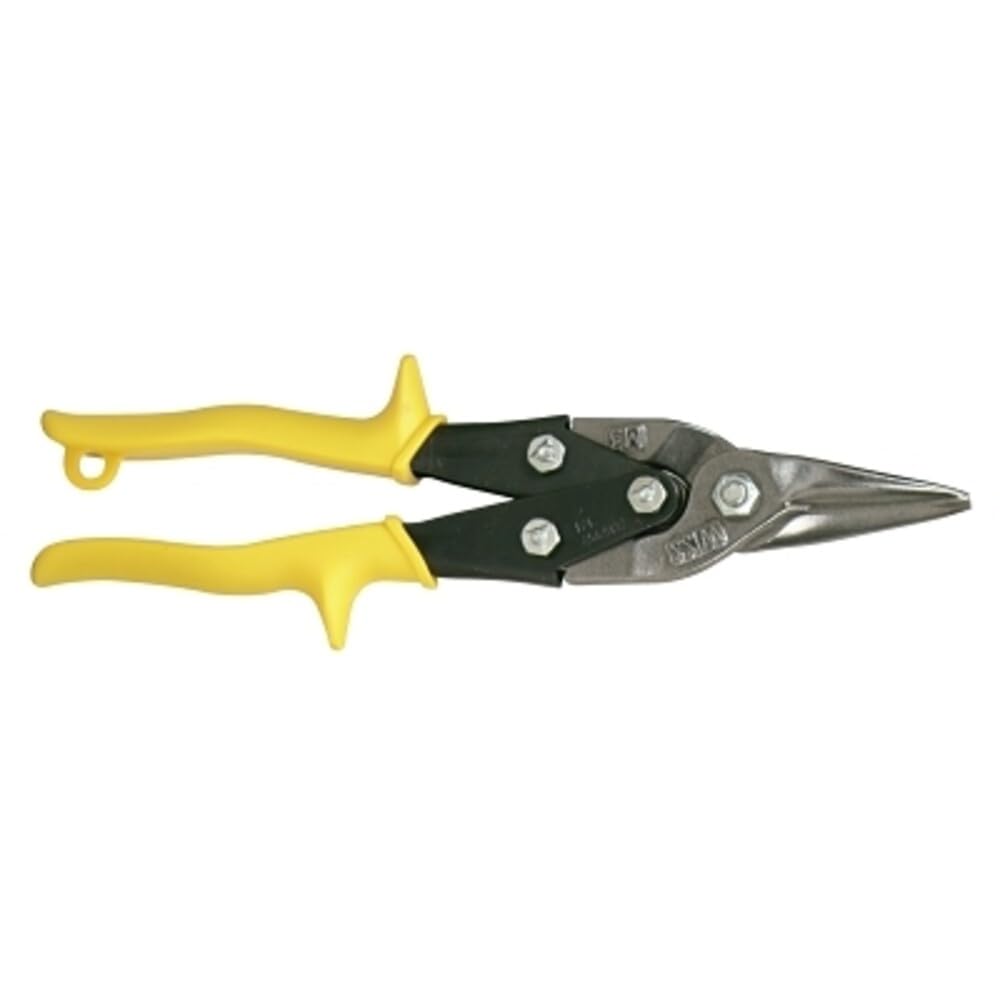
One snip that cuts straight and works a slight curve in either direction covers most of what a household does with sheet metal, and that is the M3R's argument. It is the least expensive way into a compound-action snip from an established brand, and the yellow handle means you grab the right tool without reading a label.

The blades are precision-cast molybdenum with ground serrated edges, and Wiss controls blade bypass so the cut finishes without the tearing and folding you get when two edges pass too far. The result is a cleaner end to a cut than the price suggests; we ran it through gutter and light flashing and got a flat, controllable line right around the curve.

The latch is what makes it a household tool rather than a toolbox one: thumb it open, cut, latch it shut, and it works from either side, so left-handed users do not need a different model. At 12 ounces it hangs on a pegboard hook and disappears until you need it.

Bottom line: For gutter, flashing, and light sheet work, we point most people to this one: it cuts both ways and costs the least here of the big names.

Check Latest Price
#04

Best for Thick Sheet

DeWalt DWHT14675

94 /100
Kirk Score Outstanding
Blade
Serrated high-carbon steel
Latch
External latch design
Length
10.1 inches
Cut Type
Straight
Check Details on Amazon

Pros

  • Cuts heavier sheet without stalling
  • External latch is easy to find with gloves on
  • 10.1-inch length adds leverage
  • Comfortable grip for a large snip

Cons

  • Latch can catch under the pivot screw when closing

The latch on the DeWalt sits outside the handle instead of running through it, and that small change is the first thing you notice with gloves on: your thumb finds it without hunting. Behind it is a 10.1-inch straight-cut snip with a serrated high-carbon blade, and this is the tool in the group that walked through heavier sheet without stalling. The length gives you something to lean into on a long run.

The geometry is conventional — straight cut with a little curve tolerance — so treat this as a general-purpose snip rather than a curve specialist. What we noticed was the smoothness: the jaws track without the chatter you feel when a pivot works loose, and the handles stay comfortable for a tool this size. It feels built for a full day of cutting rather than one bracket.

Where it stops is the top of what a hand snip should be asked to do. Push it into heavier stock and the cut slows and the edge pays for it. Within that range there is little to argue with, and for straight cuts in thick sheet it is the most reassuring tool here.

Bottom line: We reach for the DeWalt when the sheet is thick and the run is long; the external latch is a bonus with gloves on.

Check Latest Price
#05

Best for Repeat Cuts

Craftsman CMHT73756

94 /100
Kirk Score Outstanding
Capacity
18-gauge cold-rolled steel, 22-gauge stainless
Cut Type
Straight
Warranty
Full lifetime
Blade Markings
1/4-inch
Check Details on Amazon

Pros

  • Quarter-inch blade markings speed up repeat cuts
  • Spring-assisted latch opens one-handed
  • Cuts 18-gauge steel and 22-gauge stainless
  • Full lifetime warranty

Cons

  • Edge is not as aggressive as the forged blades here

Stamped into the blade of the Craftsman are 1/4-inch markings, and once you have used them you wonder why every snip does not have them. Set the cut a quarter inch from an edge, squeeze, move a quarter inch, squeeze again: a row of identical flashing pieces or J-channel comes out even without a tape measure or a scribe line.

The rest of the tool is competent rather than exciting: an induction-hardened cutting edge, a spring-assisted latch that opens one-handed, and a full lifetime warranty. It is rated for 18-gauge cold-rolled steel and 22-gauge stainless, the same ceiling as most of the group. We like it most for trim work, where the markings do the remembering and the straight geometry keeps a long cut true.

What you are buying is a trim snip rather than a do-everything one. The straight geometry will not turn a tight radius, and heavy sheet wants a longer, heavier tool. For soft sheet, trim, and repeat cuts at a modest price, that is a fair trade.

Bottom line: For trim and repeat cuts, we like the marked blade and the one-handed latch at a modest price.

Check Latest Price
#06

Full three-snip kit

Milwaukee 3-Pc Set

91 /100
Kirk Score Outstanding
Lock
One-handed metal lock
Pivot
Flush pivot bolt
Blades
Forged serrated
Set Contents
Straight, left, and right snips
Check Details on Amazon

Pros

  • Straight, left, and right in one purchase
  • Forged serrated blades with a flush pivot bolt
  • One-handed metal lock works with gloves

Cons

  • Three snips to carry and keep track of

Three snips arrive in this set — straight, left, and right — and that is the argument for buying it. You stop guessing which direction a cut is going to need, and you stop walking back to the bench for the one you left behind.

Each one has a forged serrated blade, a flush pivot bolt that keeps the joint tight, and a one-handed metal lock. The lock is the detail we appreciate: plastic latches and cold mornings are a bad combination, and this one moves with a gloved thumb. Chrome plating on the blades is there for rust, which matters if the set lives in a truck.

What the set really buys is not having to think. The straight snip takes the ordinary cuts, the left and right models take the corners, and a job that changes direction does not stall while you hunt for the right tool. If your work never turns a corner, one snip does the same job; if it does, this is the kit that keeps moving.

Bottom line: We carry all three when a job turns corners both ways; the metal lock and forged blades are why the set earns the space.

Check Latest Price
#07

Occasional jobs

Amazon Basics Straight Cut

93 /100
Kirk Score Outstanding
Blades
Chrome vanadium, serrated
Capacity
18-gauge cold-rolled steel, 22-gauge stainless
Cut Type
Straight
Warranty
Limited one year
Check Details on Amazon

Pros

  • Least expensive snip in this guide
  • Rated for 18-gauge steel and 22-gauge stainless
  • Rubberized grip and one-handed release

Cons

  • One-year warranty is the shortest here

This is the least expensive snip in this guide, and on paper it asks for very little: chrome vanadium blades with a high-frequency heat treatment, serrated edges, a rubberized two-tone grip, a latch that releases one-handed, and the same 18-gauge steel and 22-gauge stainless rating as tools that cost far more.

The difference shows up in the action. The spring and the release are what decide whether a snip is pleasant in year three, and this is where the Amazon Basics feels built to a price: the return can go lazy with use, and the latch wants a deliberate thumb rather than a flick.

For a single gutter repair, one sheet of flashing, or a length of hardware cloth, none of that matters. It cuts light sheet cleanly, the grip is comfortable for a budget tool, and the one-year warranty tells you what the maker expects of it.

Keep it for occasional work and it earns its drawer space. Take it to a job where you are cutting all day and the forged-blade picks here will outlast it, which is the trade you are making.

Bottom line: For one-off jobs where the snip goes back in the drawer afterward, this is the one we buy without thinking twice.

Check Latest Price
#08

Mixed materials

Irwin 2073113

94 /100
Kirk Score Outstanding
Grips
Pro-Touch textured
Action
Compound cutting
Capacity
18-gauge cold-rolled steel, 23-gauge stainless
Cut Type
Straight and wide curves
Check Details on Amazon

Pros

  • Compound leverage eases long cuts
  • Textured grips resist twisting
  • Cuts vinyl, plastic, and rubber as well as metal
  • Straight and wide-curve geometry

Cons

  • Rated for 23-gauge stainless rather than 22-gauge

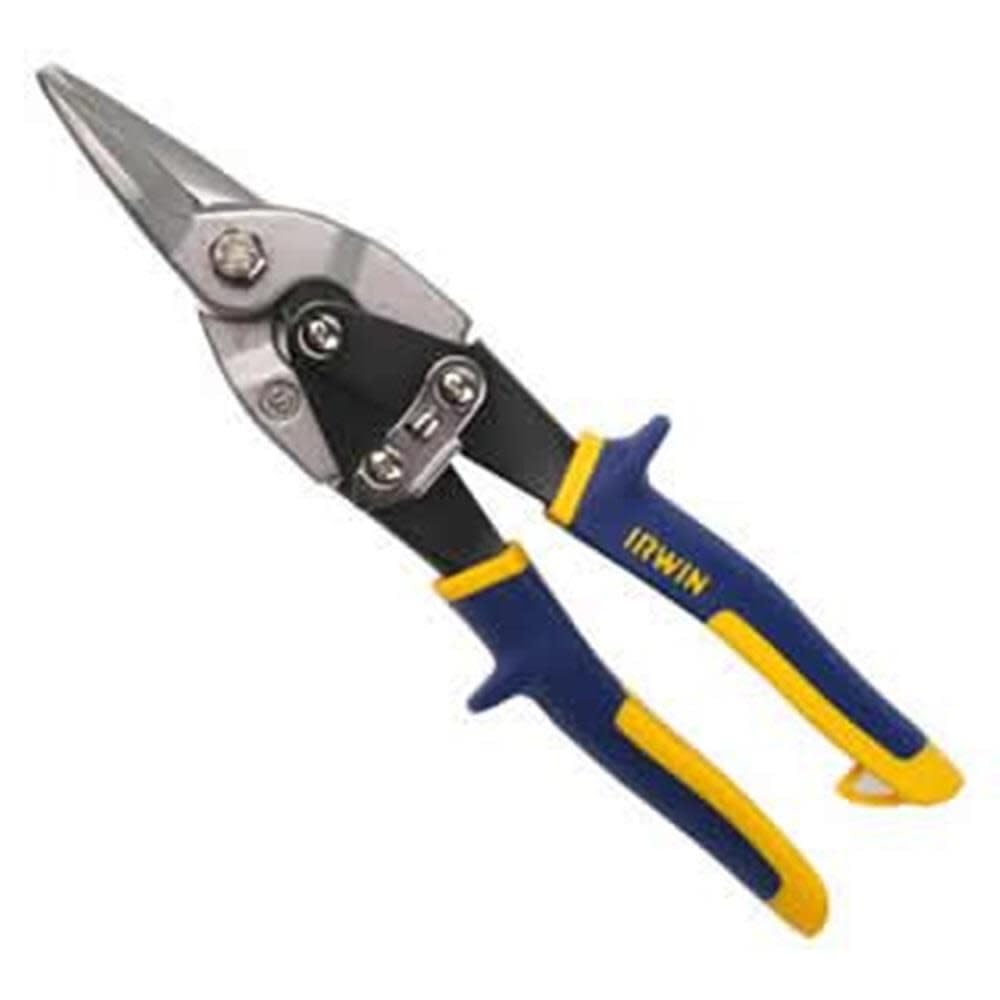
The Pro-Touch grips on the Irwin are textured to resist twisting, which sounds like a small thing until you are cutting overhead and the tool starts rolling in your hand. That grip is the detail that makes this one comfortable in awkward positions.

The compound cutting action gives you leverage without a long handle, and the blades are rated for 18-gauge cold-rolled steel. It is also rated for vinyl, plastic, and rubber alongside sheet metal, which is useful if your work is mixed rather than purely metal.

The straight-and-wide-curve geometry is conventional enough to feel familiar, and the E-Z close latch snaps the jaws shut for storage. It is a plain tool done well rather than a specialized one, and the blue handles make it easy to spot in a drawer.

Where it suits is a mixed shop — sheet metal one minute, plastic trim the next — with one tool on the bench instead of three. In that role it is the most sensible snip here.

Bottom line: We keep it for mixed jobs, where sheet metal one minute and plastic trim the next means one tool has to do both.

Check Latest Price

How We Tested 16 Pairs of Aviation Snips

We began with a long list of straight, left, and right-cut snips from brands we'd trust on a job site, then narrowed it to 16 based on blade length, cut direction, forged versus stamped blades, and price — from budget pairs to professional sets. Each one got four months of work, not an afternoon on a bench.

Most of that work happened at a bench: long rip cuts down three-foot panels of galvanized duct, tight radius cutouts, and S-curves in aluminum flashing that force you to switch between left and right snips mid-cut. I also took pairs up a ladder to trim fascia and cut stainless trim, because working overhead one-handed tells you quickly whether a grip is genuinely comfortable or just soft.

On every cut we watched whether the blades bit on the first squeeze or skated across the surface, whether the metal stayed flat along the line or curled, and whether the points left a clean notch or a snag that needed filing. Every ten cuts we checked the pivot for slop and ran a thumb along the edges for nicks; a pair that started crisp and went gritty after a week of flashing lost points. We cut with gloves on and off to judge handle size, and compared the stamped budget pairs with the forged ones to see whether the price gap showed up in the cut.

How to Choose Aviation Snips

Straight, left, or right: start with the direction

Aviation snips are compound-leverage shears with short, hardened blades, and the three configurations differ in which way the jaws steer the offcut. Straight, usually on a yellow handle, cuts straight lines and wide sweeps. A left or right snip curves in one direction and is chosen by which side of the line the waste sits on, not by which hand you write with. Buy the direction you cut most, then add the other when your work turns both ways — the Midwest left/right pair is what we suggest once curves in both directions are routine.

Watch for listings that promise all three cuts in a single tool. That usually describes a straight snip with a little curve tolerance, which is genuinely useful — our value pick is exactly that — but it will not turn a tight radius the way a dedicated left or right snip will.

Offset, regular, and Bulldog jaws

The shape of the head decides where your hand sits over the work. Offset snips put the grips above the blade line, so the sheet passes under your knuckles and you can push a long cut across a panel without lifting the metal with your other hand. Regular straight-pattern snips sit lower and feel handier for trim and notching. Bulldog-style short jaws give up reach for leverage and are at their best in thicker stock.

If your cuts run longer than a foot or so, look at offset. If you are trimming, notching, and following a pencil line, a regular or Bulldog snip will feel more precise in your hand.

What the capacity rating actually means

The gauge on the handle is a ceiling for flat sheet, not a target. Most snips here are rated for 18-gauge cold-rolled steel, roughly 1.2 mm, plus a thinner stainless rating — 22-gauge on most, 23-gauge on the Irwin — because stainless work-hardens as the blades move through it. Serrated edges grip the sheet and leave a faint tooth pattern, which matters on a face that will be seen; run a file along the cut before you install.

Forcing a snip past its rating is how pivots spring and edges chip. If the cut is slow and the handles are fighting you, you are above the ceiling.

Springs, latches, and grips

The forged cutting edges here will outlast the mechanism around them. The self-opening spring and the latch decide whether the tool is pleasant in year three, so work the spring before you start a job and choose a one-handed latch if you wear gloves. Grips matter as much as handles do on any other tool: a large handle is tiring in a smaller hand, and a textured or chemical-resistant grip earns its place if you cut overhead or keep solvents nearby.

Frequently Asked Questions

Final Verdict

Start with the Midwest Bulldog. It is the straight-cut snip we recommend first — short jaws, forged blades, and a point that keeps cutting where cheaper snips quit — and it is the lowest-risk choice for anyone cutting sheet metal by hand.

If your work turns tight curves in both directions, add the Midwest left/right offset pair; the offset handles keep your knuckles off the sheet and cover the radii a straight snip cannot. And if the job is one gutter repair you will never repeat, the Wiss M3R handles straight and slight curves for less money.