// data-verified

Best Bench Grinders of 2026

A bench grinder can ruin a good chisel in about three seconds. One pass too long against a fast wheel and the temper goes, the edge softens, and the tool never quite holds an edge again. That tension runs through the whole category: the wheels that hog off metal fastest are the same ones most likely to burn the edge you were trying to save.

I keep a sharpening bench in my garage, and I've learned the spec sheet rarely tells you which grinder will behave itself. Over the past six months my team and I ran eight of them — 6-inch and 8-inch, high-speed and variable, cast-iron bases and stamped steel — through the same chisels, mower blades, and garage-sale axe heads.

The thing nobody tells a first-time buyer is that the wheels in the box are usually the weakest part of the machine, and a grinder that walks across the bench under load is worse than one with less power. The picks below are the ones I'd plug in again.

#01

Best Overall

BUCKTOOL TDS-200DS

89 /100
Kirk Score Excellent
Motor
1/2 HP
Speeds
1,725 and 3,450 rpm
Wheel Size
8 in.
Included Wheels
80- and 120-grit
Check Details on Amazon

Pros

  • Dual speeds cover grinding and sharpening
  • 80- and 120-grit wheels plus a buffer
  • Cast-iron base with mounting holes
  • Runs smoothly and quietly in use

Cons

  • Tool rests can flex under hard pressure

We rate the Bucktool TDS-200DS as the best default for most shops because the dual-speed switch turns one 8-inch machine into two useful tools. At 1,725 rpm it gives you a controlled edge for chisels and turning tools; at 3,450 rpm it removes metal quickly on a dull mower blade or a battered axe. The 80- and 120-grit aluminum oxide wheels cover rough shaping and finer work, and the included buffer wheel adds a polishing step that most grinders here leave out. That range is why it edged out the single-speed machines.

The cast-iron base and mounting holes matter more than the spec sheet suggests. On a solid bench, the weight and base help it stay put during a heavy pass; if your bench is light, bolt it down anyway. The two cast aluminum tool rests adjust independently, which we appreciate when we need to keep a consistent angle as the wheel wears. The 8-inch wheels also give you more room to see the edge than a 6-inch machine.

The wheels carry momentum, so the grinder keeps spinning for a while after you switch it off; wait for it to stop before you reach for a wheel. For a shop that sharpens garden tools, chisels, and the occasional knife, the dual-speed range is a practical advantage you will use, not a feature you ignore.

Bottom line: We rate the Bucktool dual-speed as the best default for most shops because it covers coarse grinding, fine sharpening, and buffing in one 8-inch machine.

Check Latest Price
#02

Best for Sharpening

RIKON 80-805

90 /100
Kirk Score Outstanding
Motor
1/2 HP
Speed
1,750 rpm
Included
60- and 120-grit wheels, dresser
Wheel Size
8 in.
Check Details on Amazon

Pros

  • Low 1,750 rpm reduces heat
  • 60- and 120-grit wheels and a dresser
  • Longest warranty in this group
  • Cast-iron base with rubber feet

Cons

  • CBN wheels may need spacer washers

The Rikon 80-805 runs at 1,750 rpm, roughly half the speed of the high-speed grinders here. That sounds like less capability, but it is the point: a slow wheel gives you more time to watch the edge and less chance of drawing the temper out of a chisel or turning tool.

We choose the Rikon for sharpening because the low speed, 60- and 120-grit wheels, and included diamond dresser make a complete station. The left tool rest has a groove for drill bits, a small detail we liked more than expected. The five-year warranty is the longest in this group, and the cast-iron base with rubber feet gives it a stable feel.

The included diamond dresser is not a luxury; it lets you true a new wheel without buying another tool. That matters because a wheel that runs out of true makes the whole machine feel rougher than it is. The adjustable rests are easy to set, and the low-speed motor is forgiving when you are learning to sharpen by eye.

For a home sharpening station, the Rikon is the one we reach for when heat is the enemy. It is not the fastest way to hog off metal, but that is a different job, and the low-speed control is worth the trade.

Bottom line: We choose the Rikon for sharpening because its low speed and included dresser make it easier to hold a clean edge without overheating it.

Check Latest Price
#03

Best for Fast Metal Removal

DEWALT DW758

92 /100
Kirk Score Outstanding
Base
Cast iron
Motor
3/4 HP
Speed
3,600 rpm
Wheel Size
8 in.
Check Details on Amazon

Pros

  • 3/4-hp motor removes metal fast
  • Cast-iron base and housing
  • Rear exhaust ports direct grit away

Cons

  • Assembly instructions and small parts slow setup

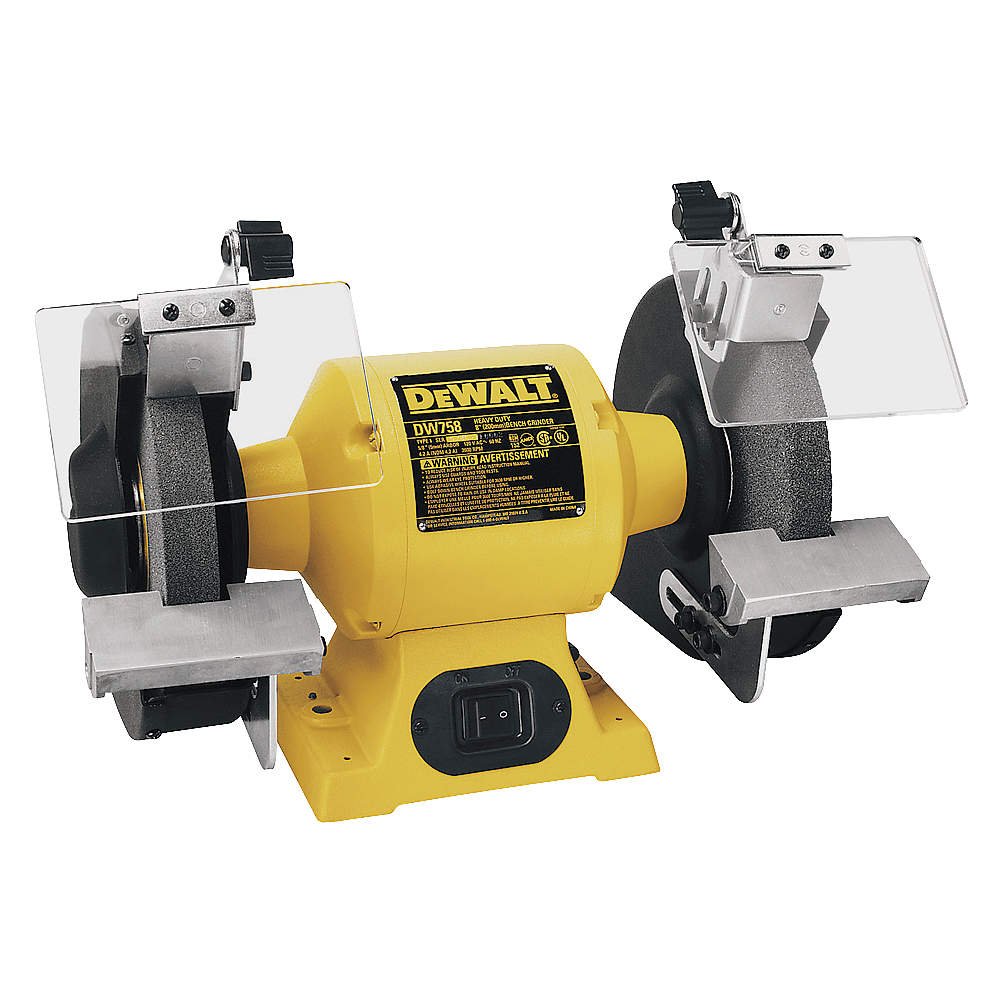
The DeWalt DW758 is built around a 3/4-hp induction motor that turns an 8-inch wheel at 3,600 rpm. That combination is for removing metal, not nibbling at it: a dull mower blade or a mushroomed chisel comes back to shape in a hurry, and the motor has enough torque to keep the wheel moving when you lean in.

The cast-iron base and housing give it a solid, old-school feel, and the rear exhaust ports in the wheel guards are a detail we appreciate. They send the stream of grit and sparks away from your face instead of straight up. The precision-machined aluminum rests adjust for angle, and the 36- and 60-grit wheels give you a coarse and a finer option.

The DeWalt is our fast-removal pick, with one condition: plan to bolt it down and dress the wheels. On a loose bench it can shake and walk, and that is not a machine you want dancing while your knuckles are near the wheel. Set it up solidly and it earns its place as the aggressive 8-inch option here.

Bottom line: The DeWalt is our fast-removal pick: its 3/4-hp motor has the torque, but plan to bolt it down.

Check Latest Price
#04

Best Industrial

JET IBG-8

92 /100
Kirk Score Outstanding
Motor
1 HP
Speed
3,600 rpm
Wheel Size
8 in.
Certification
CSA/CUS
Check Details on Amazon

Pros

  • 1-hp motor holds speed under load
  • Cast-iron build with CSA/CUS listing
  • Runs smoothly and quietly
  • Pre-drilled base for bench or stand

Cons

  • Supplied wheels may need truing

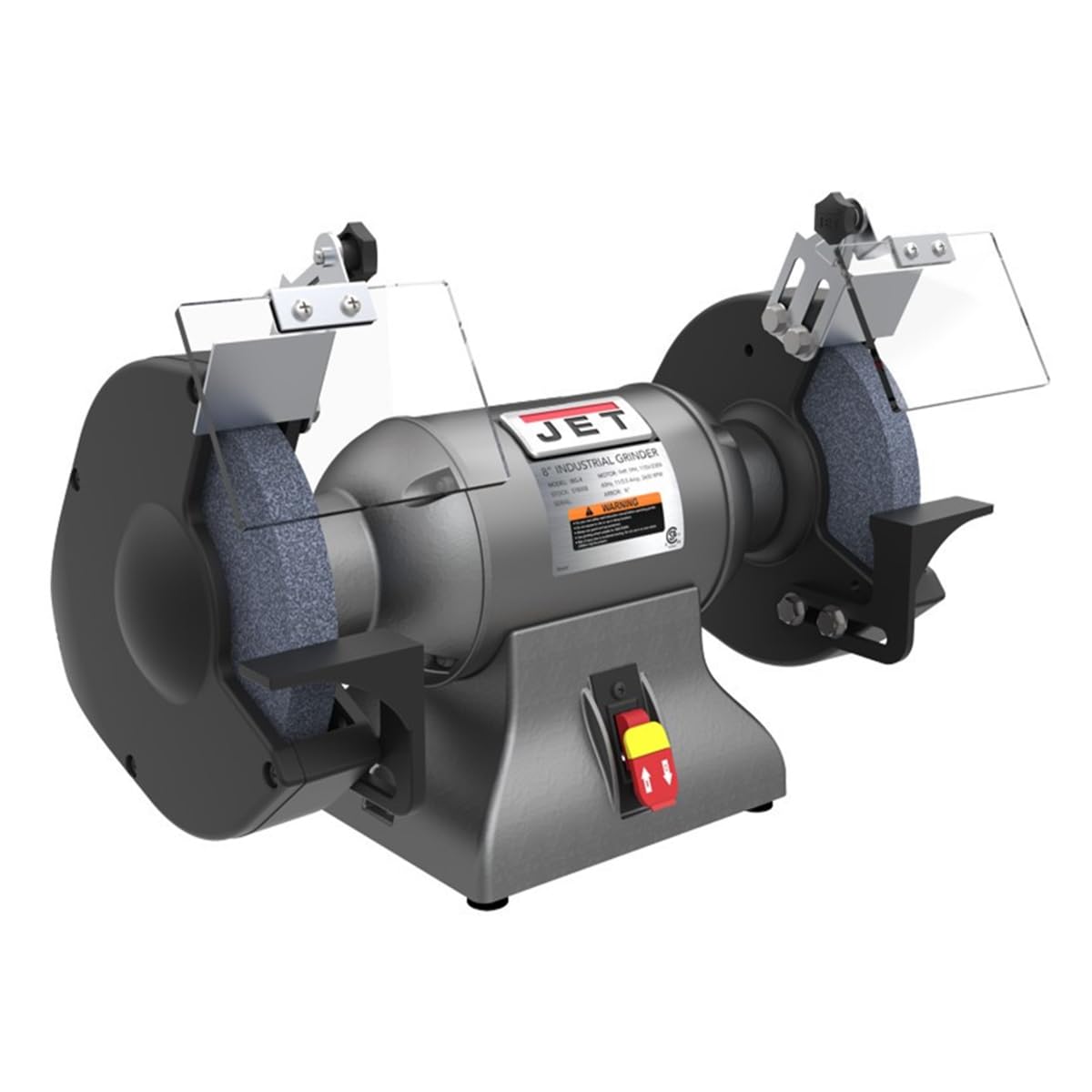
The JET IBG-8 starts with a 1-hp motor and 8-inch wheels turning at 3,600 rpm, which puts it at the industrial end of this group. It is not subtle: the cast-iron body has the heft of a machine meant to stay in one place and take repeated heavy passes.

The build is the reason to look at it. Cast-iron construction, adjustable tool rests, safety shields, and a pre-drilled base for a stand or bench add up to a grinder that feels settled even when you push a lawn-mower blade into the wheel. The CSA/CUS listing is a useful detail for a shop that cares about equipment standards.

It spins up quickly and takes at least a minute to spin down, so treat the shutdown like part of the job and keep your hands clear. The 36- and 60-grit vitrified wheels give you a conventional coarse-and-fine pair, and the adjustable rests let you keep the angle consistent as the wheels wear.

When the grinder is a daily production tool, we reach for the JET IBG-8. The premium is real, and a home shop may not need this much motor, but the 1-hp build is the one here that feels like it will outlast occasional sharpening.

Bottom line: When the grinder is a daily production tool, we reach for the JET IBG-8 and its 1-hp, cast-iron build.

Check Latest Price
#05

Best Budget 6-Inch

WEN 4276

93 /100
Kirk Score Outstanding
Motor
2.1 A
Speed
3,450 rpm
Weight
16 lb
Wheel Size
6 in.
Check Details on Amazon

Pros

  • 16-pound frame is easy to move
  • Flexible work light
  • Simple assembly

Cons

  • Wheels can wobble until dressed

The WEN 4276 is the budget pick we hand to home sharpeners because it keeps the essentials small and simple: a 6-inch wheel, a 2.1-amp motor, and a flexible work light on a 16-pound frame. It is not trying to be a production grinder, and that is exactly why it fits on a shelf or a small bench.

The light is the detail that makes it more pleasant than a bare budget grinder, but it takes a 40-watt bulb that is not included, so pick one up before you start. Assembly is straightforward, and the compact body is easy to move when the bench has to do another job. The 6-inch wheels are a good match for knives and chisels, where you want a smaller contact patch.

The trade-off is the light-duty package. The motor is better at chisels and knives than at hogging off a mower blade, and the 6-inch wheel limits how much metal you can remove in one pass. For light sharpening and a small shop, that is a fair exchange; for heavy metalwork, step up to an 8-inch machine.

Bottom line: The WEN 4276 is the budget pick we hand to home sharpeners who can live with a 6-inch wheel and a work light.

Check Latest Price
#06

Best Variable Speed

WEN BG625V

86 /100
Kirk Score Excellent
Motor
2.5 A
Speed
2,000–3,400 rpm
Wheel Size
6 in.
Included Wheels
80- and 36-grit
Check Details on Amazon

Pros

  • Variable speed from 2,000 to 3,400 rpm
  • Simple speed adjustment
  • Flexible work light

Cons

  • 6-inch wheel limits heavy stock removal

The WEN BG625V puts a speed dial on a 6-inch grinder, taking the wheel from 2,000 to 3,400 rpm. That range is the answer to a real problem: a high-speed wheel can blue a thin knife edge before you know it, while a slower wheel gives you time to watch the grind.

We like the WEN BG625V for anyone who wants to slow the wheel for heat-sensitive edges without giving up a 6-inch footprint. The 2.5-amp motor has enough for home sharpening, and the speed adjustment is simple enough to use mid-job rather than setting it once and leaving it. The 80- and 36-grit wheels cover a useful range.

The flexible work light is handy, though it can drift when the machine shakes; a firm twist keeps it pointed where you need it. The pivoting tool rests and adjustable eye guards are welcome on a machine at this level.

The WEN is not as smooth at the low end as a dedicated 1,750-rpm grinder. If you mostly sharpen knives and small tools and want to control speed, that is the compromise; the slow end is for control, not for production sharpening.

Bottom line: We like the WEN BG625V for anyone who wants to slow the wheel for heat-sensitive edges without giving up a 6-inch footprint.

Check Latest Price
#07

Best for Woodturners

BUCKTOOL TDS-200C4HL

89 /100
Kirk Score Excellent
Motor
3/4 HP
Speed
1,750 rpm
Wheel Size
8 in.
Wide Wheel
1-1/2 in. right wheel
Check Details on Amazon

Pros

  • Extra-wide 1-1/2-inch wheel
  • 3/4-hp low-speed motor
  • LED light with 3X magnifier
  • Keyed safety switch

Cons

  • Aluminum tool rests can feel sticky

The Bucktool TDS-200C4HL is built around an extra-wide 1-1/2-inch aluminum oxide wheel, a detail that matters to woodturners. A wider face gives you more room to roll a gouge or skew across the wheel instead of working at the very edge of a narrow stone.

The 3/4-hp motor runs at 1,750 rpm, so it favors control over speed, and the cast-iron base with rubber feet helps keep that low-speed torque steady. The 3-watt LED and 3X magnifier are more useful than they sound on a grinder used for small edges, and the keyed safety switch is a small but welcome detail in a shop with curious hands.

We've found the Bucktool C4HL gives woodturners the wide wheel and low-speed torque they need. Compared with our top pick, you give up the high-speed wheel and buffer, but you gain a wider sharpening face and a more dedicated low-speed feel.

Bottom line: We've found the Bucktool TDS-200C4HL gives woodturners the wide wheel and low-speed torque they need.

Check Latest Price
#08

Small shops

Woodskil TDS-150CL-A

88 /100
Kirk Score Excellent
Motor
1/2 HP
Speed
3,450 rpm
Wheel Size
6 in.
Certification
CSA
Check Details on Amazon

Pros

  • CSA-listed 6-inch grinder
  • Compact steel base with mounting holes
  • Includes 36- and 60-grit wheels
  • Simple assembly

Cons

  • Light-duty 1/2-hp motor

The Woodskil TDS-150CL-A is a compact 6-inch grinder with a steel base and a CSA listing. It takes up less bench space than the 8-inch machines here, and the pre-drilled base gives you the option to bolt it down without adding a stand.

The 1/2-hp, 2.8-amp motor turns 6-inch wheels at 3,450 rpm, and the box includes 36- and 60-grit aluminum oxide wheels. That is a sensible starter set for chisels, knives, and light deburring; the steel base is rigid enough that the machine does not feel like a toy.

The simple assembly and compact footprint are the reasons it stays in the small-shop conversation. It is easy to move when the bench has to do another job, and the CSA listing is a sensible extra for a machine that will live in a home shop.

We keep the Woodskil as the compact, CSA-listed 6-inch for light sharpening in a small shop. It covers chisels, knives, and light deburring without taking over the bench, and the steel base gives it a more solid feel than its size suggests.

Bottom line: We keep the Woodskil as the compact, CSA-listed 6-inch for light sharpening in a small shop.

Check Latest Price

How We Tested Bench Grinders (and What Broke the Tie)

We started with every 6-inch and 8-inch grinder we could find from established tool brands, then filtered on the things that actually separate them on a bench: wheel size and grit, rpm, base material, whether the tool rests adjust without a wrench, and how easy it is to find replacement wheels. That left eight machines, all bought at retail so none of them arrived as a loaner.

Each grinder came out of the box onto the same bench in my garage and had to be assembled and bolted down before it ran. We timed the setup and took notes on what the manuals got wrong. Then we spooled each one up cold, stood a nickel on edge on the base to watch for vibration, and pushed a mower blade into the wheel to see whether the machine held still or crept across the bench.

Sharpening filled most of the six months. We held chisels against the wheel and checked heat at the edge, timed how long it took to grind a nick out of a mower blade, and leaned into the motor to see where it bogged down. A pencil held against the tool rest showed which wheels ran true and which wobbled, and hanging weight on the rests showed which ones flexed.

Sound got measured at ear height, because a grinder that howls is one you stop using. Quiet models and smooth models were usually the same machines. For value we priced out a set of replacement wheels, since the stock ones that ship in the box are nearly always the first upgrade.

How to Choose a Bench Grinder

Start with wheel speed, not horsepower

The speed of the wheel decides how much heat reaches the edge. A 3,450- to 3,600-rpm grinder is the fast, conventional choice for lawn-mower blades, axes, and heavy deburring; a 1,750-rpm machine is slower and easier to control on chisels, turning tools, and thin knives. Variable speed splits the difference. We choose low speed when sharpening is the main job and high speed when shaping and stock removal are.

Think about the steel, too. Heat-sensitive tool steel benefits from light passes on a slow wheel, while a mower blade can take a more aggressive pass. The Rikon's 1,750 rpm is the clearest low-speed choice here; the WEN BG625V gives you a dial from 2,000 to 3,400 rpm if you want one machine to do both.

Size the grinder to the bench and the work

An 8-inch grinder gives you more wheel surface and usually more motor, but it also takes up more room and weighs more. The 8-inch Rikon is 37 pounds, while the 6-inch WEN 4276 is 16 pounds. If the grinder lives on a shelf and comes out for knives and chisels, a 6-inch model is easier to live with. If you sharpen axes, mower blades, or turning tools regularly, the extra room and mass of an 8-inch are worth it.

Check the footprint against your bench, not just the wheel size. The 8-inch bodies are wider, and you need clearance on both sides for long work. A 6-inch grinder can fit a small bench, but it will not magically become a heavy-duty machine.

Treat vibration as a setup problem

Vibration is the thing to sort out first, and it usually comes down to wheel balance, wheel dressing, and how solidly the machine is mounted. A cast-iron base, rubber feet, and pre-drilled mounting holes help, but they do not replace a solid bench. If the grinder walks or shakes, dress the wheels and bolt the base down before you blame the motor.

We like the cast-iron bases on the Bucktool and Rikon for this reason, and the DeWalt is the clearest example of a grinder that wants to be fastened down. Plan for the mounting hardware or a stand; it is part of the purchase, not an afterthought.

Look at the wheels, rests, and guards

The included wheels tell you a lot about what the grinder is set up to do. A 36/60-grit pair is a coarse-and-fine starting point for general metalwork; 60/120 is more oriented toward sharpening; 80/120 is a finer pair for edge tools. A diamond dresser is a small extra that makes a big difference when a new wheel needs truing. Check the arbor size and wheel width before you plan an upgrade, especially if you want CBN wheels.

The tool rests and guards matter just as much. Adjustable rests let you keep a consistent angle as the wheel wears, and eye shields and spark deflectors should be kept in place. A rest that flexes makes a sharp edge harder to hold, so check that it locks firmly.

Frequently Asked Questions

Final Verdict

For most shops, we recommend the Bucktool TDS-200DS. It is the one grinder here that gives you a low-speed edge, a high-speed wheel, and a buffer without changing machines, and its cast-iron base keeps it planted.

If sharpening is the main job, choose the Rikon 80-805 for its low speed and dresser. If the grinder is a daily production tool, the JET IBG-8 and its 1-hp motor are the step up.