// data-verified

Best Stucco Anchors of 2026

A stucco wall looks solid right up until you drill into it. Behind that thin skim coat there's usually foam, lath, or block, and the anchor that came with your house numbers can spin loose the first time a gust hits them. The fastener has to grab whatever sits behind the stucco, not just the crust of it. That's the whole job, and it's where cheap hardware gives itself away.

Over the past four months I've hung shutters, a hose reel, and one extremely stubborn house-number plaque on stucco over foam, painted block, and brick, while my team worked through 16 anchor kits alongside me. The detail I check first now is whether the correct masonry bit is in the box — it's the difference between a finished Saturday project and a second trip to the store. Hole size matters nearly as much: undersized cracks the stucco, oversized never bites.

The kits below are the ones that held, came with hardware we'd actually reach for again, and didn't leave us digging through a pile of screws that fit nothing.

#01

Best Overall

Buildex 3/16-Inch Stucco Anchors

87 /100
Kirk Score Excellent
Pack Count
25 pieces plus drill bit
Anchor Size
3/16 x 1-1/2 inches
Anchor Type
Steel stucco anchor
Drive And Head
Phillips round head
Check Details on Amazon

Pros

  • Cuts its own thread, so no separate anchor
  • Drill bit in the pack is correctly sized
  • Round head spreads load on brackets
  • Zinc-plated steel for outdoor fixtures

Cons

  • Phillips drive cams out under an impact driver
  • Highest cost per anchor in this group

Most of what gets sold for stucco is a plastic sleeve that grips by pressing outward, and a thin cement coat over lath does not give it much to press against. The Buildex anchor takes the other route: a zinc-plated steel screw with a coarse thread that cuts its own way into the stucco and into whatever sits behind it, finished with a round Phillips head. A drill bit comes in the box, sized for the screw.

That combination is why it is our top pick for a stucco wall. One hole, one step, no separate sleeve to seat and nothing that turns to mush if you lean on the driver. The round head gives real bearing area, so a camera base or a sign flange does not get chewed up as you tighten down, and the bit that ships with it is the right size for the fastener — the detail the other kits on this page get wrong most often.

The trade-off is scope: one length, one diameter, twenty-five screws. A 1-1/2-inch fastener only has so much left once a bracket flange and the stucco coat are subtracted, so a thick bracket is where this one runs short, and that is a job for a longer masonry screw rather than a bigger plastic anchor. For house numbers, a downspout clip, a hose reel bracket or a camera base, there is plenty of screw here.

What it does not try to be is a kit. No assortment, no compartment case, no two hundred pieces to store — just one size of a fastener that suits the wall, and a bit to install it. If your stucco jobs are a handful rather than a career, that is the whole box you need.

Bottom line: For a homeowner hanging a sign, a camera or a bracket on a stucco wall, this is the anchor we hand over without a second thought: steel, self-tapping, correctly bitted, and one step in the hole.

Check Latest Price
#02

Best Light-Duty Kit

Klein Tools 53729 Anchor Kit

92 /100
Kirk Score Outstanding
Pack Count
100 anchors and screws
Screw Size
#10 x 1 inch
Anchor Type
Plastic conical
Included Bit
1/4-inch masonry
Check Details on Amazon

Pros

  • Covers drywall and masonry with one box
  • Anchors and screws both included
  • Genuine 1/4-inch masonry bit included

Cons

  • Only 1-inch screws in the box

Every anchor drawer ends up with one box that does the unglamorous work. This is the one that earns the space: 100 plastic conical anchors, 100 #10 by 1-inch Phillips screws and a 1/4-inch masonry bit, all in one small box that covers drywall and masonry both.

Nothing about it is specialized, and that is the appeal. Halfway through hanging a shelf you do not want to discover that the box in your hand is for concrete only, and this one never is. The conical sleeve seats squarely in a clean hole and the screw draws it tight, which is why it has become the kit we leave in the house rather than the toolbox in the garage.

The feedback on it is the most consistent of anything in this group, and the design explains why: the screws are long enough for a shelf bracket or a picture hook, and the bit is a real masonry bit rather than a token. It also works out to far more fasteners than our top pick for about the same money.

The catch is what a conical sleeve needs, which is solid material to expand against. Through stucco into sheathing or a stud it is fine; in the coat alone there is very little for it to press on, and it can spin. That is the boundary of the kit — indoors, and over anything solid, it is the box we reach for.

Bottom line: The box we keep for the unglamorous jobs: a hundred anchors, a hundred screws and a proper masonry bit that handle drywall and masonry alike, as long as there is something solid behind the stucco.

Check Latest Price
#03

Best for Heavier Fixtures

Allkeen 1/4-Inch Concrete Screws

88 /100
Kirk Score Excellent
Pack Count
30 pieces plus bits
Screw Size
1/4 x 1-3/4 inches
Drive And Head
Torx T30
Corrosion Coating
Ruspert coated
Check Details on Amazon

Pros

  • Torx drive resists cam-out
  • 1/4-inch diameter for heavier fixtures
  • Ruspert coating for exterior work
  • Star and drill bits both included

Cons

  • Only 30 screws per box
  • Wider 1/4-inch holes to patch later

Torx on a masonry screw sounds like a detail until you have watched a Phillips head strip halfway into a block wall. These Allkeen screws use a T30 star drive, which takes the torque without camming out, and at 1/4 inch by 1-3/4 inch they are the heaviest fastener in this group. That is the combination we want for anything that gets pulled on — a hose reel, a gate latch, a bracket holding a heavy planter.

They are concrete screws rather than anchors: no sleeve, no separate piece, just a hole and a thread that cuts its way in. The Ruspert coating is there for weather, and the box includes the T30 driver bit and a drill bit.

The caveat is the one that applies to every screw on this page: nothing makes stucco itself load-bearing. A 1/4-inch screw earns its keep when it reaches the sheathing or a stud behind the coat, and the heavier the fixture, the less forgiving a miss is. Probe for framing before you drill, not after.

The included drill bit is the weak spot. It dulls quickly in hard concrete, so we pair these with a carbide bit we already trust and keep the supplied one as a spare. Everything else about the screw we were glad of, from the star recess to the coating.

Bottom line: Torx drive, 1/4-inch threads and a length that reaches past the coat: these are the screws we pick when the bracket is heavy and the driver is an impact.

Check Latest Price
#04

Best Assortment

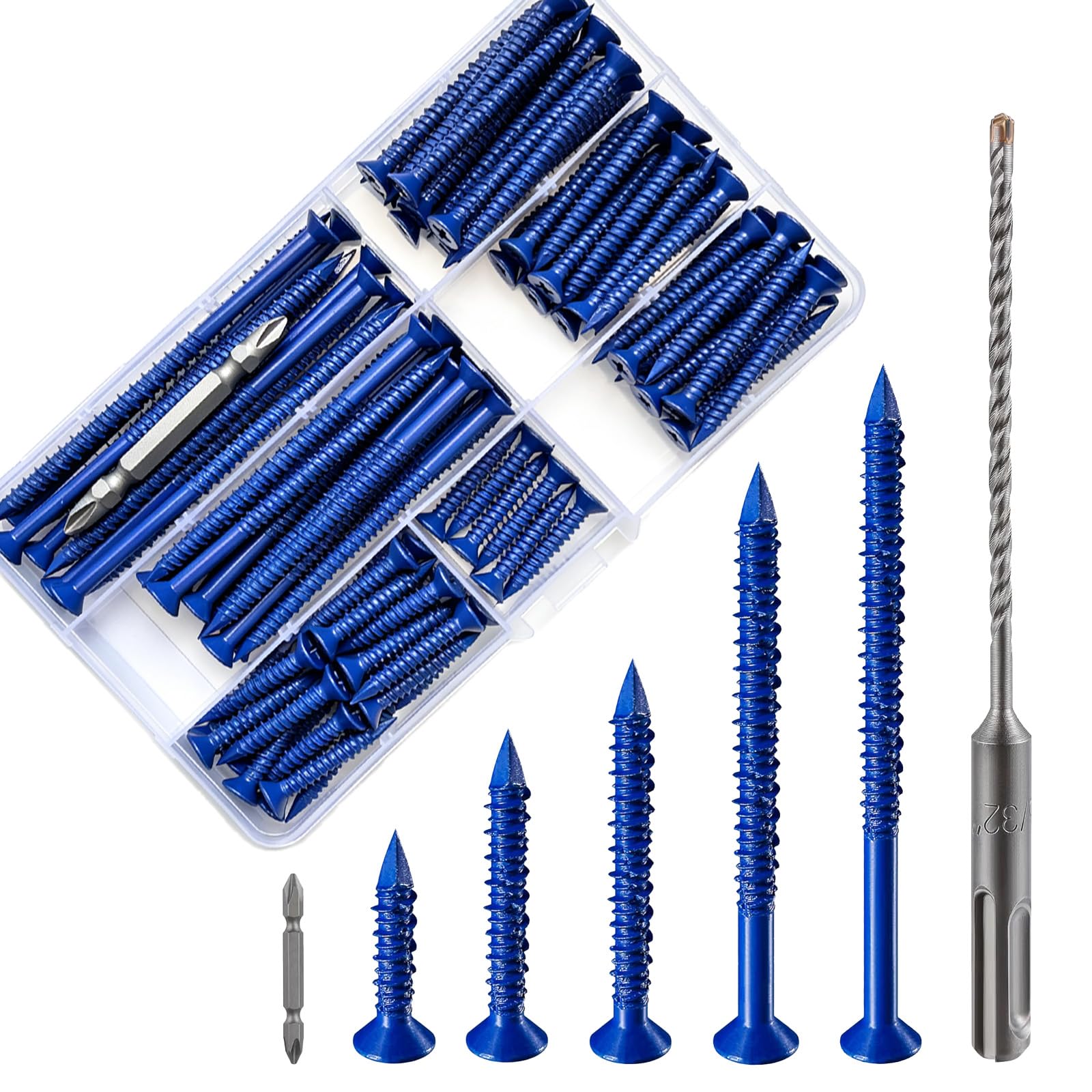
Wensilon 100-Piece Concrete Screw Kit

86 /100
Kirk Score Excellent
Head Style
Flat countersunk
Pack Count
100 pieces plus bits
Screw Size
3/16 inch
Lengths Offered
Five lengths
Check Details on Amazon

Pros

  • Five lengths cover different bracket depths
  • Flat head sits flush
  • Rust-resistant blue coating
  • Masonry and driver bits included

Cons

  • Countersunk head needs a matching hole

Five lengths of 3/16-inch screw in one box is the whole reason this kit earns a spot. The difference between a tidy fixing and a wobbly one is usually whether the screw matches the bracket in your hand, and an assortment lets you stop guessing.

What we appreciate is how ordinary the hardware is: flat countersunk heads that sit flush in a bracket, a blue rust-resistant coating, and a hundred pieces with a masonry bit and a driver bit in the box. Nothing exotic — just the sizes you keep reaching for, in quantity, which is what makes it the best assortment here for a weekend of mixed jobs.

The trap is the pairing between screw and bit. These run a hair under their stated 3/16 inch, and the supplied masonry bit is not the sharpest in the world, so a hole that ends up slightly too big is the difference between a screw that bites and one that spins. Drill a test hole in an offcut or an out-of-sight patch and try a screw before you commit to a row of them.

Drive them with a steady hand, too. An impact driver at full torque can shear a head before the thread bottoms out, and a snapped screw is a worse afternoon than a slow one. Used with a drill-driver and a properly sized hole, they seat and hold without drama.

Bottom line: Five lengths of 3/16-inch screw in one box, for the afternoon when a single bracket thickness would force you to guess twice.

Check Latest Price
#05

Small flush fixtures

SANJODS 3/16-Inch Concrete Screws

86 /100
Kirk Score Excellent
Head Style
Flat countersunk
Pack Count
80 pieces
Screw Size
3/16 x 1-1/4 inches
Included Bit
5/32-inch masonry
Check Details on Amazon

Pros

  • Short length suits shallow fixtures
  • Flat head finishes flush
  • 5/32-inch bit correctly paired to the screw
  • Rust-resistant blue coating

Cons

  • One screw size and length only

At 1-1/4 inches these are the shortest screws in the group, and that is the point of them. A doorbell camera base, a house number, a small bracket: the fastener only needs to cross a flange and bite the stucco, not bury itself two inches into whatever is behind the coat.

The rest is plain in a good way. Flat countersunk heads that finish flush, a blue anti-corrosion coating, 80 screws in the box, and a 5/32-inch masonry bit that is correctly paired with a 3/16-inch screw — a pairing the other kits here do not always get right.

We reach for this box when the fixing is small and the surface is unknown, because a short screw limits the damage if there is a conduit or the edge of a block behind the stucco. That is not a licence to drill blind; check what is back there first. It is the reason a short screw is the sensible default for shallow work, and this one is the shortest here.

The supplied bit is short too, roughly the length of the screws, which is fine for shallow holes and frustrating on anything deeper. A full-length carbide bit of your own solves it and the included one stays as a spare. Single size, single length, 80 screws — for small hardware, that is enough.

Bottom line: Short, flush-headed and easy to keep in stock, these are the screws we reach for on doorbells, house numbers and small brackets where a long fastener would be a liability.

Check Latest Price
#06

Budget starter assortment

VGBUY 180-Piece Anchor Kit

86 /100
Kirk Score Excellent
Pack Count
180 pieces
Anchor Type
Plastic conical
Included Bits
Two drill bits
Stated Load Limit
Up to 75 pounds
Check Details on Amazon

Pros

  • Large piece count for the money
  • Anchors, screws and two bits together
  • Fine for drywall and light indoor work

Cons

  • Supplied bits do not cover every anchor size
  • Plastic sleeves limit it to light loads

Nothing in this box is built for stucco specifically, and for the money that is fine: 180 pieces, conical plastic anchors in a couple of sizes, matching screws and two drill bits, for very little. It is the assortment you buy before you know what the job needs.

The stated 75-pound limit is the only load figure anyone puts on a box in this group, and we take it with salt. A plastic sleeve holds by pressing outward, so its strength is really the strength of whatever surrounds it, and in a thin stucco coat that is not much. Indoors, in drywall or block, with the anchor reaching solid material, they do the job they are sold for.

The bits are the weak link. Two sizes for a box with more than two anchor diameters leaves you matching them by eye, and a sleeve that goes in loose does not come back tight. Test one anchor in an out-of-sight patch before you drill a row of holes across a wall you care about.

As a starter drawer it works: screws, anchors and bits in one tray, and enough of them that you do not hoard the last three. As a stucco anchor, it is the last box on this page we reach for.

Bottom line: A cheap way to fill a drawer with anchors, screws and bits, best kept indoors and for light loads where a plastic sleeve has something solid to grip.

Check Latest Price

How We Tested Stucco Anchors

We built the shortlist from listings that state the anchor diameter and screw size outright, because a hole in stucco is not a place to guess. From there we split the field into two groups: single-size packs meant for one job, and multi-size assortments meant to carry a whole afternoon of hanging. Sixteen kits made it onto the wall over four months, ranging from small bags with a bit tucked in to hundred-piece boxes.

Each kit went up on three surfaces — stucco over foam board on a newer addition, painted cinder block, and old brick. We drilled with whatever bit came in the box first, then again with our own correctly sized bit when the supplied one wandered or was the wrong diameter, and noted which holes the anchors bit into cleanly and which spun in place. Screws got driven with a drill, and on a few of them by hand, to feel exactly where the torque gave out.

Then we loaded them: shutters, a hose reel, a planter bracket, plus a bucket of weight hung on a test bracket and left for days at a time. We came back after rain and a couple of frosts to re-tighten everything and look for stripped threads, hairline cracks in the stucco, rust, and any anchor that had started to walk out. The last tally was the boring one — how many anchors and screws were left in the box at the end, and whether the sizes in an assortment matched the ones we actually reached for.

How to Choose Stucco Anchors

Start With What Is Behind the Stucco

Stucco is usually a cement coat over metal lath and building paper on wood sheathing, foam board or masonry, and it is rarely more than an inch thick. A fastener that only grips the coat is fine for a house number, a small sign or a camera base, and wrong for anything you will pull on. For a hose reel, a gate latch or a bracket carrying real weight, the screw has to reach the sheathing or a stud.

Probe with a thin nail or a stiff piece of wire before you drill. If you cannot find solid material where you want the fixture, change the plan rather than the anchor: fix a plate or a cleat into framing elsewhere and hang the fixture off that.

Pick the Fastener Family First

Three kinds turn up here and they behave differently. Steel stucco anchors, like our top pick, cut their own thread and need no sleeve. Concrete screws such as the Allkeen and Wensilon sets do the same job at larger diameters and lengths. Plastic conical anchors, like the Klein and VGBUY kits, expand a sleeve outward and want firm material all around them.

Our rule is simple: metal outdoors and for anything load-bearing, plastic indoors and for light duty. A plastic sleeve in a brittle stucco skin has very little to press against, and no amount of torque fixes that.

Match Diameter, Length and Head to the Fixture

3/16 inch covers most household hardware; step up to 1/4 inch when the bracket is thick or the fixture is heavy. Length is where jobs go wrong, because the screw has to cross the bracket flange and still leave thread in the wall. Too long is as bad as too short when there is a hollow block or a pipe behind the coat.

Head style matters too. A flat countersunk head disappears into a countersunk bracket, a round or washer head spreads load on a slotted one, and a Torx or hex drive takes impact-driver torque without camming out the way a Phillips can. Buy for the bracket you actually own.

Treat the Included Bit as a Bonus

The hole size decides whether the anchor grips, and the bundled bit is the part makers cut corners on. Check that the bit matches the fastener before you drill anything, and keep a good carbide masonry bit of your own in each size you use regularly — the bits in these kits are for a handful of holes, not a season of them.

If a supplied bit wanders, binds or comes out of the hole oversized, stop and use a sharp one of your own. A slightly loose hole is the difference between a screw that bites and one that spins.

Plan for Weather and for the Fixture Coming Down

Exterior work wants a coated fastener: zinc, a blue Ruspert-type finish, or stainless if the wall sees salt air. Untreated steel in a damp stucco coat will stain the finish as it corrodes, and the stain is harder to deal with than the fastener was.

Think about removal while you are still choosing. Concrete screws and steel stucco anchors come back out with a driver; plastic sleeves often do not. If a fixture might move, drill once and mount on a plate rather than putting four holes in a wall you will have to patch.

Frequently Asked Questions

Final Verdict

For a stucco wall, our default is the Buildex anchor. It is the one fastener here built around the coat itself rather than around what might be behind it, it installs in a single step, and the bit in the box is the correct size for the screw.

Step up to the Allkeen screws when the fixture is heavier than a sign or a camera and the fastener has to reach framing. Keep the Klein kit for interior walls and mixed surfaces, where a hundred plastic anchors make more sense than a handful of steel.