// data-verified

Best Breaker Bars of 2026

A breaker bar is what you reach for when a ratchet is about to lose the fight. I’ve watched a 3/8-inch ratchet twist under a rusty lug nut, and that’s usually when someone says, “Hand me the long bar.” The right breaker bar gives you leverage without turning a fastener into a rounded-off problem, but the wrong one can flex in the wrong place, let a socket slip, or chew up your palm before the bolt even moves.

Over the past four months, I tested 14 breaker bars in 3/8-, 1/2-, and 3/4-inch drive, from 15-inch compact bars to a 40-inch long-reach model, and the differences came down to size, socket retention, and how the flex head behaved under load. A bar can feel fine in the store and still develop pivot play or a mushy detent after a few stubborn jobs, so durability and build quality mattered as much as raw leverage. Ease of use is easy to overlook until you’re swapping sockets one-handed under a fender; value is a bar that still feels tight after a season, not just the cheapest one on the shelf. The picks below are the ones I’d hand to a friend before a brake job or a trailer-hitch project.

#01

Best Overall

NEIKO 00206A 24-Inch Breaker Bar

95 /100
Kirk Score Outstanding
Drive Size
1/2 inch
Head Material
Chrome-moly (Cr-Mo)
Head Rotation
180 degrees
Overall Length
24 inches
Check Details on Amazon

Pros

  • Chrome-moly head at a budget-bar price
  • 24 inches of handle for real leverage
  • Flex head reaches behind wheel spokes
  • Ball detent holds sockets when you flip it

Cons

  • 180-degree head is the least articulation here

Twenty-four inches of handle with a chrome-moly head, for less than any other full-size bar in this guide — that combination is why the NEIKO 00206A is the one we tell most people to start with. The chrome-moly matters more than the length. The head is where a cheap breaker bar gives up: the ears spread, the drive square rounds, the joint goes loose. NEIKO spends the good steel there and leaves the handle in ordinary chrome-plated steel, which is exactly the trade we want at this price.

The 24 inches is the other half of the argument. Leverage is handle length multiplied by the force you put on the end, so a bar twice as long as the tire wrench in your trunk needs half the shove to crack the same nut. Put a solid hundred pounds into the end of this one and you're asking for roughly 200 pound-feet at the socket — well past what a passenger car's lug nuts are usually specified at.

The 180-degree flex head is what makes it usable rather than merely long. A rigid bar is a lever with one angle; a flex head lets you get the socket onto a nut sitting behind a wheel spoke, then swing the handle into the space you actually have for your arm. We worked the head at an angle rather than dead straight, which is how a wheel well with almost no swing room stops being a fight. The spring-loaded ball in the drive square clicks a socket on and holds it when you flip the bar over to reposition.

There is nothing extra in the box and nothing extra on the tool: no grip sleeve, no quick-release, no case. What you get is a long piece of steel, a joint, and a drive square, and for a bar that hangs in the garage and comes out for tire swaps and suspension work, that's the right set of priorities. Pair it with a good six-point socket in your lug size and there isn't much left to want.

Bottom line: Buy this one first: it puts 24 inches of handle and a chrome-moly head in your hands for less than any other full-size bar here.

Check Latest Price
#02

Best Build Quality

TEKTON SBH00224 1/2-Inch Breaker Bar

93 /100
Kirk Score Outstanding
Drive Size
1/2 inch
Head Material
AISI 4140 steel
Head Rotation
230 degrees
Overall Length
24 inches
Check Details on Amazon

Pros

  • External 4140 head resists spreading under load
  • Spring-held pivot keeps the angle you set
  • Pronounced finger groove for hard pulls
  • 230 degrees of head travel

Cons

  • Priciest 1/2-inch bar in this guide

Most breaker bars are one piece of steel formed into a U at the drive end, and that U is what a hard pull eventually finds: the ears spread, the joint turns sloppy, and the bar starts to feel like it's deciding whether to let go. TEKTON builds the SBH00224 the other way, with an external head in heat-treated AISI 4140 that wraps over the handle instead of being bent out of it. That construction is most of the reason this is the priciest 1/2-inch bar here, and we think it's the reason to pay.

The 230-degree pivot runs on an internal spring, which does something more useful than the number suggests: it holds the head at the angle you set it. Position it by hand, let go, come back with the socket on, and it's still where you left it. On a bar with a plain friction joint you spend half the job re-aiming the head with one hand while the other holds a socket against a nut you can barely see.

The handle is where the rest of the money went. The finger groove has pronounced inner edges, so your fingers have something to pull against when a nut finally lets go instead of sliding along a polished tube. It's the bar we hand to the person who is under a car most weekends. For a twice-a-year tire swap, the NEIKO does the same work for far less and you'll never miss the head design.

Bottom line: The bar for someone who wrenches most weekends — the external head and spring-held pivot are worth the premium if the tool gets used.

Check Latest Price
#03

Best for Extra Leverage

Capri Tools CP40123 30-Inch Breaker Bar

92 /100
Kirk Score Outstanding
Drive Size
1/2 inch
Head Material
Chrome-moly (Cr-Mo)
Head Rotation
230 degrees
Overall Length
30 inches
Check Details on Amazon

Pros

  • 30-inch handle adds about a quarter more torque
  • Chrome-moly head on a chrome-vanadium body
  • 230-degree head reaches awkward fasteners
  • Light for its length at about 1.6 pounds

Cons

  • Long handle is awkward to store and aim

Six inches doesn't sound like much until you do the arithmetic. Capri's CP40123 runs 30 inches where most 1/2-inch breaker bars stop at 24, and because leverage scales with handle length, that's about a quarter more torque from the same shove — the difference between a nut that creeps and a nut that sits there and thinks about it.

For a rust-belt truck whose lug nuts were last fitted by someone with an impact gun, this is the bar we reach for first. The body is chrome vanadium and the head chrome moly, the same split the better bars here use, and the 230-degree head rotates far enough that you can hook a socket on from underneath and still pull in a direction your shoulder agrees with. Listed weight is 0.73 kilograms, about a pound and a half, which is light for something this long.

There is a limit to how often you'll need it. On a car whose lug nuts are torqued to spec, the extra length is more bar than the job asks for, and the 24-inch NEIKO is easier to live with. The 30 inches earn their place on trucks, on anything with a rust history, and on suspension work where the fastener was never meant to come apart again.

Bottom line: Choose it when a 24-inch bar has already lost: the extra handle length is the whole point, and nothing else here offers as much in 1/2-inch drive.

Check Latest Price
#04

Best for Heavy Trucks

TEKTON SBH00340 3/4-Inch Breaker Bar

93 /100
Kirk Score Outstanding
Drive Size
3/4 inch
Item Weight
8.5 lb
Head Material
AISI 4140 steel
Overall Length
40 inches
Check Details on Amazon

Pros

  • 40-inch handle with a 3/4-inch drive
  • External 4140 head resists spreading
  • No-time-limit warranty with no receipt
  • Internal spring holds the pivot angle

Cons

  • Needs 3/4-inch sockets you probably don't own

Eight and a half pounds and 40 inches of handle is not a bar you keep in the trunk just in case. TEKTON's SBH00340 is a 3/4-inch-drive breaker bar, and it's aimed at a different class of fastener entirely: semi and equipment lug nuts, tractor hardware, suspension bolts that were torqued by someone who meant it.

The physics are the whole point. Forty inches against the 24 of a standard bar, with a 3/4-inch drive square that won't shear the way a 1/2-inch can when you lean on it, and the same external AISI 4140 head TEKTON uses on its smaller bar. The internal spring holds the pivot angle and the head covers 230 degrees, so you can bring the handle out from under a truck at an angle that doesn't require lying flat on your back in the driveway.

For anyone working on vehicles bigger than a half-ton pickup, we think it's the right tool and probably the last one you'll buy for that job. It is not, however, the bar to buy first: on a passenger car it's simply too much tool, and 40 inches is a liability in a wheel well instead of an asset.

TEKTON also lists a no-time-limit warranty with no receipt required on this one, which for something you're going to lean on with both feet is worth more than another inch of chrome. Storage takes planning too — plan a wall hook or a cargo box, because this is not a drawer resident.

Bottom line: The right tool for trucks, tractors, and equipment — provided you're ready to buy the 3/4-inch sockets it needs.

Check Latest Price
#05

Best Two-Bar Set

GEARWRENCH 85877 2-Piece Breaker Bar Set

93 /100
Kirk Score Outstanding
Warranty
Standard limited lifetime
Drive Size
1/2 inch
Bars Included
15 inches and 24 inches
Head Rotation
180 degrees
Check Details on Amazon

Pros

  • Short and long bars cover both jobs
  • Ball detent on both bars
  • Full-polish chrome wipes clean
  • Standard limited lifetime warranty

Cons

  • 180-degree tang is the least travel here

The 24-inch bar in GEARWRENCH's 85877 set gets the attention, but the 15-inch bar is the one that earns its place in the tray. A full-length breaker bar is useless in an engine bay where the handle meets the radiator support after 40 degrees of swing. A 15-inch bar with a 180-degree flex tang gets onto a caliper bracket bolt and actually turns it.

That's the case for buying a pair instead of one long bar: it covers the two jobs that actually come up, wheel-end fasteners and everything small and buried. Both bars are 1/2-inch drive, both have a ball detent, and both wear a full-polish chrome that wipes clean of brake dust and grease. The flex tang pivots far enough that the head sits at an angle instead of fighting the panel you're working around.

Where the set gives ground is in the details you can't see. The head steel isn't spelled out the way TEKTON spells out its 4140, and neither bar has the external-head construction that makes the TEKTON feel so solid in the hand. What you get instead is a standard limited lifetime warranty and two bar lengths that cover most of what a home garage does.

Bottom line: The set to buy if you do brakes as well as tires — the short bar gets into places the long one has no room to reach.

Check Latest Price
#06

Best for Tight Clearance

DURATECH DT401043 24-Inch Breaker Bar

93 /100
Kirk Score Outstanding
Drive Size
1/2 inch
Head Material
Chrome-moly (Cr-Mo)
Head Rotation
240 degrees
Overall Length
24 inches
Check Details on Amazon

Pros

  • 240-degree head finds clearance others can't
  • Chrome-moly head on 40Cr steel
  • Phosphate finish hides scuffs and glare
  • Rated to 780 newton-meters of torque

Cons

  • Round, smooth handle is slick with greasy hands

A wheel well is a bad place to need a long lever. You get the socket seated, then discover the handle is jammed against the fender liner with a quarter turn still to go. DURATECH's DT401043 answers that with a head that rotates 240 degrees — a third more travel than the usual 180 — so the bar can sit at an angle the handle can actually follow.

The rest of the build is sensible. There's a chrome-moly head on a 40Cr steel body, a spring-loaded detent ball, and a black phosphate finish instead of chrome. The finish is the part we appreciate most: chrome looks sharp in the tray and shows every scuff the first time it lands on concrete, while phosphate goes grey and stays grey and doesn't throw glare back at you when you're working under a car with a light.

DURATECH rates the bar at 780 newton-meters, which is far more than any lug nut will ask for; treat that as headroom rather than a promise, because what fails on a breaker bar is the joint, not the handle. It costs about what the NEIKO does, so the choice between the two comes down to the head — 240 degrees and phosphate here, 180 degrees and chrome there. We reach for this one when clearance is the problem, and the NEIKO when it isn't.

Bottom line: The one to buy when clearance is the problem — 240 degrees of head travel at the same money as our top pick.

Check Latest Price
#07

Car emergency kit

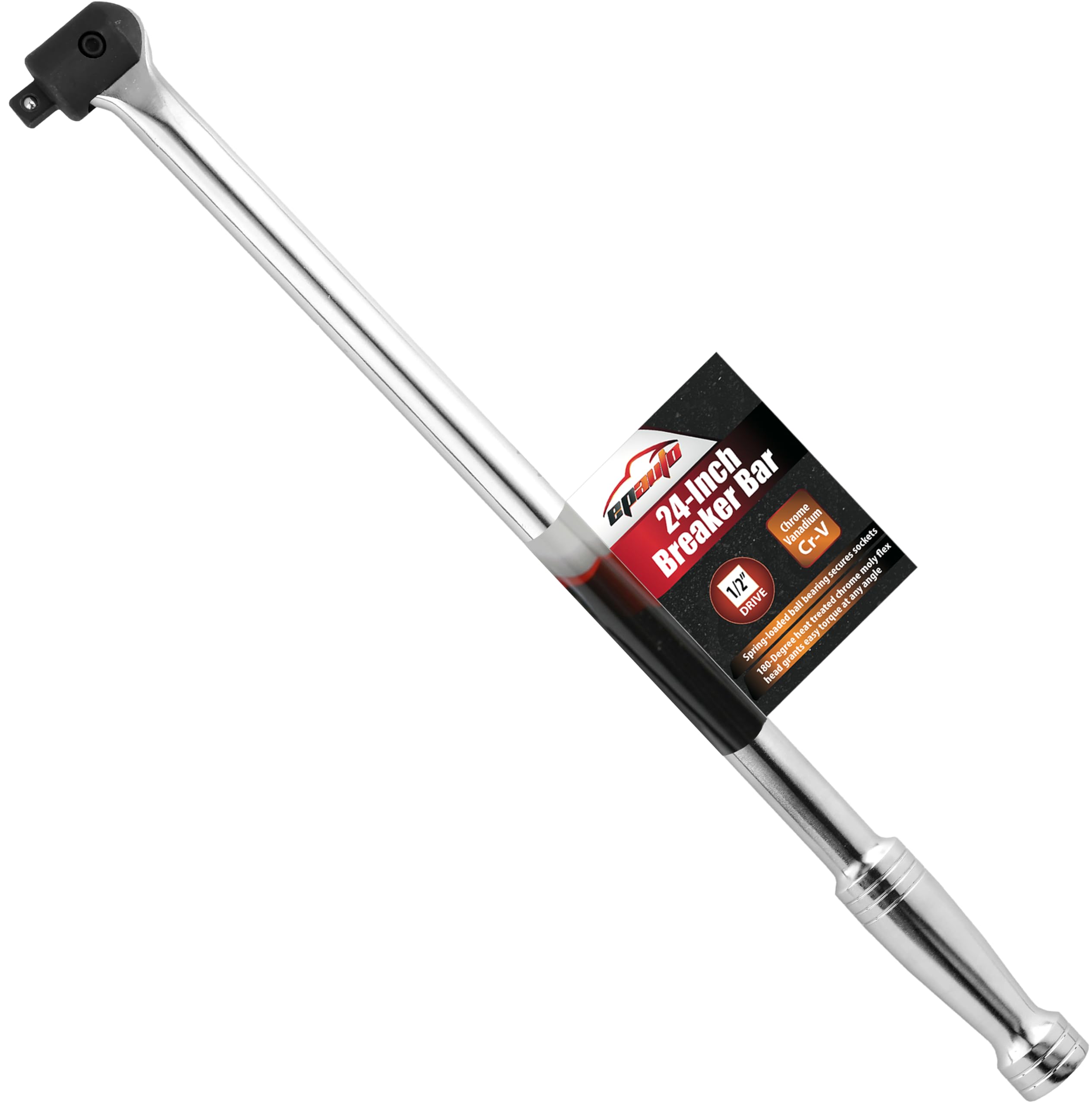
EPAuto ST-18A-1 24-Inch Breaker Bar

94 /100
Kirk Score Outstanding
Drive Size
1/2 inch
Item Weight
1.1 lb
Head Rotation
180 degrees
Overall Length
24 inches
Check Details on Amazon

Pros

  • About a pound, light enough for the trunk
  • 24-inch handle and 1/2-inch drive
  • Chrome-moly head, mirror-polished body
  • 180-degree flex head with ball detent

Cons

  • Costs more than the NEIKO for the same specs

Listed at 500 grams, barely over a pound, the EPAuto ST-18A-1 is the lightest full-size bar here, and that single number changes where the tool lives. A bar this light goes under the back seat and disappears until the night a tire goes flat in a parking lot.

Everything else about it is the standard recipe: 1/2-inch drive, 24 inches long, a 180-degree flex head with a spring-loaded ball, chrome-plated chrome-vanadium with a heat-treated chrome-moly head, mirror polished. Same capability as the NEIKO, in other words, so the choice between the two isn't about what they can do.

It's about steel and money. Less weight in the same length means less material in the handle, and a lighter handle bows more before a fastener lets go — something you feel through the bar rather than see. On lug nuts at factory torque that's a non-issue. On a rusted suspension bolt it's the reason to pick up the Capri or the TEKTON instead.

As a bar that lives in the car, this is the one we want in the trunk: light enough to forget, long enough to break a lug nut, and finished well enough that it doesn't look like an afterthought when you pull it out at the roadside.

Bottom line: The bar for the trunk rather than the toolbox: at about a pound it disappears under a seat and still gives you 24 inches when a tire goes flat.

Check Latest Price
#08

Small fasteners

NEIKO 00338A 3/8-Inch Breaker Bar

90 /100
Kirk Score Outstanding
Drive Size
3/8 inch
Head Material
Chrome-moly (Cr-Mo)
Head Rotation
180 degrees
Overall Length
15 inches
Check Details on Amazon

Pros

  • Reaches fasteners a full-size bar can't
  • Chrome-moly head on forged Cr-V
  • Stated to meet ANSI/ASME B107.110
  • Two-handed control without risking ratchet teeth

Cons

  • 15-inch handle is too short for lug nuts

This one won't crack a seized lug nut, and it isn't meant to. At 15 inches with a 3/8-inch drive, NEIKO's 00338A puts roughly two-thirds of a 24-inch bar's handle in your hand and a smaller drive square. What it does instead is reach the fasteners a big bar can't get to or shouldn't be used on — and the ones we keep coming back to it for are caliper bracket bolts and drain plugs.

The build follows the same recipe as NEIKO's big bar: drop-forged, heat-treated chrome vanadium with a hardened chrome-moly head, a 180-degree flex head, and a spring-loaded ball in the drive. The listing also states it meets ANSI/ASME B107.110, which is more than most bars at this size bother to claim.

The head is chunky for a 3/8 tool, so in a genuinely tight spot a plain 3/8 ratchet still gets places this won't, and 15 inches of handle runs out of leverage long before rusted hardware runs out of grip. What the length does buy you is control: two hands on the bar, steady force, and no ratchet teeth to strip when a caliper bolt finally moves.

That's the job it's for — brake work, drain plugs, small engine and around-the-house fasteners where a ratchet is the wrong tool and a 24-inch bar is absurd. If wheels are what you're after, put the money into the 24-inch NEIKO instead; nine more inches of handle is the whole difference.

Bottom line: Buy it for caliper bolts and small engine work, not for wheels — it's the gap between a ratchet and a full-size bar.

Check Latest Price

How We Tested Breaker Bars

We built the shortlist by researching breaker bars in 3/8-, 1/2-, and 3/4-inch drive, then filtering out anything that seemed too short for its drive size or too long to store in a normal toolbox. We bought 14 bars across price points, laid each one against a tape measure, and checked the stated length against what it actually felt like in the hand. For four months, we used them in a home garage and driveway on lug nuts, brake caliper bracket bolts, hitch bolts, a mower blade, and one very stubborn axle nut.

Size was a practical question, not a spec-sheet one: I checked whether each bar cleared a fender or wheel well and whether the handle was long enough to lean into without banging into the car. For socket retention, I fitted sockets, turned each bar upside down, and shook it to see if the detent held; then I swapped sockets one-handed to judge ease of use. I moved every flex head through its range, tightened a bolt with the head at an angle, and noted whether it held position or drooped under pressure.

Functionality got tested in the ugly jobs: rusty lugs, crusty suspension bolts, and a mower blade that had not moved in years. I paid attention to handle flex, knuckle clearance, and whether the bar felt like it was loading up evenly instead of springing. After repeated use, I checked for pivot play, chipped finish, and a detent that had gone soft, since durability and build quality are what separate a useful bar from a one-job wonder. At the end, we compared what each bar delivered for the money, because value here is control and leverage you can trust, not just a low sticker.

How to Choose a Breaker Bar

Match the Drive Size to the Sockets You Own

The drive is the square a socket clicks onto, and it decides what you can use the bar for. 1/2-inch is the size to buy for lug nuts and general suspension work: it's what most socket sets are built around and it carries the torque a car asks for. 3/4-inch is truck, tractor, and equipment territory, where the fasteners are bigger and the square needs more meat.

The trap is buying the bigger drive without pricing the sockets. A 3/4-inch bar needs 3/4-inch sockets, and a usable set of those can cost more than the bar itself. If you own exactly one socket set, buy the bar that matches it — 3/8-inch for calipers and small engine work, 1/2-inch for everything wheel-related.

Length Is Leverage, and Also Space

Leverage is handle length multiplied by the force you apply, so a 24-inch bar does the work of a 12-inch wrench with half the effort, and a 30-inch bar adds roughly a quarter again on top. That's why 24 inches is the sensible default for cars and light trucks, and why 30 and 40 inches exist for fasteners that have already beaten a shorter bar.

What the spec sheet can't tell you is whether you have room to swing it. A long handle needs a wide arc, and a wheel well or engine bay often gives you very little before the bar meets the fender liner. Long bars also have to live somewhere: a 40-inch 3/4-inch bar is a wall hook, not a drawer resident.

The Head Is Where Cheap Bars Fail

Under a hard pull the joint takes the load, not the handle. A chrome-moly head copes with that better than the chrome-plated steel most handles are made from, and how the head is built matters as much as the steel: an external head that wraps over the handle resists spreading in a way a head bent out of the handle's own material does not.

Look for a spring-loaded pivot that holds the angle you set, because a head that flops costs you a hand while you line up a socket. Articulation runs from 180 to 240 degrees here, and that extra travel earns its keep the moment a nut sits behind a wheel spoke or up under a fender lip.

Socket Retention and the Drive Square

A spring-loaded ball detent is what keeps a socket on the bar when you flip it over to reposition, and without one sockets end up in the gravel. Check the detent when the bar arrives and keep the square clean — grit around the ball is what makes a socket feel loose a few months later.

Then seat the socket fully before you load the bar. A socket that's half on will cam off a rusted nut under force, and it takes knuckle skin with it.

Weight and Finish Are What You Live With

A pound in the hand and eight and a half pounds on the end of your arm are different tools. If the bar rides in the car, buy light: something around a pound disappears under a seat and still gives you 24 inches. If it lives in the garage, weight is your friend, because more steel in the handle means less bow when you lean on it.

Finish is the smaller call but a real one. Chrome wipes clean and shows every scuff; black phosphate goes grey and hides marks, and it throws less glare back at you when you're working under a car with a light.

Frequently Asked Questions

Final Verdict

The NEIKO 00206A is the breaker bar we recommend to almost everyone: 24 inches of handle, a chrome-moly head where the load actually lands, and enough money left over for a proper six-point socket. It cracks lug nuts loose without drama, and there's nothing on it to wear out except the detent.

Change the requirement and the pick changes. If a 24-inch bar has already lost the fight, the Capri's 30 inches give you about a quarter more torque from the same pull. If you work on trucks or equipment, the TEKTON 3/4-inch bar is built for it, provided you're ready to buy 3/4-inch sockets. And if you do brakes as well as tires, the GEARWRENCH pair covers both jobs out of one tray.